


Here's something development companies won't put on their websites: plenty of businesses that come asking for custom software would be better off with an off-the-shelf subscription and a few days of proper setup. The ones that genuinely need something built tend to figure it out late, usually after a year or so of exporting CSVs out of a SaaS tool and stitching them back together in Excel every Monday morning.
So this guide does two jobs. It helps you work out which group you're in, and if you are going to build, it covers how to hire a custom software development company in India without overpaying or, worse, ending up not owning your own code. Finding a team isn't the hard part. India's tech industry is on track for $315 billion in revenue in FY26 and employs 5.95 million people[1]. Picking the right one out of that crowd is. (We verify and list development companies on UpBusiness, so a fair bit of what's below comes from watching these projects from the buyer's side.)
If you only have a minute
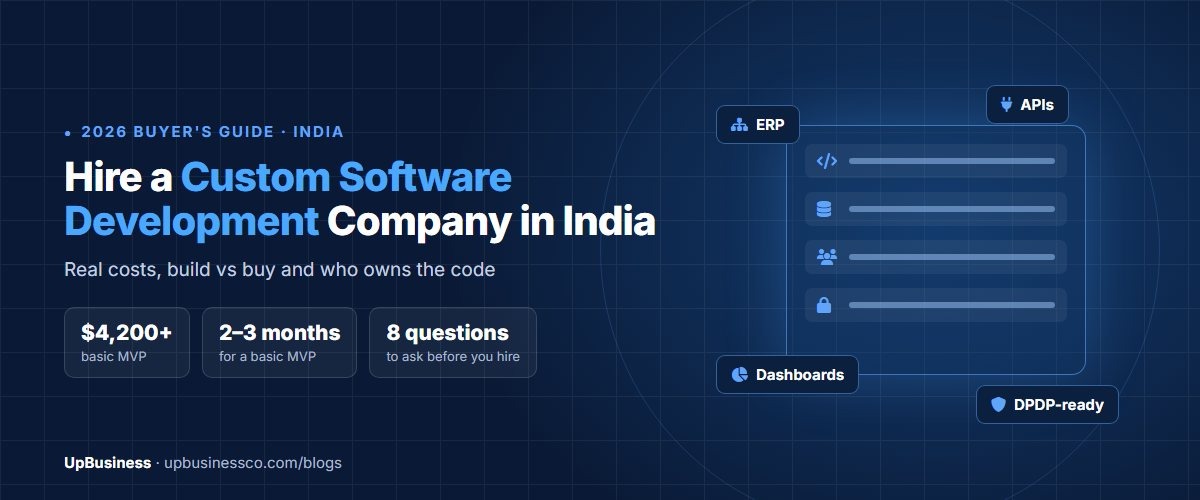
- Budget roughly $4,200–8,400 for a basic MVP, $10,500–26,300 once you need third-party APIs and payments, and $31,600–78,900 or more for enterprise systems with ERP sync, AI features and serious security requirements[2].
- Those three usually take about 2–3 months, 4–6 months and 6–12 months respectively[2].
- Set aside 15–20% of the build cost every year for maintenance[3].
- Get code ownership in writing. Under Indian copyright law, a transfer of copyright only counts if it's written down and signed[4].
Should You Build Custom Software at All?
Often, no. eCorpIT, a development firm that would make money if you did build, says in its own pricing guide that most custom builds should not happen[3]. If a ready-made tool already handles most of your process, spending thousands of dollars to rebuild it is hard to justify.
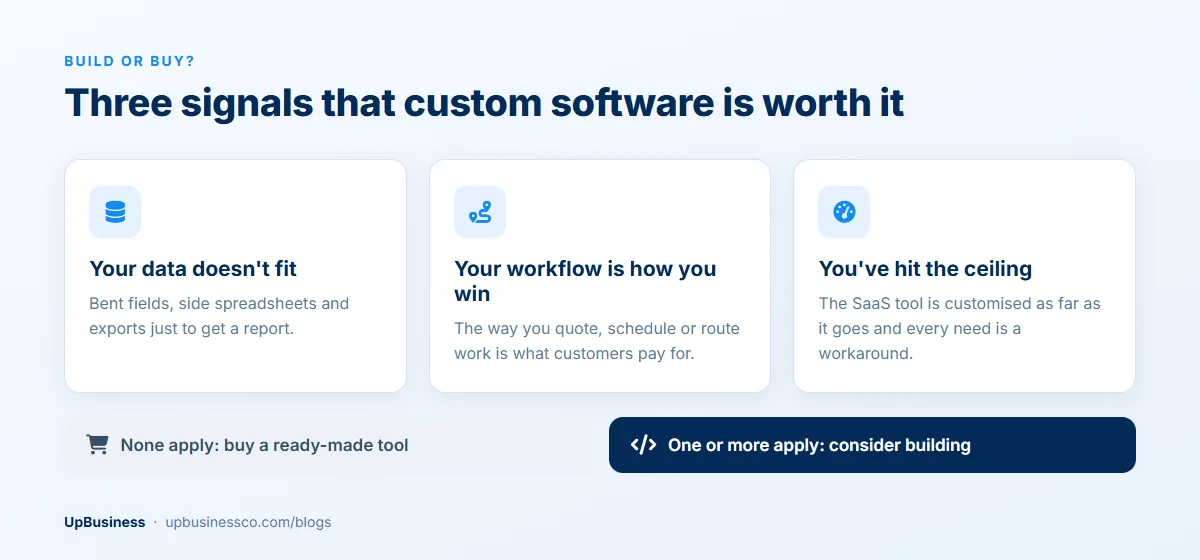
Their guide lists three situations where building does make sense[3], and they work well as a filter:
- Your data doesn't fit the tool. You keep repurposing fields, maintaining side spreadsheets and exporting everything just to put one report together.
- The way you work is the reason customers pick you. Maybe it's how you quote, how jobs get scheduled or how orders reach the right warehouse, and a generic product would flatten all of that.
- You've already customised the SaaS product as far as it'll go, and every new requirement turns into yet another workaround.
If none of those sound like you, buy. If one or two do, look at the middle ground before committing to a full system. A low-code build or a small internal tool sitting on top of what you already use can cost a fraction of the price. (We made a similar case for AI in custom AI vs off-the-shelf AI.)
Custom Software Development Cost in India (2026)

Browse our curated list of Custom Software Development Companies
The bands below are from a 2026 pricing guide published by Cyfuture, an Indian IT firm[2]. We added the right-hand column to translate each band into what you'd actually get for the money.
| Stage | Typical cost | Timeline | What it usually means |
|---|---|---|---|
| Basic MVP | $4,200–8,400 | 2–3 months | A simple interface, 5–8 screens and a basic database. Good enough to put in front of real users and see if the idea holds up. |
| Moderate product | $10,500–26,300 | 4–6 months | Third-party APIs plus a payment gateway. A customer portal or a booking system that collects payments would sit here. |
| Enterprise system | $31,600–78,900+ | 6–12 months | ERP sync, AI features and high security. Typically something several departments lean on every day. |
Internal tools land somewhere in between. A custom dashboard, portal or internal tool typically costs $5,300–31,600[3], and where yours falls depends mostly on how many other systems it has to pull data from.
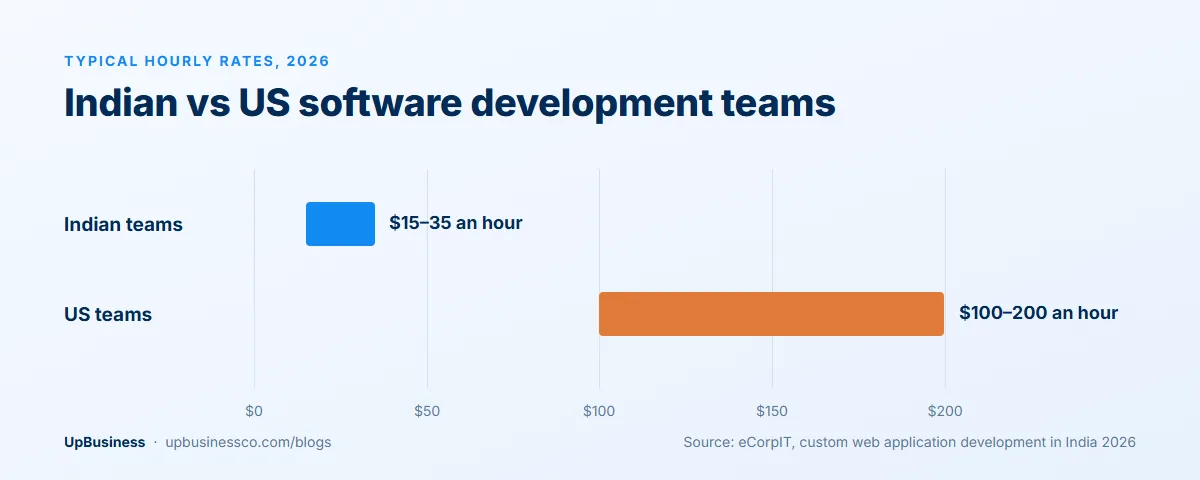
Hourly rates are the other half of the picture. Indian teams usually bill around $15–35 an hour, while US teams charge $100–200[3]. If a quote sits at the very bottom of the Indian range, it's fair to ask how senior the people writing your code really are.
What Pushes the Price Up
Two quotes for what looks like the same software can be thousands of dollars apart. Usually the gap comes down to a handful of things.
- Integrations. Each system your software has to talk to, whether that's Tally, Zoho, SAP, a payment gateway or the WhatsApp API, needs building and testing, and then fixing again whenever the other side changes something. Some teams that focus on API integration or CRM integration will quote this piece separately.
- User roles. An admin, a branch manager and someone out in the field each need their own screens and see different data, and every extra role means more design and more testing.
- Old data. Moving five or ten years of Excel sheets into a clean database takes far longer than people expect, and it's almost never in the first quote. Ask about data migration early on.
- Personal data. Software that stores customer or employee details has to follow India's data protection rules (there's more on this further down).
- Scope creep. Features that get added in month four, after the database has already been designed, tend to cost the most.
Costs After Launch
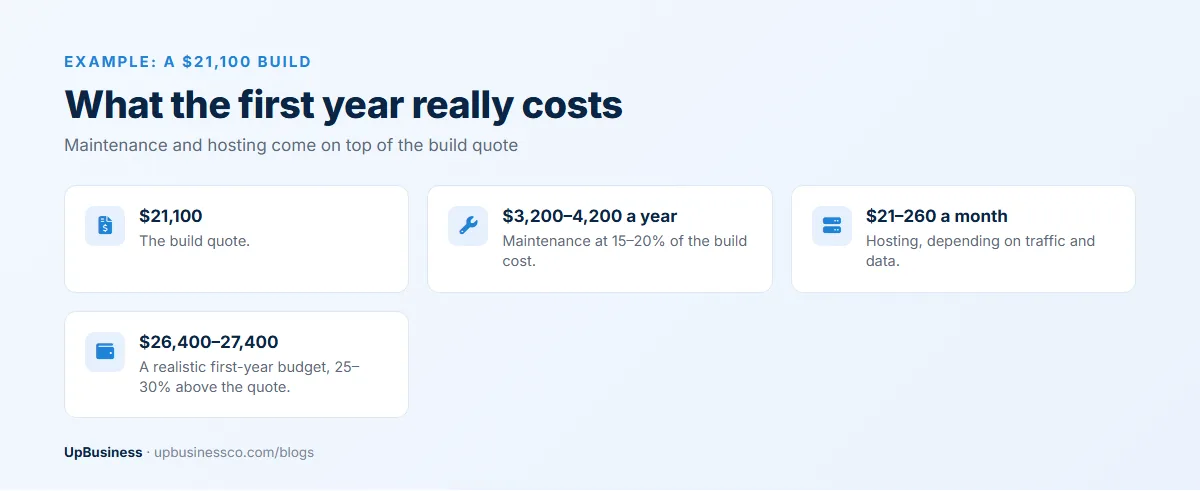
The build quote is only part of what you'll spend. Hosting runs roughly $21–260 a month, depending on traffic and how much data you keep[3]. Maintenance is usually 15–20% of the build cost per year, so on a $21,100 build you'd be setting aside $3,200–4,200 annually[3]. Add it all up and eCorpIT suggests budgeting 25–30% above the original quote for the first year[3].
First-time buyers tend to plan for the build and forget about the rest. Keeping software running, patched and working as the tools around it change is a cost that doesn't really stop after launch.
What We See on UpBusiness
Published price guides only tell part of the story, so we also looked at what software companies listed on UpBusiness say about their own work. The figures below come from the profiles of approved companies in October 2026. Companies report them themselves and the numbers are small, so treat them as a rough guide rather than a survey.
Across the 36 approved companies in our Software Development category, the median minimum project size is $790, while the median average project is about $10,500. About a third of them will take on projects under $530, yet 21 of the 36 put their typical project at $10,500 or more, which is worth knowing when you send out a brief for a small job.
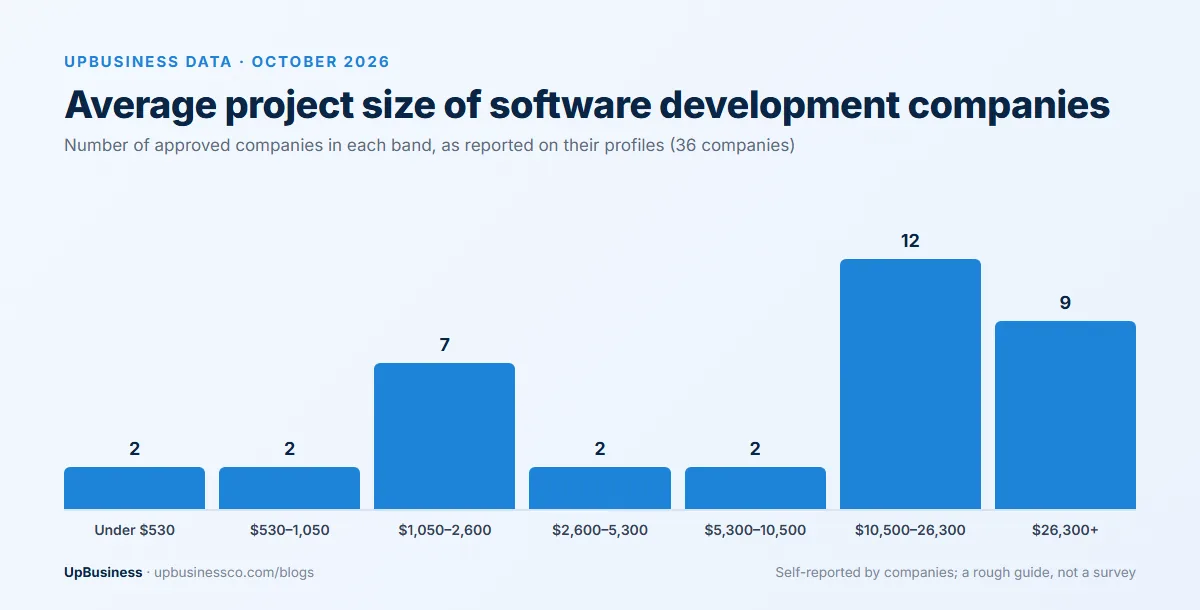
The 10 companies listed specifically under Custom Software Development work at a higher level again. Their median minimum project is around $2,600, and four of the ten put their average project above $26,300. They're mostly small to mid-sized teams: four have 11–50 people, three have 51–200, two have fewer than ten and one has 201–500.
So if your budget is under $2,600, mention it in your first message. Plenty of teams will still talk to you, and it saves everyone a round of calls that go nowhere.
How a Custom Software Project Runs
Teams name the stages differently, but a well-run project tends to go roughly like this.
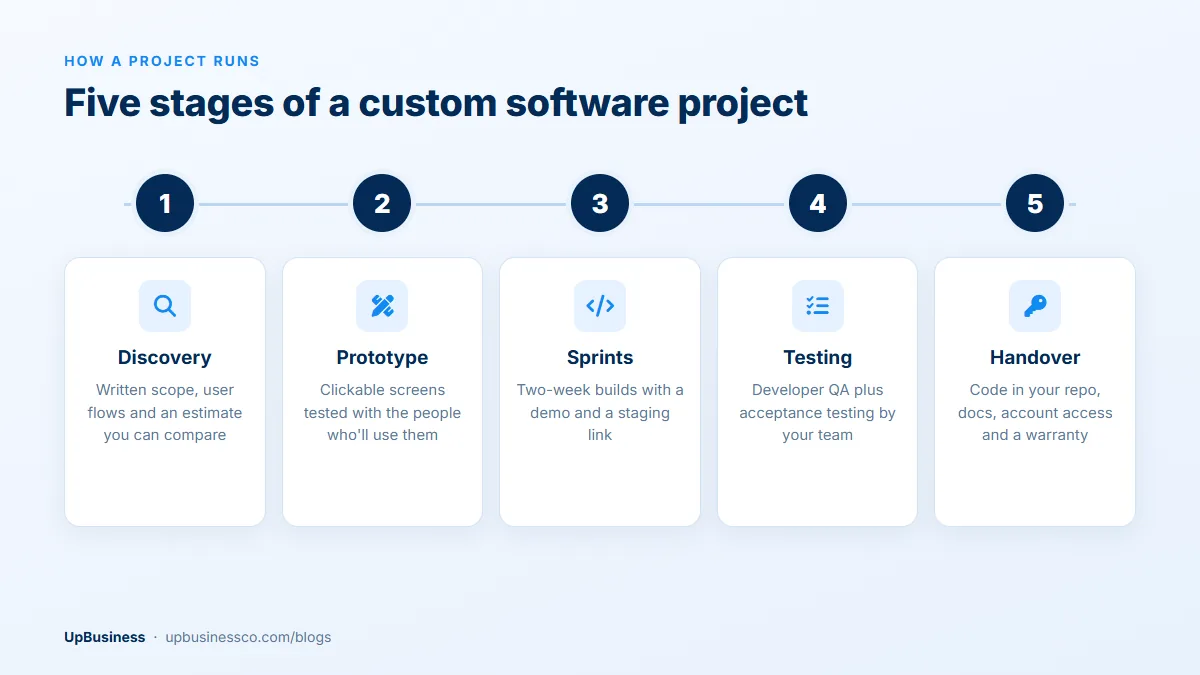
- Discovery. A short, paid phase where the team learns your process, who'll be using the software and which systems it touches. By the end you should have a written scope, user flows and an estimate solid enough to compare against other quotes.
- Design and a clickable prototype. Put it in front of the people who'll actually use it, your accounts team or field staff for example, and not only the founder. Changing things at this point costs very little.
- Building, in sprints. Usually two weeks at a time, with a demo after each one and a staging link you can log into and click around yourself. For version one, aim for an MVP that solves one problem properly.
- Testing. The developer's own QA finds the bugs. User acceptance testing by your staff finds the things that work fine technically but don't match how your business runs.
- Launch and handover. You should get the source code in your own repository, documentation, admin access to every account and a warranty period for bug fixes.
Two sprints in, you should be able to log in and use something, even if it's rough around the edges. If all you've had so far is slides and status updates, ask why.
Who Owns the Code? Get It in Writing
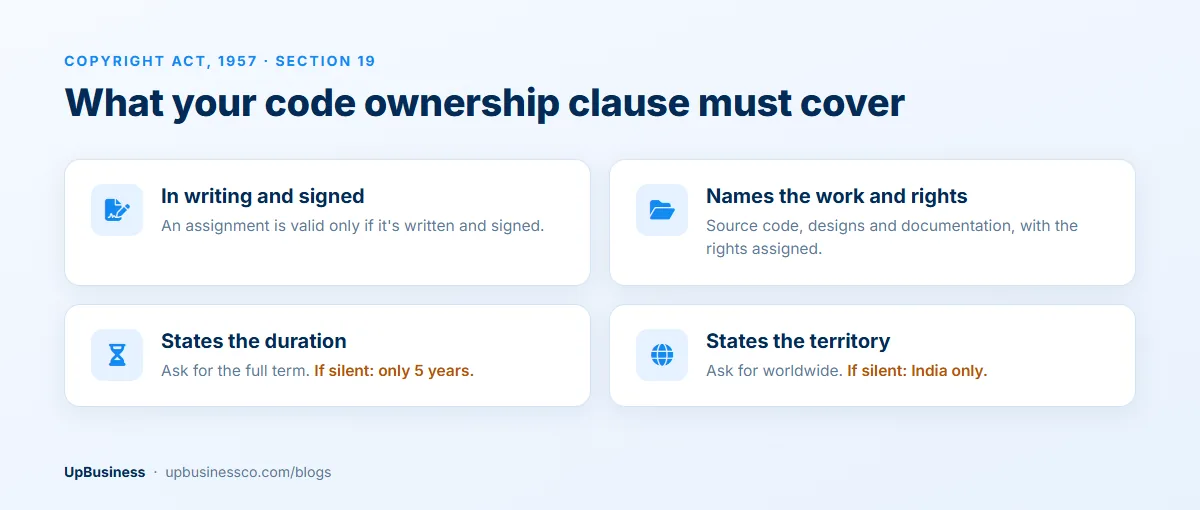
People tend to skim this part of the contract, and it's a mistake. India's Copyright Act makes the author of a work its first owner[4]. When an outside company writes your software, its developers are working for that company, not for you, and simply paying the invoice doesn't move the copyright over to you.
For that you need an assignment, and it only counts if it's in writing and signed. It also has to identify the work and spell out the rights, the duration and the territory. Leave out the duration and the law reads it as five years; leave out the territory and it's assumed to cover India only[4].
So a one-liner like "all IP belongs to the client" might not hold up. What you want is a written assignment that names the software, covers the source code, designs and documentation, and runs for the full term of copyright, worldwide. Get your lawyer to look it over, since this is general information and not legal advice.
Then make sure the practical side matches the paperwork. The code should live in your company's GitHub or GitLab account, and the cloud, domain and third-party accounts should be registered in your company's name.
Personal Data and the DPDP Rules
The Digital Personal Data Protection Rules were notified on 14 November 2025, and businesses get 18 months to comply in phases[5]. If your software holds customer or employee data, your business is the Data Fiduciary, and the development company processing that data for you counts as a Data Processor[5].
In practice, the legal responsibility sits with you rather than the developer. If there's a breach, the people affected have to be told without delay, and the steepest penalty, up to $26.3 million, is for failing to keep reasonable security safeguards in place[5]. Ask every team on your shortlist how they handle consent, access logs, encryption and deleting data, and get their answers written into the contract.
How to Choose a Custom Software Development Company
Narrow it down to three or four teams and put the same questions to each of them. Seeing the answers side by side tells you more than any portfolio will.
Questions to Ask Before You Hire
- Can you show me two or three systems you've built that people use every day? Could I speak to one of those clients?
- Who will actually work on my project, and are they on your payroll?
- Which tech stack would you pick for this, and why? Could another team take it over later if needed?
- What does the price include: discovery, design, testing, deployment, documentation, a bug-fix warranty?
- Will you sign a written assignment of copyright for the code, designs and documentation?
- Where will the code be kept, and who controls the cloud accounts?
- How will you handle personal data under the DPDP Rules?
- Roughly what will maintenance cost each month once we've launched?
Red Flags
- A fixed quote based on a one-page brief, with no discovery at all.
- Any hesitation about putting code ownership in writing.
- Your code sitting in their repositories and your servers in their cloud accounts.
- A big payment upfront rather than payments tied to milestones.
- A proprietary framework that only they know how to maintain.
One low-risk way to start is paying for discovery on its own. You come away with a clear scope and a firm quote, and you've seen how the team works before handing over the full budget.
Every company in our Custom Software Development category goes through verification, and you can compare their TrustScores and profiles before you shortlist anyone. For bigger systems, have a look at enterprise software and ERP specialists. And if you'd rather have companies come to you, post your project and get matched with verified teams.
Fixed Price, Time and Materials or Dedicated Team?
| Model | Works well when | Watch out for |
|---|---|---|
| Fixed price | The scope is small and written down in detail, such as an MVP after discovery | Every change turns into a change request, and teams build a buffer into the price to cover their risk |
| Time and materials | Requirements will shift as you learn from users | Someone on your side has to track hours against delivered features every week |
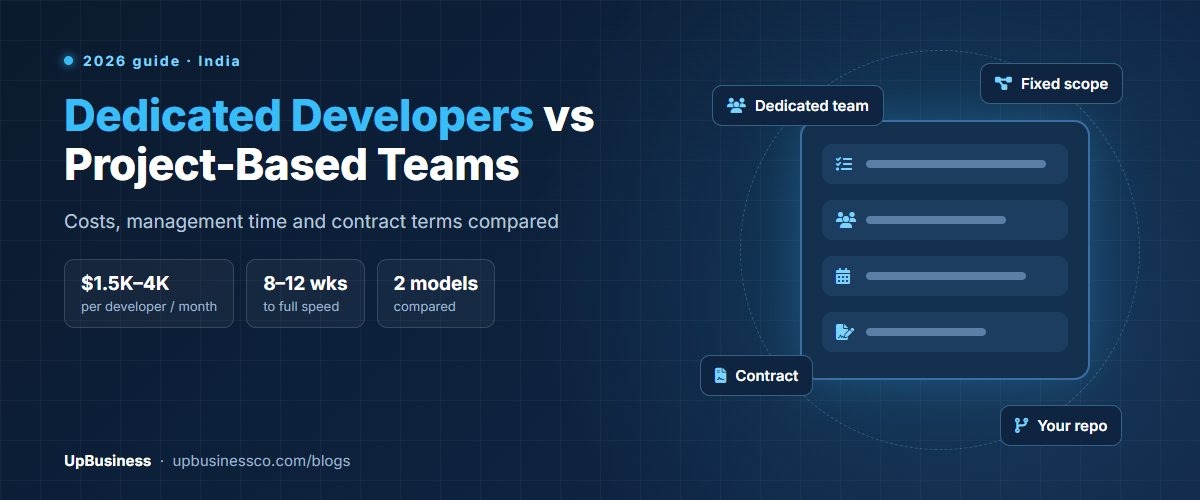
| Dedicated team | The software is a long-running product you'll keep improving | You set the priorities yourself, and quiet months cost the same as busy ones |
A sequence that suits a lot of buyers is fixed-price discovery first, then a fixed-price MVP, and only after launch, once there's a real backlog, a move to time and materials or a dedicated outsourced team.
Comments 1
Great insights! Every business has unique workflows and requirements, which is why custom software development can be valuable. Building solutions around actual business needs helps improve efficiency, flexibility, and long-term scalability.