


Browse our curated list of Multi-Seller Marketplace Development Companies
Marketplace development cost runs from about $2,400 a year on a hosted marketplace builder to $25,000 to $80,000 for a custom-built first version. A full platform with mobile apps, dispute handling and seller verification costs $80,000 to $300,000 or more[1][2]. The gap is that wide because "a marketplace" can mean a 20-seller directory with payments or a regulated platform moving millions a month. This guide is for founders and product owners planning a two-sided or multi-seller marketplace and hiring a partner company to build it. It covers the three build routes, the features that move the budget, the payment fees you pay every month after launch and a worked budget for a first version.
Key takeaways
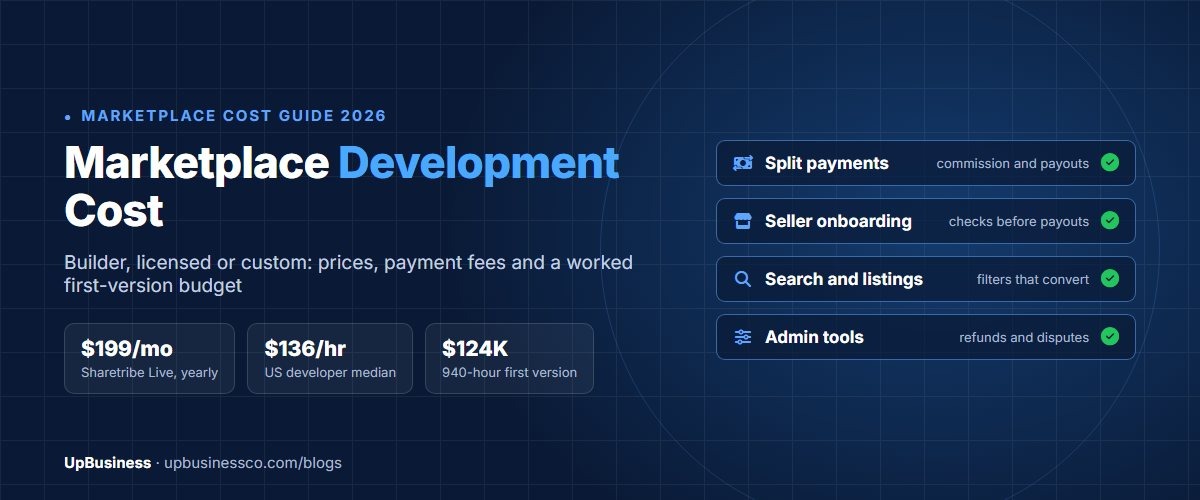
- Hosted builders cost far less up front. Sharetribe's Live plan costs $199 a month billed yearly, and licences for CS-Cart's marketplace edition run $725 to $3,599 a year, against $25,000 or more for custom code.
- US contract developers bill a median ceiling rate of $136 an hour on GSA schedules, so a 940-hour first version costs about $124,000 at those rates and $28,000 to $56,000 at published offshore rates.
- Payments are a monthly cost, not a one-off feature. At $100,000 a month in sales, card fees plus Stripe Connect platform fees come to about $4,000.
- Our marketplace development listing shows 6 companies, but none names marketplace development as a service on its profile yet. Ask each one for a marketplace it built with live payouts.
How Much Does It Cost to Build a Marketplace?
A marketplace costs $725 to $8,000 in first-year platform or licence fees on a hosted builder or licensed script, before setup work. A custom first version costs $25,000 to $80,000, and a full custom platform $80,000 to $300,000 or more. Payment processing, hosting and upkeep add 15% to 25% of the build cost each year.
Those ranges come from three different routes, and choosing the route is the biggest single decision in your budget. The table puts them side by side.
| Build route | Typical first-year cost | What you get | Best fit |
|---|---|---|---|
| Hosted marketplace builder (for example Sharetribe) | $2,388 to $3,108 in plan fees, plus setup and any custom front end[3] | Listings, search, checkout, payouts and admin out of the box; code changes possible on higher effort | Testing demand, service and rental marketplaces with standard flows |
| Licensed multi-seller software (for example CS-Cart's marketplace edition) | $725 to $3,599 a year, or $3,590 to $7,990 for a lifetime licence, plus hosting and setup[4] | Self-hosted product marketplace with seller panels and commission settings | Product marketplaces that want to own the code base without building it |
| Custom first version (MVP) | $25,000 to $80,000[1][2] | One transaction flow end to end, built to your rules | Unusual pricing, booking or trust rules a builder can't handle |
| Full custom platform | $80,000 to $300,000 or more[2] | Mobile apps, disputes, verification, analytics, integrations | Proven demand and volume that justify owning every layer |
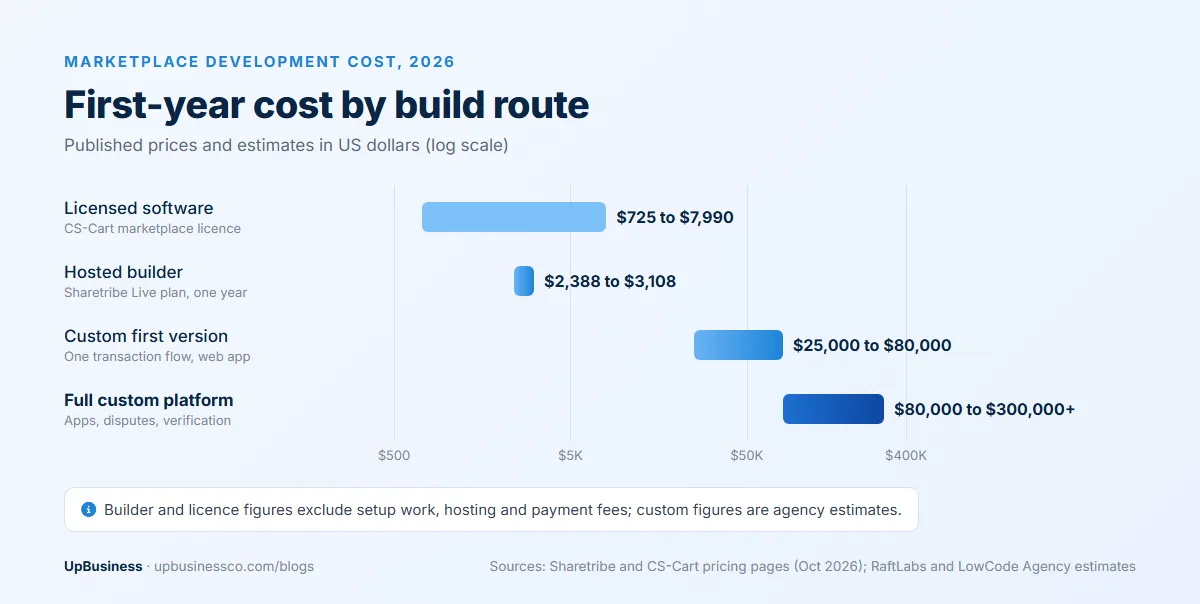
The custom figures above come from agencies that build marketplaces for a living (RaftLabs, LowCode Agency and Cleveroad), so read them as market quotes rather than neutral research. They do agree on the shape. RaftLabs prices a first version at $25,000 to $45,000 over 8 to 12 weeks[1]. LowCode Agency starts its MVP band at $30,000 and runs it to $80,000[2], and Cleveroad puts a simple marketplace at $41,000 to $80,000 at $50 an hour[5].
Marketplace Development Cost by Build Route
Start by asking whether a builder can run the first six to twelve months. If it can, you'll spend a few thousand dollars instead of tens of thousands to find out whether sellers and buyers turn up.
Hosted builders
Sharetribe is a hosted builder made for two-sided marketplaces. Its Build plan costs $39 a month for testing, and the Live plan costs $199 a month billed yearly or $259 billed monthly. A Hold plan at $49 a month pauses a marketplace while keeping its data. Sharetribe charges no transaction fees of its own[3]. If you change the front-end code, you host it yourself; Sharetribe's pricing page suggests Render at $19 a month for that.
The trade-off is control. You work inside the builder's data model, payment setup and page structure. That's fine for a services or rental marketplace with standard booking and payment flows, and limiting for anything with custom pricing logic, auctions or several payment steps.
Licensed multi-seller software
Licensed products sit in the middle. CS-Cart's marketplace edition lists Standard at $725 a year, Plus at $1,449 a year or $3,590 for a lifetime licence, and Ultimate at $3,599 a year or $7,990 lifetime[4]. You get a self-hosted product marketplace with seller dashboards, commission settings and a storefront. You still pay for hosting, theme work, payment setup and any custom features, and a partner company usually handles that setup.
If your marketplace is really a store with a few outside sellers, compare this route with an ecommerce platform plus a marketplace app. Our Shopify development cost guide and ecommerce web development guide cover that path.
Custom builds
Custom code makes sense when the way money moves is part of your product. Think of deposits held until a job is done, one order split across several sellers, or bookings with cancellation rules and verification steps a builder can't model. You own the code and can change anything, and you also pay for every part of it, including the dull parts like payout reconciliation and admin tools.
What Drives Multi-Seller Marketplace Development Cost
Features drive custom budgets far more than page count. A marketplace has two sets of users, each with its own account, dashboard and notifications, plus an admin side that needs real tools from day one. These are the items that move a quote, with the add-on costs that agency guides publish.
| Feature | What it involves | Published cost signal |
|---|---|---|
| Split payments and payouts | Charging buyers, holding funds, paying sellers, taking a commission, refunds | Stripe Connect work is roughly 30% to 35% of first-version engineering time[1] |
| Escrow and disputes | Holding money until delivery, a decision path for who gets paid when a buyer complains | $15,000 to $30,000 extra for an escrow system[2] |
| Seller verification (KYC) | Identity checks before a seller can list or get paid | $10,000 to $25,000 extra[2] |
| Messaging | Buyer and seller chat, ideally in real time | $8,000 to $20,000 extra[2] |
| Search and filters | Category, price, location and availability filters | Hosted search such as Algolia Grow includes 10,000 searches a month, then $0.50 per 1,000[6] |
| Native mobile apps | iOS and Android apps for buyers, sellers or both | $20,000 to $40,000 extra[1], or $40,000 to $120,000 for full native apps[2] |
| Admin and commission rules | User management, payout controls, commission by category or seller, reports | Usually inside the first version; grows with every rule you add |
Two items are easy to underestimate. The first is payment edge cases: a refund after the seller has been paid, a seller whose bank account fails verification, a partial delivery. RaftLabs reports that dispute and escrow logic take 20% to 25% of the second-phase budget[1]. The second is the admin panel. Founders tend to treat it as an afterthought, then spend the first months after launch fixing payouts by hand.
Hourly Rates Behind a Custom Marketplace Build
Every custom quote is hours multiplied by rates. Agency rate tables are rarely sourced, so we pulled the US General Services Administration's CALC database of contract labour rates on 26 October 2026[7]. These are ceiling rates, the most a contractor may charge US government buyers. Commercial quotes from the same firms are often similar or lower.
| Role | Rates found | Median ceiling rate | Middle half | By experience (0-4 / 5-9 / 10+ years) |
|---|---|---|---|---|
| Software developer or engineer | 2,904 rates, 831 contractors | $136 | $110 to $168 | $117 / $147 / $173 |
| UI/UX designer | 297 rates, 143 contractors | $140 | $117 to $175 | $132 / $149 / $175 |
| QA and test engineer | 1,959 rates, 609 contractors | $115 | $94 to $146 | $100 / $128 / $157 |
| Project manager | 5,978 rates, 2,516 contractors | $118 | $100 to $130 | $113 / $120 / $124 |
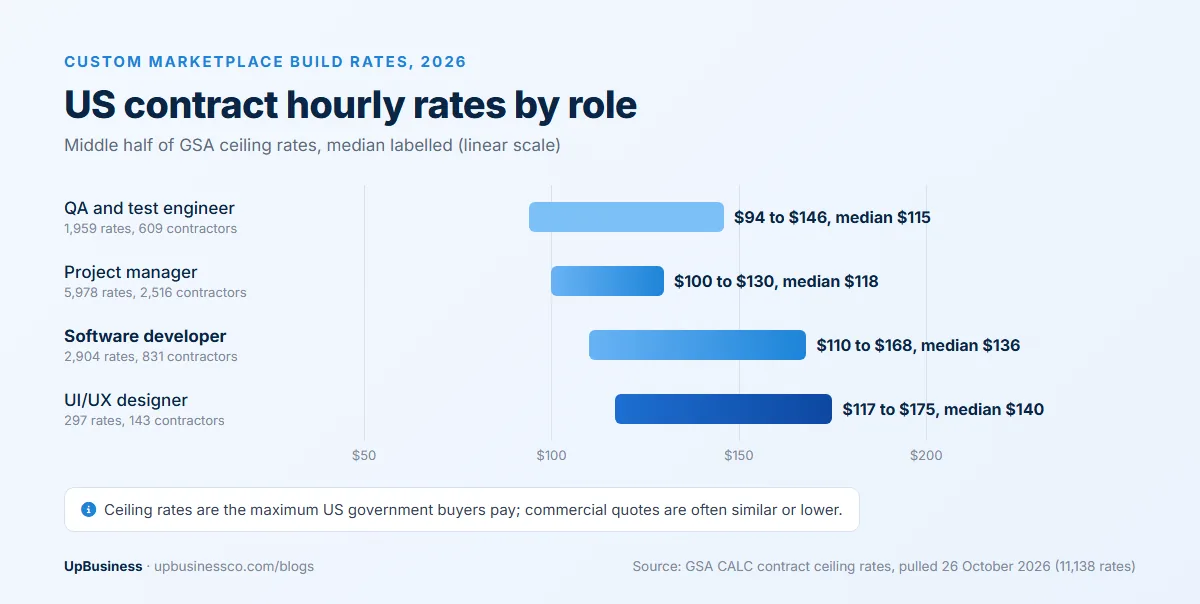
Rates outside the US are lower. One agency guide quotes offshore teams at $30 to $60 an hour against $100 to $180 for agencies[2]. It also warns that very cheap builds at $25 to $40 an hour often need $30,000 to $80,000 of rework later, a point worth weighing against the saving. For a wider view of how rates differ by country and team type, our software development cost benchmark lays out the numbers.
Worked Example: A Services Marketplace First Version
Here's how the numbers come together for a services marketplace where buyers book local professionals, pay online and leave a review. The hours below are our illustrative estimate for the first-version scope RaftLabs describes[1]. They aren't a quote, and your own scope will change them.
| Work package | Hours | Role | At US GSA median |
|---|---|---|---|
| Discovery, user flows and UI design | 120 | UI/UX designer at $140 | $16,800 |
| Buyer and seller accounts, onboarding | 120 | Developer at $136 | $16,320 |
| Listings, search and filters | 140 | Developer at $136 | $19,040 |
| Checkout, Stripe Connect split payments, payouts | 160 | Developer at $136 | $21,760 |
| Reviews, messaging and email notifications | 100 | Developer at $136 | $13,600 |
| Admin panel, commission rules, transaction log | 100 | Developer at $136 | $13,600 |
| Testing | 120 | QA engineer at $115 | $13,800 |
| Project management | 80 | Project manager at $118 | $9,440 |
| Total | 940 | $124,360 |
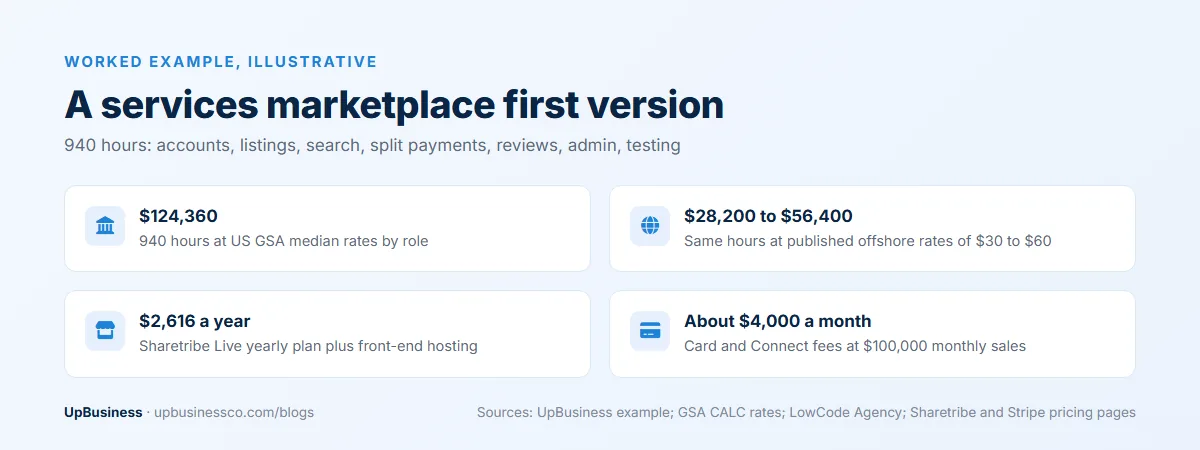
At US contract rates, this first version costs about $124,000. The same 940 hours at the $30 to $60 offshore band comes to $28,200 to $56,400[2], which lines up with the $25,000 to $80,000 MVP quotes above. On a hosted builder, the first year of plan fees for the same idea is $2,388 on Sharetribe's yearly Live plan, plus $228 for front-end hosting[3], and setup work on top.
The example also shows where to cut if the budget is tight. Messaging can start as email notifications. Disputes can be handled by your support team by hand for the first hundred orders. Mobile apps can wait while the web app works well on phones. Cutting payments or admin tools is the wrong place to save, because those are the parts that break when real money starts moving.
Payment and Platform Fees You Pay Every Month
Every marketplace pays a payment processor, and a multi-seller marketplace usually pays twice: once to take the buyer's money and again to route it to sellers. Stripe's standard US card price is 2.9% plus 30 cents per successful charge, with 1.5% more for international cards and 1% more when currency conversion is needed[8].
Stripe Connect, which handles seller payouts, has two pricing models. If you let Stripe bill your sellers for processing directly, your platform pays no extra Connect fees. If you set your own pricing, which a marketplace taking a commission usually does, Connect costs $2 per monthly active seller account plus 0.25% and 25 cents per payout sent[9].
Here's what that looks like for a marketplace with $100,000 in monthly sales, an $80 average order, 200 sellers paid twice a month and a 10% commission. The figures use Stripe's published US rates for domestic cards.
| Fee | Calculation | Monthly cost |
|---|---|---|
| Card processing | 1,250 orders x ($2.32 + $0.30) | $3,275 |
| Connect active accounts | 200 sellers x $2 | $400 |
| Connect per-payout fee | 400 payouts x $0.25 | $100 |
| Connect payout volume fee | 0.25% of $90,000 paid out to sellers | $225 |
| Total | $4,000 |
That's 4.0% of sales, against $10,000 in commission. The share drops with larger orders, since the 30-cent charge matters less, and rises with international buyers. Ask any partner company quoting your build to show this calculation for your own order size, because it decides what commission you can afford to charge.
Other running costs are smaller. Search on Algolia's Grow plan comes to about $20 a month at 50,000 searches, since the first 10,000 are free[6]. Hosting and email add a little more, and mobile apps need store accounts. Apple's developer program costs $99 a year[10] and Google Play charges a one-time $25 registration fee[11].
Marketplace App Development Cost: Web First or Mobile?
For a first version, a responsive web app is usually enough, with native apps added later. RaftLabs puts mobile apps at $20,000 to $40,000 on top of the web build[1], and LowCode Agency puts full native iOS and Android apps at $40,000 to $120,000[2]. The exception is a marketplace where sellers work from their phones all day, such as home services or delivery. There, a seller app belongs in the first version, while buyers can still start on the web.
A cross-platform framework can bring the cost of two apps closer to one. Whatever the choice, keep the payment and booking logic on the server, so the web and mobile apps share it instead of each carrying its own copy.
Ongoing Costs After Launch
The build is only the first bill. LowCode Agency estimates that hosting, payment fees and maintenance run 15% to 25% of the initial build cost every year[2]. By its numbers, a $100,000 build needs $10,000 to $15,000 a year just to keep working as browsers, APIs and operating systems change. New features on top of that are a separate budget.
RaftLabs describes a typical path in phases. After the core transaction version comes a phase for trust and seller tools such as disputes and verification, at $40,000 to $80,000. Mobile apps and scale work follow at $60,000 to $120,000[1]. Plan cash for at least the second phase before you launch, since the problems it fixes show up as soon as volume grows.
What Our Data Shows About Marketplace Development Partners
The 6 multi-seller marketplace development partner companies listed on UpBusiness in October 2026 are full-service software firms. Four are based in Noida, one in Ahmedabad and one in Mumbai. Team sizes run from 1-10 people to 201-500, and the founding years range from 2004 to 2024.
None of the six names marketplace development as a service on its profile yet. So we don't quote their project sizes here, because those figures cover all their client work. Their profiles lead with software, app or ecommerce work. Ask each one for a marketplace they have built, ideally with live payouts. You can compare them on the multi-seller marketplace development page.
How to Get an Accurate Marketplace Development Quote
Quotes for the same idea can differ by five times or more, usually because each partner company pictured a different product. A written brief narrows that gap. Our software project brief template works for marketplaces if you add these points:
- who the sellers are, how they sign up and what checks they pass before they can list or get paid,
- how money moves, step by step, including commission, refunds and what happens when a buyer complains,
- which route you'd accept (builder, licensed software or custom) and why,
- launch countries and currencies, since they change payment and tax setup,
- what the first version leaves out on purpose.
When proposals come in, check that each one names the payment provider and the Connect pricing model it assumes. Each should list hours by role and keep one-time build costs apart from monthly running costs. Code, hosting and payment accounts should sit in your company's name. Our guide to comparing software development proposals explains how to line quotes up, and the software development contract checklist covers ownership and payment milestones. If you are still deciding how much to build first, read our MVP development cost guide; if the marketplace is one part of a subscription product, our custom SaaS development guide covers that model.
Red Flags in Marketplace Proposals
- A fixed price with no mention of how refunds, disputes or failed payouts are handled.
- Payments described only as "Stripe integration", with no word on Connect, seller onboarding or payout timing.
- A custom build proposed for a standard rental or services model that a builder already covers, with no reason given.
- Stripe, hosting or app store accounts opened in the partner's name.
- Mobile apps, admin tools and testing missing from the hours, then promised "in phase two".
- No monthly running cost estimate at all.
If you'd like quotes from verified partner companies, post your project on UpBusiness with your marketplace type, how payments should work, your preferred build route and your budget, and compare the proposals side by side.