

Browse our curated list of Shopify Development Companies
Shopify is often the first platform an Indian D2C brand looks at, and for good reason: you can open a store in an afternoon and take payments the same week. The harder question is what it will really cost once you add a proper theme, the apps you need, payment gateway fees and an agency to put it together.
This guide breaks down Shopify development cost in India in 2026: Shopify’s own India plan prices (converted to US dollars), what themes, customisation and apps cost, how transaction fees change with your sales, and how to compare quotes from Shopify development companies.
If you only have a minute
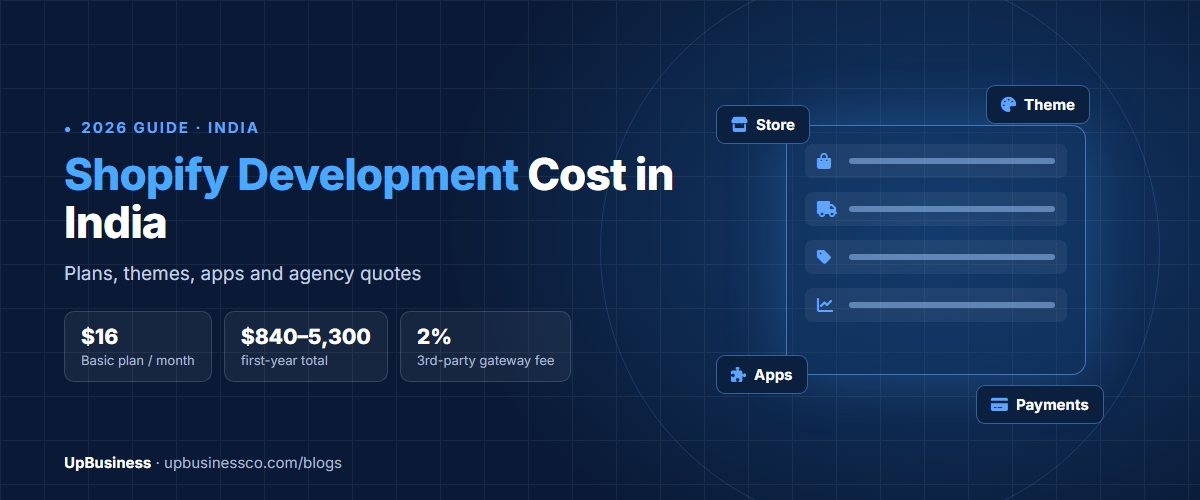
- Shopify’s India plans start at $16 a month for Basic on yearly billing ($21 monthly), $59 for Grow and $240 for Advanced. Shopify Plus starts at $1,800 a month[1].
- A premium theme costs about $130–320 one-time, theme customisation $160–530, and apps $21–160 a month[2].
- The first-year total for a typical Indian Shopify store comes to roughly $840–5,300, with ongoing costs of $530–4,200 a year[2].
- If you take payments through a third-party gateway such as Razorpay, Shopify adds its own fee of 2% on Basic, 1% on Grow and 0.6% on Advanced[1], on top of the gateway’s charge.
Shopify Plan Prices in India (2026)
These are Shopify’s published India prices per month, converted from rupees at 95 to the dollar. Shopify bills Indian stores in rupees, and its US dollar prices for other countries are different. Check at checkout whether GST is added, since the pricing page doesn’t say.
| Plan | Billed yearly | Billed monthly | Staff accounts | Third-party gateway fee |
|---|---|---|---|---|
| Basic | $16 | $21 | None extra | 2% |
| Grow | $59 | $78 | 5 | 1% |
| Advanced | $240 | $320 | 15 | 0.6% |
| Plus | From $1,800 | Not listed | Unlimited | 0.2% |
Source: Shopify India pricing page[1].
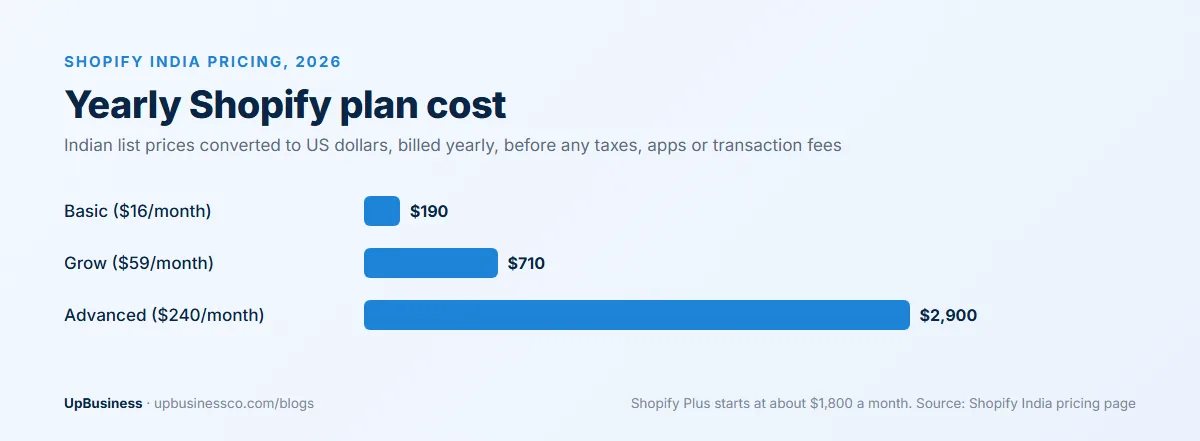
For most new stores, Basic is enough to start. The plan fee is rarely the biggest cost, though. Themes, apps, payment fees and the agency’s work usually add up to several times the plan price in the first year.
What a Shopify Store Costs to Build
An Indian ecommerce cost guide from 2026 puts the main build costs at these ranges[2]:
| Cost item | Typical cost in India | Notes |
|---|---|---|
| Premium theme | $130–320 one-time | Free themes such as Dawn cost nothing; Shopify Theme Store premium themes are often $260–340 |
| Theme customisation | $160–530 | Brand colours, layouts, custom sections and product page changes |
| Apps | $21–160 a month | Reviews, WhatsApp, email, subscriptions, upsells |
| First-year total | $840–5,300 | Plan, theme, setup work and apps together |
| Ongoing cost | $530–4,200 a year | Plan, apps and transaction fees |
The note on Theme Store prices comes from a separate 2026 Shopify pricing guide by an Indian agency[3].
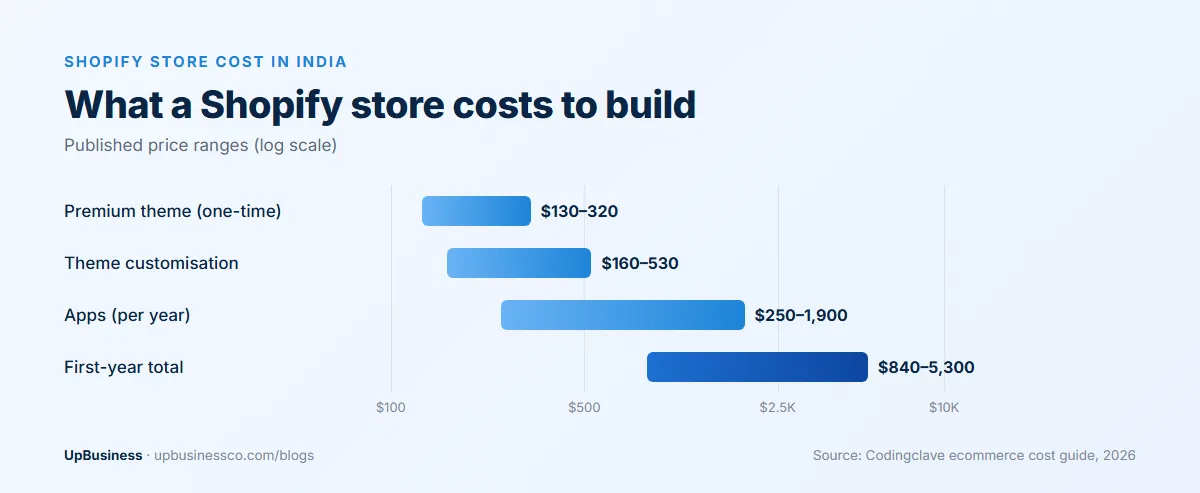
Where you land in those ranges depends mostly on how custom the store needs to be. A store using a free theme with a few changes and 50 products sits near the bottom. A D2C brand with custom product pages, bundles, subscriptions and integrations with an ERP or courier aggregator sits near the top, and teams that specialise in D2C store development typically handle that kind of build.
What Pushes a Shopify Quote Up
Two stores can both be called “a Shopify store” and differ in price by ten times. These are the things that usually move a quote:
- Custom design. Adapting a ready-made theme is quick; designing every page from scratch in Figma first adds weeks and a designer’s fee.
- Product catalogue. Uploading 50 products with clean photos is a day’s work. Thousands of products with variants, sizes and bulk data cleaning is a project of its own.
- Custom features. Bundles, subscriptions, gift cards, B2B price lists or a custom product configurator need apps, custom code or both.
- Integrations. Connecting Shopify to Tally, Zoho, an ERP, a courier aggregator or a WhatsApp tool takes setup and testing.
- Languages and markets. Selling in several languages or currencies adds setup for each market.
- Migration. Moving from WooCommerce or Magento means transferring products, customers and orders, and redirecting old URLs so you don’t lose search rankings.
When comparing quotes, ask each company to list which of these they have priced in. A low quote that assumes a free theme and 20 products isn’t comparable with a higher one that includes custom design and 2,000 products.
How Long a Shopify Build Takes
The same 2026 cost guide puts a basic ecommerce store at 2–4 weeks, a mid-range store at 4–8 weeks and an advanced store at 8–16 weeks[2]. On Shopify, the platform setup itself is fast; most of the time goes on design approvals, product data and testing payments, shipping and GST invoices end to end.
The most common delay isn’t development at all. It’s waiting for product photos, descriptions and policies from the business side. Getting those ready before the agency starts can take weeks off the timeline.
Transaction and Payment Gateway Fees
This is the cost most first-time store owners miss. When you take payments through a third-party provider instead of Shopify Payments, Shopify charges its own fee on each order: 2% on Basic, 1% on Grow and 0.6% on Advanced[1]. The payment gateway then charges its own fee as well. Razorpay, for example, is listed at 2% plus 18% GST, while PayU, Cashfree and CCAvenue are in a similar range[3].
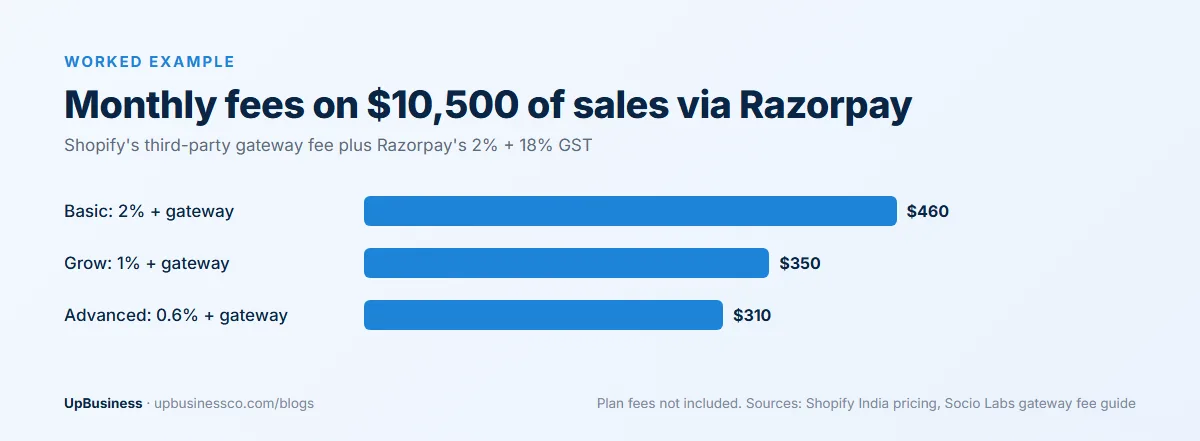
The example above shows why your plan choice should follow your sales. On $10,500 of monthly sales, moving from Basic to Grow saves $110 a month in Shopify’s gateway fee, which is more than the $43 difference in plan price on yearly billing. The break-even point is around $4,300 of monthly sales: below that, Basic is cheaper overall, and above it, Grow usually wins.
Setting up the gateway, COD rules and shipping integrations properly is part of a good build. Partner companies that offer payment gateway integration can help if you’re connecting Shopify to an existing accounting or ERP setup.
Freelancer, Agency or In-House?
- A freelancer suits a simple store on an existing theme with small changes. It’s usually the cheapest option, but check who handles support after launch.
- A Shopify agency suits a brand launch or a redesign, with design, development, apps, testing and training handled by one team. Expect the higher end of the build ranges above.
- An in-house developer makes sense once the store is a large share of your revenue and changes happen every week. Many brands combine an in-house marketer with an agency on a monthly Shopify maintenance retainer.
How to Compare Shopify Development Quotes
Ask every company to quote against the same list, and check that each quote answers these questions:
- Which theme will you use, and is the theme licence included in the price?
- How many pages, product templates and custom sections are included?
- Which apps do you recommend, and what will they cost us each month?
- Will you set up the payment gateway, COD, shipping and GST invoices?
- Is product upload included, and for how many products?
- Will the store and every app be registered in our company’s name?
- What support is included after launch, and what does a monthly retainer cost?
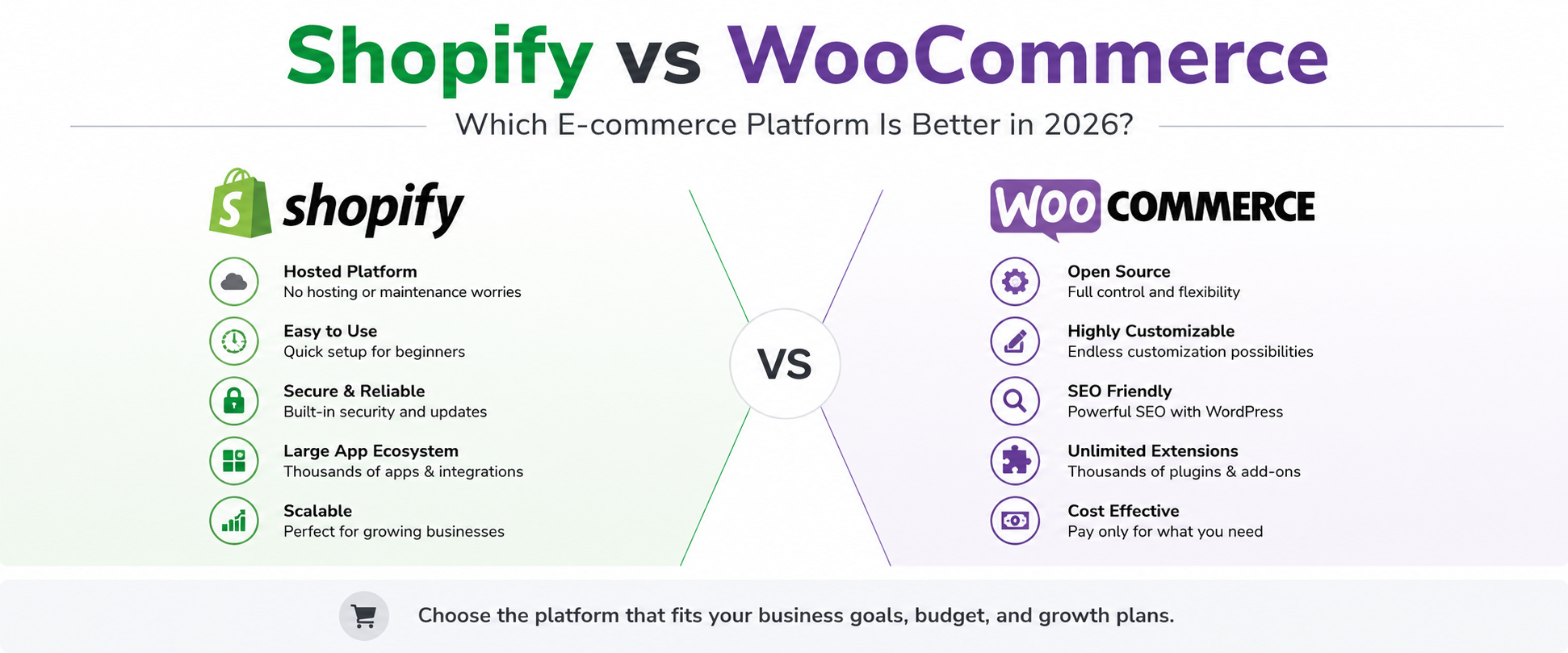
Moving an existing WooCommerce or Magento store adds data and SEO work: redirects for old URLs, customer accounts and order history. Teams that focus on Shopify migration quote this separately. If you’re still deciding between platforms, our Shopify vs WooCommerce comparison covers the trade-offs, and specialists in WooCommerce development can quote the alternative.
On UpBusiness, you can compare verified Shopify development companies by their TrustScores and profiles before shortlisting. If you’d rather have companies come to you, post your project and get matched with verified teams.