


Browse our curated list of React Native App Development Companies
React Native app development cost in 2026 usually runs from about $15,000 for a simple app to $90,000 for a mid-complexity product, and complex apps pass $200,000. Those figures cover one codebase that ships to both iOS and Android, built by a blended or offshore team. Our UpBusiness React Native listing shows 7 companies, but none names React Native as a service on its profile yet.
The saving comes from writing most of the client code once for both platforms instead of twice. It does not remove design, backend work, testing on two platforms or the native code some features still need. This guide shows where a React Native budget goes, what Expo and its build service cost, what developers charge per hour and how to read a quote line by line.
Key takeaways
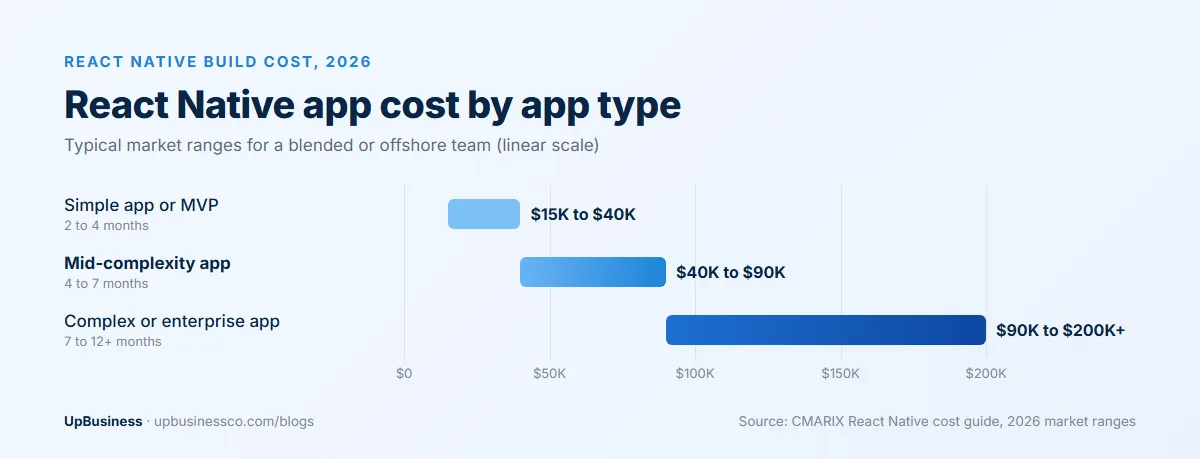
- Market ranges for a React Native app are $15,000 to $40,000 for a simple app and $40,000 to $90,000 for a mid-complexity app. A complex one costs $90,000 to $200,000 or more.[1]
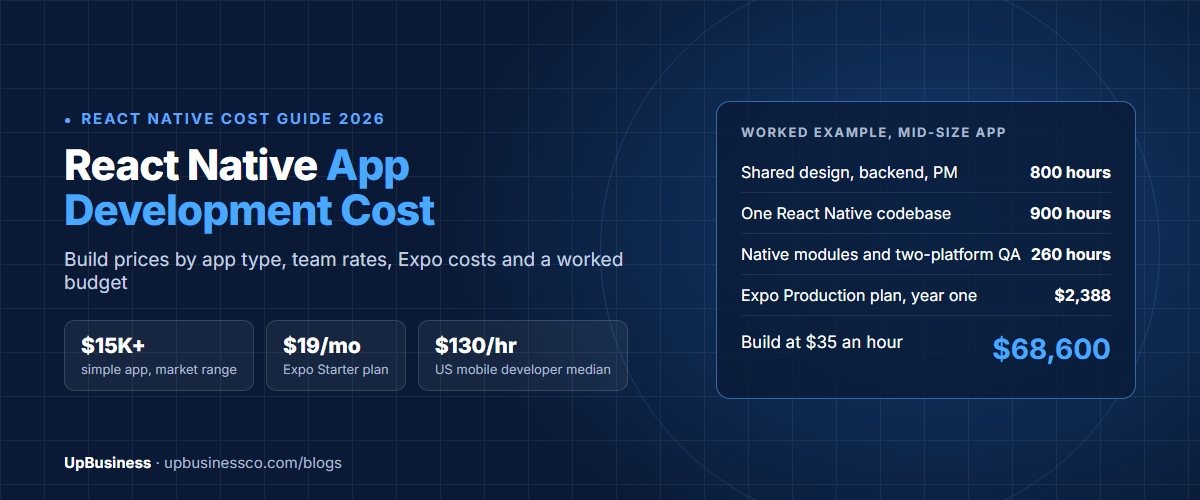
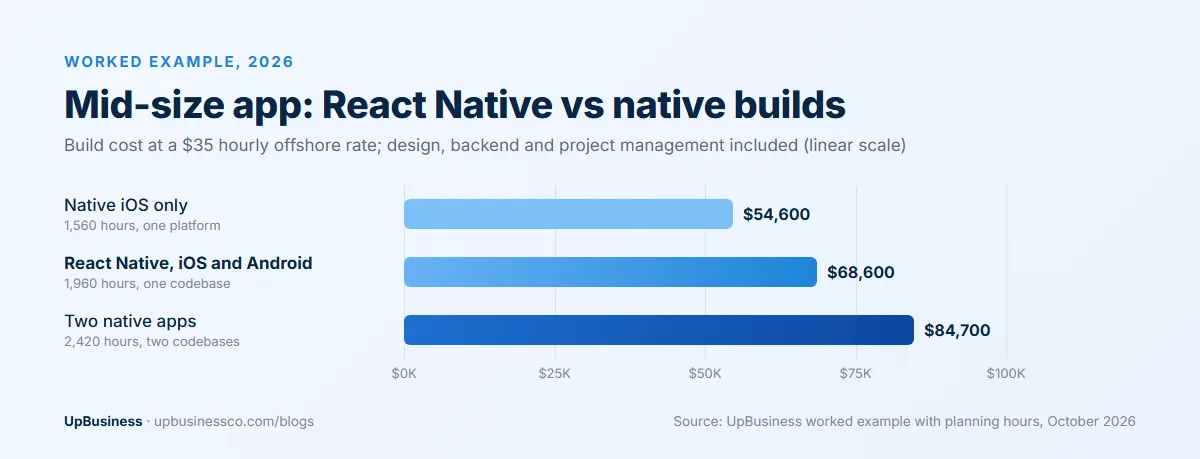
- In our worked example, a mid-size app costs $68,600 in React Native against $84,700 for two native apps, a saving of about 19%, not 50%.
- Expo's build and update service costs $0, $19 or $199 a month on its self-serve plans, plus usage. Builds cost $1 to $4 each beyond the included credit.[2]
- US contract rates for mobile developers have a median of $130 an hour in GSA data. Offshore teams often bill $20 to $50.
- Custom native modules, older libraries and real-time features move a quote more than screen count does.
How Much Does React Native App Development Cost in 2026?
The cost guides we reviewed group React Native projects into three tiers. The ranges below assume a blended or offshore team. A fully onshore team in the US or Western Europe usually pushes a project up one tier.[1]
| App type | Typical scope | Cost range | Timeline |
|---|---|---|---|
| Simple app or MVP | Login, a few core screens, standard APIs, one user role | $15,000 to $40,000 | 2 to 4 months |
| Mid-complexity app | Custom design, payments, chat or maps, admin panel, several integrations | $40,000 to $90,000 | 4 to 7 months |
| Complex or enterprise app | Real-time data, several user roles, heavy integrations, security reviews | $90,000 to $200,000+ | 7 to 12+ months |
These bands are wide because the framework is not what sets the price. Scope does. A booking app with a calendar, payments and push notifications sits in the middle tier whether it is written in React Native, Flutter or two native languages. What React Native changes is how many times the client code gets written.
Still deciding whether a mobile app is the right first step? Our MVP development cost guide covers smaller first releases. The mobile app development cost guide covers app budgets across all frameworks.
What Changes a React Native Quote?
Two apps with the same number of screens can be quoted $30,000 apart. These are the items that usually explain the gap.
Custom native modules
React Native talks to the phone through native code. Common features such as the camera, maps and push notifications have mature libraries. When a feature has no library, someone writes a native module in Swift for iOS and Kotlin for Android, then tests both. A Bluetooth device integration or a custom video pipeline can add several weeks for this reason alone.
The New Architecture and older libraries
React Native 0.82, released in October 2025, was the first version that runs entirely on the New Architecture. Version 0.81 and Expo SDK 54 were the last releases that still allowed the older one.[3] The project ships new releases every few months, and recent ones aimed to avoid breaking changes for app code.[4] For a new app this is good news. Trouble starts with libraries that are no longer maintained. If a package never moved to the new system, a developer has to replace or patch it, and that time belongs in the quote. Ask every bidder which libraries they plan to use and whether each one supports the current architecture.
Expo or bare React Native
The React Native docs recommend starting new apps with a framework and name Expo as the main one.[5] Expo adds routing, maintained libraries and plugins that change native code without hand-editing native files. A hosted build service sits on top. A bare project gives full control of the native folders but leaves more setup and upgrade work to your team. The next section shows what Expo's paid services cost.
Integrations and backend
The app on the phone is often half the work. Payments, single sign-on, a CRM or ERP connection, an admin panel and the API behind it are priced the same way in any framework. If a quote looks cheap, check whether the backend is in it at all.
Design depth and the web target
A design system with custom components, animation and accessibility work costs more than a styled template. Some teams also offer a web version from the same code. That can save money for simple screens. It also adds browser testing. Ask for it as a separate line.
Expo vs Bare React Native: What Each Costs
Expo itself is free and open source. The paid part is Expo Application Services (EAS), which builds the app in the cloud, submits it to the stores and sends over-the-air updates. Here are the published plans as of October 2026.[2]
| EAS plan | Monthly price | Build credit included | Update users included |
|---|---|---|---|
| Free | $0 | 15 Android and 15 iOS builds, low-priority queue | 1,000 monthly active users |
| Starter | $19 plus usage | $45 of build credit | 3,000 monthly active users |
| Production | $199 plus usage | $225 of build credit | 50,000 monthly active users |
| Enterprise | Custom | $1,000 of build credit | Preferred pricing |
Beyond the credit, each build has a flat price. Android builds cost $1 on a medium worker and $2 on a large one. iOS builds cost $2 and $4. Over-the-air updates are billed per monthly active user who downloads an update, at $0.005 per user from the plan's allowance up to 200,000 users, with lower rates above that.[2]
A quick example shows how the plans compare. An app with 20,000 users a month who download updates would pay $19 plus 17,000 extra users at $0.005, about $104 a month on Starter. The same app pays $199 on Production. Starter stays cheaper until roughly 39,000 monthly update users. After that, Production costs less and adds priority support and more build credit.
A bare project can skip EAS and build on its own CI service, but then someone has to maintain macOS build machines, signing certificates and release scripts. For a small team, $19 to $199 a month is usually cheaper than those engineering hours.
What Do React Native Developers Cost Per Hour?
There is no separate GSA labour category for React Native, so the closest checkable US figures are mobile and front-end developer rates. These are ceiling rates, the most a contractor may charge US government buyers per hour. Treat them as an upper reference for US work.[6]
| Role | US median ceiling rate | Sample |
|---|---|---|
| UX designer | $140 an hour | 298 rates, 144 contractors |
| Mobile app developer | $130 an hour | 51 rates, 29 contractors |
| Front-end developer | $130 an hour | 65 rates, 30 contractors |
| Quality assurance analyst | $95 an hour | First 600 rates returned |
Market rates by region vary by up to nine times for the same work. One 2026 guide puts US React Native developers at $80 to $180 an hour, Eastern Europe at $30 to $80 and South Asia at $20 to $50.[7] Seniority matters as much as location. A senior developer who has shipped several apps on the New Architecture will often finish native module work in half the time of a junior one.
The hourly rate is only one part of the bill, though. What really sets the total is how many hours each role spends on your scope.
Who Is on a React Native Team?
A typical mid-size React Native project uses a small mixed team rather than a single developer. The split below is our planning assumption, not a measured average. Your partner company should explain any large difference from it.
| Role | Typical share of hours | What they own |
|---|---|---|
| React Native developers (1 to 3) | 40% to 50% | Screens, state, navigation, API calls, shared code |
| Native mobile developer (part time) | 5% to 10% | Custom modules in Swift and Kotlin, store builds |
| Backend developer | 15% to 20% | API, database, admin panel, integrations |
| UI/UX designer | 10% to 15% | Flows, design system, prototypes |
| QA engineer | 10% to 15% | Testing on iOS and Android devices |
| Project manager | 5% to 10% | Scope, sprints, releases, reporting |
If a quote has no QA line, testing is either hidden inside developer hours or not planned. Both are worth asking about, because React Native still needs testing on real iPhones and a spread of Android devices. Our guide to dedicated teams vs project-based teams explains how these roles are billed under each model.
How Long Does a React Native App Take to Build?
Timelines follow the same tiers as cost. A simple app usually takes 2 to 4 months, a mid-complexity app 4 to 7 months and a complex app 7 to 12 months or more.[1] Discovery and design take the first few weeks. Store review and a short beta come at the end.
A shared codebase shortens the build of the second platform, not the whole project. Backend work, design and QA run on the same calendar as they would for native apps, so expect a time saving of weeks rather than months on a mid-size build.
A Worked Budget: One React Native Codebase vs Two Native Apps
Here is the same mid-size booking app we costed in our iOS vs Android app development cost guide. This time it is built in React Native, to show the trade-off. The hours are illustrative planning figures, not a quote, and use the same $35 hourly offshore rate.
| Work package | Hours | Cost at $35 an hour |
|---|---|---|
| Design, backend and project management (shared) | 800 | $28,000 |
| React Native app code for both platforms | 900 | $31,500 |
| Native modules, platform fixes and two-platform QA | 260 | $9,100 |
| React Native total | 1,960 | $68,600 |
| Native iOS only, for comparison | 1,560 | $54,600 |
| Two native apps, for comparison | 2,420 | $84,700 |
The one-codebase build comes in about $16,100, or 19%, below two native apps. Compared with an iOS-only launch, the second platform adds 400 hours, about $14,000. That is the honest size of the saving for an app like this one. It grows when the app is mostly standard screens and shrinks when much of the work sits in custom native features.
Running costs in year one are small next to the build. Expo's Production plan adds $2,388 a year, or $228 on Starter for a smaller app. Store fees are covered in our iOS vs Android guide. At US rates, the same 1,960 hours at the $130 GSA median would cost about $254,800, which is why many teams mix onshore product leadership with an offshore build team.
After launch, budget for updates, OS changes and library upgrades. Our app maintenance cost guide covers that yearly figure.
Is React Native Cheaper Than Native or Flutter?
Usually cheaper than two native apps, and usually close to Flutter. In our example the saving against native is about 19%. Several agency guides claim 30% to 40%, but those figures tend to assume an app with few native features. Between React Native and Flutter, the cost gap for the same scope is small, and the better choice depends on your team's skills and the libraries your features need. For the full three-way comparison, see our Flutter app development cost guide.
The framework tends to suit companies that already have JavaScript or React developers, apps that share logic with a React website and products that need over-the-air updates for fast fixes. Native code still wins for apps built around heavy graphics, advanced camera work or the newest platform features on launch day.
React Native Partner Companies on UpBusiness
Our React Native app development companies page shows 7 companies as of October 2026. They do broader software and app work. None of them names React Native as a service on its profile yet. So we have no React Native price data from these companies to share.
A company may still build React Native apps without listing the service. Before you hire any company, ask for 2 or 3 React Native apps it has shipped. Ask which libraries those apps use and whether they run on the New Architecture. Then compare each quote against the market ranges above.
You can also compare React Native bids with native ones from our iOS and Android app development listings.
How to Read a React Native Quote
A quote that only says "React Native app, 12 weeks, $35,000" is hard to compare. Ask each bidder for these lines.
| Quote line | What to check |
|---|---|
| Library list | Main packages planned and whether each supports the New Architecture |
| Native modules | Which features need custom Swift or Kotlin code, with hours for each |
| Expo or bare | Which setup, and who pays for EAS or the build machines |
| Backend and admin panel | Included or separate, and who hosts it |
| Testing | Device list for iOS and Android, and hours for QA |
| Store release | Who prepares listings, signing and review responses |
| Over-the-air updates | Whether they are set up, and the rules for using them |
| Code and account ownership | Your company owns the repository, the store accounts and the Expo account |
Put two or three bids side by side using our guide to comparing software development proposals. Before signing, check ownership, payment milestones and warranty terms against our software development contract checklist.
How to Lower React Native App Development Cost
- Cut the first release to what users need on day one. Each extra role, dashboard or integration adds weeks.
- Prefer maintained libraries. A feature with a current, well-used package costs less than one that needs a custom native module.
- Start on Expo unless there is a clear reason not to. It removes much of the build and release setup.
- Use a design system. Reusable components cut both design and development hours.
- Agree the device test list early. It stops QA from growing late in the project.
- Phase the web version. Add it once the mobile app is stable rather than in the first contract.
Getting Accurate React Native Quotes
The fastest way to a reliable number is a short written brief. Describe who uses the app, list the core features and integrations, and give a launch date. With that, partner companies can price native modules, backend work and testing instead of guessing. You can post your project brief on UpBusiness and get matched with partner companies, then compare their quotes against the ranges in this guide.