


Browse our curated list of iOS App Development Companies
iOS app development cost in 2026 usually starts around $20,000 for a basic native iPhone app built by an agency. A complex product can pass $160,000. Android app development cost sits in the same range. An Android build often needs a little more testing time. On UpBusiness, only one company on our iOS listing names iOS app development on its profile. None on our Android listing names Android work yet.
So which platform is cheaper? The honest answer: the gap between iOS and Android is small next to the gap between a simple app and a complex one. The same is true of a US team versus an offshore team. This guide shows where the two platforms really differ in cost and what the app stores charge. It also covers what developers cost per hour and what it costs to build one app for one platform or for both.
Key takeaways
- Published agency guides put a basic native app at $20,000 to $45,000 per platform and a complex one at $90,000 to $170,000 or more. iOS and Android sit in the same bands.
- Android often costs a little more to build and test, because it runs on far more phone models. iOS developers often charge more per hour. In our worked example the net difference was about 6%.
- Store fees are small: Apple charges $99 a year and Google Play charges $25 once. Commission on sales is usually 15% for small developers on both stores.
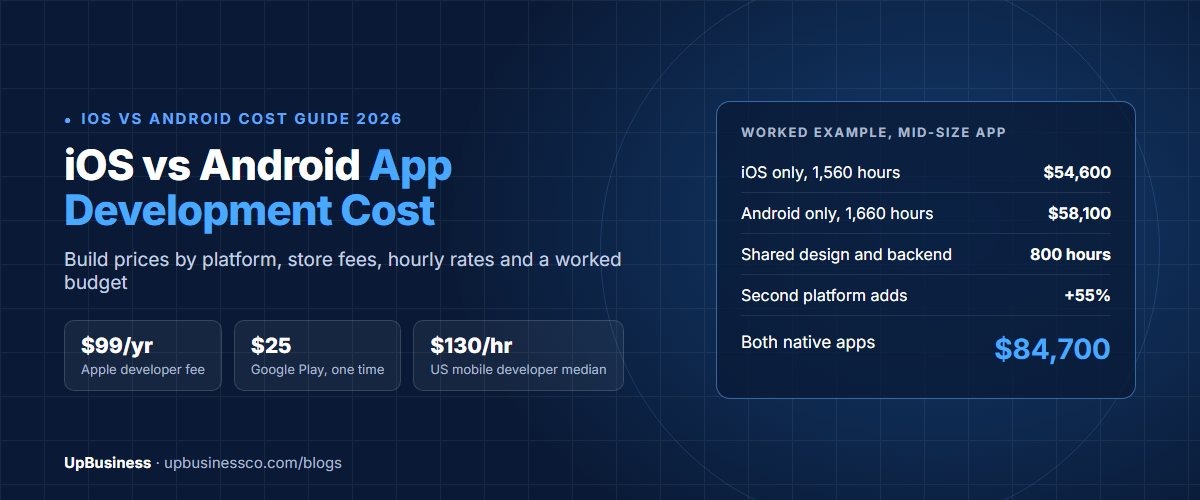
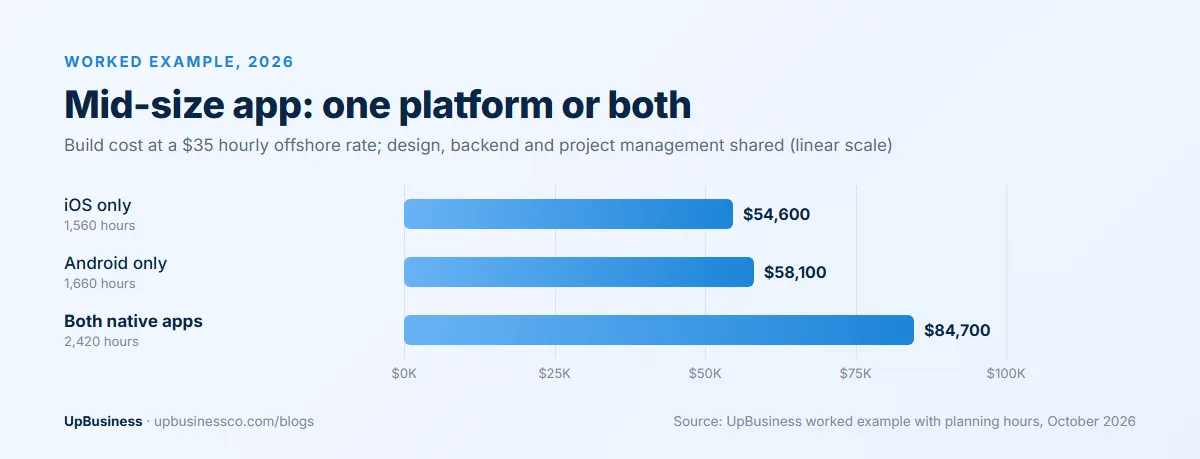
- In our worked example, a mid-size app costs about $54,600 on iOS only, $58,100 on Android only and $84,700 for both native apps, at a $35 hourly offshore rate.
- Adding the second platform raised the cost by about 55%, not 100%. Design, backend and project management are shared.
How Much Does iOS App Development Cost in 2026?
Two widely read agency guides put the starting point for a native iPhone app at $10,000 to $20,000. They put the top end past $120,000. One agency guide puts a basic native iOS or Android app at $20,000 to $45,000 per platform. It puts a medium app at $45,000 to $95,000 and a complex one at $90,000 to $170,000 or more[1]. Another gives $10,000 to $120,000 or more for iOS mobile apps[2].
These ranges are wide because they mix very different scopes. They also come from agencies with US or mixed teams. Offshore partner companies often quote below them for the same scope. So the most useful number is not a single price. It is the cost of your own feature list, priced in hours.
| App type | Typical scope | iOS planning range | Android planning range |
|---|---|---|---|
| Basic | Login, profiles, content screens, push notifications, simple API | $20,000 to $45,000 | $20,000 to $45,000 |
| Medium | Payments, subscriptions, maps, chat, admin dashboard | $45,000 to $90,000 | $45,000 to $95,000 |
| Complex | Real-time features, hardware access, AI features, enterprise security | $90,000 to $160,000+ | $90,000 to $170,000+ |
Planning ranges as published in an October 2026 agency comparison[1]. Treat them as US and mixed-team prices. Our worked example later in this guide shows how the same scope prices at an offshore rate.
How Much Does Android App Development Cost Compared With iOS?
Android app development cost is close to iOS for the same features. Where a difference shows up, Android is usually a little more costly to build. There are three reasons, and all come back to testing:
- More devices. Android runs on phones and tablets from many makers, with different screen sizes, chips and custom looks. A team has to decide which devices it supports and then test on them.
- More OS versions in use. Android users update more slowly than iPhone users. So an Android app usually supports more system versions. Each extra version adds tests.
- Manufacturer quirks. Battery savers, background limits and camera behaviour can differ by brand. That adds bug-fixing time that rarely comes up on iOS.
iOS has its own costs. iOS developers often charge more per hour. App Store review can send a build back for changes. And Apple raises its minimum Xcode and SDK version each spring. Since April 28, 2026, every upload to App Store Connect must be built with Xcode 26 and an iOS 26 SDK or later[3]. Google sets a similar rule each August. New apps and updates must now target Android 16 (API level 36)[4].
For most business apps, Android needs a few more build and testing hours. Lower Android developer rates make up part of that. The gap is rarely big enough to pick a platform on cost alone.
Why Do iOS and Android Development Costs Differ?
Here are the specific line items that move when you change platform, and the ones that don't.
| Cost item | iOS | Android | Which costs more |
|---|---|---|---|
| Programming language and tools | Swift, SwiftUI, Xcode (needs a Mac) | Kotlin, Jetpack Compose, Android Studio | Similar; iOS rates often higher |
| Device testing | A few iPhone and iPad families | Many brands, screen sizes and OS versions | Android |
| Store review | Manual review, can reject builds | Mostly automated review, faster | iOS, slightly |
| Yearly platform updates | New Xcode and SDK minimum each spring | New target API level each August | Similar |
| Developer account | $99 a year | $25 once | iOS |
| Design | Apple Human Interface Guidelines | Material Design | Similar |
| Backend, APIs and admin panel | Shared | Shared | Same for both |
Look at the last row. In our worked example below, design, backend and project management make up a third of the two-app budget. They cost the same whichever platform you start with. They are also built once, which is why a second platform rarely costs as much as the first.
What Do iOS and Android Developers Cost Per Hour?
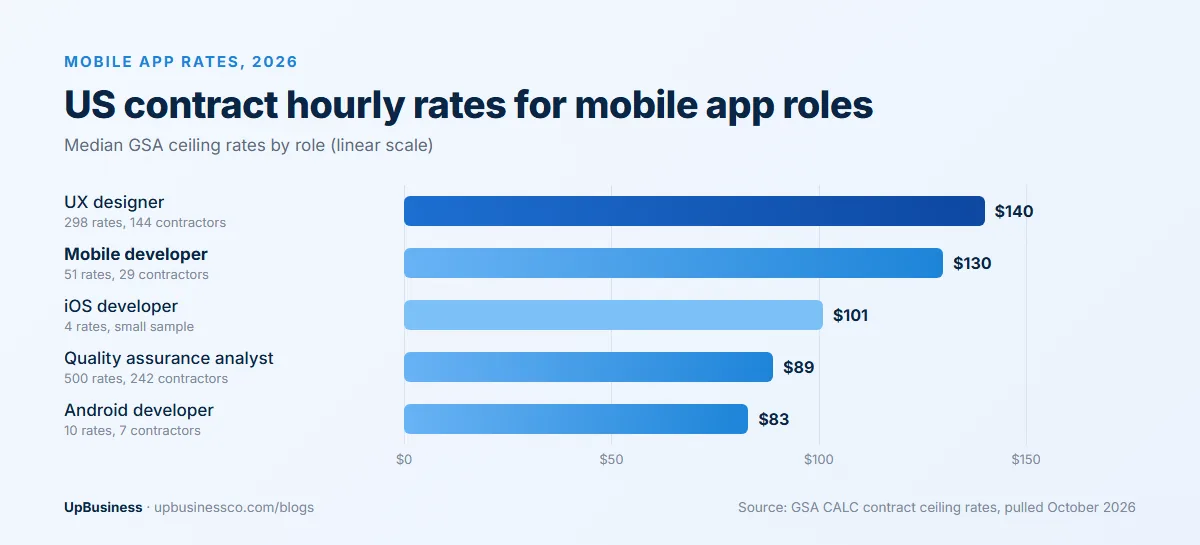
For a US benchmark you can check, we pulled top (ceiling) rates from the US government's GSA CALC database in October 2026[5]. These are the highest hourly rates agreed with federal buyers. Business quotes in the US often land near or below them.
| Role | GSA median ceiling rate | Sample |
|---|---|---|
| Mobile developer and mobile application developer | $130 an hour | 51 rates from 29 contractors |
| UX designer | $140 an hour | 298 rates from 144 contractors |
| iOS developer (title includes iOS) | $101 an hour | 4 rates, too few to rely on |
| Android developer (title includes Android) | $83 an hour | 10 rates from 7 contractors |
| Quality assurance analyst | $89 an hour | 500 rates from 242 contractors |
The samples for each platform are small. So use the combined mobile developer median of about $130 as the US planning rate. Offshore partner companies in India and Eastern Europe usually quote well below it. Our worked example uses $35 an hour as a sample offshore rate. It is not a quote from any company.
Offshore iOS app development costs less mainly because of these hourly rates. The work is the same: the same Swift code, the same App Store rules and the same testing. What changes is how you manage time zones, calls and quality. Our guide to dedicated developers vs project-based teams covers this in detail.
Which Features Cost More on One Platform?
Feature lists are where the two platforms drift apart. Many features cost about the same on both. A few are clearly cheaper or dearer on one side. Ask your partner company to flag these early. They're easy to miss in a first estimate.
| Feature | Extra work on iOS | Extra work on Android |
|---|---|---|
| In-app payments | Apple Pay and StoreKit setup, App Store review of purchase flows | Google Play Billing and Google Pay setup |
| Home screen widgets | WidgetKit, limited interaction | App widgets, more layouts to test across launchers |
| Background tasks and alarms | Strict system limits, careful design needed | Manufacturer battery savers can stop tasks, extra testing |
| Tablets and large screens | iPad layouts if you support iPad | Tablets and foldables if you support them |
| Wearables | Separate watchOS app if needed | Separate Wear OS app if needed |
| Camera and Bluetooth | Consistent hardware, fewer variants | Behaviour can differ by device, more testing |
| Privacy disclosures | Privacy nutrition labels and required reason APIs | Data safety form in Play Console |
Two of these deserve a decision before any quote. The first is tablet support. Supporting iPad or Android tablets properly means extra layouts, design and testing. Leave it out of version one unless your users need it. The second is background work. Apps that track location, sync large files or send time-critical reminders need more engineering on both platforms. On Android that work has to be tested on several brands, because battery settings differ by maker.
Payments are the other common surprise. If your app sells digital content or subscriptions inside the app, both stores require their own billing systems. Each has its own setup and review steps. If it sells physical goods or real-world services, a normal payment gateway works on both platforms. No store commission applies to those sales.
What Do the App Store and Google Play Charge?
Store fees are a small part of the budget. But they differ between the two platforms, and they never go away.
| Fee | Apple App Store | Google Play |
|---|---|---|
| Developer account | $99 a year; $299 a year for the Enterprise Program[6] | $25 one-time registration fee[7] |
| Commission on sales, small developers | 15% for developers in the Small Business Program, which covers those earning under $1 million a year[8] | 15% on the first $1 million of yearly earnings for developers in the 15% tier[9] |
| Commission above $1 million | 30% standard rate | 30% on earnings above $1 million |
| Auto-renewing subscriptions | Covered by the same 15% Small Business Program rate for qualifying developers | 15% regardless of earnings |
Google is rolling out new fees region by region. Both companies have also changed their rules in some countries after court and government rulings. If your app sells digital goods, check the current terms for each market you launch in. Free apps and apps that sell physical goods or services pay no commission at all on those sales.
Which Platform Should You Build First?
If you can only afford one native app at launch, let your users decide, not the build price. StatCounter's September 2026 data shows how differently the two platforms split by market[10].
A consumer app for the US can reasonably start on iOS. One for India, Southeast Asia or Latin America usually starts on Android. A B2B app for a known set of customers should follow the phones those customers already carry. Your own website analytics often show this. If the answer is "both, from day one", the next question is native or cross-platform.
Native Apps for Both Platforms or Cross-Platform?
Building two native apps means two sets of code, two sets of developers and two rounds of testing. A cross-platform framework such as Flutter or React Native lets one codebase serve both platforms for most screens. The second platform then costs less to add. Native still wins for apps that lean hard on the phone's hardware, on features unique to one platform, or on top speed.
We cover that decision, with prices, in our Flutter app development cost guide, including how Flutter compares with native and React Native. This guide stays with native builds. That's where the iOS vs Android cost question really applies.
A Worked Example: One App, One or Two Platforms
To make the comparison concrete, here is a mid-size booking app with accounts, search, payments, push notifications and an admin panel. The hours below are sample planning figures. Your own partner company's estimate will differ.
| Work | Shared | iOS | Android |
|---|---|---|---|
| UX and UI design | 160 hours | ||
| Backend, APIs and admin panel | 480 hours | ||
| Project management | 160 hours | ||
| Native app build | 640 hours | 680 hours | |
| Testing and store release | 120 hours | 180 hours | |
| Total hours | 800 | 760 | 860 |
Android gets 40 more build hours and 60 more testing hours here, for a wider device list. Now price the three options:
| Option | Hours | At $35 an hour (offshore example) | At $130 an hour (US GSA median) |
|---|---|---|---|
| iOS only | 1,560 | $54,600 | $202,800 |
| Android only | 1,660 | $58,100 | $215,800 |
| Both native apps | 2,420 | $84,700 | $314,600 |
Three things stand out. Android only costs about 6% more than iOS only. Adding the second native app adds $30,100 at the offshore rate. That is about 55% more, not double, because the 800 shared hours are paid once. And the choice of team location moves the total far more than the choice of platform. Store fees ($99 a year for Apple, $25 once for Google) barely register.
Ongoing upkeep comes on top of the build, every year, for each platform you ship. Ask for it as a separate line in the quote.
What iOS and Android Partner Companies on UpBusiness Charge
Our iOS app development listing shows 8 companies as of October 2026. Only one of them names iOS app development as a service on its profile. Here is what it reports:
| Partner company | City | Team size | Average project size | TrustScore | Share of work in iOS |
|---|---|---|---|---|---|
| Capsquery Private Limited | Kolkata | 1-10 | $1,000 | 75.0 | 25% |
The $1,000 figure is an average across all of its projects, not a minimum price. One company is too small a sample for a market median, so use the worked example above to set your budget.
Our Android app development listing shows 7 companies with broader software and app work. None of them names Android app development on its profile yet. So we have no Android price data from these companies to share. Before you hire any company, ask for two or three native Android apps it has shipped.
How does that compare with the published ranges? Here's the side by side:
| Benchmark | Basic app | Typical figure | What it reflects |
|---|---|---|---|
| Published agency guides | $20,000 to $45,000 per platform | $45,000 to $95,000 for a medium app | US and mixed teams, full native builds |
| Our worked example, offshore | $54,600 iOS only, $84,700 both | Mid-size app at $35 an hour | |
| UpBusiness iOS partner company | $1,000 average project size | One offshore team; the average covers small jobs and full apps |
The partner figure is far lower than a full new build for two reasons. Average project size includes smaller jobs, such as new features, redesigns and app updates. The company also prices at offshore rates. A full native app at medium complexity will still sit well above $1,000. Use the listings to shortlist, then compare written estimates for your own scope.
How to Get Comparable iOS and Android Quotes
Quotes for the same app can differ by three or four times. Often the gap comes from what each quote leaves out. Before you compare numbers, ask every partner company to price the same things:
- Platforms and versions. iOS only, Android only or both, plus the oldest OS version and the device list each platform will support.
- Native or cross-platform. If one company quotes native and another quotes Flutter, you're comparing two different products.
- Backend included or not. A low app quote often assumes you already have the APIs and admin panel.
- Hours by role and platform. List iOS, Android, backend, design, testing and project management hours separately. Then you can see where each platform's money goes.
- Store release work. Developer account setup, App Store and Google Play listings, privacy forms and handling a rejected review.
- Warranty and upkeep. A fixed bug-fix period after launch, then a separate yearly figure for each platform.
- Code and account ownership. Source code, signing keys and both store accounts should be in your company's name.
Our guides to comparing software development proposals and software development contracts go further on both points. If you're testing an idea before a full build, the MVP development cost guide shows how to keep version one small. For the overall cost of building and hiring for apps in India, see our mobile app development cost guide.
When your scope is ready, you can post your project brief and get matched with partner companies that build iOS and Android apps.