


Browse our curated list of App Maintenance Companies
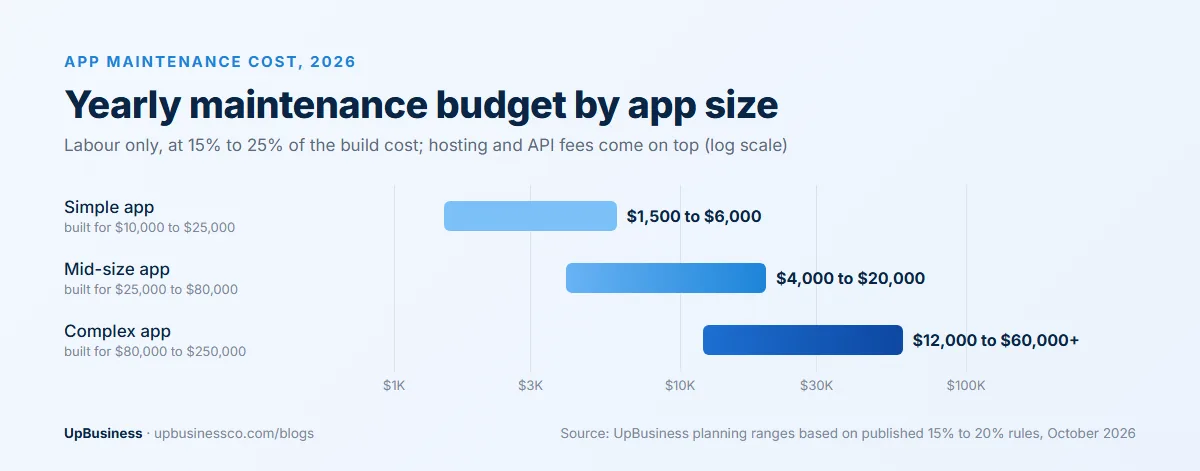
App maintenance cost in 2026 is usually 15% to 25% of what the app cost to build, every year. Servers and paid services come on top. For a simple app that means roughly $1,500 to $6,000 a year. A mid-size app with accounts, payments and a backend lands between $4,000 and $20,000. A complex app with real-time features or regulated data often needs $12,000 to $60,000 or more.
Those numbers surprise many app owners, because the build quote rarely mentions them. Apple and Google change their rules every year. Phones get new systems. The services an app uses change their prices. An app nobody touches for a year can still be downloaded. On Android, though, it slowly drops out of reach for new users. On iOS it can't ship a fix until someone updates the build tools. This guide shows what maintenance covers and which deadlines force the work. It also shows what it costs per hour and per year, and how to buy it from a partner company.
Key takeaways
- Plan for 15% to 25% of the build cost a year in maintenance labour, plus hosting, monitoring and API fees on top.
- Store rules set the calendar. Apple has required Xcode 26 and the iOS 26 SDK for uploads since April 28, 2026. Google Play has required new apps and updates to target Android 16 (API level 36) since August 31, 2026.
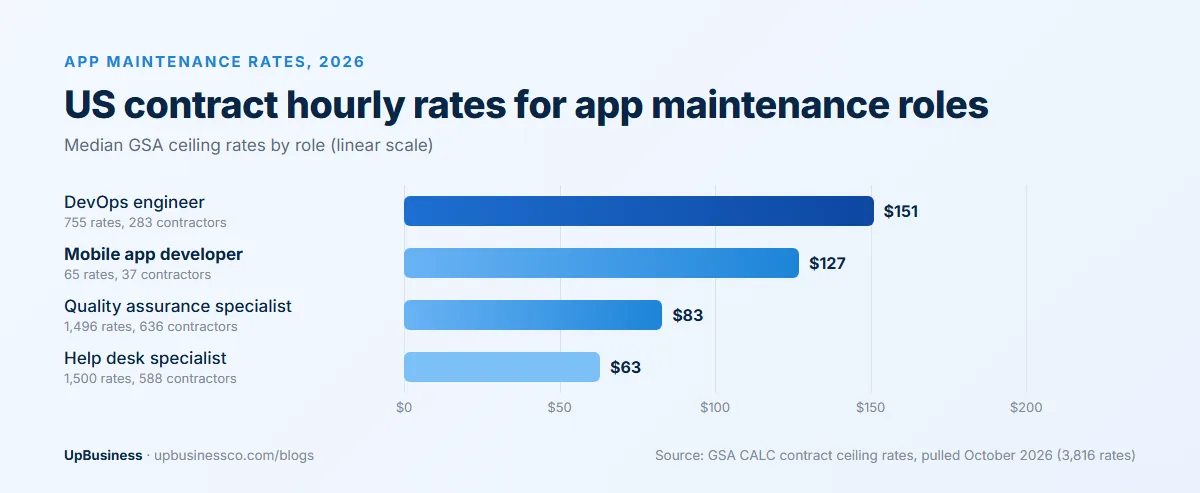
- US federal contract data puts mobile app developers at a median ceiling rate of $127 an hour. The same maintenance hours cost far more at US rates than at offshore rates.
- Our UpBusiness app maintenance listing shows 7 companies, but none names app maintenance on its profile yet. Ask any company for proof of apps it supports.
How Much Does App Maintenance Cost in 2026?
Many development firms' guides, in the US and India alike, use the same planning rule. It puts yearly maintenance at 15% to 20% of the original build[1]. We use a slightly wider band of 15% to 25%. Apps with many links to other services, or a backend the same team runs, sit at the top of the range. The table turns that rule into yearly and monthly budgets. The build bands are only a guide. Our mobile app development cost guide covers build prices in detail.
| App size | Typical build budget | Yearly maintenance (labour) | Monthly equivalent |
|---|---|---|---|
| Simple (a few screens, light or no backend) | $10,000 to $25,000 | $1,500 to $6,000 | $125 to $500 |
| Mid-size (user accounts and payments on iOS and Android, with its own backend) | $25,000 to $80,000 | $4,000 to $20,000 | $330 to $1,670 |
| Complex (real-time features, many integrations or regulated data) | $80,000 to $250,000 | $12,000 to $60,000+ | $1,000 to $5,000+ |
Running costs come on top of the labour figure. A small app's hosting, monitoring and API bills can be under $100 a month. A busy app with media, maps and a large database can spend thousands. The first year after launch usually costs more than later years. Real users find bugs that testing missed. The team ships several quick fixes in the first few months.
What Does App Maintenance Include?
Maintenance is everything needed to keep a live app working, safe and accepted by the app stores. It isn't new features. But many contracts let you spend part of the hours on small improvements. The work falls into four groups.
| Type of work | What it covers | How often |
|---|---|---|
| Corrective | Fixing crashes and bugs reported by users or crash monitoring | Weekly to monthly |
| Adaptive | Updating the app for new iOS and Android versions, new devices, new SDK rules and third-party API changes | Every year, at fixed dates |
| Preventive | Updating libraries, patching security issues, renewing certificates, cleaning up code that slows the team down | Monthly to quarterly |
| Perfective | Small usability fixes and performance work based on analytics and store reviews | As hours allow |
Many apps also have a backend behind them, with servers, databases, APIs and an admin panel. If the same partner company runs it, uptime checks, backups and server updates belong in the maintenance scope too. Websites have their own version of this work, covered in our guide to website maintenance cost.
Which Apple and Google Deadlines Drive App Maintenance Cost?
Adaptive work is the part you can't skip, because the app stores set the dates. Both companies publish their rules, and both raise the bar every year.
| Store | Requirement | Since |
|---|---|---|
| Apple App Store | Apps uploaded to App Store Connect must be built with Xcode 26 or later using the iOS 26 SDK (or the matching iPadOS, tvOS, visionOS or watchOS 26 SDK) | April 28, 2026 |
| Apple App Store | iOS and iPadOS apps uploaded must target iOS 13 or later | September 9, 2026 |
| Apple App Store | Answers to the updated age rating questions needed to avoid interruptions when submitting updates | January 31, 2026 |
| Google Play | New apps and app updates must target Android 16 (API level 36) or higher | August 31, 2026 (extension available to November 1, 2026) |
| Google Play | Existing apps must target Android 15 (API level 35) or higher to stay available to new users on newer Android versions | August 31, 2026 |
Sources: Apple's upcoming requirements page[2] and Google's target API level requirements[3]. Apple has raised the minimum Xcode and SDK version each spring. Google sets a new target API level each August. Expect a similar round in 2027.
What does this mean in money? Moving to a new SDK or target API level is rarely a one-line change. New privacy rules, permission changes and retired APIs have to be handled and tested on real devices. Budget a fixed block of hours for it each year, per platform. Don't treat it as a surprise. Apps built with a cross-platform framework still need this work. The framework and its plugins have to be updated first. Our Flutter app development cost guide explains how that trade-off plays out.
The penalty for skipping it is real. On Google Play, an existing app that targets Android 14 or lower is only offered to devices running that Android version or older[3]. New users on current phones won't see it in the store. On iOS, you can't upload a bug fix or update until the app builds with the required Xcode version.
Running Costs Outside the Maintenance Fee
A maintenance quote from a partner company normally covers people's time. The bills below usually go to you directly. Ask each partner company if its quote includes any of them.
| Item | Typical cost | Notes |
|---|---|---|
| Apple Developer Program | $99 a year ($299 for the Enterprise Program) | Required to publish and update iOS apps[4] |
| Google Play developer account | $25, one time | Paid once at registration[5] |
| Cloud hosting, database and storage | From under $50 to thousands a month | Grows with users, media and data kept |
| Crash and error monitoring | Free tiers; Sentry Team from $26 a month billed annually | Needed to find bugs before users report them[6] |
| Push notifications | Firebase Cloud Messaging is listed as no-cost | Paid alternatives charge by volume[7] |
| Maps, SMS, payments and other APIs | Usage based | Prices and free allowances change |
Third-party price changes are easy to miss when you budget. Google Maps Platform is one example. From March 1, 2025 it swapped its $200 monthly credit for free usage limits on each product[8], That raised bills for some apps and lowered them for others. Keep a list of every paid service the app uses, with the account owner and the renewal date.
How Much Do App Maintenance Services Cost Per Hour?
Maintenance is usually bought by the hour, either directly or inside a monthly fee. For a US benchmark you can check, we pulled top rates from the US government's GSA CALC database in October 2026[9]. These are the highest hourly rates agreed with federal buyers. Business quotes in the US often land near or below them.
| Role | Median US ceiling rate | Middle half of rates | Rates in sample |
|---|---|---|---|
| Mobile app developer | $127 an hour | $92 to $153 | 65 rates from 37 contractors |
| DevOps engineer | $151 an hour | $121 to $181 | 755 rates from 283 contractors |
| Quality assurance specialist | $83 an hour | $70 to $91 | 1,496 rates from 636 contractors |
| Help desk specialist | $63 an hour | $52 to $73 | 1,500 rates from 588 contractors |
Offshore partner companies usually quote well below these rates. At the $35 example rate used in the budget below, an hour costs under a third of the US median for mobile developers. The rate isn't the whole picture, though. A cheaper team can cost more in the end. It may need twice the hours to learn your code, or change developers every few months. Ask who will work on your app and whether they also built it.
Should you hire an in-house developer instead? One full-time mobile developer covers one skill set, takes holidays and needs managing. A partner company gives you mobile, backend, testing and DevOps skills in one contract. You pay only for the hours you use. In-house makes sense when the app needs a full-time person on new features anyway. Our guide to dedicated developers vs project-based teams compares the two models.
How Is App Maintenance Priced?
Partner companies sell maintenance in four main ways. The right one depends on how often your app changes and how fast you need fixes.
| Pricing model | How it works | Good for | Watch out for |
|---|---|---|---|
| Monthly retainer | A fixed fee for a set number of hours and a response time | Live apps with steady users and regular small changes | Unused hours that expire each month |
| Prepaid hour bank | You buy a block of hours, used as needed | Stable apps with few changes | Slower response, since you aren't a retainer client |
| Per ticket or per fix | Each issue is quoted and paid separately | Very small apps | No one watches the app between tickets |
| Fixed annual plan | One yearly price covering a defined scope, often including the OS update | Owners who want one predictable number | Tight scope lists; anything outside costs extra |
For a typical business app, we'd pick a retainer with a modest number of hours. Add a separate quote for the yearly Apple and Google update. That keeps the same people on your code and still makes the big yearly job easy to see.
A Worked Yearly Budget for a Mid-Size App
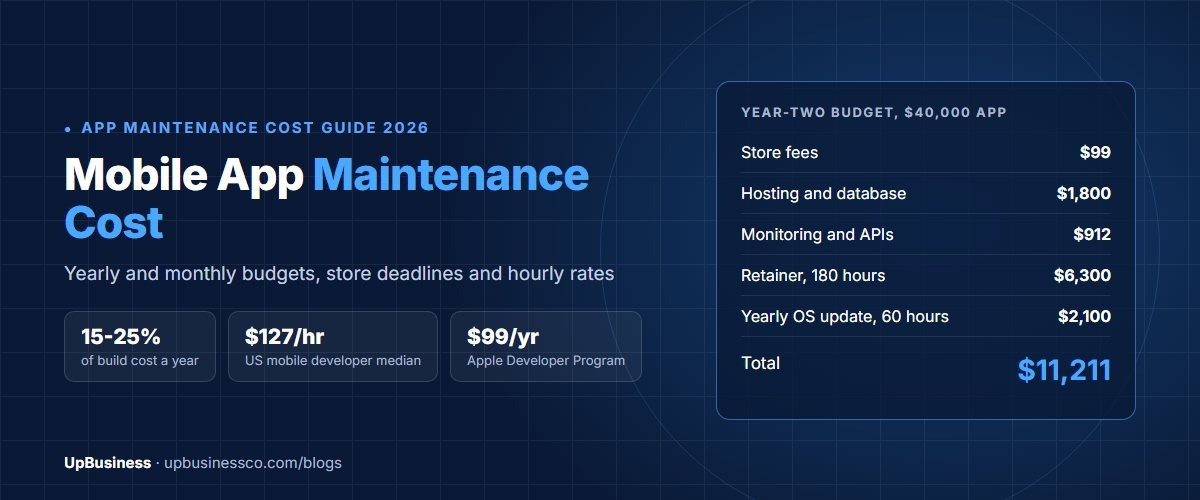
Here is a year-two budget for a typical business app. It was built for $40,000 by a partner company and runs on iOS and Android, with user accounts, a cloud backend and a map screen. The hosting, API and hourly figures are examples to show the method. Swap in your own numbers.
| Line item | Assumption | Yearly cost |
|---|---|---|
| Apple Developer Program | Standard membership | $99 |
| Google Play | One-time fee already paid at launch | $0 |
| Cloud hosting and database | $150 a month | $1,800 |
| Error monitoring | Sentry Team, billed annually | $312 |
| Push notifications | Firebase Cloud Messaging | $0 |
| Maps and other paid APIs | $50 a month | $600 |
| Partner retainer | 15 hours a month at an example offshore rate of $35 | $6,300 |
| Yearly iOS and Android update | 60 hours at $35 | $2,100 |
| Total | $11,211 |
The labour lines come to $8,400. That's 21% of the build cost, inside the usual 15% to 25% band. Add the running costs and the total is about 28% of the build. If the same 240 hours were bought at the US GSA median for mobile developers of $127 an hour, labour alone would be $30,480. The year would cost about $33,300.
Two things move this budget more than anything else. The first is users, because hosting and API bills follow traffic. The second is change. If you keep adding features, those hours belong in a separate budget, not in maintenance. Teams still testing an early version should read our MVP development cost guide, Looking after a product that is still changing shape is a different job.
App Maintenance Partner Companies on UpBusiness
Our app maintenance companies listing shows 7 companies as of October 2026. They do broader software and app work. None of them names app maintenance as a service on its profile yet. So we have no maintenance price data from these companies to share.
A company may still support live apps without listing the service. Before you hire any company, ask for two or three apps it has maintained for at least a year. Ask how it handled the last Apple and Google deadlines for those apps.
What do published guides quote? The table puts them side by side.
| Source | What it says | How to read it |
|---|---|---|
| US development firm guide | $5,000 to $120,000 or more a year, depending on complexity[10] | Covers everything from simple apps to large platforms; mostly US rates |
| Regional agency guide | About $5,000 to $15,000 a year for a simple app and $50,000 to $150,000 or more for a complex one[11] | Upper figures reflect UK and US rates |
| Development firm rule of thumb | 15% to 20% of the build cost each year[1] | Labour only; add running costs |
The pattern is clear. A $10,000 yearly maintenance budget buys a solid retainer for a mid-size app from an offshore partner company. The same money at US rates covers about 80 hours. That is barely enough for the yearly platform update and a handful of fixes.
Does iOS or Android Cost More to Maintain?
Neither is cheaper by default. Android apps have to be tested on more devices and screen sizes. The yearly target API change often touches permissions and background work. iOS has fewer devices. But Apple's yearly Xcode and SDK rule, its review process and the $99 yearly fee are fixed. An app on both platforms needs both rounds of work every year. If you only support one platform today, ask the partner company for a separate quote per platform. Then you can see the split. You can also compare companies on our iOS app development and Android app development listings.
What to Put in an App Maintenance Contract
A good maintenance contract tells you what you get, how quickly problems are handled and what you own. Check for these points before you sign.
- A list of covered work (bug fixes, OS and SDK updates, library and security updates, backend upkeep) and a list of what isn't covered, such as new features.
- Response times. A crash that stops users logging in or paying needs a faster target than minor issues. Ask if weekends count.
- The hours included in the fee, whether unused hours roll over and what extra hours cost.
- Ownership. The Apple Developer and Google Play accounts, the code repository, cloud hosting and every paid API should belong to your company, with the partner added as a user.
- App signing keys and logins kept where you control access. Losing them can stop you from updating your own app.
- A short monthly report covering work done, hours used and the next store deadlines.
- Exit terms, meaning the notice period, handover of code and documentation, and a few hours of help for the next team.
Our software development contract checklist covers ownership, payment and exit clauses in more detail.
How to Lower App Maintenance Cost Without Cutting Corners
- Keep the team that built the app if you can. The people who wrote the code fix it fastest. If you do switch partners, a short paid code review first saves hours later.
- Start the Apple and Google work as soon as the new rules are announced, not in the last week before the deadline.
- Turn on crash monitoring and fix the crashes that hit the largest number of users first.
- Drop screens and plugins nobody uses. Each one has to be updated every year. Your analytics will show which ones are safe to remove.
- Check hosting, maps and messaging bills once a year and change plans when your traffic changes.
- Keep new features in a separate budget from maintenance, so you can see what keeping the app alive really costs.
Getting Accurate App Maintenance Quotes
You can only compare quotes if every partner company sees the same details. Share the platforms and frameworks used, the backend and where it's hosted, and the list of third-party services. Add monthly active users, the crashes and bug reports from the last three months and the response time you need. Then lay the replies side by side using our guide to comparing software development proposals.
If you'd like quotes from partner companies, post your app maintenance project on UpBusiness with your app details and budget, and we'll match you with companies that fit. You can also browse the app maintenance companies listing, ranked by TrustScore.