


Browse our curated list of AI Development Companies
An AI RFP template is a ready-made outline for a request for proposal that you send to AI development companies before you hire one. It covers the usual project details, such as goals, scope, budget and dates. It also covers what makes AI work different: the data you have, how answers will be tested, how your data is protected and who owns the model at the end. A clear AI RFP gets you proposals you can compare side by side, instead of five quotes for five different projects.
This guide gives you a 12-section template you can copy, the questions to ask every bidder, a scoring sheet and a filled-in example for a customer support assistant. It also covers what the US government now requires in its own AI contracts, because those rules make a good checklist for any buyer.
Key takeaways
- An AI RFP needs everything a software RFP has, plus four extra parts: your data, how success will be measured, data protection and ownership of models and outputs.
- Describe the problem and the result you want. Don't prescribe the model or the architecture, or you'll get worse proposals.
- Ask every bidder to test their approach on a small sample of your real data before you pick a winner.
- Put in writing that the company can't train its own models on your data, and that you can take your data, code and prompts with you if you leave.
- Score proposals with fixed weights you decide before you open them. Price should rarely be more than 20% of the score.
What Is an AI RFP?
A request for proposal (RFP) is a document that tells companies what you need and asks them to reply with a plan and a price. For a normal software project, the RFP describes features, screens and deadlines. The company can usually tell from that what it will build.
AI projects are less predictable. Two teams can build the same chatbot and get very different results, because quality depends on your data, the model, the prompts and how answers are checked. An AI RFP has to describe what "good" looks like and how it will be measured, not just what to build.
That's why a general software project brief isn't enough on its own for AI work. Use it as the base and add the AI sections below.
When You Need a Full RFP, and When a Brief Is Enough
Not every AI project needs a formal RFP. A full document takes a week or two to write and gives bidders two to four weeks to reply. Use it when:
- The project is large enough that a wrong choice would hurt, such as anything over about $25,000.
- The AI will touch customer data, money or decisions about people.
- Your company's buying rules require competing quotes.
- You'll compare four or more companies.
For a small proof of concept with two or three companies, a two-page brief built from the same sections is usually enough. Keep the data, evaluation and ownership parts either way. Those are the parts that cause trouble later.
AI RFP Template: 12 Sections to Include
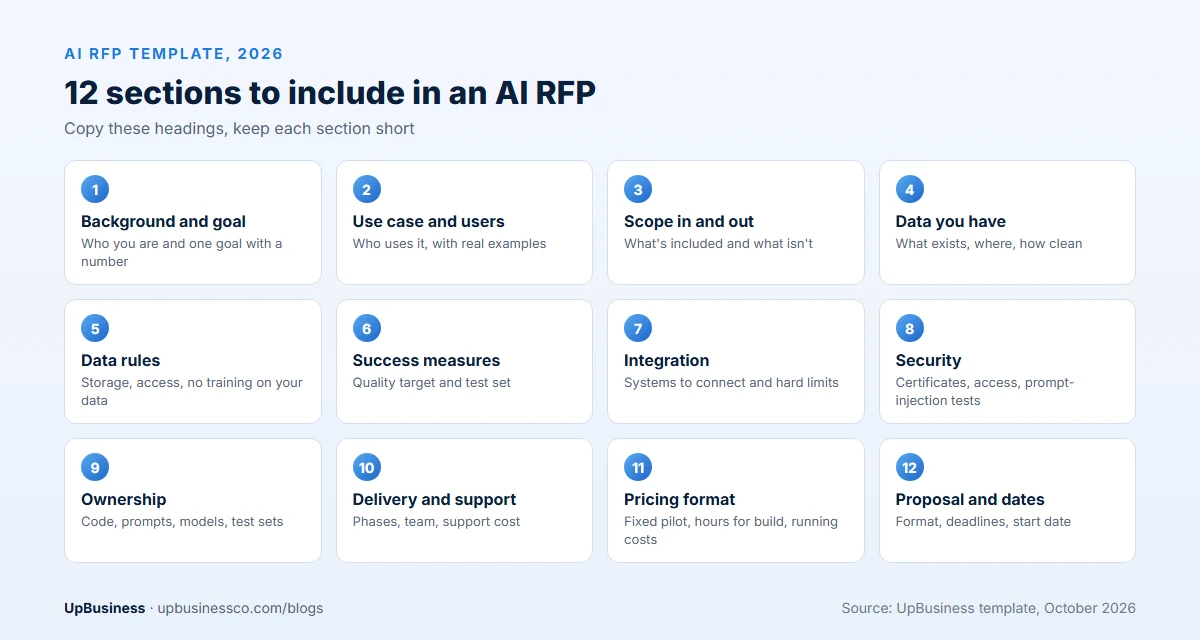
Copy these sections into your own document. Under each one, we list what to write and what to ask for. Keep each section short. Bidders read long RFPs quickly, and the important parts get lost.
1. Background and goal
Write three or four short paragraphs. Who you are, what you sell, how big you are and why this project matters now. Then state one business goal with a number, such as "cut average support reply time from 9 hours to 1 hour" or "reduce manual invoice checks by 60%".
2. Use case and users
Describe who will use the AI and what they'll do with it. Give three to five real examples of tasks, questions or documents. Real examples help bidders more than any long description.
3. Scope: in and out
List what's included, such as a web chat assistant, an admin screen and a link to your help desk. Then list what's not included, such as voice, other languages or mobile apps. A clear "out of scope" list stops price surprises later.
4. The data you have
Be honest here. Say what data exists, where it lives, how much there is and how clean it is. For example: "4,200 help articles in Zendesk, 18 months of tickets, about 30% of articles out of date." If you don't have labelled data, say so. A good company will plan and price the clean-up.
5. Data rules and privacy
State what data can leave your systems, where it may be stored and who may see it. Ask bidders to confirm in writing that neither they nor their AI providers will use your inputs or outputs to train other models. Name any rules you must follow, such as HIPAA for health data or GDPR for European customers.
6. Success measures and evaluation
This is the heart of an AI RFP. Say how you'll judge quality, with numbers. For example: "At least 85% of answers rated correct on a test set of 200 real questions, and no answer that invents a refund policy." Ask each bidder how they'll build the test set, how often they'll run it and what happens if results drop after launch.
7. Integration and technical limits
List the systems the AI must connect to, such as your CRM, help desk or database, and how. Mention any limits, such as "must run in our AWS account" or "no customer data may go to servers outside the US". Leave the choice of model and architecture to the bidder, unless you have a firm reason.
8. Security and compliance
Ask for the bidder's security practices, access controls and how they handle secrets and logs. Ask which certificates they hold, such as ISO 27001 or a SOC 2 report, and ask how they test for prompt injection, where a user tries to trick the AI into ignoring its rules.
9. Ownership, licences and portability
State that you own the code, prompts, fine-tuned models, test sets and outputs made for you. Ask bidders to list any tools or code they'll reuse and under what licence. Ask how you'd move to another company or provider if you needed to, and what they'd hand over.
10. Delivery plan, phases and support
Ask for a phased plan. A common shape is discovery, a small pilot, a full build and then support. Ask what each phase delivers, how long it takes and who on their team does the work. Ask what support after launch includes and what it costs each month.
11. Pricing format
Ask every bidder to price in the same format, so you can compare. Ask for a fixed price for discovery and the pilot, then an estimate in hours and rates for the full build. Ask them to list running costs separately: model usage, hosting and support. AI running costs can be larger than the build over two or three years.
12. Proposal format and timeline
Tell bidders exactly what to send: a page limit, the headings to use, two client references and a named team. Give a question deadline, a reply deadline with a time zone, the date you'll pick a winner and the planned start date.
Who Should Write and Sign Off the RFP
An AI RFP is not just an IT document. The best ones are written by a small group of three or four people, each owning part of it.
- A business owner writes the goal, the users and the success measures. This is usually the head of the team that will use the AI.
- A technical lead writes the data, integration and security sections. If you don't have one, a short paid session with an independent adviser is worth it.
- Someone from legal or finance reviews the ownership, data protection and pricing sections before the RFP goes out.
- One named contact answers bidder questions, so every company hears the same thing.
Agree who makes the final decision before you send the RFP. Projects stall when three people each think they have the last word. Share all questions and answers with every bidder, not just the one who asked. It keeps the process fair, and it stops a bidder winning because it got extra information.
Questions to Ask Every AI Bidder
Add these to section 12 and ask bidders to answer each one directly. Vague answers are a warning sign.
- What similar AI project have you delivered, and can we speak to that client?
- Who exactly will work on our project, and what has each person built before?
- How will you test answer quality, and what score do you expect on our sample data?
- What happens when the AI gives a wrong answer? How is it caught and fixed?
- Which AI models and providers will you use, and why? What would it take to switch?
- What will the system cost to run each month at our expected volume?
- How do you keep our data out of model training, and can you put that in the contract?
- What will you hand over at the end, and in what format?
Our list of questions to ask an AI development company goes deeper on each of these.
How to Score AI Proposals
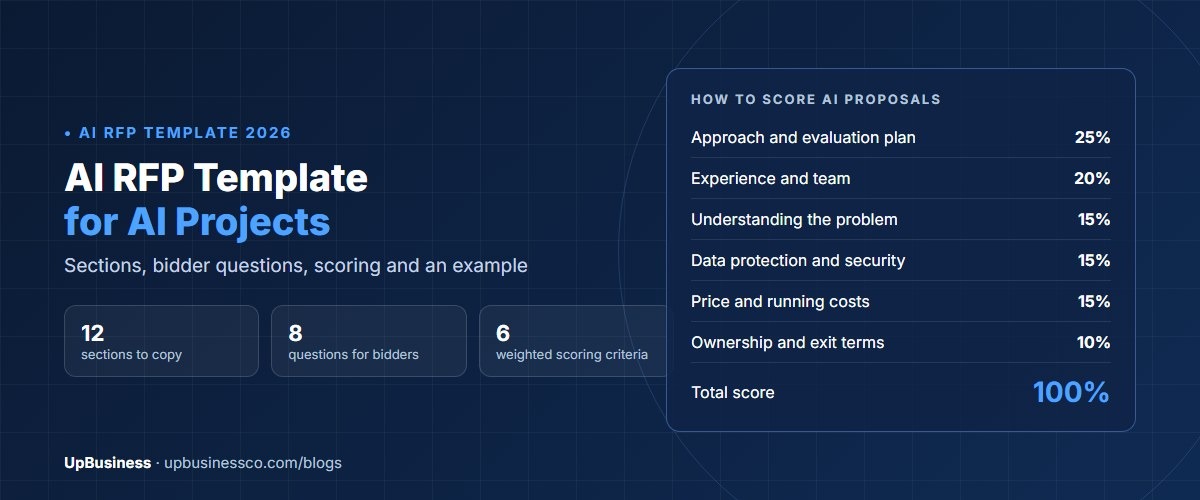
Decide your scoring weights before you open a single proposal. Otherwise the most polished pitch tends to win. Here's a starting point you can adjust.
| Criterion | Weight | What a strong answer looks like |
|---|---|---|
| Understanding of the problem | 15% | Restates your goal in their own words and spots risks you missed |
| Approach and evaluation plan | 25% | Clear test set, quality targets and a plan for when results drop |
| Relevant experience and team | 20% | Similar projects, named people and references you can call |
| Data protection and security | 15% | No training on your data, clear access rules, a tested security process |
| Ownership and exit terms | 10% | You own code, prompts, models and test sets; a clear handover |
| Price and running costs | 15% | Build and monthly costs both shown, in your requested format |
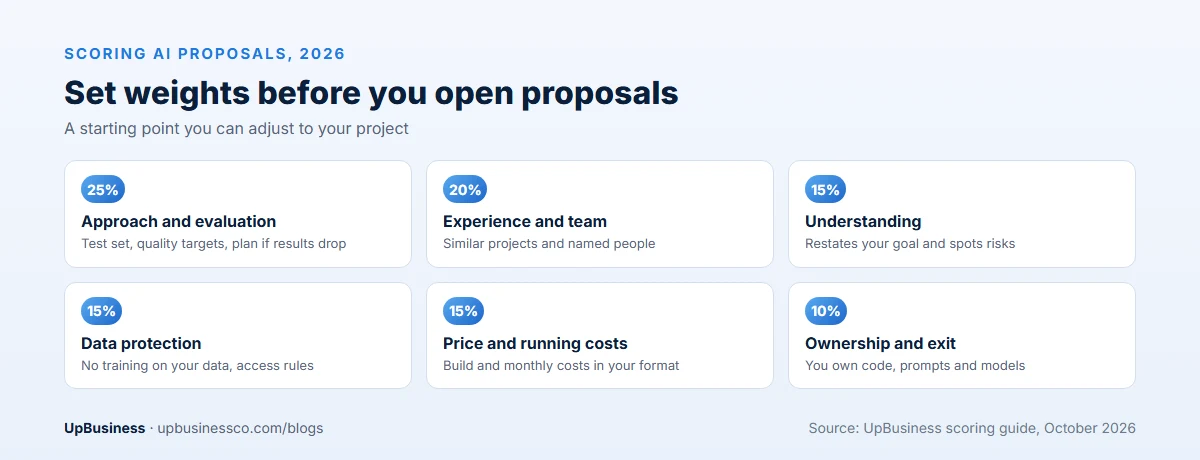
Score each proposal on its own first, then compare. Shortlist two or three, and ask each to run a short paid test on a sample of your data. A one or two week test usually tells you more than the whole written proposal. Our guide to comparing software development proposals covers how to line up quotes that look nothing alike.
What the US Government Asks For in AI Contracts
In April 2025, the White House budget office issued memo M-25-22 on how US federal agencies should buy AI[1]. You don't have to follow it as a business. But it's a useful checklist, because it was written to stop the problems buyers run into most. It asks agencies to:
- Agree ownership and IP rights up front. Contracts should clearly set out who owns what, especially where the buyer's data is used to train or fine-tune a model.
- Ban training on the buyer's data. Contracts should permanently stop the supplier using the buyer's non-public inputs and outputs to train AI models without consent.
- Avoid lock-in. It names knowledge transfer, data and model portability, clear licence terms and open pricing as ways to avoid getting stuck with one supplier.
- Test before buying. Agencies should test proposed solutions where they can, to see what they actually do.
- Keep testing after launch. Contracts should allow ongoing testing and monitoring, with results detailed enough to check independently.
Each of these maps to a section of the template above: sections 5, 6, 9 and 11. If your RFP covers them, you're asking for what one of the largest buyers in the world asks for.
Standards and Rules Worth Mentioning
You don't need to be an expert in AI law to write a good RFP. But naming the right framework tells bidders you'll check their work.
- NIST AI Risk Management Framework. A free, voluntary US framework released in January 2023, built around four functions: govern, map, measure and manage[2]. You can ask bidders how their process lines up with it.
- NIST Generative AI Profile (AI 600-1). Published in July 2024, it applies the same framework to generative AI, such as chatbots and content tools[3].
- EU AI Act. Rules for general-purpose AI models have applied since 2 August 2025. Rules for AI used in certain high-risk areas, such as hiring or credit, now apply from 2 December 2027[4]. If you serve customers in the EU, ask bidders how they'll help you meet these.
- ISO/IEC 42001. A standard for running an AI management system. Few smaller firms are certified yet, so treat it as a plus, not a must.
Common Mistakes in AI RFPs
- Naming the model. "Must use GPT" or "must fine-tune Llama" limits good options. Describe the result and let bidders propose.
- No real data. Without sample data, bidders guess, and every quote carries a big safety margin.
- No quality target. If you don't say what "good enough" means, nobody can prove they delivered it.
- Asking for one fixed price for everything. AI work changes as you learn. Fix the price of discovery and the pilot, then price the rest once both sides know more.
- Forgetting running costs. A cheap build with high monthly model and hosting costs can cost more over two years than a pricier build.
- No exit plan. If you can't take your prompts, test sets and data elsewhere, you're tied to one company.
Example: A Filled-In AI RFP Summary
Here's how the template looks for a mid-size online retailer that wants an AI assistant for customer questions. It fits on one page, and each line points to a fuller section in the RFP.
| Section | What the retailer wrote |
|---|---|
| Goal | Answer 40% of order and returns questions without an agent, within 6 months of launch |
| Users | Website visitors and logged-in customers, in English |
| Scope | Web chat assistant, handoff to agents in Zendesk, an admin screen to review answers; no voice |
| Data | 1,100 help articles, order status via an API, 12 months of tickets for testing |
| Data rules | No training on our data by the company or its AI providers; data stays in US data centers |
| Quality target | 90% correct on a 300-question test set; every refund answer quotes the current policy |
| Security | SOC 2 report or equivalent; prompt-injection testing before launch |
| Ownership | We own code, prompts, test sets and configuration; full handover on exit |
| Pricing | Fixed price for discovery and pilot; hours and rates for the build; monthly running cost at 20,000 chats |
| Timeline | Questions by day 10, proposals by day 21, paid test in week 4, start in week 6 |
An assistant like this usually sits on retrieval-augmented generation, where the AI looks up your help articles before it answers. Our RAG chatbot cost guide shows typical build and running costs.
What an AI Project Costs, So You Can Sanity-Check Bids
Prices vary widely with scope, but the hourly rate is a good starting point. On US government contracts, the median ceiling rate for software developers and engineers is about $132 an hour[5]. Offshore partner companies are often far cheaper. Our AI developer rates guide compares rates by country and seniority.
As a rough guide, a discovery phase for a focused AI project often takes 60 to 150 hours. A pilot often takes 200 to 600 hours. If one bid is far below the others, check what it leaves out, such as testing, security or support. If one is far above, ask what the extra pays for.
Find AI Partner Companies on UpBusiness
Once your RFP is ready, you need the right companies to send it to. UpBusiness lists 30 AI partner companies, 16 of them on our AI development page. Each one has passed a five-step check by our team: registration papers, the founder's identity, expertise and three client projects with evidence. Only companies with a TrustScore of 70 or more out of 100 are listed.
- Post your requirement with your goal, budget and timeline. You can attach your RFP.
- Get three partner companies matched to your budget, service and industry.
- Send them your full RFP, compare replies side by side and contact them directly. Buyers pay nothing, and there's no commission.
Not sure your project is ready for an RFP? An AI consulting partner can help you scope it first. And before you sign, run the contract past our software development contract checklist.