
Every AI development company in India now says it builds "agents" or "agentic AI." Some of them do. A lot of them are selling a chatbot with a new label.
That matters, because an AI agent is a real investment. In India, a simple one starts around $3,000–8,000. A production agent connected to your CRM, ERP and payment systems can cost $47,000 or more. Pick the wrong partner and you pay that money for a demo that never goes live.
Because we list and verify AI companies on UpBusiness, we watch a lot of agent projects unfold from the buyer's side. What follows is what we'd tell a friend before they sign anything: what an agent is, what it really costs here, why so many projects die, and how to pick a team that will actually ship.
The short answer
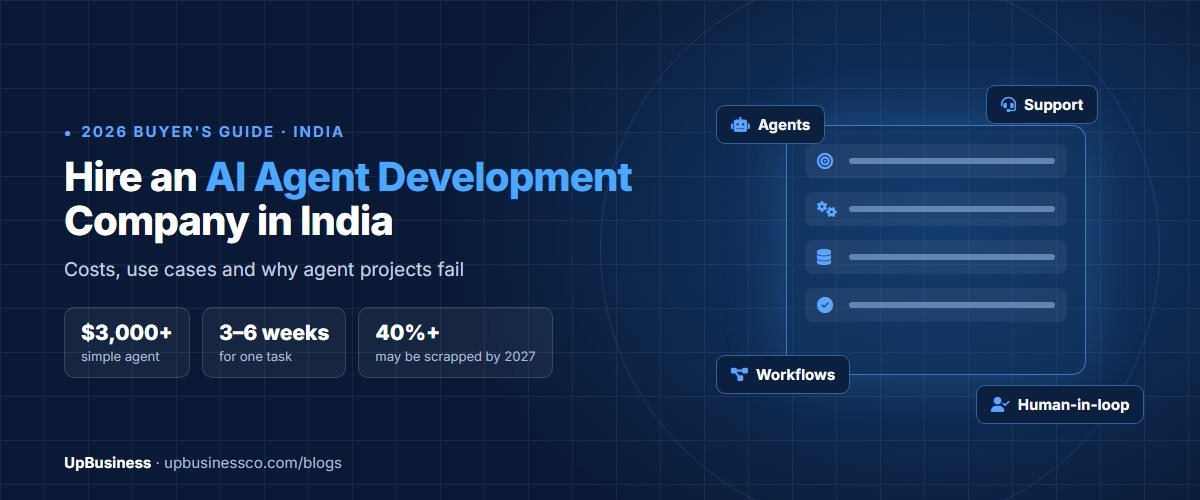
A single-task agent costs roughly $3,000–$8,000 to build in India, and a multi-agent system wired into your business tools costs $25,000–$100,000+. Expect 3–6 weeks for a simple agent and 3–9 months for an enterprise one.
Budget separately for the monthly running cost of model usage, hosting and monitoring, because many quotes leave it out. And know the biggest risk going in: Gartner expects more than 40% of agentic AI projects to be cancelled by the end of 2027, so start with one narrow job you can measure.
All figures are in US dollars and rounded.
What an AI Agent Actually Is

Browse our curated list of AI Agent Development Companies
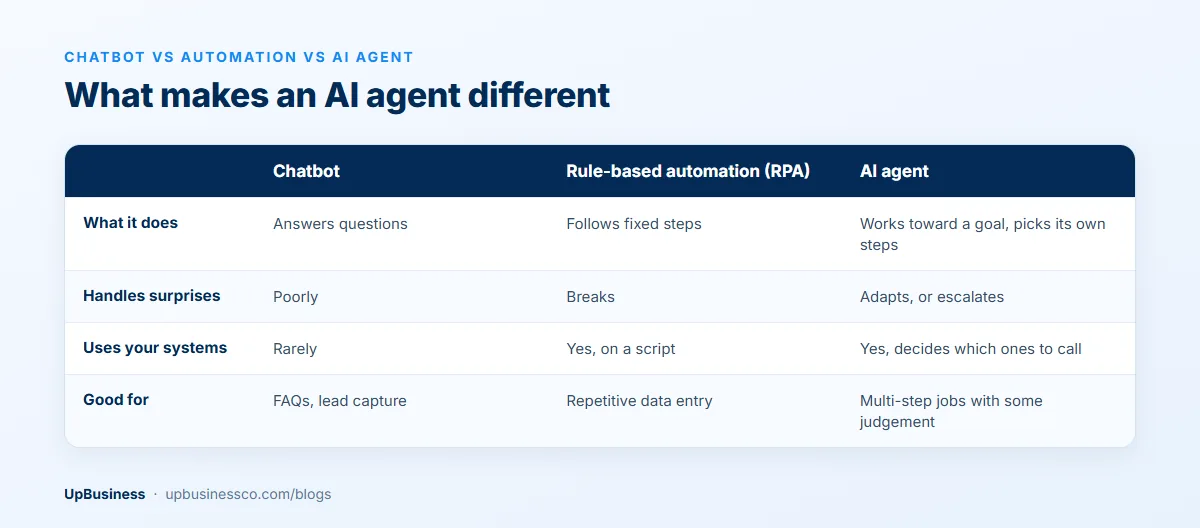
A chatbot answers. An AI agent does the work.
Ask a chatbot "where is my order?" and it tells you the status. Ask an agent the same thing and it checks the courier, sees the parcel is stuck, books a re-delivery, updates your CRM and messages the customer. It plans the steps, uses your tools, and only pulls in a human when it hits something it shouldn't decide alone.
| Chatbot | Rule-based automation (RPA) | AI agent | |
|---|---|---|---|
| What it does | Answers questions | Follows fixed steps | Works toward a goal, picks its own steps |
| Handles surprises | Poorly | Breaks | Adapts, or escalates |
| Uses your systems | Rarely | Yes, on a script | Yes, decides which ones to call |
| Good for | FAQs, lead capture | Repetitive data entry | Multi-step jobs with some judgement |
One honest warning: Gartner calls the relabelling trend "agent washing." It estimates that only about 130 of the thousands of companies claiming agentic AI offer the real thing[1]. If a company's "agent" can't take an action in another system, it's a chatbot.
If you're still deciding between a chatbot and an agent, our guide to AI chatbots in customer service covers the simpler option.
Where Indian Companies Use Agents Today
Adoption is real, but most companies are still early. ServiceNow's 2026 maturity index found that 54% of Indian organisations it surveyed are deploying AI agents, yet only 11% run fully autonomous workflows[2]. In other words, most agents still work with a human checking their output. That's fine. It's usually the right way to start.
An IDC study with UiPath found Indian firms use agents mainly for productivity (69%), personalised customer engagement (59%) and risk and fraud detection (57%)[3]. In practice, these are the jobs we see most.
Customer support comes first: reading tickets, checking orders and refunds, replying in Hindi or English, and handing the hard cases to a person. Sales follow-up is close behind, with agents qualifying leads from IndiaMART, website forms or WhatsApp, updating the CRM and booking demos.
In the finance back office, agents match invoices to purchase orders, flag GST mismatches and chase overdue payments. Operations teams use them to watch stock levels, raise purchase orders and track shipments across couriers. And internal helpdesks use them to answer HR and IT questions from policy documents, raising a ticket when the answer isn't there.
Notice what these have in common. Each one is a single job with a clear finish line. That's where agents earn their money.
What AI Agent Development Costs in India
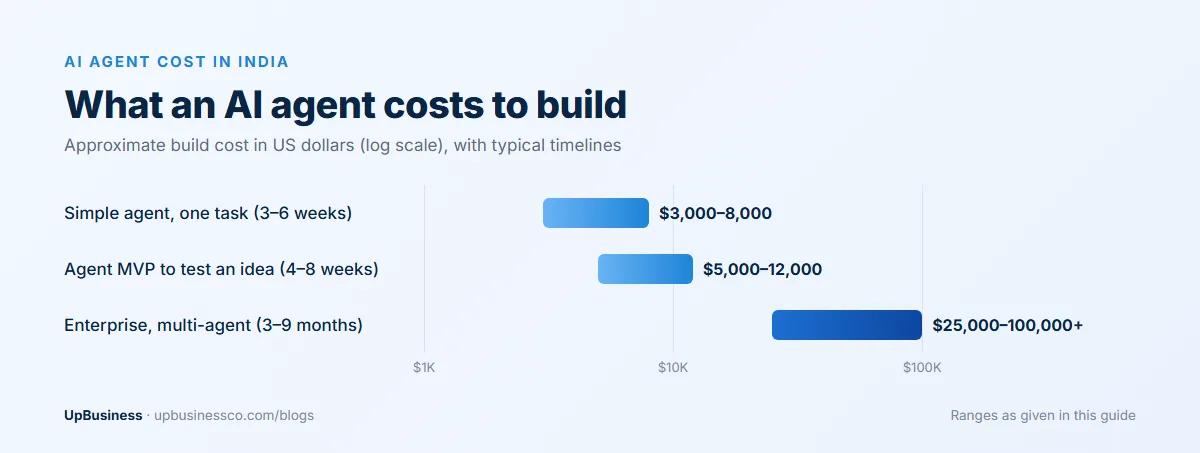
Indian AI developers typically charge $15–$65 an hour, against $100–$200 for similar talent in the US. Here are typical 2026 ranges from Indian development firms[4]:
| Agent type | Build cost | Timeline |
|---|---|---|
| Simple agent, one task | $3,000–$8,000 | 3–6 weeks |
| Agent MVP to test an idea | $5,000–$12,000 | 4–8 weeks |
| Enterprise, multi-agent, integrated | $25,000–$100,000+ | 3–9 months |
If you hire by the hour instead, a mid-level AI agent developer in India costs about $28–$72 an hour[5].
Don't be surprised if you get one quote for $6,000 and another for $60,000 for the "same" agent. Global estimates for building an AI agent run from $15,000 to $400,000, depending on what it has to do[6]. The gap almost always comes down to four things.
The first is integrations, and it's the cost buyers underestimate most. Every system the agent touches (Tally, Zoho, Salesforce, Shopify, a payment gateway) adds build and testing time.
The second is how much the agent decides on its own. One that drafts replies for a person to approve is far cheaper than one that issues refunds by itself. The third is data quality. If your policies live in old PDFs and people's heads, someone has to clean that up first.
The fourth is security and compliance. India's DPDP Rules give companies until 13 May 2027 to meet the full data protection requirements[7], and an agent that reads customer data needs consent, logging and access controls built in.
Then there's the cost nobody puts in the quote: running it. You pay every month for model usage, hosting and monitoring, so ask for it as a separate line item. Ask how they cap spending too, because a badly built agent can get stuck in a loop and burn through API credits overnight.
Why 40% of Agent Projects Get Cancelled
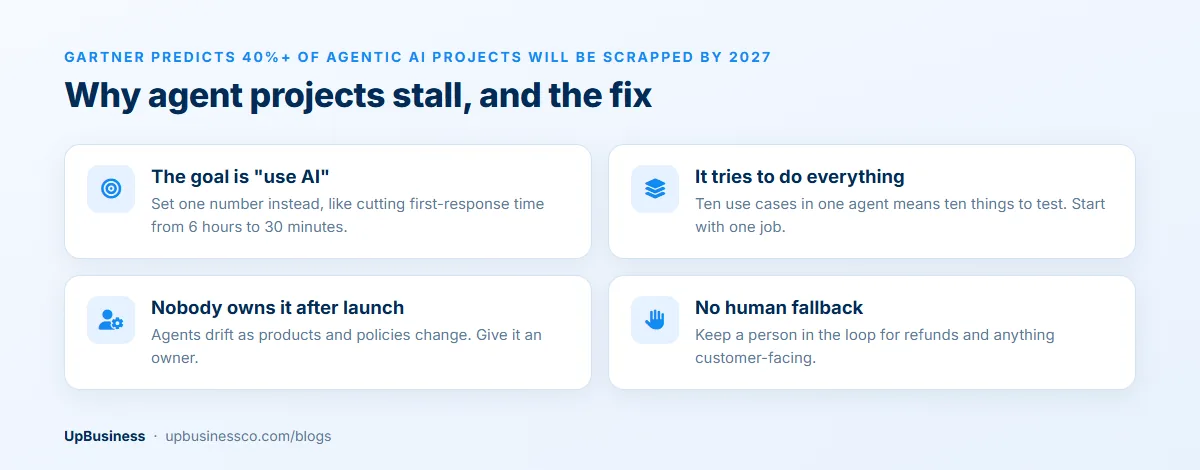
Gartner predicts that more than 40% of agentic AI projects will be scrapped by the end of 2027 because of rising costs, unclear business value or weak risk controls[1]. Its analysts describe most current projects as hype-driven experiments.
That sounds scary, but the reasons are boring and avoidable. From the buyer's side, we see projects stall for the same handful of reasons.
The goal is "use AI" instead of a number. "Cut first-response time from 6 hours to 30 minutes" can be measured. "Automate support" can't. Or the first version tries to do everything, and ten use cases in one agent means ten things to test and nothing finished.
Sometimes nobody owns the agent after launch. Agents drift as your products, prices and policies change, and without an owner, accuracy quietly drops within a few months. Sometimes there's no human fallback, so one wrong refund or rude reply in front of a customer is enough for leadership to pull the plug. And sometimes the development partner was agent-washing all along, and the "agent" turns out to be a scripted bot that can't handle real cases.
The fix is the same in every case. Pick one job, set one number, keep a person in the loop, and expand only after it works.
What We See on UpBusiness
For a reality check on budgets, we looked at what the 12 approved AI agent development companies on UpBusiness report on their own profiles (October 2026). It's self-reported and a small group, so treat it as a rough guide.
Their median minimum project is around $1,900, and the median average project is about $26,300. Seven of the 12 put their typical project above $26,300, which lines up with the enterprise end of the cost table above, while three of them will still look at work under $530.
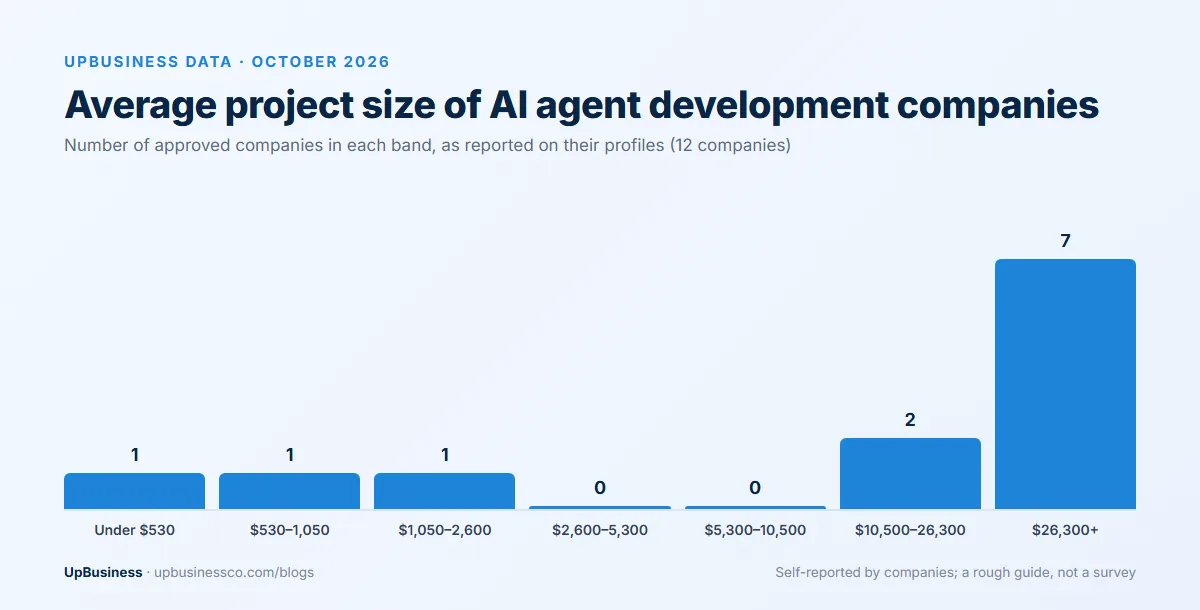
Most are small to mid-sized teams: seven have 11–50 people, three have fewer than ten and two have 51–200. If your first agent is a single task, look for a team whose minimum project fits it rather than one built around $26,300 programmes.
How to Hire an AI Agent Development Company
Whether the team is in Bengaluru, Chennai, Hyderabad or Pune, a polished demo tells you very little. Anyone can make an agent look smart on five rehearsed questions. These are the questions that separate real builders from the rest.
Questions to Ask on the First Call
- Show me an agent you built that is live in production today. What does it do, and how many requests does it handle a month?
- Which systems did it connect to, and what broke during integration?
- How do you test it before launch? Ask to see their test set and accuracy numbers.
- What happens when the agent isn't sure? Who does it hand off to, and how?
- What will it cost per month to run at our volume, and how do you cap spending?
- How will you handle customer data under the DPDP rules? Where is it stored?
- Who owns the code, prompts and data after the project ends?
- What does support look like after launch, and what does it cost?
Red Flags
- They can't name a single agent running in production for a real client.
- The quote has a build price but no monthly running cost.
- They promise full automation from day one with no human review.
- Every answer is about which model they use, not about your process.
- They want a large payment upfront instead of paying by milestone.
A good first step is a paid pilot of 4–6 weeks on one use case, with a success number agreed in writing. If they won't commit to a number, keep looking.
Reviews from past clients help here too. On UpBusiness, every company in our AI Agent Development category goes through verification, and you can compare their TrustScores and profiles before you shortlist. If you'd rather have companies come to you, post your project and get matched with verified teams.