


Browse our curated list of Ecommerce SEO Companies
Ecommerce SEO services cost about $700 to $5,250 a month in 2026 with an offshore partner company, plus a one-time technical audit and setup of $1,000 to $2,500. US agencies charge more. WebFX's survey of 250 businesses found most online stores pay $500 to $7,500 a month for ecommerce SEO[1]. A 1,200-product fashion store, for example, pays about $1,645 a month in our worked budget.
This guide is for the person who signs off the quote: a store owner, an ecommerce manager or a marketing lead at a brand that sells online. You'll see what ecommerce SEO services include, how agencies price them, what different store sizes should budget, a worked year-one plan, and the numbers that show whether the work is paying off.
Key takeaways
- Most small stores pay $700 to $1,225 a month with an offshore partner company. Stores with 500 to 5,000 products pay $1,400 to $2,450.
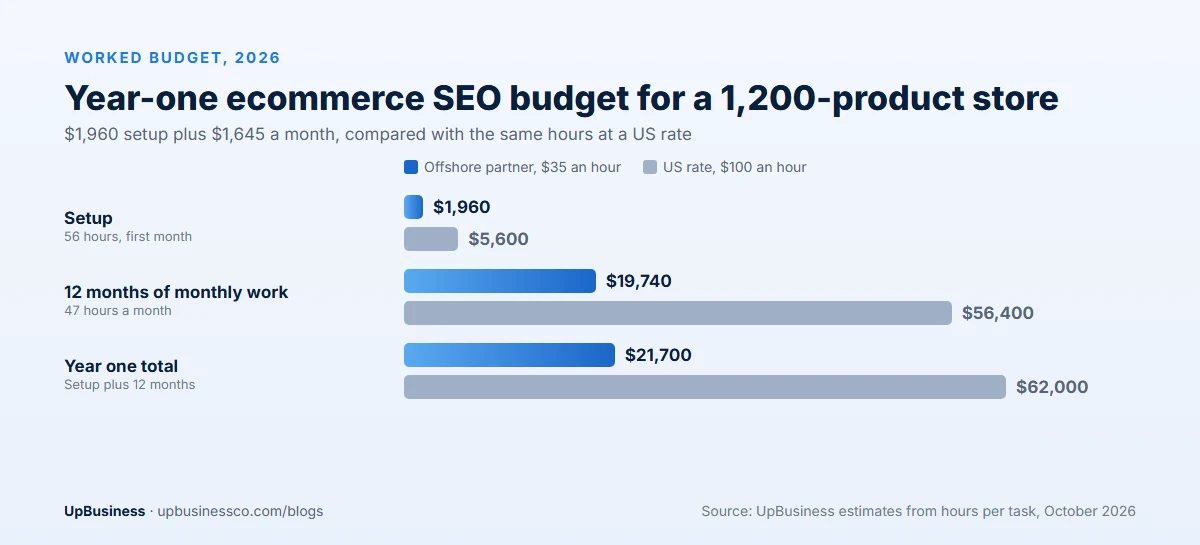
- Setup is a separate cost. Our worked store needs 56 hours, or $1,960 at $35 an hour, to fix technical issues, structured data and filter pages.
- The same work costs close to three times more at US rates. Our store plan is about $21,700 in year one offshore and about $62,000 at $100 an hour.
- Category pages usually bring more search traffic than single product pages. A good plan spends real hours on them.
- Judge the work by organic revenue and non-brand clicks, not by a list of keywords that moved.
How Much Do Ecommerce SEO Services Cost in 2026?
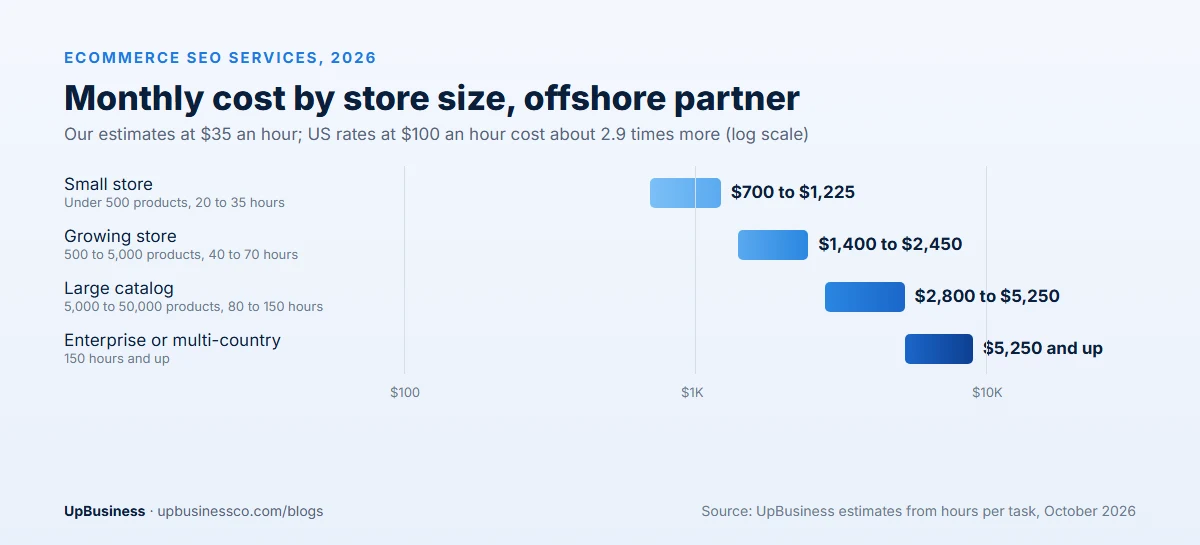
Ecommerce SEO services cost in 2026 depends mostly on the size of your catalog, your platform and how much technical clean-up your store needs. A 200-product Shopify store needs far fewer hours than a 20,000-product store with filters, variants and several countries.
Our estimates below use an offshore partner rate of $35 an hour and a US agency rate of $100 an hour. They are built from the hours each task takes, not from agency price lists.
| Store type | Hours a month | Offshore partner ($35/h) | US agency rate ($100/h) |
|---|---|---|---|
| Small store, under 500 products | 20 to 35 | $700 to $1,225 | $2,000 to $3,500 |
| Growing store, 500 to 5,000 products | 40 to 70 | $1,400 to $2,450 | $4,000 to $7,000 |
| Large catalog, 5,000 to 50,000 products | 80 to 150 | $2,800 to $5,250 | $8,000 to $15,000 |
| Enterprise or multi-country store | 150 and up | $5,250 and up | $15,000 and up |
These are monthly fees for ongoing work. They don't include the first-month audit, paid shopping ads, new store builds or paid tools you may need to buy yourself.
What Ecommerce SEO Services Include
Ecommerce SEO is different from SEO for a service business. Most of your pages are products and categories, many of them look alike, and filters can create thousands of extra URLs. A good plan covers six areas.
| Service | What the partner does | Setup hours | Monthly hours |
|---|---|---|---|
| Technical audit | Crawls the store, finds broken pages, duplicate URLs, slow templates and indexing problems | 16 | 4 to 8 |
| Category pages | Picks the searches each category should win, then writes useful intro text, headings and internal links | 12 | 8 to 15 |
| Product pages | Rewrites titles and descriptions, fixes images and alt text, and handles out-of-stock pages | 6 | 8 to 15 |
| Structured data | Adds or fixes product, price, stock and review markup so Google can show rich results | 8 | 1 to 2 |
| Content and buying guides | Writes guides that answer buyer questions and link to the right categories | 4 | 6 to 12 |
| Links and reporting | Earns mentions from relevant sites and reports revenue, clicks and rankings each month | 6 | 6 to 10 |
Google's own guide for online stores covers the same ground: help Google find and understand every product, share product data through structured data or a Merchant Center feed, and build a clear link path from menus to categories to products[2]. Product structured data can make your listings show price, stock and ratings in search results[3].
If you only need general SEO for a brand site with a small shop, our guide to professional SEO services may be a better fit.
How Ecommerce SEO Agencies Price Their Work
Most ecommerce SEO partner companies use one of five pricing models. Each suits a different kind of store.
| Pricing model | Typical price | Best for | Watch out for |
|---|---|---|---|
| Monthly retainer | $700 to $5,250 offshore | Ongoing growth for most stores | Vague hours; ask for a task list |
| One-time audit | $1,000 to $2,500 offshore | Finding and fixing technical problems | A long report with no help to fix it |
| Project fee | $1,500 to $10,000 | Migrations, redesigns and big category rebuilds | No follow-up after launch |
| Hourly | $35 offshore, $100 or more in the US | Small fixes and advice | Bills that grow without a cap |
| Revenue share | A share of organic revenue growth | Large stores with clean tracking | Arguments over what SEO caused |
WebFX's survey puts typical ecommerce SEO budgets between $500 and $7,500 a month[1]. Plans under $500 a month rarely cover more than a report and a few product rewrites. That might keep a tiny store tidy, but it won't move a competitive category.
Ask every partner to show the hours behind the price. A $2,000 monthly plan should say roughly how many hours go to categories, products, technical fixes, content and reports.
What Do Ecommerce SEO Packages Include at Each Price?
Many partner companies sell ecommerce SEO as three packages. Names change between agencies, but the work inside them is fairly standard.
| Package | Offshore price a month | Hours | What you should get |
|---|---|---|---|
| Starter | $700 to $1,225 | 20 to 35 | Technical checks, 5 to 10 category pages, 20 to 40 product rewrites, a monthly report |
| Growth | $1,400 to $2,450 | 40 to 70 | Everything in Starter, plus 1 to 2 buying guides a month, structured data fixes and link outreach |
| Scale | $2,800 to $5,250 | 80 to 150 | Everything in Growth across a large catalog, with filter page rules, international setup and a monthly call |
The biggest jump between packages is category work and content. A Starter plan keeps the store healthy. It rarely adds the category copy, guides and links that lift you above bigger rivals. If you already rank on page one for your main categories, Starter may be enough. If you don't, plan for Growth for at least six months.
What Drives the Cost of Ecommerce SEO?
Six factors move the price up or down:
- Catalog size. More products and categories mean more pages to write, fix and check.
- Filters and variants. Colour, size and price filters can create thousands of near-duplicate URLs. Google's guidance is to stop crawling filter URLs you don't need indexed, and to keep the ones you do need clean and consistent[4].
- Platform. Shopify, WooCommerce, Magento and custom stores each have their own limits and fixes. Platform quirks can add 5 to 20 setup hours.
- Starting point. A store with old redirects, thin pages or a recent migration needs more clean-up first.
- Site speed. Slow product and category templates hurt both rankings and sales. Our website speed optimization guide explains what that work costs.
- Countries and languages. Each extra market needs its own pages, currency, language tags and checks.
Ecommerce SEO Cost by Platform
Your store platform changes how much technical work is needed. Our setup estimates below assume a store with 500 to 2,000 products, at $35 an hour with an offshore partner company.
| Platform | Common SEO work | Setup hours | Offshore setup estimate |
|---|---|---|---|
| Shopify | Duplicate product URLs inside collections, theme speed, app bloat, collection page copy | 40 to 60 | $1,400 to $2,100 |
| WooCommerce | Plugin overlap, slow hosting, category and tag pages, structured data plugins | 45 to 70 | $1,575 to $2,450 |
| Magento (Adobe Commerce) | Layered navigation URLs, large catalogs, indexing rules, server speed | 60 to 100 | $2,100 to $3,500 |
| Custom or headless store | Rendering, internal links, sitemaps and markup built from scratch | 60 to 120 | $2,100 to $4,200 |
If you are still choosing a platform, our Shopify vs WooCommerce comparison covers the real running costs. If you are moving stores, read our Shopify migration services guide first, because a migration without redirects can wipe out years of rankings.
Common Ecommerce SEO Problems and What Fixing Them Costs
Most stores share the same handful of problems. Knowing what each one costs to fix helps you check whether a quote is fair. Our estimates assume a store with 500 to 2,000 products, at $35 an hour with an offshore partner company.
| Problem | What it does to your store | Hours to fix | Offshore estimate |
|---|---|---|---|
| Filter pages indexed by mistake | Thousands of thin pages compete with your real categories | 6 to 15 | $210 to $525 |
| Duplicate product URLs | Rankings split across several copies of the same product | 4 to 10 | $140 to $350 |
| Copied maker descriptions | Your products look the same as every other seller | 1 hour per 4 to 6 products | $6 to $9 per product |
| Empty category pages | Category searches go to rivals with useful copy | 1 to 2 per category | $35 to $70 per category |
| Out-of-stock pages removed | Lost rankings and broken links when stock returns | 3 to 6 | $105 to $210 |
| Missing product structured data | No price, stock or rating details in search results | 6 to 12 | $210 to $420 |
| Slow templates and heavy apps | Lower rankings and fewer sales on mobile | 10 to 30 | $350 to $1,050 |
Some of these are one-time fixes, such as filter rules and duplicate URLs. Others, such as product rewrites and category copy, carry on month by month until the catalog is done. A good proposal makes that split clear, so you know which costs end and which continue.
Be careful with out-of-stock products. Deleting the page throws away its rankings and links. Most stores do better keeping the page live, showing that the item is out of stock, and linking to close alternatives until it returns.
Ecommerce SEO vs Shopping Ads
Shopping ads and SEO work well together, but they cost money in different ways. With ads, you pay for every click, and traffic stops the day the budget runs out. With SEO, you pay for the work up front, and the traffic it earns keeps coming without a fee per click.
Many stores use ads to sell from day one, then use what the ads show about best-selling products and search terms to decide which categories SEO should target first. Over time, strong organic rankings can let you cut ad spend on searches you already win.
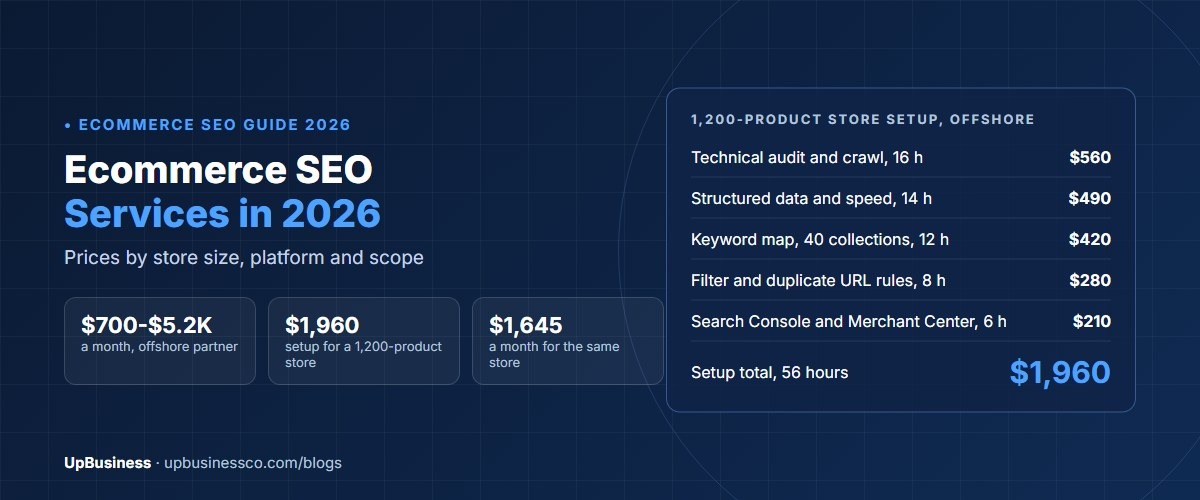
Worked Example: Ecommerce SEO Budget for a 1,200-Product Store
Here is a plan for a fashion brand on Shopify with 1,200 products, 40 collections and colour and size filters. It ranks well for its brand name but poorly for category searches such as "linen shirts for men".
| Setup task (first month) | Hours | Offshore ($35/h) | US rate ($100/h) |
|---|---|---|---|
| Technical audit and crawl | 16 | $560 | $1,600 |
| Structured data and speed fixes | 14 | $490 | $1,400 |
| Keyword map for 40 collections | 12 | $420 | $1,200 |
| Filter and duplicate URL rules | 8 | $280 | $800 |
| Search Console, analytics and Merchant Center | 6 | $210 | $600 |
| Setup total | 56 | $1,960 | $5,600 |
| Monthly task | Hours | Offshore ($35/h) | US rate ($100/h) |
|---|---|---|---|
| Rewrite 10 collection pages | 12 | $420 | $1,200 |
| Rewrite 40 product pages | 12 | $420 | $1,200 |
| Technical checks and fixes | 6 | $210 | $600 |
| Two buying guides | 8 | $280 | $800 |
| Links and digital PR | 6 | $210 | $600 |
| Report and call | 3 | $105 | $300 |
| Monthly total | 47 | $1,645 | $4,700 |
Year one comes to about $21,700 with an offshore partner company ($1,960 setup plus 12 months at $1,645). At $100 an hour, the same plan costs about $62,000. Many stores run the full plan for six months, then drop to fewer product rewrites once the main collections are done.
How to Measure Ecommerce SEO Results
A good monthly report should answer one question: is organic search bringing more sales from people who didn't already know your brand?
| Metric | Where it comes from | What good looks like |
|---|---|---|
| Organic revenue | Analytics with ecommerce tracking | Rising month on month, after seasonal swings |
| Non-brand clicks | Search Console, excluding your brand name | Rising faster than brand clicks |
| Category page rankings | Search Console or a rank tracker | More collections on page one |
| Indexed product and category pages | Search Console page indexing report | Key pages indexed, filter junk excluded |
| Product rich results | Search Console enhancements report | Few or no errors |
| Conversion rate from organic visits | Analytics | Steady or rising as traffic grows |
Give ecommerce SEO four to six months before you judge it. Technical fixes can show results within weeks. New category copy, guides and links take longer. If revenue and non-brand clicks haven't moved after six months, ask the partner what they would change.
Google's AI answers are changing how shoppers search. Our SEO trends 2026 guide explains what that means for the work you pay for.
Red Flags in an Ecommerce SEO Proposal
- Guaranteed first place. No one controls Google's results.
- Hundreds of AI product descriptions with no review. Thin, copied text across many products rarely helps and can hurt.
- Indexing every filter page. This wastes crawl time on near-duplicate pages.
- Links bought in bulk. Cheap link packages can trigger spam problems.
- Reports with only keyword rankings. You need revenue and non-brand clicks too.
- Locked accounts. You should own Search Console, analytics and Merchant Center, not the agency.
For SEO-specific warning signs on any retainer, read our SEO agency pricing guide, which includes a red flags checklist.
Can You Do Ecommerce SEO Yourself?
Yes, for part of the work. A store owner can handle simple product rewrites and basic checks. The technical work, such as filter rules, structured data and migrations, needs skill and paid tools.
| Task | Do it yourself? | Why |
|---|---|---|
| Write better product titles and descriptions | Yes | You know your products and buyers best |
| Add good product photos and alt text | Yes | Simple, and helps image search |
| Check Search Console for errors | Yes | Free, and takes 15 minutes a week |
| Fix filter and duplicate URL problems | Usually hire | Mistakes can de-index real pages |
| Structured data and speed fixes | Usually hire | Needs theme or code changes |
| Category keyword plan and link building | Hire | Needs research tools and outreach skill |
A mixed plan works for many small stores. Your team rewrites products. The partner company handles technical fixes, category pages and reports. This can cut a Starter plan to 12 to 20 hours a month, or about $420 to $700 with an offshore partner.
Freelancer vs Ecommerce SEO Agency vs a Verified Partner on UpBusiness
You can hire ecommerce SEO help in three common ways. The right choice depends on your catalog size and how much checking you want to do yourself.
| Freelancer | Ecommerce SEO agency | Verified partner on UpBusiness | |
|---|---|---|---|
| Typical monthly price | $500 to $1,500 | $2,500 to $7,500 in the US | $700 to $5,250 offshore |
| Who checks their claims | You do | You do | UpBusiness verifies documents and client work |
| Cover when someone leaves | None | Team cover | Team cover |
| Best for | Small stores and one-off fixes | Large or fast-growing stores | Comparing several checked quotes at once |
Freelancers can be great value for a small store. Agencies bring writers, developers and analysts together. A verified partner company gives you that team at offshore rates, with business documents and client work checked before they appear on UpBusiness.
How to Choose an Ecommerce SEO Partner
Ask these questions before you sign:
- Have you worked on stores on our platform and of our size?
- Which tasks will you do each month, and how many hours go to each?
- How will you handle filter pages, variants and out-of-stock products?
- Can you show a report from a similar store, with names hidden?
- Will we own Search Console, analytics and Merchant Center?
- Can we cancel with 30 days' notice?
Compare at least three quotes side by side. Line up the hours, tasks and reporting, not just the price. If you also sell from a shop front, our local SEO services cost guide covers map rankings, and our content marketing agency pricing guide covers buying guides and blogs.
If your store itself needs work first, fix that before you pay for monthly SEO. Our ecommerce website development cost guide and Shopify development cost guide cover build budgets, and a redesign done without SEO checks can undo months of progress.
When you're ready, post your project on UpBusiness with your platform, catalog size and budget, and we'll match you with verified ecommerce SEO partner companies.