


Browse our curated list of Website Development Companies
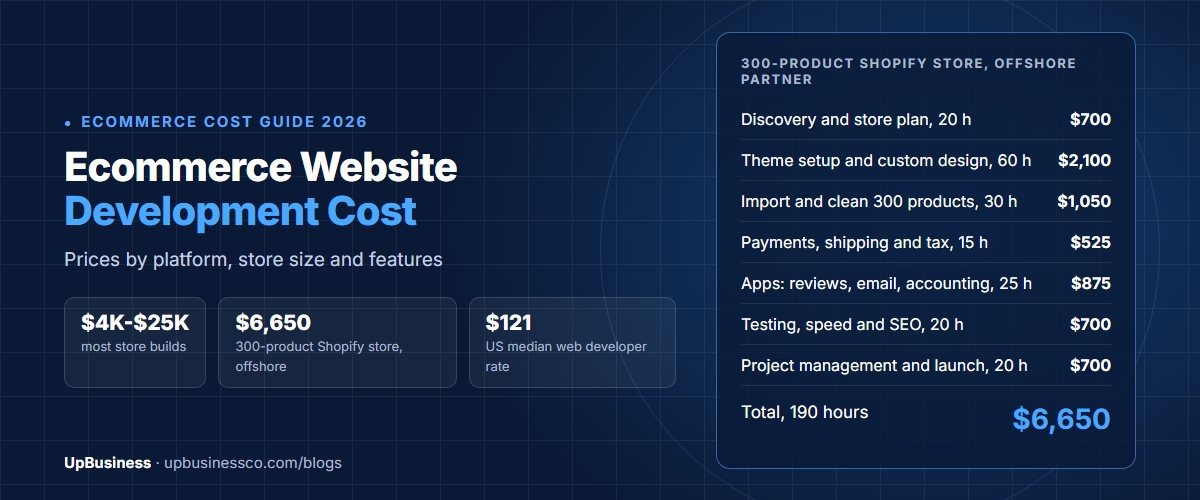
Ecommerce website development cost in 2026 runs from about $1,400 for a simple theme store to well over $100,000 for a custom build. Small and growing brands usually spend $4,000 to $25,000. A 300-product Shopify store, for example, costs about $6,650 with an offshore partner company and about $23,000 at US contract rates.
This guide is for the person paying for the store: a founder, an ecommerce manager or an operations head. You'll see prices by store type, by platform and by feature. You'll also get real hourly rates from US government data, monthly running costs, a worked budget and what partner companies on UpBusiness charge.
Key takeaways
- A typical store costs $4,000 to $25,000 to build. Theme stores start near $1,400, and custom builds from code can pass $100,000.
- The same 190-hour Shopify build costs $6,650 at an offshore rate of $35 an hour and about $23,000 at the US contract median of $121.
- Platform fees are small next to the build. Shopify plans start at $29 a month and BigCommerce plans at $29 a month, billed yearly.
- Payment fees often cost more than the platform. A US store pays about 2.9% plus 30 cents per card sale on Shopify Basic or WooPayments.
- Our analysis of 19 website development companies on UpBusiness found 5 that list ecommerce work, with a median average project size of $500.
How Much Does Ecommerce Website Development Cost in 2026?
A typical ecommerce website costs $4,000 to $25,000 in 2026. A simple theme store costs $1,400 to $2,800 with an offshore partner company. A growth store with custom design and several integrations costs $10,500 to $24,500 offshore and $36,300 to $84,700 at US rates.
We built these ranges from hours, not guesses. Each row lists the hours the work usually takes. We then priced it at two rates. The first is $35 an hour, a common rate for offshore partner companies. The second is $121 an hour, the US contract median for web developers.
| Store type | Typical scope | Hours | Offshore partner ($35/h) | US rates ($121/h) |
|---|---|---|---|---|
| Starter store | Theme setup, up to 50 products, 1 payment method | 40 to 80 | $1,400 to $2,800 | $4,800 to $9,700 |
| Small business store | Theme with custom changes, 50 to 500 products | 120 to 250 | $4,200 to $8,750 | $14,500 to $30,300 |
| Growth store | Custom design, 500 to 5,000 products, 3 to 5 integrations | 300 to 700 | $10,500 to $24,500 | $36,300 to $84,700 |
| Custom or headless store | Built from code, own checkout and admin | 800 to 2,000 | $28,000 to $70,000 | $96,800 to $242,000 |
| Enterprise or multi-store | Several brands, countries or currencies, ERP links | 2,000 and up | $70,000 and up | $242,000 and up |
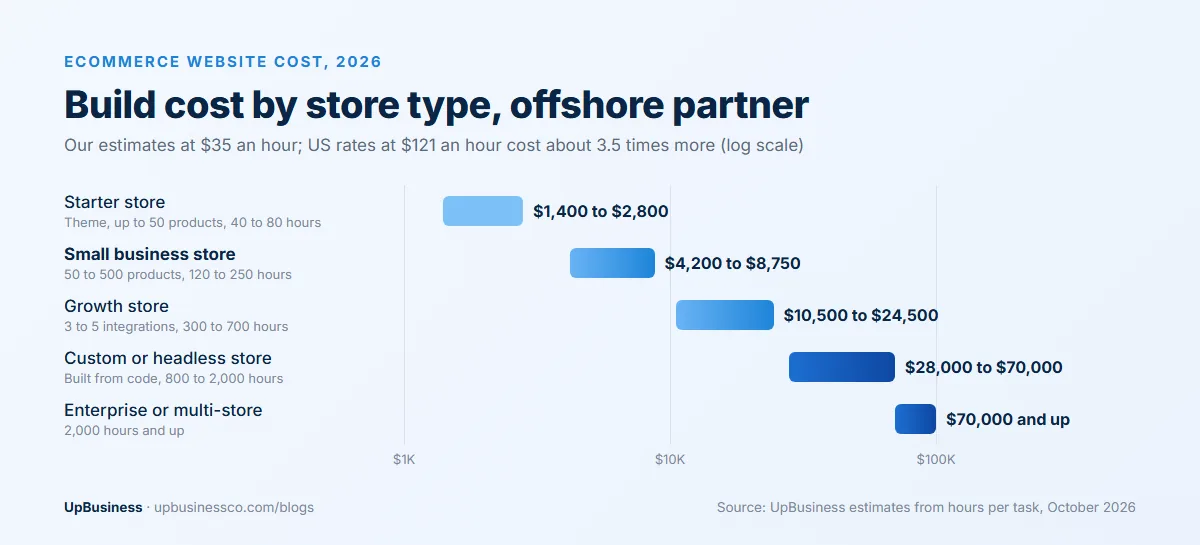
The work in each row is the same in both columns. Only the hourly rate changes. That is why two honest quotes for one store can differ by three or four times.
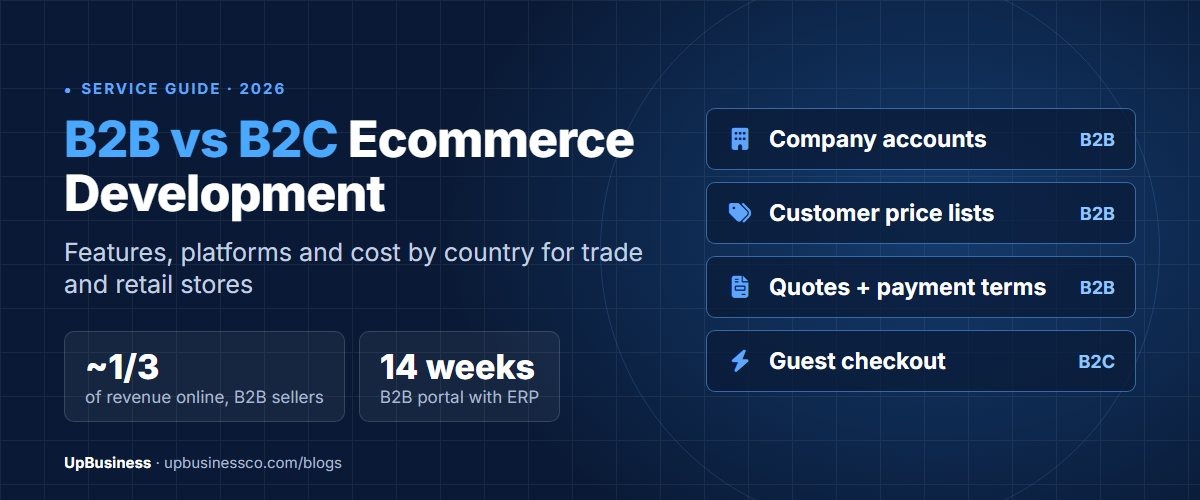
Selling to other businesses is a different job. Trade pricing, quotes and ERP links add a lot of cost. Our B2B vs B2C ecommerce guide prices that side in detail.
Ecommerce Website Cost by Platform
Your platform sets two things. It sets the monthly fee, and it sets how much custom work the build needs. Hosted platforms like Shopify and BigCommerce run the servers for you. Open-source tools like WooCommerce and Magento are free to use, but you pay for hosting and upkeep.
| Platform | Software fee (official) | Typical build cost, offshore | Best fit |
|---|---|---|---|
| Shopify | $29, $79 or $299 a month on Basic, Grow and Advanced, billed yearly[1] | $1,400 to $15,000 | Direct-to-consumer brands |
| Shopify Plus | From $2,300 a month on a three-year term[1] | $15,000 to $60,000 | High-volume brands |
| BigCommerce | $29, $79 or $299 a month on Core, Growth and Scale, billed yearly[2] | $2,000 to $20,000 | Large catalogues, B2B features |
| WooCommerce | Free plugin; you pay for hosting | $1,400 to $15,000 | Stores already on WordPress |
| Adobe Commerce (Magento) | Quote only; Magento Open Source is free[3] | $20,000 to $100,000+ | Complex catalogues, enterprise |
| Custom build | No licence; you pay for cloud hosting | $28,000 to $70,000+ | Unusual checkout or business model |
BigCommerce plans now carry sales caps. Core covers up to $30,000 in yearly sales, and Growth covers up to $100,000. Above that, you move up a plan or pay a fee on the extra sales[2].
Shopify works the other way. It does not cap your sales. But if you use a payment provider other than Shopify Payments, it adds its own fee on each sale. That fee is 1% on Grow, 0.6% on Advanced and 0.2% on Plus[1].
For a closer look at the two popular choices, read our Shopify vs WooCommerce cost comparison. If you have settled on Shopify, our Shopify development cost guide breaks down themes, apps and agency quotes.
What Drives the Cost of an Ecommerce Website?
Six things move the price more than anything else. Check each one before you ask for quotes.
- The number of products. Fifty can be added by hand; five thousand need a clean import file, and someone has to fix the data first.
- Design. A ready-made theme costs little, while a custom design for the main pages can take 40 to 100 hours.
- Integrations, meaning links to other tools such as your stock system, accounting software or courier. Each link adds build and testing time.
- Payments, shipping and tax. One country and one currency is simple. Selling into several countries means more rules to set up and test.
- Moving data from an old store. Products, customers and orders all have to come across, and broken links can cost you search traffic.
- Content. Quotes often leave out product photos, descriptions and size guides. Ask who writes and uploads them.
If you are moving an existing store, plan the move as its own project. Our Shopify migration checklist covers redirects, data and checkout testing.
Ecommerce Feature Costs, Line by Line
Quotes are easier to judge when you can see the parts. The table shows how long common features take and what they cost at both rates. Use it to spot lines that look too high or too low.
| Feature | Typical hours | Offshore partner ($35/h) | US rates ($121/h) |
|---|---|---|---|
| Product import and cleanup, per 100 products | 4 to 10 | $140 to $350 | $480 to $1,200 |
| Custom theme design (home, category, product, cart) | 40 to 100 | $1,400 to $3,500 | $4,800 to $12,100 |
| Product filters and search | 10 to 40 | $350 to $1,400 | $1,200 to $4,800 |
| Payment gateway setup | 4 to 16 | $140 to $560 | $480 to $1,900 |
| Shipping and tax rules | 8 to 24 | $280 to $840 | $970 to $2,900 |
| Multiple currencies and languages | 16 to 60 | $560 to $2,100 | $1,900 to $7,300 |
| Subscriptions | 16 to 40 | $560 to $1,400 | $1,900 to $4,800 |
| Data migration from an old store | 20 to 80 | $700 to $2,800 | $2,400 to $9,700 |
| ERP or stock system link | 40 to 200 | $1,400 to $7,000 | $4,800 to $24,200 |
ERP stands for enterprise resource planning. It is the system that tracks stock, orders and invoices. Linking it to your store is often the single biggest line in a growth-stage quote.
How Much Does Ecommerce Website Design Cost?
Design alone costs about $1,400 to $3,500 with an offshore partner company and $4,800 to $12,100 at US rates. That pays for a custom look on the home page, category pages, product pages and cart. Those are the pages shoppers actually use.
A paid theme is the cheaper route. You buy a theme, then pay a few hours to change colours, fonts and layout blocks. Shoppers notice clear photos, fast pages and an easy checkout long before they notice a unique layout.
Custom design pays off when your brand depends on it. Fashion, beauty and premium goods often fall in this group. For a store selling spare parts, clean filters and search matter more than style.
How Long Does It Take to Build an Ecommerce Website?
A starter theme store takes about 2 to 4 weeks. A small business store takes 6 to 8 weeks. A growth store with integrations takes 3 to 5 months, and a custom build takes 6 to 12 months.
The build is rarely what slows a project down. Delays usually come from the buyer's side. Product data arrives late, photos are missing, or feedback takes a week each round. Have your product sheet, photos and payment accounts ready before work starts, and you can save weeks.
How Much Does a Basic Ecommerce Website Cost?
A basic ecommerce website costs about $1,400 to $2,800 with an offshore partner company. At US rates it costs $4,800 to $9,700. Basic means a ready-made theme, up to 50 products, one payment method and simple shipping.
You can go cheaper by building it yourself on Shopify or a hosted builder. Then your main cost is your own time plus the monthly plan. That works for testing an idea. Many brands hire help once sales start, because a slow or confusing store loses orders.
How Much Does a Custom Ecommerce Website Cost?
A custom ecommerce website costs $28,000 to $70,000 with an offshore partner company. At US rates the same work costs $96,800 to $242,000. Custom here means the store is built from code, not from a theme.
Some brands go headless. Headless means the shop front is a separate app, and the platform only runs products, carts and orders in the background. It gives you full design freedom and fast pages. It also roughly doubles the work, because you now run two systems.
Go custom only when a platform truly can't do what you need. Good reasons include an unusual checkout, a rental or booking model, or heavy trade pricing. If many sellers will list their own products, you are building a marketplace instead (a much bigger job). Our marketplace development cost guide covers that case.
Ecommerce Website Development Cost by Country
Where your team sits changes the price more than any feature. The same 190 hours can cost $6,650 or $23,000. Here is what the public data shows for the US, and what offshore teams charge.
US federal buyers publish their contract rates. In October 2026 we pulled the GSA CALC data for web roles[4]. The median ceiling rate for web developers was $121 an hour, across 1,428 rates from 510 contractors. Front-end developers came in at $130, web designers at $109 and project managers at $105.
Employees cost less per hour but more per year. The US Bureau of Labor Statistics puts the median web developer salary at $92,650 in May 2025[5]. Wages make up 70.0% of what employers pay in total[6]. So one in-house developer costs about $132,400 a year, or about $64 an hour.
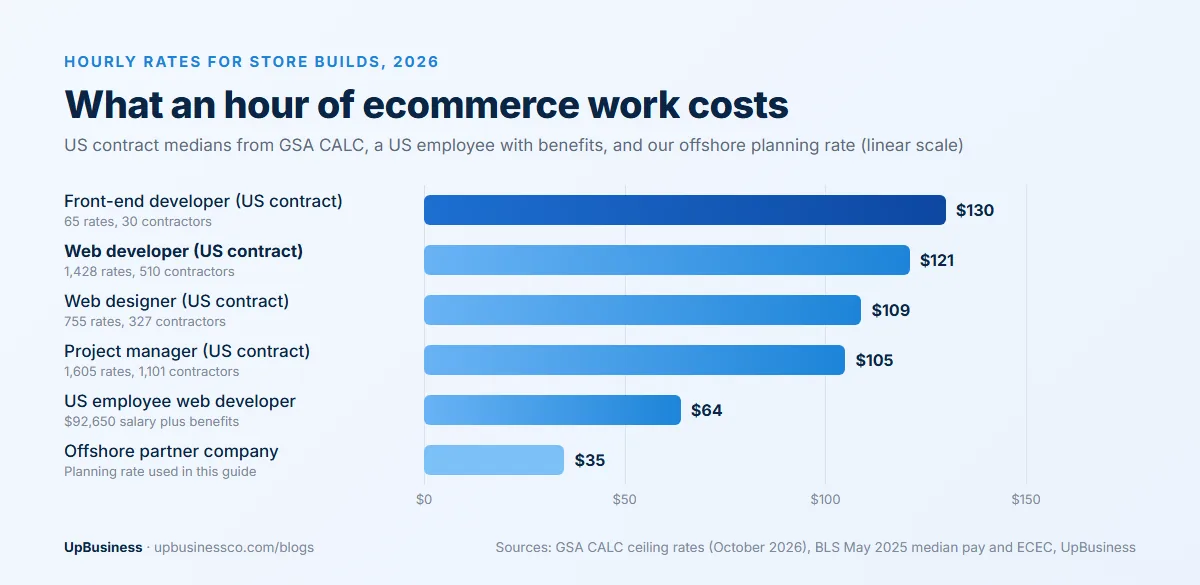
Offshore partner companies in India usually charge far less. We use $35 an hour as a planning rate in this guide. The companies we checked on UpBusiness quote small stores from a few hundred dollars, as the partner data below shows.
Buyers in the UK, Canada, Australia and the UAE face the same choice. A local agency gives you the same time zone and easy meetings. An offshore team costs less but needs a tighter brief and set check-in times. Many brands split the work: local strategy and design, offshore build and upkeep.
Monthly Running Costs of an Ecommerce Website
The build is a one-time cost. The store then costs money every month. Budget for these lines from day one.
| Running cost | Typical monthly cost | Notes |
|---|---|---|
| Platform plan | $29 to $299 | Shopify or BigCommerce, billed yearly; Plus and enterprise plans cost more |
| Hosting (WooCommerce, Magento, custom) | From $28 | WP Engine managed WordPress hosting starts at $28 a month, billed yearly[7] |
| Paid apps and plugins | $50 to $300 | Reviews, email, upsells, backups; our estimate for a small store |
| Payment fees | About 2.9% + $0.30 per card sale | WooPayments US card rate, plus 1.5% for cards issued abroad[8] |
| Maintenance and small changes | $175 to $700 | 5 to 20 hours a month at $35 an hour |
Payment fees grow with your sales. A store selling $20,000 a month with an average order of $50 makes 400 sales. At 2.9% plus 30 cents, that is $580 plus $120, or $700 a month. That is often more than the platform, hosting and apps put together.
Maintenance covers updates, bug fixes, speed checks and small changes. Our website maintenance cost guide explains monthly plans and what a support contract should include.
Worked Example: Budget for a 300-Product Shopify Store
Here is a real-world shape of a small business build. The store sells clothing in one country, has 300 products and uses the Shopify Grow plan. It needs a custom look on a paid theme, a few apps and basic search engine setup.
| Work | Hours | Offshore partner ($35/h) | US rates ($121/h) |
|---|---|---|---|
| Discovery and store plan | 20 | $700 | $2,420 |
| Theme setup and custom design | 60 | $2,100 | $7,260 |
| Import and clean 300 products | 30 | $1,050 | $3,630 |
| Payments, shipping and tax setup | 15 | $525 | $1,815 |
| Apps: reviews, email and accounting | 25 | $875 | $3,025 |
| Testing, speed and SEO basics | 20 | $700 | $2,420 |
| Project management and launch | 20 | $700 | $2,420 |
| Total | 190 | $6,650 | $22,990 |
The first year adds the Grow plan at $79 a month, or $948. Add apps at about $100 a month, or $1,200. So the store costs about $8,800 in year one with an offshore team, before payment fees.
Notice which lines are big. Design and product data take almost half the hours. If your product data is already clean, you can cut the import line in half.
What Do Partner Companies on UpBusiness Charge?
We checked the 19 companies on our website development listing in October 2026. Eleven put website work at 20% or more of their services. Five list ecommerce work in their own service mix. Those five are the ones we count here.
| Company | Ecommerce share of services | Average project size | Team and city |
|---|---|---|---|
| TechieFormation | 60% (Shopify, WooCommerce, ecommerce apps) | $250 | 1-10 people, Ludhiana |
| Dextrous Infosolutions | 30% (ecommerce website design) | $1,000 | 11-50 people, Noida |
| 10G Spectrum | 25% (ecommerce website development) | $250 | 1-10 people, Parakode |
| Dexinprime Technologies | 25% (ecommerce consulting) | $25,000 | 51-200 people, Fatehgarh Sahib |
| Digital Marketing Cube | 5% (ecommerce website development) | $500 | 1-10 people, Delhi |
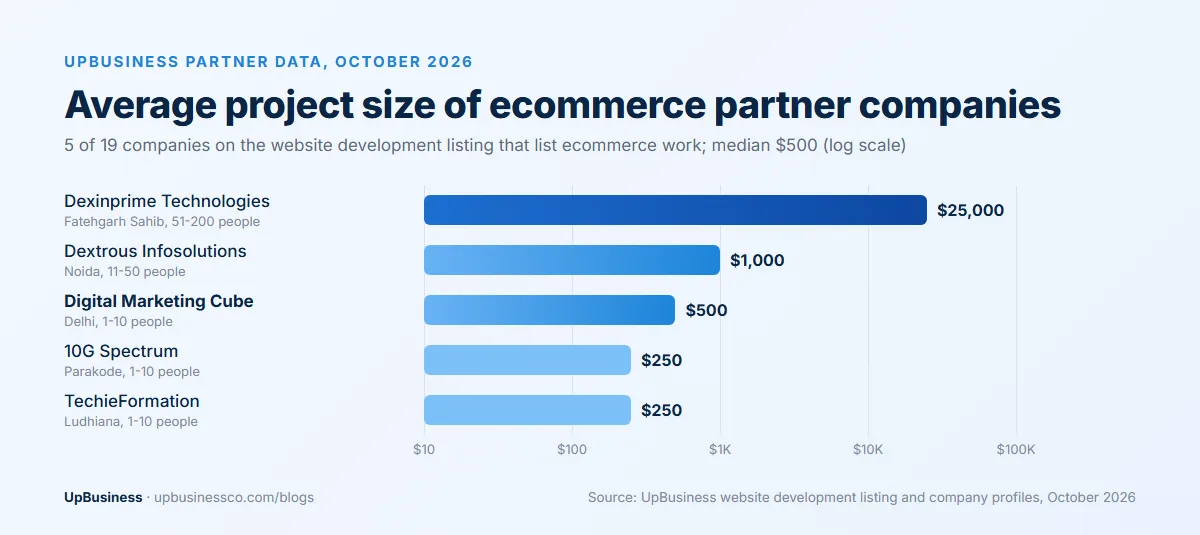
The median average project size of the five is $500. Four of them are teams of 50 people or fewer that build theme stores and small business stores. Dexinprime is the exception, with a larger team and a $25,000 average project.
All five have TrustScores between 70.17 and 74.67. TrustScore is our rating built from each company's verified details. Since none of these companies has a long ecommerce track record on our platform yet, ask each one for 2 or 3 live stores they built.
How to Compare Ecommerce Development Quotes
Send every company the same brief. List your products, platform, payment methods, countries and the tools the store must link to. Our software project brief template gives you a ready format.
Then ask each company to price the same lines. Use the feature table above as your list. When the quotes come back, check these points:
- Check who loads the products. Some quotes assume you do it. For 300 products, that can mean 30 hours of work you didn't plan for.
- Ask how many design rounds are included. Two is common, and extra rounds are usually billed by the hour.
- Ask which paid apps the quote assumes, with the monthly price of each. Otherwise the running cost stays hidden until launch.
- Look for a free bug-fix period after launch, typically 30 to 60 days.
- Make sure the theme files, code and admin logins belong to you.
For WooCommerce builds, our WooCommerce proposal checklist lists the plugin and hosting questions to ask. Our guide to comparing proposals line by line shows how to line quotes up side by side.
How to Lower Your Ecommerce Website Cost
- Start with a theme and change colours, fonts and layout blocks. Pay for custom design only where it lifts sales.
- Clean your product data before the build. A tidy spreadsheet with names, prices, sizes and photo links cuts import time.
- Launch with fewer apps. Each one adds a monthly fee and can slow the store down.
- Sell in one country first. Extra currencies, languages and tax rules can wait until sales prove the demand.
- Pay for the platform yearly. Shopify and BigCommerce both cut plan prices by about 25% that way.
Still pricing the rest of your site? Our website development cost guide covers non-store pages, rates and timelines.
Get Quotes for Your Ecommerce Website
You now have the numbers to judge a quote. A small business store with an offshore team should land near $4,000 to $9,000. A growth store with integrations should land near $10,000 to $25,000. Much higher or lower quotes need a clear reason.
When you're ready, post your project on UpBusiness with your platform, product count and budget, and we'll match you with verified partner companies that build ecommerce stores.