

Browse our curated list of Software Development Companies
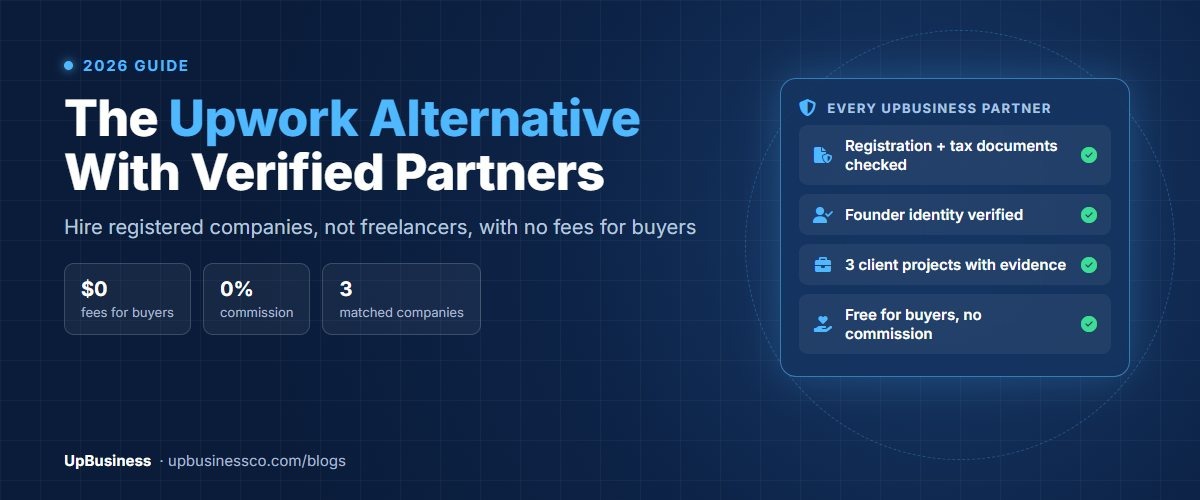
If you've outgrown hiring individual freelancers, UpBusiness is an Upwork alternative built for hiring registered service companies instead. You post your project once and get three partner companies matched to it, each of which has had its registration documents, founder identity and three client projects checked by our team before it could list. Buyers pay nothing to use it, there's no marketplace fee or commission on the work, and buyers and companies can be anywhere in the world.
If you only have a minute
- Upwork charges clients a marketplace fee on every payment (5% on its Basic plan) plus a contract initiation fee on each new contract. UpBusiness charges buyers nothing.
- Only registered businesses can list on UpBusiness. Freelancers without a registered business can't.
- Every partner company completes a five-step onboarding and needs a TrustScore of 70+ out of 100.
- Agencies can list free, keep 100% of what they earn, and receive matched briefs from buyers.
Why Businesses Look for an Upwork Alternative
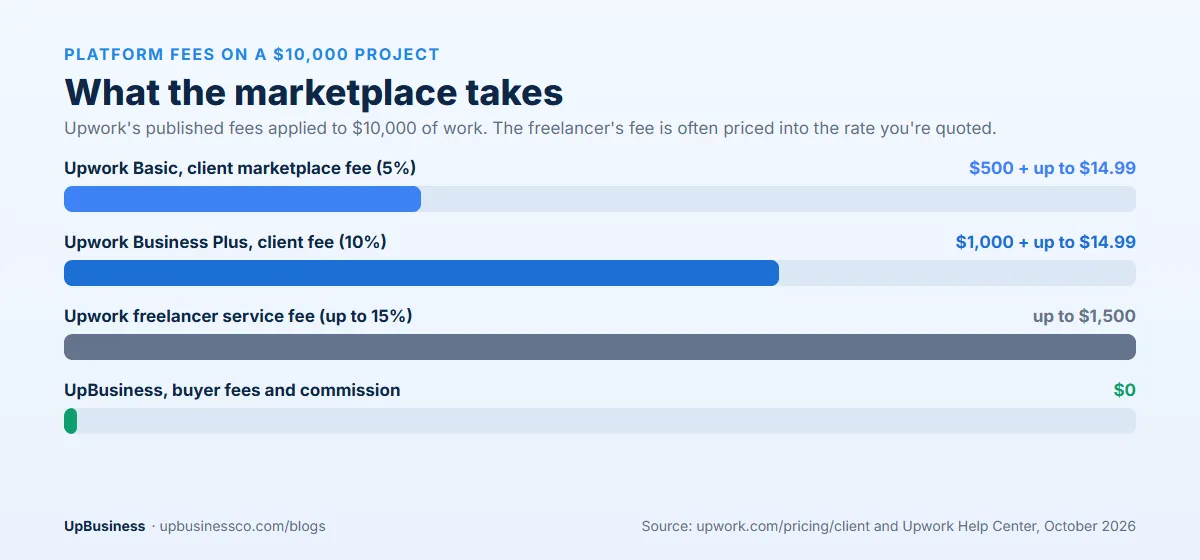
Upwork is a marketplace built around independent freelancers, and it works well for small, well-defined tasks. The friction shows up as projects get bigger. On Upwork's own pricing page, clients on the Basic plan pay a 5% marketplace fee on payments to freelancers and those on Business Plus pay 10%, plus a one-time contract initiation fee of $0.99 to $14.99 for every new contract[1]. Freelancers pay their own service fee of 0% to 15% per contract on top of that[2], which tends to find its way into the rates you're quoted.
The bigger issue for many buyers isn't the fee, though. It's that a multi-month build needs design, development, testing and project management, and stitching three or four freelancers together means you become the project manager.
UpBusiness vs Upwork at a Glance
| UpBusiness | Upwork | |
|---|---|---|
| Who you hire | Registered service companies with a team behind them | Mostly individual freelancers |
| Fees for buyers | None, and no commission on the project | 5% marketplace fee (Basic) or 10% (Business Plus), plus $0.99 to $14.99 per new contract |
| Fees for the provider | None, free listing and no commission | 0% to 15% service fee per contract |
| How you find them | Post one brief and get 3 matched companies, or browse categories ranked by TrustScore | Post a job, review proposals, interview applicants |
| What gets checked | Registration and tax documents, founder identity, three client projects with evidence | Profiles, work history and reviews on the platform |
What a $20,000 Build Costs Through Each Route
Fees are easier to judge on a real number, so take a $20,000 web app that needs a designer, a developer and someone to test it. On Upwork you'd usually hire those as three separate contracts, and each contract carries its own initiation fee on top of the marketplace fee on every payment.
| Cost line on a $20,000 project | Upwork Basic | Upwork Business Plus | UpBusiness |
|---|---|---|---|
| Client marketplace fee | $1,000 (5%) | $2,000 (10%) | $0 |
| Contract initiation fees | 3 contracts at $0.99 to $14.99 each | 3 contracts at $0.99 to $14.99 each | $0 |
| Fee taken from the people doing the work | 0% to 15% of their earnings, up to $3,000 | 0% to 15% of their earnings, up to $3,000 | $0 |
| Who coordinates the three roles | You | You | The partner company |
The provider-side fee isn't on your invoice, but freelancers know about it when they set their rates, so some of it usually comes back to you in the quote.
To be fair to Upwork, a company's day rate is often higher than a solo freelancer's, because it's paying for a project manager, QA and people who can cover for each other. That's why it makes more sense to compare the total price for the finished project, including your own time spent coordinating, than to compare hourly rates. A freelancer at $35 an hour can end up costing more than a company at $50 if you're the one holding the project together every evening.
Freelancer or Company: Which Do You Need?
A freelancer is often the right call for a single, contained task: a logo, a landing page, a bug fix, a month of social posts. You know exactly what you want and one person can deliver it.
A company makes more sense once the work needs several skills at once, runs for months, or has to be maintained after launch. You get one contract, one invoice and one team that's accountable for the whole result, someone else covers when a developer is on leave, and the knowledge doesn't walk out the door when one person moves on. That's the kind of hire UpBusiness is built for, and why only registered businesses can list.
If you're weighing up how to structure the team itself, our guide to dedicated developers vs project-based teams walks through the trade-offs.
When Upwork Is Still the Better Choice
Upwork isn't the wrong tool, it's just built for a different kind of hire, and there are jobs where we'd point you to it ourselves.
- You need one small, clearly defined task done this week, such as fixing a WordPress plugin or cleaning up a spreadsheet, and you don't want to talk to a company about it.
- You want payment held by the platform. Upwork funds fixed-price milestones before work starts and releases them when you approve, which is useful protection with someone you've never worked with. On UpBusiness you contract with the company directly, so you agree the payment terms yourselves.
- You already run a product team and need one more pair of hands on hourly billing, with time tracked by the platform.
- Your budget is under what most registered companies will take on. Every UpBusiness company states a minimum project size, and some won't go below it.
If two or more of those describe your project, Upwork or a similar freelance marketplace will probably serve you better. If the work is a multi-month build that needs several skills and someone accountable for the result, that's where a partner company makes more sense.
How UpBusiness Checks Every Company
No company can simply sign up and appear. Each one completes a five-step onboarding that our team reviews by hand.
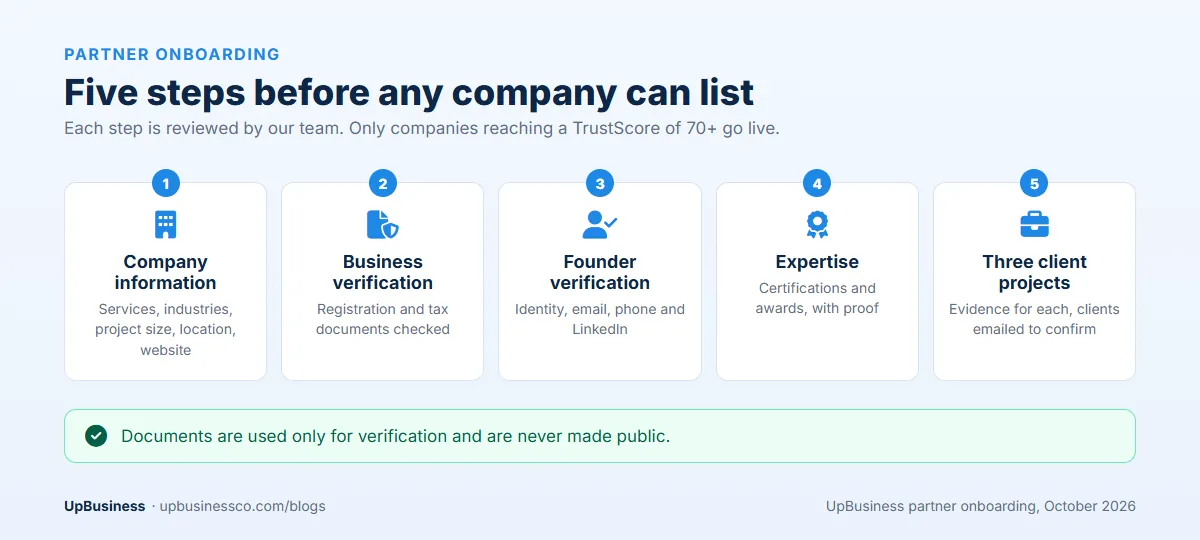
We collect the company's services, industries, client size, minimum project size and rate, and location. We check its incorporation certificate and tax registration, and credit its years in business from the date on those documents. We verify the founder's identity, email, phone and LinkedIn profile, and we look for proof behind any certification or award it claims.
Then come three client projects, each with the client's name, the services delivered, the size, the dates, a description, evidence of the work and proof of the engagement. If the company shares the client's email, we write to the client and ask them to confirm. All of this adds up to a TrustScore out of 100, and only companies that reach 70 are listed. Optional paid plans can move a listed company higher in the default "Recommended" order, but they can't get an unchecked company listed.
Hiring a Company in Another Country
Many buyers who leave Upwork still want the cost advantage of an offshore team, just with a company behind it. That works well if you sort out a few practical things at the start.
Agree the hours of overlap before anything else. Two to four shared working hours a day is enough for most projects, and it's worth writing down who joins the daily or weekly call and when. Ask for invoices in your currency, usually US dollars, pounds or euros, and confirm how the company receives international payments so nobody loses a week to a bank query.
Decide which country's law governs the contract and where disputes would be settled. Plenty of Indian companies will accept the client's jurisdiction for larger projects, and it's a normal thing to ask. Indian companies can also bill overseas clients for exported services without adding Indian GST when they've filed the right undertaking, so if a quote from India includes 18% GST for a client abroad, it's worth asking why.
How Hiring Works on UpBusiness
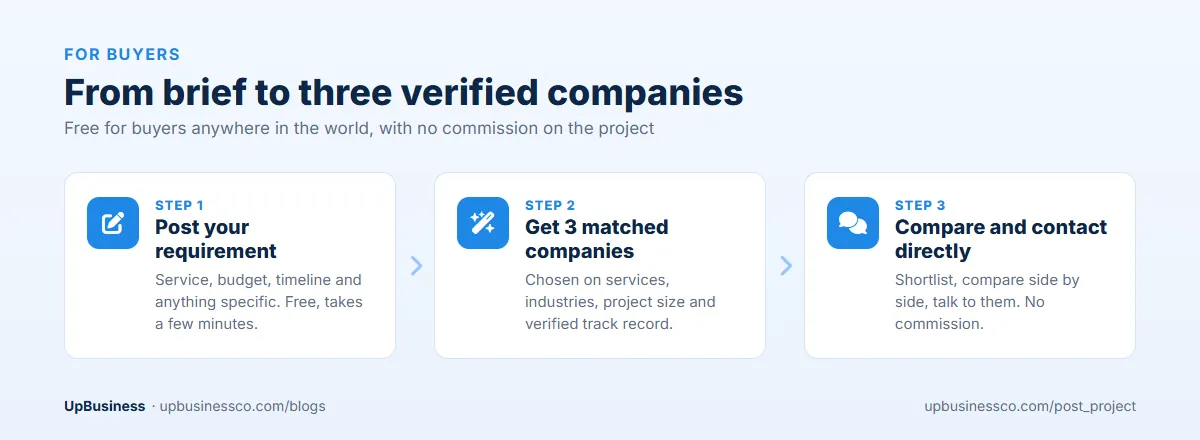
- Post your requirement: the service, a rough budget, the timeline and anything specific, such as a tech stack or a time zone you need overlap with.
- Get three partner companies matched on their services, industries, project size and verified track record.
- Shortlist, compare them side by side, and contact them directly. There's no proposal bidding war and no fee on top of what you agree.
Before you post, our software project brief template helps you write a brief that gets useful replies.
Post your requirement free and get 3 verified companies
Questions to Ask Before You Sign With Any Company
Verification tells you a company is real and has done the work it claims. It can't tell you whether it's right for your project, so these are the questions worth asking on the first call, wherever you found the company.
- Who exactly will work on my project, and are they employees or subcontractors? Ask for names and roles, and what happens if one of them leaves halfway through.
- Can I speak to a client whose project was similar to mine in size and type? A reference from a much bigger or much smaller project tells you less than you'd think.
- How do you handle a change in scope? You want a written change request with a price and a date, not a vague "we'll be flexible".
- Who owns the code, designs and accounts at the end? The answer should be you, in writing, once you've paid, and that includes the source repository, cloud accounts and domain.
- What does support look like after launch, and what does it cost per month?
- How will we pay? Milestones tied to delivered and accepted work protect both sides far better than a large upfront payment.
Our software development contract checklist covers the clauses that turn those answers into something you can enforce, and the guide to comparing proposals helps when the quotes look nothing alike.
Other Upwork Alternatives, by What You're Hiring
There isn't one replacement for Upwork, because people leave it for different reasons. It helps to work out which of these you actually need before you sign up anywhere.
| If you need | The model that fits | Examples |
|---|---|---|
| A packaged task at a fixed price, delivered in days | Gig marketplace | Fiverr |
| One senior individual to join your existing team | Vetted talent network | Toptal |
| Bids from many freelancers on an open job post | Freelance marketplace | Freelancer.com, Guru, PeoplePerHour |
| A team that owns a whole project from scope to support | Verified company matching | UpBusiness |
We've written separate comparisons if you're weighing one of these up: our Fiverr alternative guide covers packaged gigs against full projects, and the Toptal alternative guide looks at hiring one vetted person against a vetted team.
Running an Agency? List Without Commission
If you're an agency looking for an Upwork alternative to win clients, UpBusiness works differently from a bidding marketplace. Listing is free, there's no commission on the projects you win, and buyers come to you through matched briefs rather than a race to the lowest proposal. You'll go through the same five-step onboarding as everyone else, and a strong TrustScore is what moves you up.