

Browse our curated list of Software Development Companies
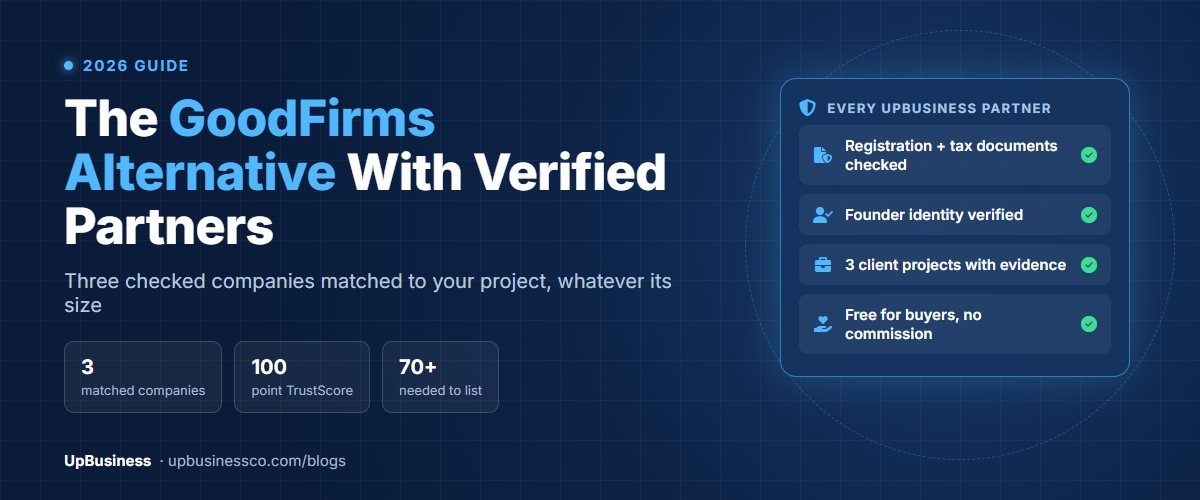
UpBusiness is a GoodFirms alternative for buyers who want a short list of checked companies instead of a long directory to research. You describe your project once and get three partner companies matched to it, each of which has been through a five-step onboarding where our team reviews its registration documents, its founder's identity and three real client projects. Buyers use it free, there's no commission on the deal, and it works for companies and buyers anywhere in the world.
If you only have a minute
- Every UpBusiness partner company needs a TrustScore of 70 or more out of 100 to be listed, and we publish exactly how that score is built.
- Each company submits three client projects with evidence, and we can email those clients to confirm the work.
- You get three matched companies for your brief, free, whatever the size of your project.
- You can shortlist companies, compare them side by side and share the list with your team.
Why Buyers Look for a GoodFirms Alternative
GoodFirms describes itself as a research-led marketplace used by enterprise buyers sourcing partners for engagements of $10K to $1M+, and it earns money from sponsored placements and PRO Verified plans[1]. That suits a large company running a formal search for a partner, but many buyers have a smaller project, less time, or simply want someone to narrow the field for them.
That's the gap UpBusiness fills. Instead of handing you a ranked directory, we match your brief to three companies that have already been checked, and you take it from there.
UpBusiness vs GoodFirms at a Glance
| UpBusiness | GoodFirms | |
|---|---|---|
| How you find companies | Post one brief and get 3 matched companies, or browse categories ranked by TrustScore | Browse a directory and its rankings |
| Project size | Each company states its own minimum project size, so small and large projects both get matches | Built around engagements of $10K to $1M+ |
| How the score works | TrustScore out of 100 with the points for every part published | Leader Matrix and star ratings |
| Client projects | Three per company, with evidence, and clients can be emailed to confirm | Client reviews |
| Cost for buyers | Free, no commission | Free to browse |
Directory, Marketplace or Matching: Which Do You Need?
Sites for finding a service partner work in three quite different ways, and most of the frustration buyers feel comes from using one built for a different job.
| Model | How it works | Suits | Examples |
|---|---|---|---|
| Ranked directory | You browse long lists sorted by reviews, rankings and paid placement, then contact firms yourself | Buyers with time to research and a formal selection process | GoodFirms, Clutch |
| Freelance marketplace | You post a job and individuals bid, with payments held by the platform | Small, well-defined tasks | Upwork, Fiverr |
| Verified matching | You describe the project once and get a short list of checked companies that fit it | Buyers who want fewer, better options quickly | UpBusiness |
A directory gives you breadth, which is useful if you're running a long request-for-proposal process and have someone whose job is to research firms. Matching gives you a starting shortlist, which is more useful if you're a founder or a marketing manager trying to get a project moving alongside everything else. If you're also looking at freelance marketplaces, our Upwork alternative guide covers when a single freelancer is the better hire.
A Trust Score You Can Actually Read
Most directories show you a rating and ask you to trust it. UpBusiness shows you what the number is made of, so you can decide how much weight to give it.
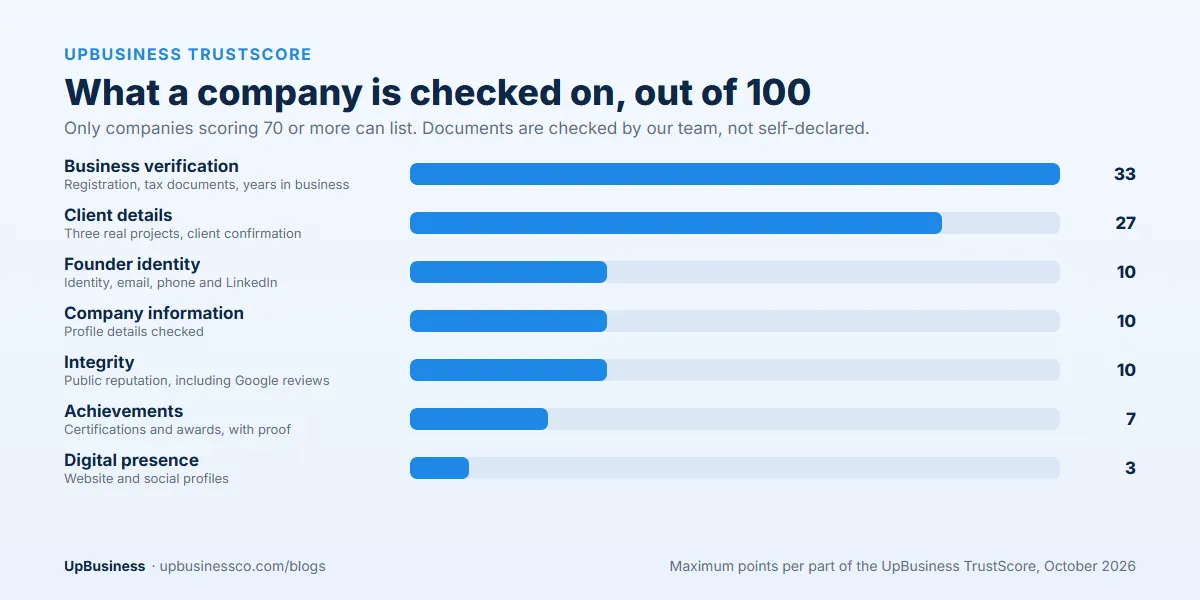
Business verification is the largest part, worth up to 33 points: our team checks the company's incorporation certificate and tax registration and credits its years in business from the date on those documents. Client details come next at up to 27 points, built from three real projects. Founder identity, company information and public reputation (including Google reviews) are worth up to 10 points each, achievements up to 7 and online presence up to 3. A company that scores below 70 doesn't get listed, however much it might want to pay.
Partner companies can choose optional paid plans that appear first in the default "Recommended" order on category pages. Those companies still go through the same onboarding and still need the same TrustScore of 70, so a paid plan changes where a checked company sits on the page, never whether it was checked.
What Each Company Submits Before It Goes Live
Onboarding has five steps, and each one is reviewed by a person rather than accepted automatically.
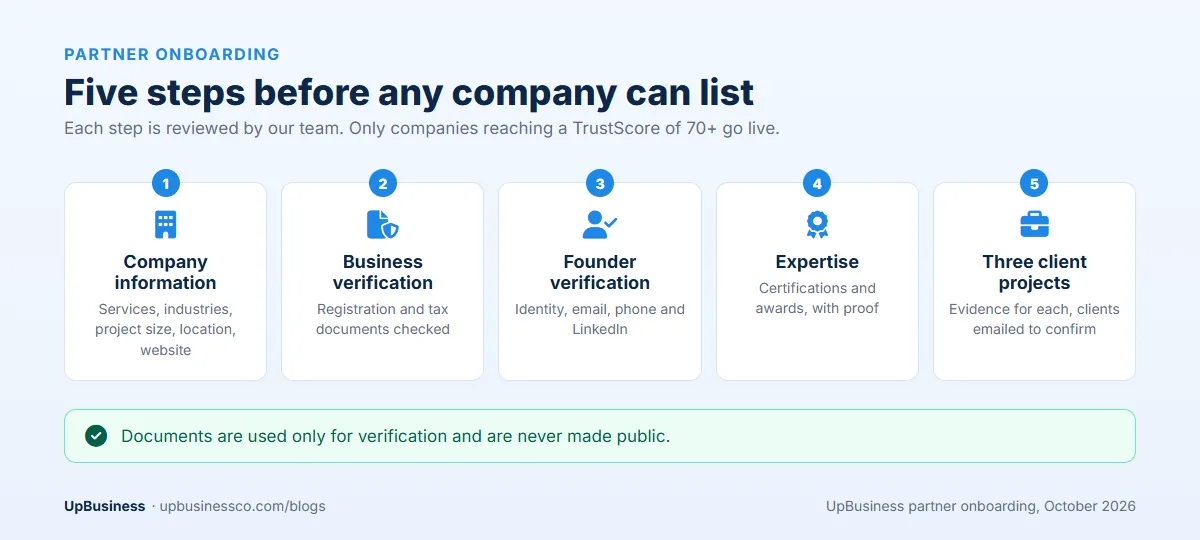
- Company information: services, industries served, typical client size, minimum project size and rate, location, website, social profiles and office photos or video.
- Business verification: the incorporation or registration certificate and, where the company has one, its tax registration certificate.
- Founder verification: the founder's identity, email address, phone number and LinkedIn profile.
- Expertise and achievements: certifications and awards, each with a link or a document as proof.
- Three client projects: for each, the client's name, the project, the services, size, dates and a description, with evidence of the work and proof of the engagement. The company can share the client's email, and we write to that client to confirm the work.
The company chooses which clients appear publicly, and the documents are used only for verification, which is why companies share real work with us rather than a page of logos.
Projects of Any Size Get a Match
Because every partner company sets its own minimum project size during onboarding, the matching can send a modest website rebuild to companies that take on modest projects and a large platform build to companies set up for that. You don't have to guess from a directory listing whether a firm will even reply to a smaller brief.
Post the requirement with a rough budget and timeline, and UpBusiness recommends the three companies best suited to it based on their services, industries, project size and verified track record. You then contact them directly, with no middleman and no commission.
If you want to sharpen the brief first, our software project brief template covers what to include, and when proposals arrive, our guide on how to compare software development proposals helps you line them up.
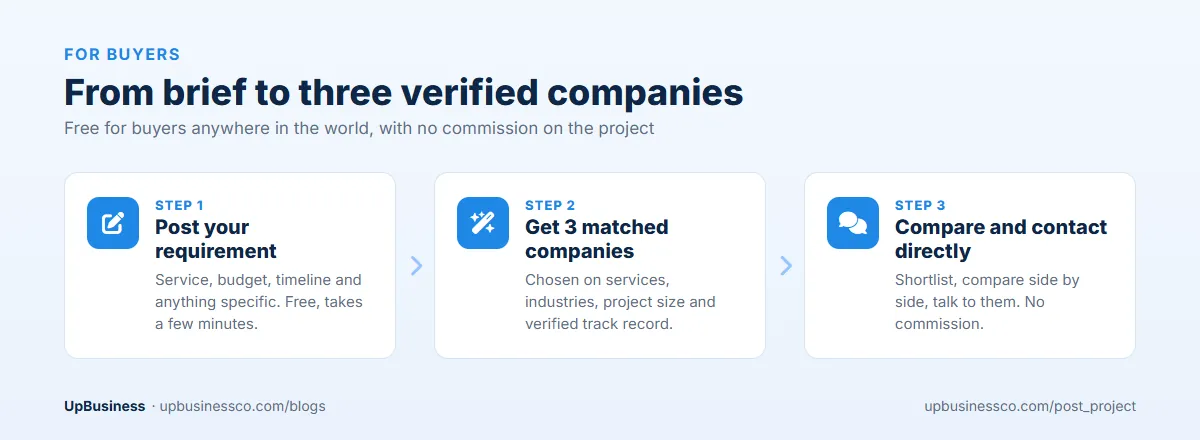
Post your requirement free and get 3 verified partner companies
How to Read Any Rating Without Being Misled
Whichever site you use, a score is only as good as what's behind it. A few minutes on each of these will tell you far more than the star rating does.
- Look at when the reviews were written. Ten reviews from four years ago say little about a company whose senior team may have changed since.
- Check whether the reviewed projects resemble yours. A firm with great reviews for $200,000 enterprise builds may not be set up for a $15,000 website, and the reverse is just as true.
- Find out whether a listing is sponsored. Paid placement is normal on most directories, including ours for already-verified companies, but you should know which positions were bought.
- Ask for one reference you choose from the company's client list, not one it picks for you.
- Check the company's registration yourself in its country's public register if the project is large. It takes ten minutes and rules out the worst cases.
On UpBusiness, the TrustScore breakdown above shows which of these we've already checked, and the shortlist lets you add your own notes on the rest.
A Four-Week Way to Choose a Partner Company
Buyers who take months to choose a partner usually haven't decided how they'll decide. A simple four-week plan keeps it moving without cutting corners.
- Week one: write a one-page brief with the problem, the must-have features, a budget range and the date that matters. Post it, and add anyone you've found elsewhere to the same shortlist.
- Week two: hold a 30-minute call with each of three to five companies. Notice the questions they ask, because good partners ask about your business before they talk about themselves.
- Week three: ask for written proposals on the same brief and line them up on scope, team, timeline, price and what's excluded. Our guide to comparing proposals shows how to do this fairly.
- Week four: speak to one reference per finalist, then negotiate the contract with your first choice, keeping the second warm until it's signed.
For a small project you can squeeze this into two weeks, and for a large one you might add a paid discovery phase between weeks three and four. Either way, the structure stops the decision drifting while everyone waits for one more quote.
Shortlist and Compare Before You Decide
You can also browse categories yourself and shortlist the companies that interest you. The shortlist puts them side by side on TrustScore, reviews and ratings, industry experience, commercial fit, portfolio quality, case studies and responsiveness. Add your own ratings and notes, save the list, and share a link with your team so everyone is reviewing the same companies.
When GoodFirms Still Makes Sense
If you're an enterprise buyer running a formal search for a large engagement, a wide directory is useful at the very start, because you want to see the whole market before narrowing it down. GoodFirms also reviews software products, so it's helpful when you're still deciding between buying a tool and having something built.
Many buyers use both kinds of site. They browse a directory to understand who's out there, then post one brief on UpBusiness to get three checked companies that fit the budget and timeline, and compare those against anyone else they've found. If you're weighing up other directories as well, our Clutch alternative and DesignRush alternative guides explain how their rankings are built and where UpBusiness checks things differently.