


Browse our curated list of Custom Software Development Companies
To hire a software development company in India from New Zealand, write a short brief and shortlist three to five registered companies. Call their past clients and run a small paid discovery phase first. Ask for an Indian team that starts at 7:00 am India time, because a normal Indian day barely overlaps with yours. Then sign a contract that assigns all code to you in writing, add privacy terms before personal data moves, and pay in New Zealand or US dollars against tested milestones.
This guide covers what is different for New Zealand buyers: the biggest time gap of any major market, Information Privacy Principle 12, the commissioning rule in New Zealand copyright law, GST on imported services and a worked cost example in New Zealand dollars. For the general case for outsourcing, read our guide to outsourcing software development to India. If your group also buys from Australia, our Australia guide covers the Australian rules.
Key takeaways
- India is 7 hours 30 minutes behind New Zealand in summer and 6 hours 30 minutes behind in winter. A standard Indian working day gives you less than one shared hour, so ask for an early Indian shift.
- With a 7:00 am India start, you share about 2.5 hours in summer and 3.5 hours in winter, all in your afternoon.
- Information Privacy Principle 12 controls personal data sent overseas. If the Indian company only handles data for you, you stay responsible for it under section 11 of the Privacy Act 2020.
- New Zealand still has a commissioning rule, so a paid-for program may belong to you by default. Indian law has no such rule, so get a written, worldwide assignment anyway.
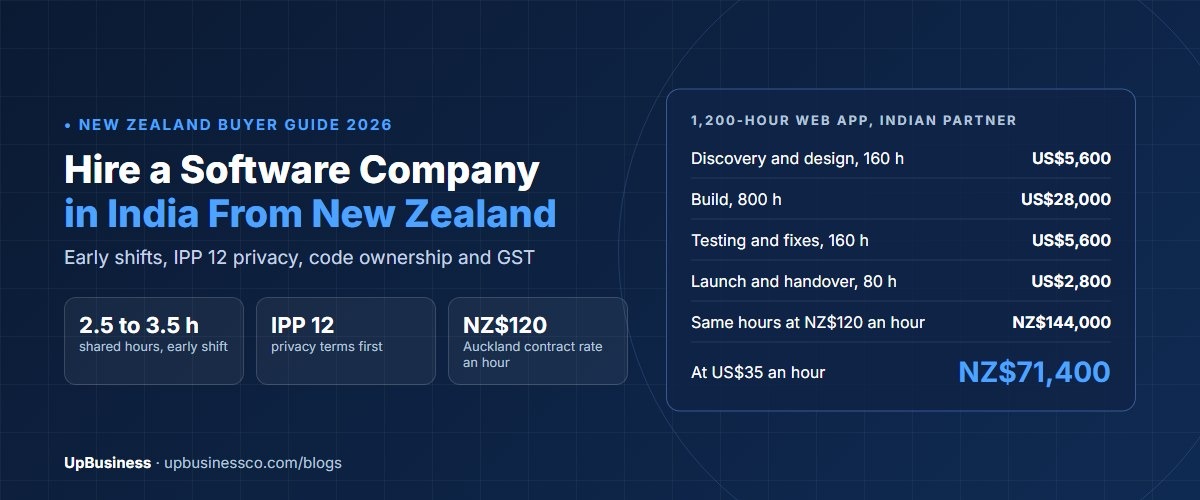
- A 1,200-hour build costs about NZ$144,000 at NZ$120 an hour and about NZ$71,400 with an Indian partner at US$35 an hour.
Why New Zealand Companies Hire a Software Development Company in India
The first reason is the size of the talent pool. New Zealand has a small tech workforce, and good senior developers are hard to find outside Auckland and Wellington. An Indian partner can start a full team in two to four weeks, with testers, designers and a project lead included.
The second reason is cost. Contract ads for senior developers on Seek in 2026 often list rates around NZ$120 to NZ$130 an hour plus GST[1]. Indian partner companies usually quote a fraction of that, with project management and testing in the price.
The third reason is shared habits. New Zealand and Indian business English are close, cricket gives every first call an easy start, and many Indian companies already serve clients in Australia and New Zealand. They know the time gap and plan for it.
The trade-off is the clock. India sits further from New Zealand than from the UK, Europe or the Gulf. That gap shapes almost every other decision in this guide.
Partner Company, Freelancers or Your Own Team in India?
| Indian partner company | Indian freelancers | Your own team in India | |
|---|---|---|---|
| Contracts | One for the whole team | One per person | Employment through an employer of record or your own Indian company |
| Who runs the work | The company's project lead | You | Your managers |
| Early shift for your hours | Easy to agree in the contract | Depends on each person | Your call, but harder to staff |
| If someone leaves | The company replaces them | You find someone new | You hire again |
| Setup time | Two to four weeks | One to two weeks per person | Three to six months |
For a first project, a partner company is the simplest choice. One contract covers everyone, and the company handles hiring, payroll and Indian employment law. It's also easier to make an early shift a contract term with a company than with five freelancers. If you need people working only for you for a year or more, read our comparison of dedicated developers and project-based teams.
Working Hours: The Biggest Gap of Any Major Market
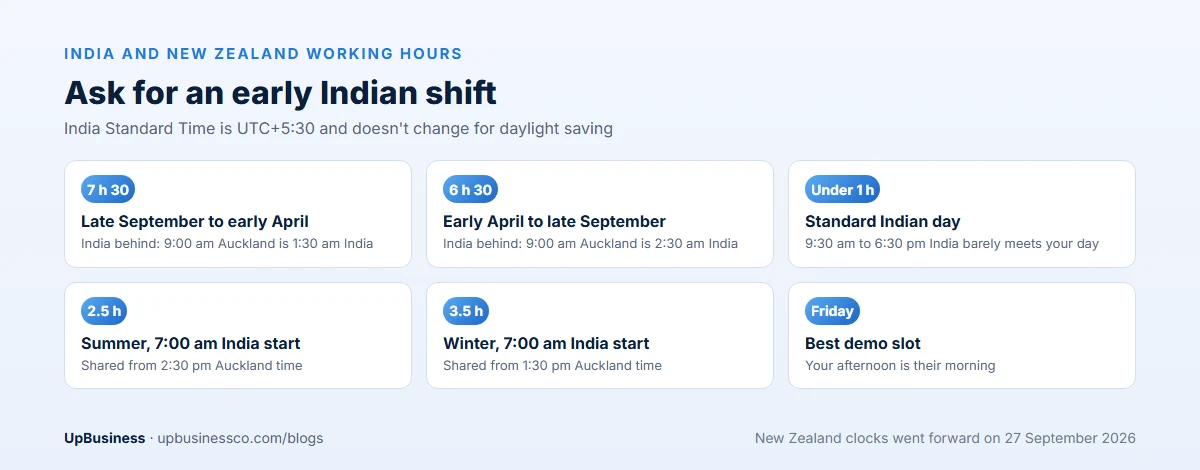
India Standard Time is UTC+5:30 and India doesn't change its clocks. New Zealand moves between NZST (UTC+12) and daylight time, NZDT (UTC+13). New Zealand clocks went forward on 27 September 2026 and go back on 4 April 2027.
- From late September to early April, India is 7 hours 30 minutes behind. 9:00 am in Auckland is 1:30 am in India.
- From early April to late September, India is 6 hours 30 minutes behind. 9:00 am in Auckland is 2:30 am in India.
A typical Indian team works from about 9:30 am to 6:30 pm. In summer that is 5:00 pm to 2:00 am in Auckland, so you share no real working time at all. In winter it starts at 4:00 pm Auckland time, which leaves about one hour.
The fix is an early Indian shift. Many Indian companies that serve Australian and New Zealand clients start at 7:00 am India time. That is 2:30 pm in Auckland in summer and 1:30 pm in winter. You then share about 2.5 hours in summer and 3.5 hours in winter. Put the shift, the shared hours and who attends into the contract, not just the proposal.
Plan your week around the gap too. Your Monday morning is still Sunday evening in India, so the first real overlap of the week is Monday afternoon your time. Your Friday afternoon is Friday morning in India, which makes it a good slot for the weekly demo.
Privacy: Sending Personal Data to India Under IPP 12
New Zealand's Privacy Act 2020 has a specific rule for sending personal information overseas. Information Privacy Principle 12 lets you disclose personal information to a foreign person or company only in set cases[2]. The most common are that the receiver is bound by comparable privacy laws, or that you've agreed contract terms that protect the information in a comparable way. India isn't on any approved list, so most buyers use contract terms.
There is an important exception. If the Indian company only stores or processes the data for you, and doesn't use it for its own purposes, section 11 of the Act treats that as your own use, not a disclosure. IPP 12 then doesn't apply, but you stay fully responsible for what the Indian company does with the data. In practice you need the same protections either way.
The Office of the Privacy Commissioner publishes free model contract clauses and an online agreement builder for overseas transfers[3]. Most Indian companies with Australian or European clients have signed similar terms and won't push back.
Do these five things before data moves:
- Keep personal data out if you can. Developers can build and test most systems with fake or masked data.
- Sign privacy terms. Use the Commissioner's model clauses or equivalent terms on purpose, security, sub-contractors and deletion.
- Limit access. Give the team access only to the systems and data each person needs, and remove it when they leave the project.
- Set a breach clock. A notifiable privacy breach must be reported to the Commissioner as soon as practicable, so the Indian company must tell you within hours, not days.
- Agree deletion. At the end of the project the company deletes your data and confirms it in writing.
On the Indian side, the Digital Personal Data Protection Act 2023 exempts data about people outside India that an Indian company processes for a foreign client under a contract. So New Zealand law and your contract carry the protection.
Contracts and Code Ownership Under New Zealand and Indian Law
New Zealand copyright law has a feature most countries dropped long ago: the commissioning rule. Under section 21(3) of the Copyright Act 1994, if you commission and pay for certain works, including a computer program, you're the first owner of the copyright unless the contract says otherwise[4]. The Court of Appeal applied this to source code in Pacific Software Technology v Perry Group in 2003.
Don't rely on it. The rule only covers work made after the commission, not the company's existing code and libraries. Indian copyright law has no commissioning rule for software, so the Indian company owns the code it writes unless it assigns it. And under Indian law, an assignment that doesn't state its term lasts five years, and one that doesn't state its territory covers India only. So the contract must assign all new code to you in writing, worldwide and for the full term of copyright.
New Zealand also gives authors moral rights, such as the right to object to derogatory treatment of their work. These can be waived in writing. Ask for a waiver from the company and its staff, so you can change and extend the code freely.
Your contract should also cover:
- Disputes. India has declared New Zealand a reciprocating territory, so a money judgment from New Zealand's senior courts can be enforced in an Indian court. That process is still slow, so many buyers choose New Zealand law with arbitration in Auckland or a neutral seat such as Singapore. Both countries enforce awards under the New York Convention.
- Working hours. The early shift, the shared hours and the named people who attend.
- Open source. The company lists every open-source library and its licence.
- Handover. You get code, passwords, cloud accounts and documents at each milestone.
- Exit. Either side can end with 30 days' notice, with help to hand over to a new team.
Our software development contract checklist has the full clause list.
GST, Tax and Invoices
The Indian company won't charge New Zealand GST. For most GST-registered businesses, that's the end of it. New Zealand's reverse charge on imported services only applies if less than 95% of your supplies are taxable, for example in financial services or residential rentals[5]. If that's you, you account for GST at 15% on the fee in your return.
Ordinary fees for building software for you usually carry no New Zealand non-resident withholding tax. Licence fees for existing software can count as royalties, which are treated differently. If part of the price is a licence for the company's own product, ask your tax adviser before you sign.
On the Indian side, the project is an export of services. The company normally charges no Indian GST and marks the invoice as an export. Ask for invoices with the company's legal name, address, GST number and bank details, and keep them for seven years in line with Inland Revenue's record rules.
Paying an Indian Company From New Zealand
Most Indian companies accept US dollars by bank transfer, and many accept New Zealand dollars. If you price in New Zealand dollars, you carry no exchange-rate risk. If you price in US dollars, a weaker kiwi dollar makes the project dearer, so check the rate before each milestone. Pay against milestones: 10% to 20% up front, then a payment after each delivery you have tested. Never pay into a personal account, and confirm any change of bank details by phone.
What It Costs: A Worked Example in New Zealand Dollars
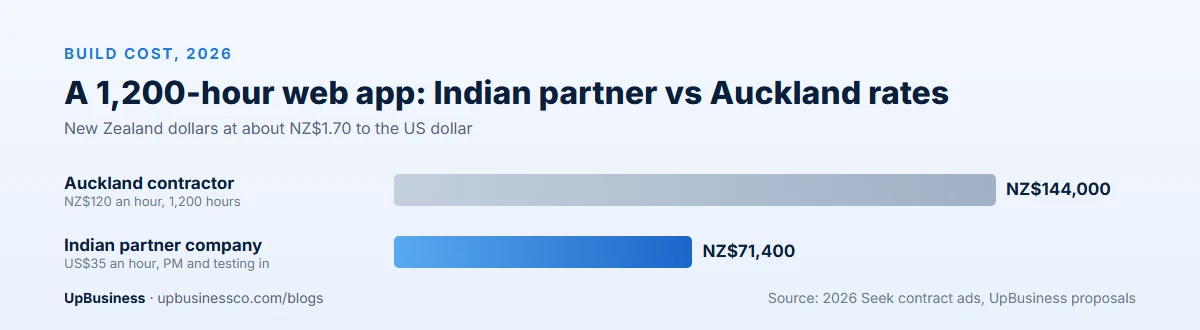
Take a web application with a customer portal, an admin area and payments. It needs about 1,200 hours of work.
| Phase | Hours | Indian partner at US$35 an hour | Auckland contractor at NZ$120 an hour |
|---|---|---|---|
| Discovery and design | 160 | US$5,600 | NZ$19,200 |
| Build | 800 | US$28,000 | NZ$96,000 |
| Testing and fixes | 160 | US$5,600 | NZ$19,200 |
| Launch and handover | 80 | US$2,800 | NZ$9,600 |
| Total | 1,200 | US$42,000 (about NZ$71,400) | NZ$144,000 |
The New Zealand figure uses NZ$120 an hour, the low end of the contract rates in 2026 Seek ads, before GST. The conversion uses about NZ$1.70 to the US dollar. Your quotes will differ, but the gap is usually close to two times. A New Zealand agency usually charges more than a single contractor, because its rate covers project management and testing too.
Two things eat into the saving. The first is your own time: someone must write the brief, answer questions and test the work, and with a short overlap that person must write clearly. The second is rework when the brief is vague. A clear software project brief is the cheapest protection. Our software development cost benchmark has Indian rates by role.
Working Well With a Short Overlap
With only two or three shared hours, the way you work matters more than for a European buyer. These habits make the gap an advantage, because the Indian team works while you sleep:
- Write tasks the night before. Add clear tickets with screenshots and acceptance tests before you finish. The Indian team starts on them the next morning, their time.
- Use the overlap for decisions only. Keep a 15-minute call for blockers and questions. Status updates go in writing.
- Record short videos. A two-minute screen recording explains a bug faster than a long message.
- Name one decision maker on each side. If questions wait a day for an answer, a two-week sprint loses two days.
- List holidays for both countries. Diwali and Holi can take a few days out of a sprint, and Waitangi Day, Matariki and Anzac Day are working days in India.
Building for New Zealand Users
- Te reo Māori. Names and place names use macrons, such as Māori and Whangārei. Ask for full Unicode support in forms, search and sorting, and test it.
- Addresses. New Zealand addresses use four-digit postcodes and rural delivery numbers. Use an address lookup such as the NZ Post or LINZ data, rather than a UK-style form.
- Accessibility. Government agencies must meet the NZ Government Web Accessibility Standard, based on WCAG. For any product, write WCAG 2.2 level AA into the acceptance tests.
- Payments and GST. Prices shown to consumers must include GST. Agree how the system shows GST and which payment providers it supports before the build.
- Hosting. Public sector and some health work may need data hosted in New Zealand or Australia. Settle the hosting region early.
How to Check an Indian Company Before You Sign
- Check the registration. Ask for the company's CIN and look it up on India's Ministry of Corporate Affairs site. Check the GST number too. Our guide on how to verify an Indian software company shows each step.
- Call two past clients in New Zealand or Australia. Ask how the time gap worked in practice and what went wrong.
- Test the early shift before you sign. Book the first calls at 2:30 pm your time and see who joins and how prepared they are.
- Meet the actual team on video. Ask the developers to walk you through a past project.
- Ask about security. ISO 27001 is the most common certificate. Government buyers should also check the New Zealand Information Security Manual requirements.
- Run a paid discovery phase. Two to four weeks, fixed price, with a written plan at the end.
Our due diligence checklist and questions to ask a software company go deeper. When proposals arrive, use our software development company scorecard to compare finalists.
Mistakes New Zealand Buyers Make
- Accepting a standard Indian day. Without an early shift, every question waits a full day.
- Relying on the commissioning rule. It doesn't cover existing code and may not hold under Indian law. Get a written assignment.
- Sending live customer data on day one. Sign the privacy terms first and use masked data where you can.
- Copying an Australian contract. Australian templates cite the Australian Privacy Principles and Australian GST. Use New Zealand law, IPP 12 terms and New Zealand GST wording.
- Picking the lowest quote. A quote far below the rest usually means missed scope or junior staff.
Red Flags
- The company won't commit to an early shift in writing.
- It won't put the code assignment and moral rights waiver in the contract.
- It won't sign privacy terms or agree a breach notice period.
- It won't let you meet the developers before you sign.
- It asks for most of the money up front.
- It keeps the code in its own accounts.
Your First 30 Days
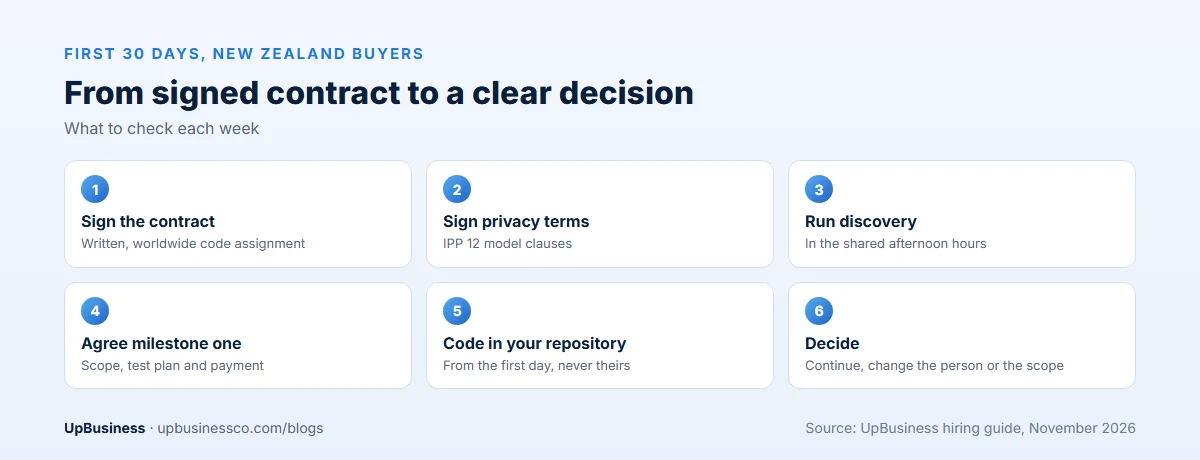
- Week 1: Sign the contract and privacy terms. Give access to your code and cloud accounts, in your name.
- Week 2: Run discovery workshops in the shared afternoon hours. The company writes up the scope, plan and risks.
- Week 3: Agree the first milestone and how you'll test it. Start the first sprint.
- Week 4: See the first demo. Check the code is in your repository and the team is the one you were promised.
What UpBusiness Partner Data Shows
We looked at the 46 partner companies on our software development page on 31 October 2026, most of them based in India.
- Their TrustScores run from 70.17 to 75.85 out of 100, with a median of 71.67.
- Of the 45 that report an average project size, 22 average $5,000 or less. The median is $10,000.
- 38 of the 46 have 50 employees or fewer.
On our custom software development page, 12 companies are listed and 6 of them list custom software as a core service. Smaller companies suit a first project, because your work gets senior attention and an early shift is easier to arrange. If your group also has a US parent or office, see our guide for US buyers.
How Hiring Works on UpBusiness
Every partner company on UpBusiness has passed five checks reviewed by our team: company details, registration and tax papers, the founder's identity, expertise and three client projects with evidence. Only companies with a TrustScore of 70 or more are listed.
- Post your requirement with the service, a rough budget and that you're based in New Zealand.
- Get three partner companies matched to your budget, service and industry.
- Compare them side by side, meet them on video and contract with the one you choose. Buyers pay nothing, and there's no commission on the project.
Then follow the steps in this guide: an early shift, privacy terms, a written assignment, milestones and a paid discovery phase. That's how New Zealand companies get the saving without the surprises.