


Browse our curated list of Software Development Companies
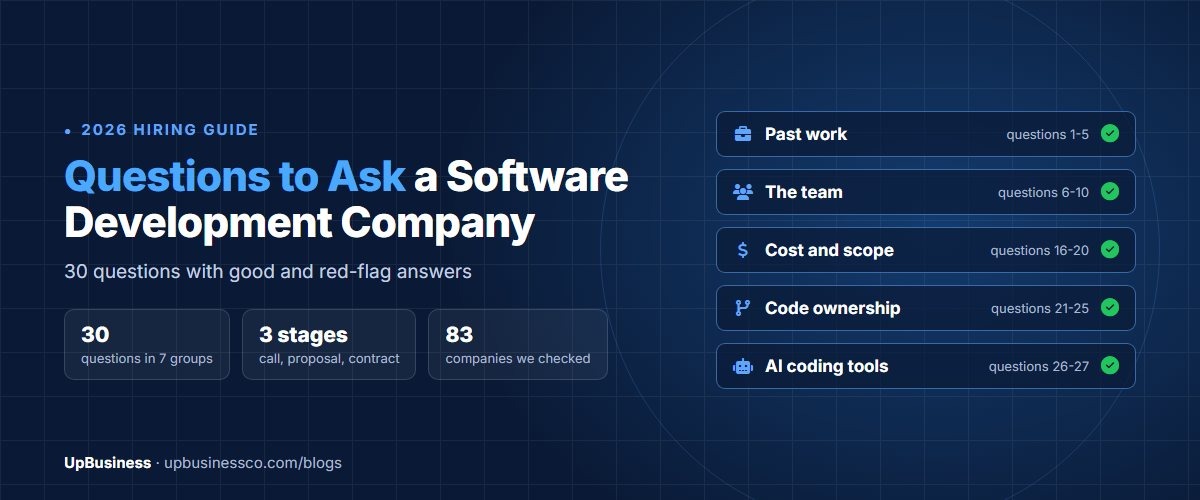
The questions to ask a software development company fall into seven groups. They cover past work, the team, process, cost, code ownership and security, AI coding tools, and support after launch. The 30 questions below cover all seven. For each one, you'll see what a good answer sounds like and which answer should worry you.
This guide is for the person doing the hiring. That's usually a founder, an operations head, an IT manager or a product owner who needs an outside company to build software. Most lists on this topic are written by agencies that want you to pick them. This one is written from the buyer's side. It uses what we've learned from checking every company that applies to list on UpBusiness.
Key takeaways
- Ask about the people, not the company. "Who will write the code, and are they employees?" tells you more than any portfolio.
- In our analysis of 83 partner company applications, 25 were rejected. Client confirmation was the weakest area. Speak to two past clients yourself before you sign.
- Get the answers on cost, code ownership and exit in writing. Under Indian copyright law, the company that writes the code owns it unless the contract assigns it to you[1].
- 84% of developers now use or plan to use AI coding tools[2]. Ask how that code gets reviewed before it reaches you.
Which Questions to Ask a Software Development Company First?
Ask questions that make the company show evidence instead of making promises. Six questions matter most. Which past project is closest to yours? Who exactly will work on it? How are scope changes priced? Who owns the code from day one? How is AI-written code reviewed? And what happens if you want to leave? A good company answers these with names, numbers and documents.
A vague answer isn't always a bad sign on a first call. Sales teams don't always know the delivery details. But by the time you have a proposal, every answer below should be specific. If it still isn't, that tells you how the project will run.
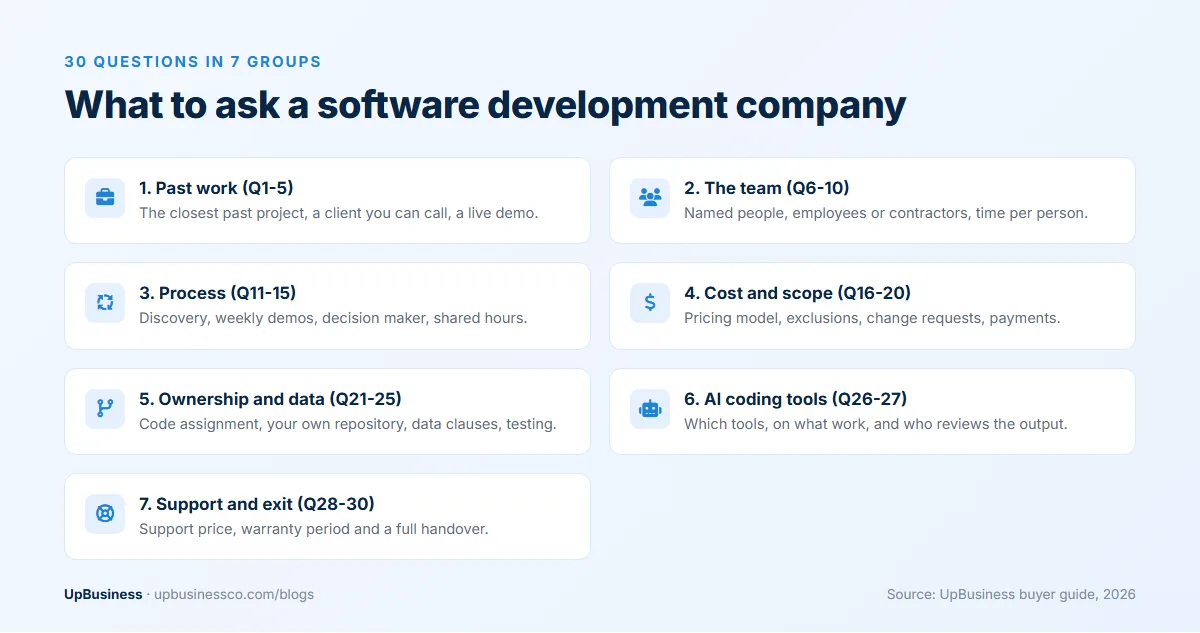
When to Ask Each Question
You don't need to ask all 30 questions in one meeting. Spread them across the hiring process. Early questions filter out poor fits fast. Later ones protect you before you sign.
| Stage | Questions | What you're checking |
|---|---|---|
| First call (30 minutes) | 1 to 10 | Relevant experience and who will do the work |
| Proposal review | 11 to 20 | Process, communication, cost and scope changes |
| Before you sign | 21 to 30 | Code ownership, security, AI tools, support and exit |
Send the same questions to every company on your shortlist, on the same day. Then you're comparing like with like. If you haven't written a brief yet, start with our software project brief template. Companies answer much better when they know what you want built.
Questions About Experience and Past Work
1. Which past project is closest to ours, and why?
This is the best opening question. A good company picks one project and explains the overlap. It might be the same industry, the same type of users or the same hard problem, such as payments or offline sync.
Red flag: a long list of logos with no link to your project. "We've worked with 200 clients" doesn't answer the question.
2. Can I speak to that client?
Case studies are written by the company. A client call is not. Ask for two clients from the last 18 months, ideally on projects like yours. Then call them yourself and ask what went wrong and how it was fixed.
We learned this the hard way. When we emailed reference requests to the clients that applicants named, only 17 of 159 replied. Email references mostly go unanswered. Pick up the phone instead.
3. Can you show me the product live?
Screenshots can come from anywhere. A live app, a public website or a recorded demo with real data is much harder to fake. If the work is under a non-disclosure agreement, a good company will say so and offer a different example.
4. Tell me about a project that went badly. What did you change afterwards?
Every company has had a difficult project. A good answer is honest and specific. It says what broke and what it cost the client. Then it says what the company now does differently. "We've never had a failed project" usually means the person isn't being straight with you.
5. How long do your clients usually stay with you?
Long relationships suggest clients stayed happy after launch. Ask how many clients from two years ago still work with them. Strong companies know this number roughly.
Questions About the Team
The people matter more than the company name. A strong agency can still put a junior team on your project. These five questions find out who you're really hiring.
6. Who will work on our project, by name and role?
Ask for names, roles and years of experience for the project lead, the main developers and the tester. Then ask to meet the project lead before you sign. That's the person you'll speak to every week.
7. Are they employees or contractors?
Some companies win work and then pass it to freelancers. That isn't always bad, but you should know. Employees are easier to replace on short notice, and the company is more clearly responsible for them.
8. How much of their time goes to our project?
"Dedicated" can mean full-time or two hours a day. Ask for a percentage per person. A developer split across four clients will move slowly on yours.
9. What happens if a key person leaves?
People do leave in the middle of projects. Listen for notice, handover and who pays for the new person to catch up. The strongest companies keep documentation current so that a replacement can start within a week.
10. Can we approve changes to the team?
You should be able to interview anyone new who joins in a senior role. Put this right in the contract. A promise on a call is easy to forget.
Questions About Process and Communication
11. What happens in the first two weeks?
Good companies start with discovery. That means workshops to agree what the software must do, sketches of the main screens and a first plan. If the answer is "we start coding on day one", expect surprises later. Nobody has checked the plan.
12. How do you work week to week?
Most companies say they use Agile. That's a way of building software in short cycles, usually one or two weeks, with a demo at the end of each. The label means little on its own. Ask what you'll actually see each week. You want a working demo you can click through. A status report alone shows very little.
13. Who is my main contact, and can they make decisions?
Some contacts only pass messages along. That slows everything down. You want a project lead who can agree small changes without going back to sales.
14. When will our working hours overlap?
This matters most if the company is in a different time zone. India Standard Time is UTC+5:30 all year, with no daylight saving. A normal Indian working day gives about four to five shared hours with London. It gives almost none with the US East Coast, so many Indian teams work a later shift for US clients. Ask which hours the team will be online for you, and put them in the contract.
15. How do you handle disagreements?
Ask for a real example. The better companies escalate early, write down the options and let you decide. A poor one goes quiet and then delivers something you didn't agree to.
Questions About Cost, Scope and Payment
Price causes more fights than code. These questions make the hidden costs visible before you sign. Our guide to comparing software development proposals shows how to line the answers up side by side.
16. Is this fixed price or time and materials, and why?
Fixed price means one agreed price for agreed work. Time and materials means you pay for the hours actually worked. Fixed price suits a small, clear project. Time and materials suits work that will change as you learn. A good company explains why it chose one for your project.
17. What's not included in this price?
This one question often saves the most money. Common gaps include hosting, app store fees, third-party software licences, design work, testing on extra devices and support after launch. Ask for the list in writing.
18. How do you price a change in scope?
Changes will happen. The question is how they're priced. A good answer is a written change request with a cost and a new date, signed by you before work starts. A red flag is "we'll be flexible". That often ends in a large bill.
19. What is the payment schedule?
Payments should follow delivered work, not the calendar. A common pattern is a small deposit and then payments when each agreed milestone is accepted. Be careful with requests for more than about a third upfront on a new relationship.
20. How did you arrive at this estimate?
Ask to see the breakdown by feature or by stage. An estimate built from a list of features is more reliable than one round number. For a sense of typical project sizes, our software development cost benchmark found a median typical project of $5,300 across 53 approved partner companies.
Questions About Code Ownership, Security and Data
21. Will we own the code, designs and accounts?
Don't assume you do. Under India's Copyright Act, the author of the work is the first owner unless the work is made under a contract of employment[1]. An outside company is not your employee. So you need a written assignment of the code, designs and documentation to you. Our software development contract checklist covers the exact clauses.
22. Will the code live in a repository we own from the start?
A repository is the online store for your code, such as GitHub or GitLab. The safest setup is one that you create and then invite the company into. That way you never have to ask for your own code back.
23. How do you protect our data and passwords?
Ask who can see production data, where passwords and keys are stored, and how access is removed when someone leaves. Look for a password manager and a separate login for each person.
24. Will you sign a data processing agreement?
If your software handles personal data, you stay responsible for it, even when another company processes it for you. India's Digital Personal Data Protection Act places that duty on the business that decides why the data is used[3]. So the company you hire should sign a clause on security, breach reporting and deleting data at the end. If you're in Europe or the UK, your own data law will ask for the same thing.
25. How do you test before each release?
Good answers mention automatic tests that run on every change, a person who tests by hand, and a security check before launch. If testing is "the developers check their own work", budget for problems.
Questions About AI Coding Tools
This group is new, and most question lists still skip it. Nearly every team now uses AI to write some code. That can save you money. It can also hide mistakes. In the 2025 Stack Overflow survey, 46% of developers said they distrust the accuracy of AI tools. And 66% named "AI solutions that are almost right, but not quite" as their biggest frustration[2].
26. Which AI tools does your team use, and on what?
You want an open answer. A good company names its tools and says where it uses them, for example writing tests or first drafts of simple screens. It should also say where it doesn't use them, such as payment logic.
27. Who reviews AI-written code, and does any of our code go into those tools?
Every line should be reviewed by a person before it's merged. Also ask whether your code or data is pasted into AI tools that might store it. A careful company uses business plans that don't train on your data, and can tell you which ones.
Questions About Support and Exit
28. What does support cost after launch?
Most software needs fixes and updates for years. Ask for a monthly support price, what it includes and how fast they respond to an urgent problem. Get the response times in writing.
29. How long is the warranty period?
A warranty period is time after launch when the company fixes its own bugs for free. Thirty to ninety days is common. Ask what counts as a bug and what counts as a new request.
30. If we move to another company, what will you hand over?
Companies like this question least. Ask it anyway. Expect the code, documentation, passwords and design files, plus a handover call. Ask for a notice period and a fair exit fee in the contract. You may never use it, but you'll be glad it's there.
Extra Questions When You Hire an Offshore Company
Hiring a company in another country adds three more topics. These matter most for buyers in the US, the UK, Europe and Australia hiring in India.
- Payments: Which currency do you invoice in, and who pays the bank and transfer fees?
- Law: Which country's law governs the contract, and where would a dispute be settled?
- Visits: Can someone from the team visit for the kickoff, and who pays for it?
Our guide to hiring a software development company in India from the US covers tax forms, contracts and working hours in detail.
How to Score the Answers
Notes from four calls blur together fast. A simple score keeps the comparison fair. Give each answer 0, 1 or 2 points.
| Score | What it means | Example for question 6 |
|---|---|---|
| 2 | Specific, with evidence you can check | Names, roles and CVs, plus a call with the project lead |
| 1 | Reasonable but vague | "A senior team of five" with no names yet |
| 0 | Missing, dodged or worrying | "We'll assign the team after you pay the deposit" |
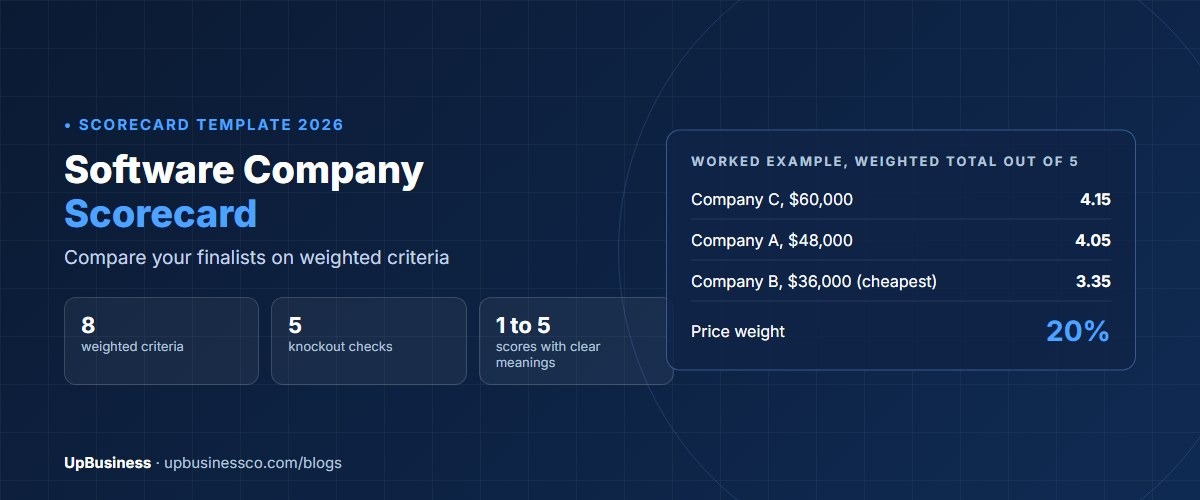
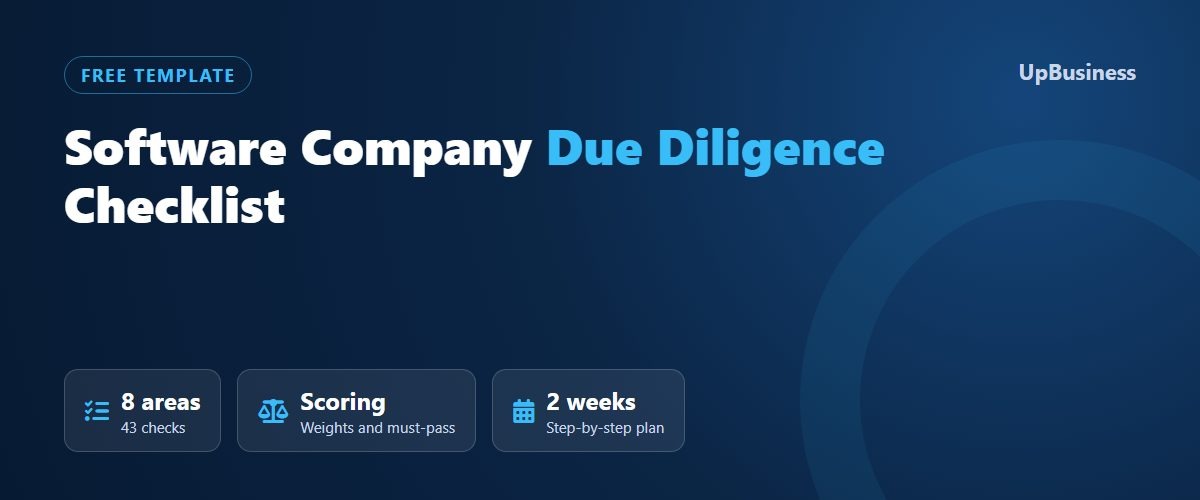
Weight two groups double: the team (questions 6 to 10) and code ownership (21 to 25). Those are the hardest to fix after you've signed. Any 0 on questions 2, 21 or 22 should end the process, whatever the total. For a full scoring template with 43 checks, use our software company due diligence checklist.
Red-Flag Answers That Should End the Call
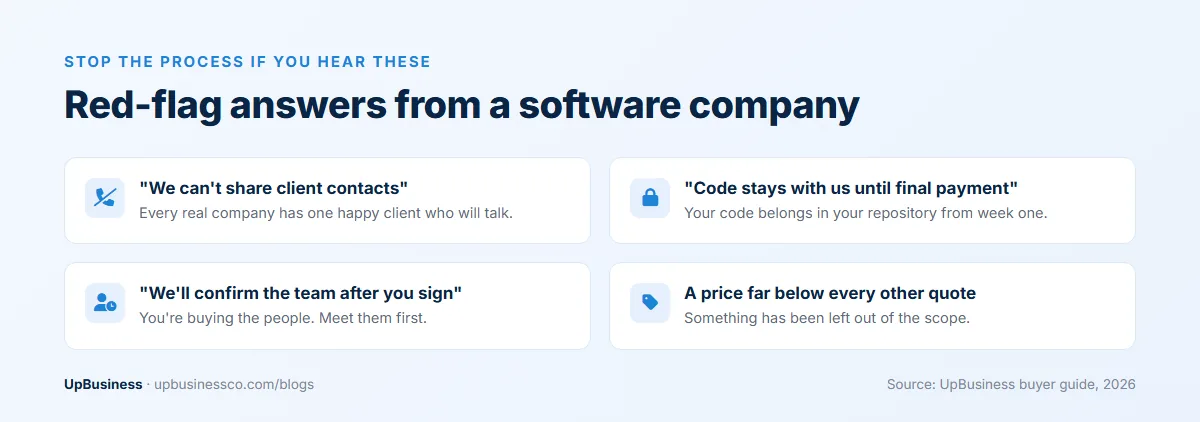
Some answers are serious enough to stop. In our experience, these are the ones that predict trouble:
- "We can't share client contacts." Every company can find one happy client willing to talk.
- "The code stays on our servers until the final payment." Your code should be in your repository from week one.
- "We'll confirm the team after you sign." You're buying the people. Meet them first.
- A price far below every other quote with no clear reason. Something has been left out.
- Pressure to sign this week to keep a discount.
What Our Verification Data Shows
Every company that applies to list on UpBusiness goes through document and portfolio checks first. As of October 2026, 83 companies had applied. We approved 53 and rejected 25, and approval took a median of 10 days.
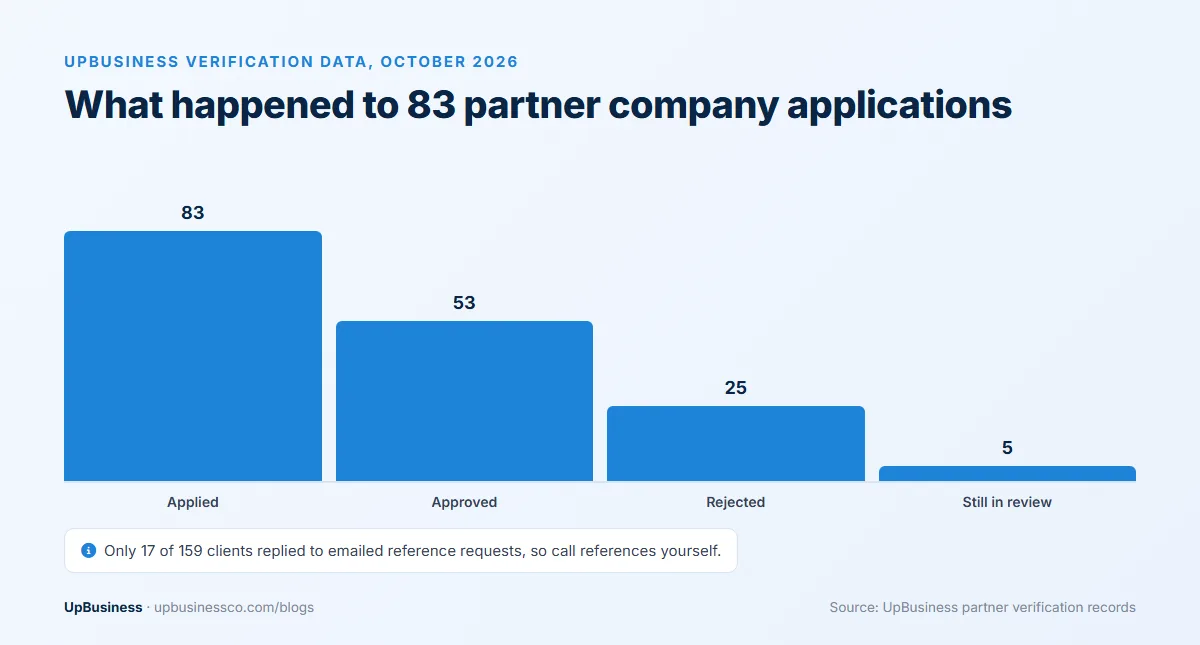
Three findings shape the questions above. First, documents were rarely the problem for genuine companies. Of the 53 approved, 50 passed the GST check. Second, client confirmation was the weakest area. Questions 2 and 3 exist for that reason. Third, rejection isn't always final. Of 8 rejected applicants who fixed their gaps and resubmitted, 5 were approved. So a company that answers a hard question with "we'll send that document tomorrow" and then does send it is a good sign.
The same data shows how varied the market is. Among approved companies, the median minimum project was $530 and the median typical project was $5,300. A small studio and a 200-person firm will answer these questions very differently. Neither is wrong, but you should know which one you're talking to.
If you want to check a company's public records too, our guide on how to verify a software development company in India walks through each free check. If your project is an AI build, use our separate questions to ask an AI development company. It covers data, models and accuracy.
How UpBusiness Answers the First Questions for You
Asking 30 questions to five companies is a lot of calls. UpBusiness does part of that work before you speak to anyone, so you can spend your calls on the questions only the company can answer.
| Question | What UpBusiness already does | What you still ask |
|---|---|---|
| Is this a real, registered company? | Checks incorporation and GST documents before listing | Nothing, unless the contract is large |
| 1. Which past project is closest to ours? | Shows each company's portfolio, case studies and industries on its profile | Why that project fits yours |
| Does the company work at our budget? | Matches you on your budget against each company's project sizes | What's not in the price (question 17) |
| Which finalist is strongest? | Side-by-side compare on TrustScore, industry, commercial fit, portfolio, case studies and responsiveness | Team, code ownership and exit (6 to 10, 21 to 30) |
You can save companies to a shortlist, add private notes after each call and share the shortlist link with your co-founder or finance team. That keeps everyone looking at the same scores.