


Browse our curated list of Backend Development Companies
To hire Node.js developers, start with what the back end must do: the API, the data, the users and the load. Then screen for TypeScript, a framework such as NestJS, Fastify or Express, database skills, security and testing. Run a short paid test task, keep the code in your own repository and start with a two-week trial. In 2026, US government contract ceiling rates for back end developers have a median of $121 an hour, while offshore partner companies commonly bill $25 to $50 an hour for Node.js work.
This guide is for buyers who need Node.js work done well: founders, product owners and managers. It covers sourced rates, the skills that matter in 2026, a screening process, 12 interview questions with good and weak answers, security checks, red flags and a cost example.
Key takeaways
- Node.js is the most used web technology in the 2025 Stack Overflow Developer Survey, so there are many developers to choose from and a wide range of quality.
- US federal contract ceiling rates have a median of $121 an hour for back end developers and $124 for full-stack developers.
- Offshore partner companies commonly charge $25 to $50 an hour for Node.js, with project management and testing often included.
- Node.js 20 reached end of life in April 2026. Any project still on it needs an upgrade plan, and new work should use an LTS release.
- npm supply chain attacks are a real risk. Ask how a developer checks packages before adding them.
How to Hire Node.js Developers: The Short Version
- Write a one-page brief. Say what the back end does, which apps use it, the data it stores, the services it connects to and the traffic you expect.
- Pick a hiring model. A freelancer, a dedicated developer from a partner company, or a full project team.
- Shortlist three to five people or companies. Ask each for two production Node.js systems and a code sample.
- Screen in three steps. A 30-minute call, a paid test task and a review of the task with the developer.
- Start with a two-week trial. Code goes into your repository, and servers run in your cloud account.
Node.js Developer Rates in 2026
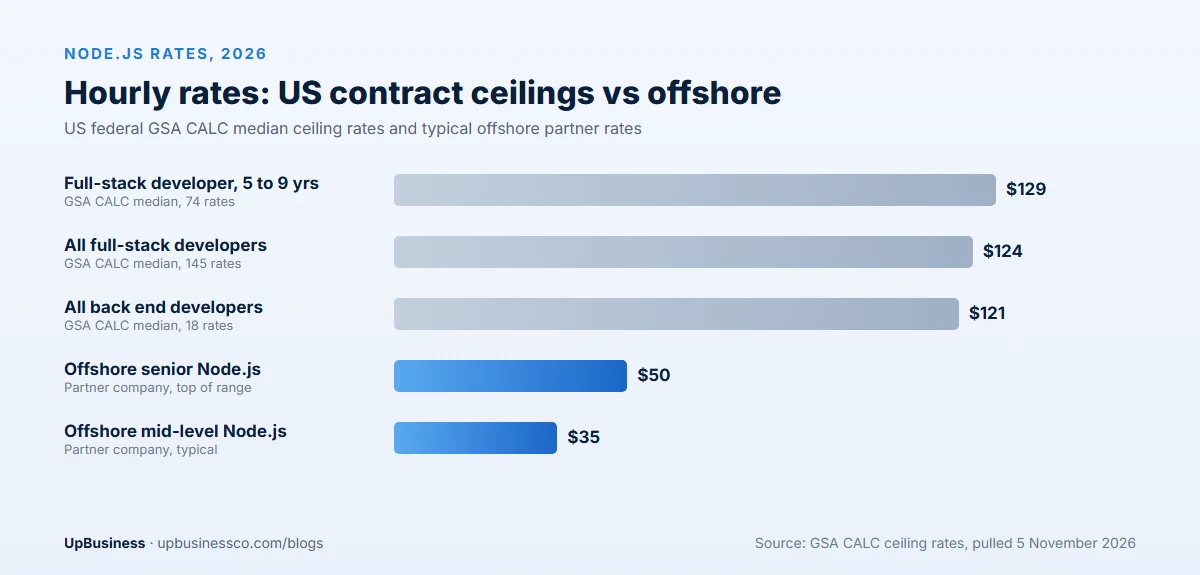
Most Node.js rate pages are written by companies selling developers, and many quote different numbers on the same page. We used checkable sources instead.
The US government's CALC tool lists the maximum hourly rates contractors may charge federal buyers under GSA schedules[1]. These are ceiling rates, so private US projects often pay less. Very few contracts use "Node.js" in the job title, so on 5 November 2026 we pulled back end and full-stack developer titles, which is where Node.js work sits.
| Role in GSA CALC | Rates found | Contractors | Median ceiling rate |
|---|---|---|---|
| Back end developer, 0 to 4 years | 6 | 9 in total | $101 an hour |
| Back end developer, 5 to 9 years | 10 | $127 an hour | |
| All back end developer rates | 18 | 9 | $121 an hour |
| Full-stack developer, 0 to 4 years | 63 | 75 in total | $112 an hour |
| Full-stack developer, 5 to 9 years | 74 | $129 an hour | |
| Full-stack developer, 10 years or more | 8 | $174 an hour |
Salary is the other benchmark. The 2025 Stack Overflow Developer Survey reports developer pay by role and country[2]. In US private industry, wages are about 70% of an employee's total cost, according to the Bureau of Labor Statistics[3], so a $140,000 back end developer costs an employer about $200,000 a year.
Offshore partner companies, mostly in India and Eastern Europe, usually bill:
| Level | What they can do | Typical offshore partner rate |
|---|---|---|
| Junior, 1 to 2 years | Build endpoints from a clear spec with guidance | $20 to $28 an hour |
| Mid-level, 3 to 5 years | Own features, design database tables, write tests | $28 to $40 an hour |
| Senior, 6 years or more | Design the system, handle scale and security, review code | $40 to $50 an hour |
| Lead or architect | Plan services, cloud setup and team structure | $50 to $65 an hour |
These ranges come from the proposals we see on UpBusiness and match our software development cost benchmark. If you're comparing languages for the back end, our Python developer rates guide has the same breakdown for Python.
Hourly, Monthly or Fixed Price?
- Hourly suits bug fixes, small integrations and work where the scope isn't clear. Ask for weekly timesheets tied to tasks.
- Monthly dedicated developer suits an ongoing product. A full-time offshore Node.js developer usually costs $3,500 to $8,000 a month through a partner company. Read our comparison of dedicated developers and project-based teams.
- Fixed price suits a defined API with a written spec. You pay a risk premium, but your budget is set.
Freelancer, Partner Company or In-House?
| Freelancer | Partner company | In-house hire | |
|---|---|---|---|
| Speed to start | Days | One to three weeks | Two to four months |
| Who reviews the code | You | A senior on their team | Your tech lead |
| Cloud, DevOps, testing | Usually you find others | Often in one team | Separate hires |
| If the person leaves | You start again | The company replaces them | You hire again |
| Best for | Small, clear tasks | A product or project with a deadline | Long-term core platform |
A back end holds your data and your security, so it needs a second pair of eyes. If you don't have a technical lead, a partner company with a senior reviewer is the safer choice. Our guide to agency vs freelancer vs in-house compares the full cost of each.
Skills to Look For in a Node.js Developer in 2026
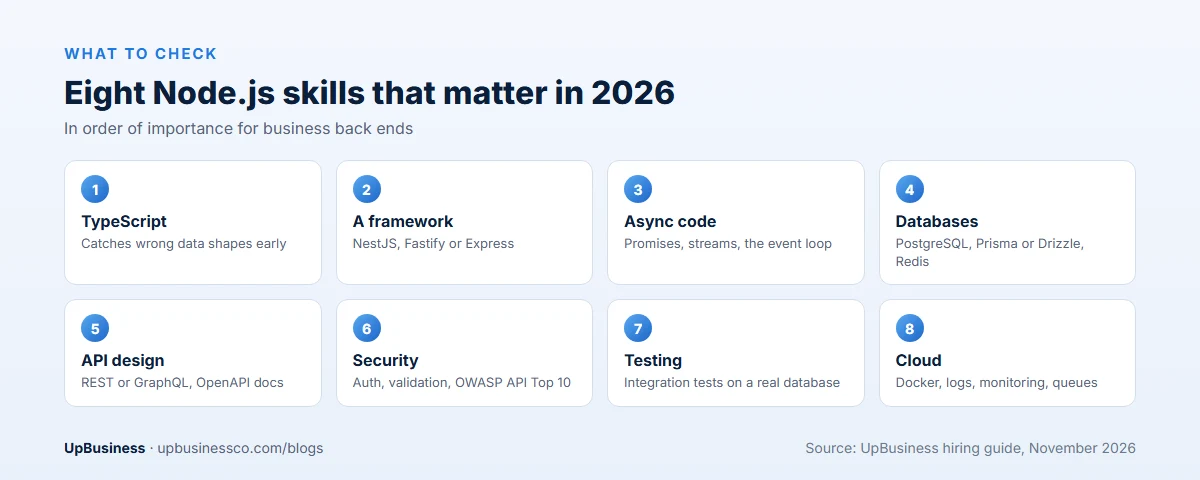
Node.js itself has grown. Recent releases include a built-in test runner, a built-in fetch, a watch mode and the ability to run TypeScript files directly by stripping types. Developers who still add a package for every small job write heavier, riskier code.
- TypeScript. Now standard for serious back end work. It catches wrong data shapes before they reach production.
- A framework. NestJS for large, structured apps, Fastify for speed, Express for simple services. Ask which they shipped and why.
- Async code. Promises, async and await, streams, and how the event loop behaves under load.
- Databases. SQL with PostgreSQL or MySQL, often through Prisma or Drizzle, plus MongoDB or Redis when they fit. Good developers design indexes and migrations, not just queries.
- API design. REST or GraphQL, versioning, pagination, error formats and clear documentation with OpenAPI.
- Security. Authentication, input validation, rate limiting and the OWASP API Security Top 10[4].
- Testing. Unit and integration tests with the Node test runner, Vitest or Jest, and tests that run against a real database.
- Cloud and operations. Docker, a cloud such as AWS, Azure or Google Cloud, logging, monitoring and background jobs with queues.
Most Node.js projects sit behind a web or mobile front end. If you also need the front end, see our guide on how to hire React developers, or look for full-stack developers who do both.
Node.js Versions: A Question Most Buyers Forget
Node.js releases follow a fixed schedule. Even-numbered versions become Long Term Support (LTS) releases with security fixes for about 30 months. Odd-numbered versions are short-lived and shouldn't be used in production[5].
- New projects should start on the current Active LTS release.
- Node.js 20 reached end of life on 30 April 2026 and gets no more security fixes.
- Ask every company which version they'll use and how they'll upgrade during the contract.
If you're taking over an existing app, ask the new team to check the Node.js version and the age of its main packages in the first week. An app two or three major versions behind can need weeks of upgrade work before new features.
Supply Chain Security: Checking npm Packages
A typical Node.js app pulls in hundreds of open-source packages from npm. In 2025, attackers took over popular npm packages and published versions that stole passwords and cloud keys, hitting thousands of projects within hours. Your developer's habits decide whether that reaches your servers.
Ask candidates how they handle this. Good answers include:
- Committing the lockfile and installing with npm ci, so builds use exact, known versions.
- Running npm audit or a tool such as Dependabot or Snyk on every change.
- Checking a new package's maintainers, downloads and age before adding it.
- Keeping secrets in a secrets manager, not in code or environment files in the repository.
- Turning on two-factor sign-in for any npm account that publishes packages.
How to Screen Node.js Developers in Three Steps
Step 1: a 30-minute call. Ask about the last two back ends they built. How many users? What broke under load? How did they find it? Strong developers talk about data, failures and monitoring. Weak ones list packages.
Step 2: a paid test task, four to eight hours. A small REST API with two resources, validation, a PostgreSQL database, authentication and tests. Pay for it, and ask for a short README that explains how to run it.
Step 3: a review call. Ask them to walk you through it. How would it handle 100 requests a second? Where would they add caching? What happens if the database is down? This shows whether they wrote it and understand it.
If you aren't technical, pay an independent senior developer for an hour to review the task. On a hire worth tens of thousands of dollars a year, that hour is cheap insurance.
12 Interview Questions for Node.js Developers, With Good and Weak Answers
| Question | A good answer mentions | A weak answer |
|---|---|---|
| What is the event loop, and what blocks it? | Single thread for JavaScript, async I/O, CPU-heavy work blocks it, worker threads or queues for heavy jobs | Node is multi-threaded so it never blocks |
| How do you handle errors in async code? | try and catch with await, central error handler, no unhandled rejections, clear error responses | Wrap everything in one try block |
| How do you validate input? | Schema validation with Zod, Joi or class-validator at every endpoint | The front end checks it |
| How do you store passwords? | bcrypt or argon2 hashing, never plain or reversible, rate-limited login | Encrypt them |
| How would you add authentication? | Sessions or short-lived tokens, refresh tokens, roles, or a provider such as Auth0 or Cognito | Put the user ID in a cookie |
| How do you design a paginated list endpoint? | Cursor or offset pagination, limits, sort order, indexes | Return all rows |
| When would you use a queue? | Emails, file processing and slow tasks, with retries, using BullMQ, SQS or similar | Never needed one |
| How do you make an API faster? | Measure first, fix slow queries and indexes, cache with Redis, avoid N+1 queries | Add more servers |
| How do you test an API? | Unit tests plus integration tests against a real test database, run in CI | Test it by hand in Postman |
| How do you check a new npm package? | Maintainers, downloads, age, licence, audit tools, lockfile | Install whatever has the most stars |
| How do you deploy a Node.js app? | Docker, CI pipeline, environment config, health checks, zero-downtime releases | Copy files to the server |
| Tell me about a production incident. | What failed, how they found it, the fix and what they changed after | Never had one |
For questions to ask the company rather than the developer, use our list of questions to ask a software development company.
Red Flags When Hiring Node.js Developers
- No production systems to show, only tutorials or small demos.
- Passwords, API keys or database details in their sample code.
- No tests and no input validation in their samples.
- A plan to use an unsupported or odd-numbered Node.js version.
- They want servers in their own cloud account, not yours.
- The company sends a senior to the interview and a junior to do the work.
- A quote far below the ranges above with no clear reason.
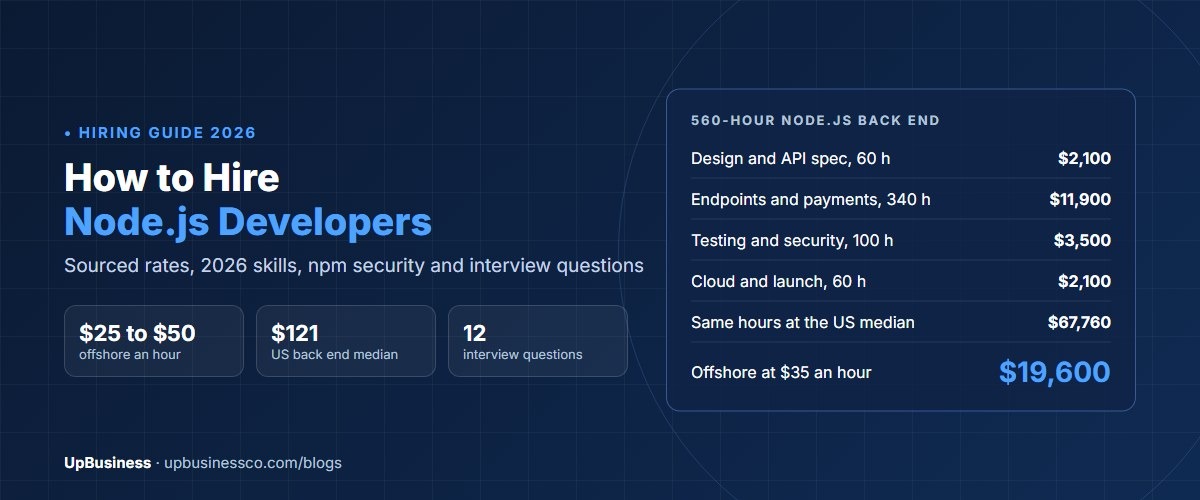
What a Node.js Project Costs: A Worked Example
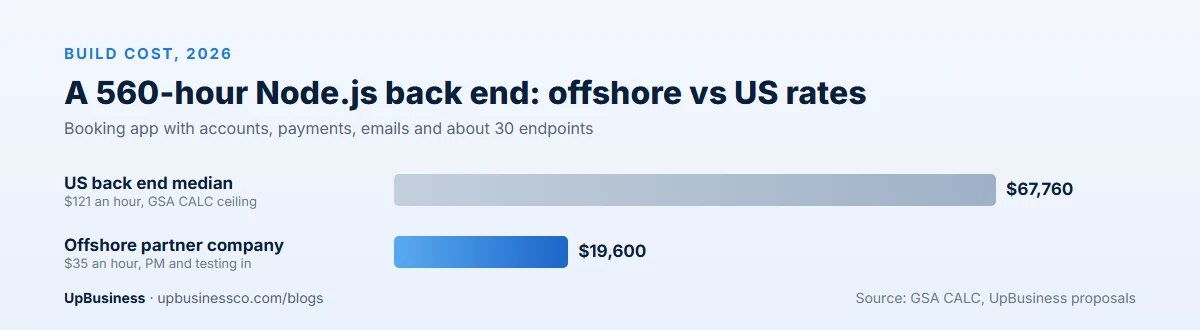
Take a back end for a booking app: user accounts, listings, bookings, payments through Stripe, email notifications, an admin API and about 30 endpoints. A partner company estimates about 560 hours.
| Phase | Hours | Offshore partner at $35 an hour | US at the $121 back end median |
|---|---|---|---|
| Design, database and API spec | 60 | $2,100 | $7,260 |
| Endpoints, payments and emails | 340 | $11,900 | $41,140 |
| Testing and security review | 100 | $3,500 | $12,100 |
| Cloud setup, launch and handover | 60 | $2,100 | $7,260 |
| Total | 560 | $19,600 | $67,760 |
The US column uses the GSA CALC median ceiling rate, so a private US agency may charge less. Running costs come on top: cloud hosting, a database, email sending and monitoring often total $100 to $500 a month for a new app. If this is a first version to test an idea, our MVP development cost guide shows how to cut scope.
What Pushes the Price Up
- Unclear data. If nobody knows what the app must store, the database gets rebuilt mid-project.
- Many integrations. Each payment, CRM, ERP or messaging service adds testing and edge cases.
- Real-time features. Chat, live tracking and notifications need WebSockets and more testing.
- High traffic or strict uptime. Caching, queues and monitoring cost hours, but save outages.
- Old code. Upgrading an old Node.js version and its packages can take weeks.
How to Keep Node.js Costs Down
- Write the API spec first. An OpenAPI file agreed before the build lets the front end and back end teams work at the same time.
- Use managed services. A managed database, sign-in provider and email service cost a little each month but save weeks of build and upkeep.
- Don't split into microservices too early. One well-structured app is cheaper to build, test and run until your team or traffic is large.
- Pay for tests and monitoring. Finding a bug in testing costs hours. Finding it after customers do costs days and trust.
- Keep packages few and current. Fewer packages mean fewer upgrades and fewer security alerts.
Contract Points for Node.js Work
- All code is assigned to you in writing, worldwide and for the full copyright term.
- Code lives in your repository. Servers, databases and keys sit in your cloud account.
- The company lists every open-source package and its licence.
- The Node.js version and an upgrade plan are written into the scope.
- A security review against the OWASP API Top 10 happens before launch.
Our software development contract checklist has the full clause list, and a clear software project brief gets you comparable quotes.
The First 30 Days With a New Node.js Developer
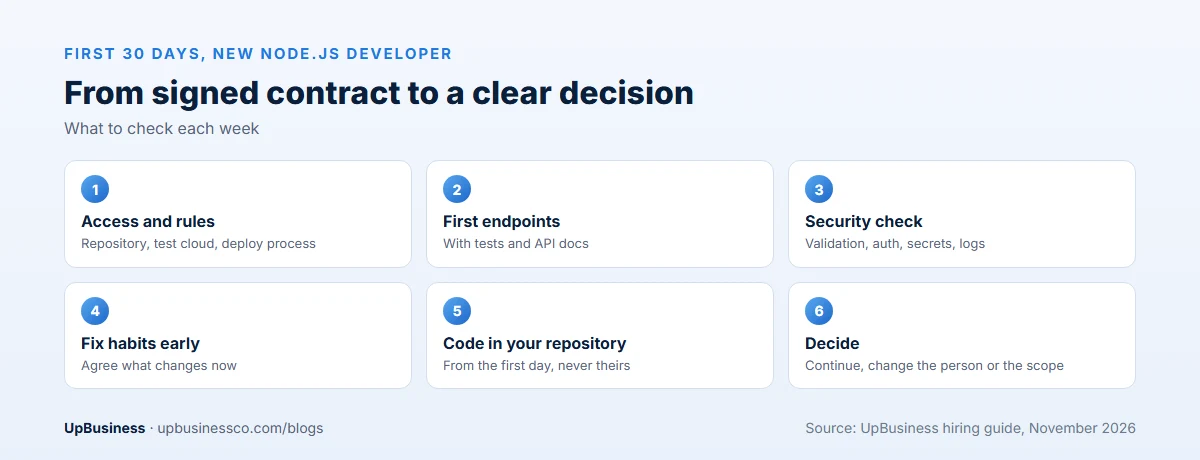
- Week 1: Give access to the repository and a test cloud account. Agree coding rules, the review process and how deployments work.
- Week 2: They build the first endpoints with tests. You check them through the API docs or the app.
- Week 3: Review security basics: validation, authentication, secrets and logging.
- Week 4: Decide: continue, change the person or change the scope.
Finding Node.js Developers on UpBusiness
UpBusiness lists verified partner companies, not individual freelancers. Every company has passed five checks reviewed by our team: company details, registration and tax papers, the founder's identity, expertise and three client projects with evidence. Only companies with a TrustScore of 70 or more are listed.
Our backend development page and full-stack development page list companies that build server-side systems. Not every one names Node.js as a core service, so ask each for two production Node.js systems and a code sample before you shortlist.
- Post your requirement with Node.js, your budget and the timeline.
- Get three partner companies matched to your budget, service and industry.
- Compare them side by side, run the paid test task with your favourite and start a two-week trial. Buyers pay nothing, and there's no commission on the project.