


Browse our curated list of Software Development Companies
Python developer rates in 2026 run from about $25 to $60 an hour with an offshore partner company. On US government contracts, the median for software developers is about $132 an hour[1]. That gap is why many companies hire Python talent offshore. Take a typical API backend for a new product. It costs about $12,600 offshore in our worked budget, and about $47,500 at the US median.
This guide is for the person who signs off the hire. That might be a founder, a CTO or a product lead who wants good code at a fair price. You'll see current rates by experience and what common Python projects cost. You'll also learn how to choose a hiring model and how to screen people before you commit.
Key takeaways
- US government contract ceiling rates for software developers have a median of about $132 an hour, across 5,827 rates from 1,602 contractors. Offshore partner companies commonly quote $25 to $60.
- Experience matters more than location. Senior engineers with 10 or more years sit at a $162 median on US contracts, against $115 for those with under five years.
- Our worked API backend is 360 hours: $12,600 offshore at $35 an hour, or about $47,500 at the US median.
- Pay for tested, documented code you own. Tests, code review and deployment scripts are part of the job, not extras.
- Screen with a short paid task and a code review, not just a quiz on Python syntax.
Python Developer Rates in 2026
Python developer rates in 2026 depend on experience, the kind of work and how you hire. A junior developer writing simple scripts costs far less than a senior engineer designing a data platform or an AI feature.
We pulled every software developer and software engineer rate on the US government's GSA schedule on 31 October 2026[1]. These are ceiling rates, the most a contractor may charge government buyers, so private US agency quotes vary around them. They are still the largest public, checkable set of US developer rates.
| Experience | Number of US rates | US median ceiling rate | Typical offshore partner rate |
|---|---|---|---|
| 0 to 4 years | 2,703 | $115 an hour | $25 to $35 an hour |
| 5 to 9 years | 2,327 | $141 an hour | $35 to $50 an hour |
| 10 years or more | 797 | $162 an hour | $45 to $60 an hour |
| All software developer rates | 5,827 | $132 an hour | $25 to $60 an hour |
The middle half of all US rates sits between about $106 and $158 an hour. Offshore partner companies in India, Eastern Europe and Latin America often quote $25 to $60 an hour for Python work. We use $35 as our base rate below.
Monthly pricing works the same way. A full-time Python developer works about 160 hours a month. Through an offshore partner company, that usually costs $4,000 to $9,600 a month, based on seniority.
Hourly, Monthly or Fixed Price: Which Is Cheaper?
The same developer can cost very different amounts depending on how you pay. Hourly billing is flexible and fair for small or unclear work, but the total can drift if nobody watches it, so always set a monthly cap. A monthly dedicated developer is usually 10% to 20% cheaper per hour than ad hoc hourly work, because the partner can plan their time. Fixed price feels safest, but partners add a buffer for risk, and every change request is billed on top. For most products, start with a short paid discovery. Then agree a fixed price for the first version and move to a monthly team after launch.
Python Developer Rates by Specialty
Python is used for very different jobs, and rates follow the skill needed. Python's own site lists web development, scientific and numeric computing, software development and business applications among its main uses[2]. Here is how those areas compare.
| Specialty | Common tools | Offshore partner rate | What raises the price |
|---|---|---|---|
| Scripts and automation | Standard library, requests, pandas | $25 to $35 an hour | Many systems to connect, poor documentation |
| Web backends and APIs | Django, FastAPI, Flask | $30 to $45 an hour | Complex permissions, payments, high traffic |
| Data engineering | Airflow, dbt, Spark, pandas | $35 to $55 an hour | Large volumes, real-time data |
| AI and Machine Learning | PyTorch, scikit-learn, LLM tools | $40 to $60 an hour | Model training, evaluation, production use |
| DevOps and cloud tooling | Python with AWS, Azure or Google Cloud | $35 to $50 an hour | Security rules, many environments |
If your project is mainly AI work, read our AI developer rates guide as well. For pipelines and warehouses, our data engineering services cost guide goes into more detail.
What Python Projects Cost
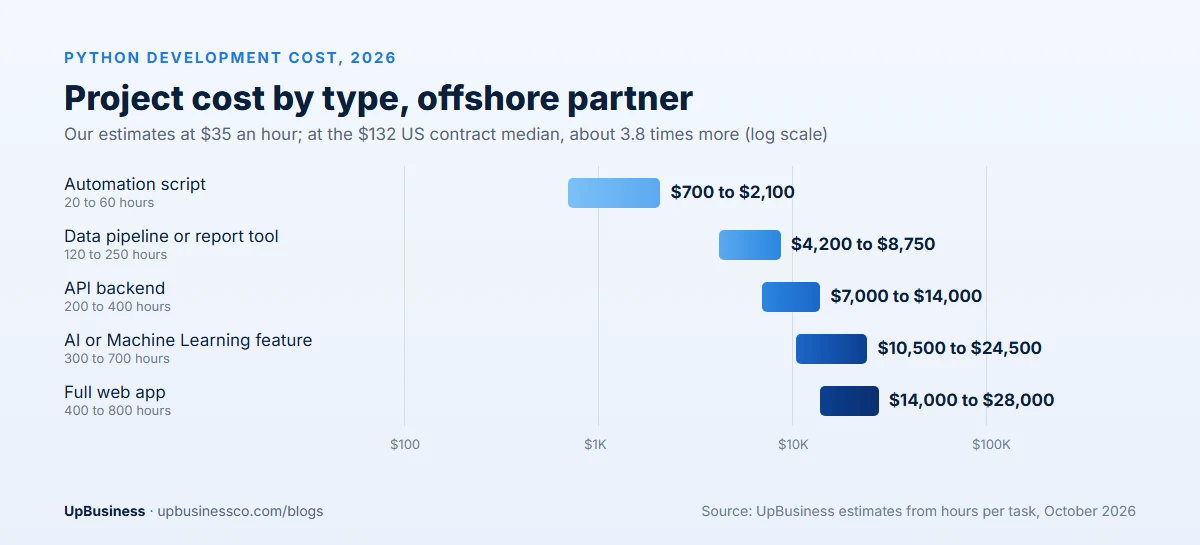
Hourly rates only tell half the story. What you really need to know is how many hours your project takes. Our estimates below use $35 an hour offshore and the $132 US contract median for comparison.
| Project type | Hours | Offshore partner ($35/h) | US median ($132/h) |
|---|---|---|---|
| Automation script or small integration | 20 to 60 | $700 to $2,100 | $2,640 to $7,920 |
| Data pipeline or reporting tool | 120 to 250 | $4,200 to $8,750 | $15,840 to $33,000 |
| API backend for a web or mobile app | 200 to 400 | $7,000 to $14,000 | $26,400 to $52,800 |
| Full web app with Django or FastAPI | 400 to 800 | $14,000 to $28,000 | $52,800 to $105,600 |
| AI or Machine Learning feature in production | 300 to 700 | $10,500 to $24,500 | $39,600 to $92,400 |
These figures cover development, testing and deployment. They don't include design, cloud hosting, paid APIs or project management on your side.
Freelancer vs Dedicated Developer vs Partner Company
How you hire changes both the price and the risk. There are three common ways to get Python work done.
| Freelancer | Dedicated developer through a partner | Fixed-price project with a partner | |
|---|---|---|---|
| Typical price | $20 to $150 an hour | $4,000 to $9,600 a month offshore | Agreed price for agreed scope |
| Best for | Small, clear jobs | Long-running products with steady work | Projects with a clear scope and deadline |
| Who reviews the code | Usually no one | A tech lead at the partner | A tech lead at the partner |
| Cover when someone leaves | None | Replacement from the team | Team cover |
| Main risk | Disappearing mid-project | Paying for idle hours | Change requests adding cost |
Freelancers are good value for small, well-defined tasks, such as a script that moves data between two tools. For anything your business depends on, a partner company adds code review, testing and cover when someone is ill or leaves. A dedicated developer suits a product that needs steady work every month. A fixed-price project suits a clear scope, such as an API with a known list of features.
Why Offshore Python Rates Are Lower, and When They Are Not
Offshore rates are lower mainly because salaries and living costs are lower in the countries where many partner companies are based. A senior Python engineer in India or Eastern Europe can earn a good local salary at a third of a US contract rate. That gap is real, and it is why so many companies build their products with offshore teams.
The saving is smaller than the hourly rate suggests when the work needs a lot of back-and-forth. Time zone gaps, unclear requirements and slow feedback all add hours. A team that waits a day for every answer will take longer to finish the same job. The best offshore partners plan for this with a few hours of shared working time each day, written specs and short demos every week or two.
The saving also shrinks when you pick the cheapest quote. A developer at $18 an hour who needs twice the hours, or whose code must be rewritten, costs more than a reviewed team at $35. Compare total project cost and code quality, not just the hourly number.
Hidden Costs Beyond the Hourly Rate
The rate on a quote is only part of what you will spend. Plan for these as well:
- Your own time. Someone on your side must answer questions, review demos and test features. Budget a few hours a week.
- Cloud and tools. Hosting, databases, monitoring, email services and paid APIs all have monthly bills.
- Onboarding. A new developer needs a week or two to learn your code and business, even when they are skilled.
- Rework. Code without tests or review often needs fixing later, which is the most expensive hidden cost of all.
- Handover. If a developer leaves, someone must learn their code. Good documentation keeps this short.
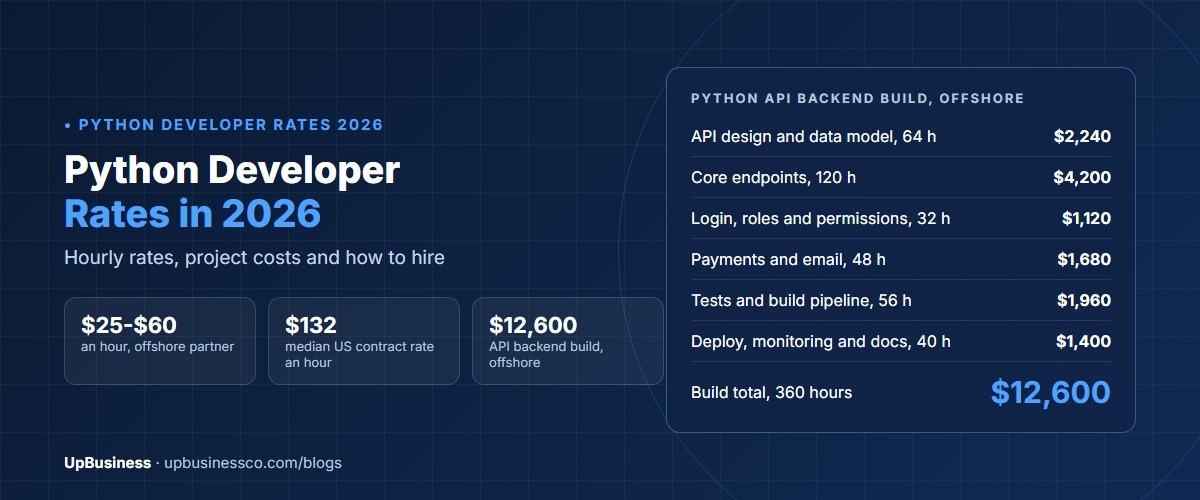
Worked Example: Python API Backend Budget
Here is a plan for a new software product that needs a Python backend for its web and mobile apps. It has user accounts with roles, a payments integration, email notifications and about 40 API endpoints.
| Task | Hours | Offshore ($35/h) | US median ($132/h) |
|---|---|---|---|
| API design and data model | 64 | $2,240 | $8,448 |
| Core endpoints (about 40) | 120 | $4,200 | $15,840 |
| Login, roles and permissions | 32 | $1,120 | $4,224 |
| Payments and email integrations | 48 | $1,680 | $6,336 |
| Automated tests and build pipeline | 56 | $1,960 | $7,392 |
| Deployment, monitoring and documentation | 40 | $1,400 | $5,280 |
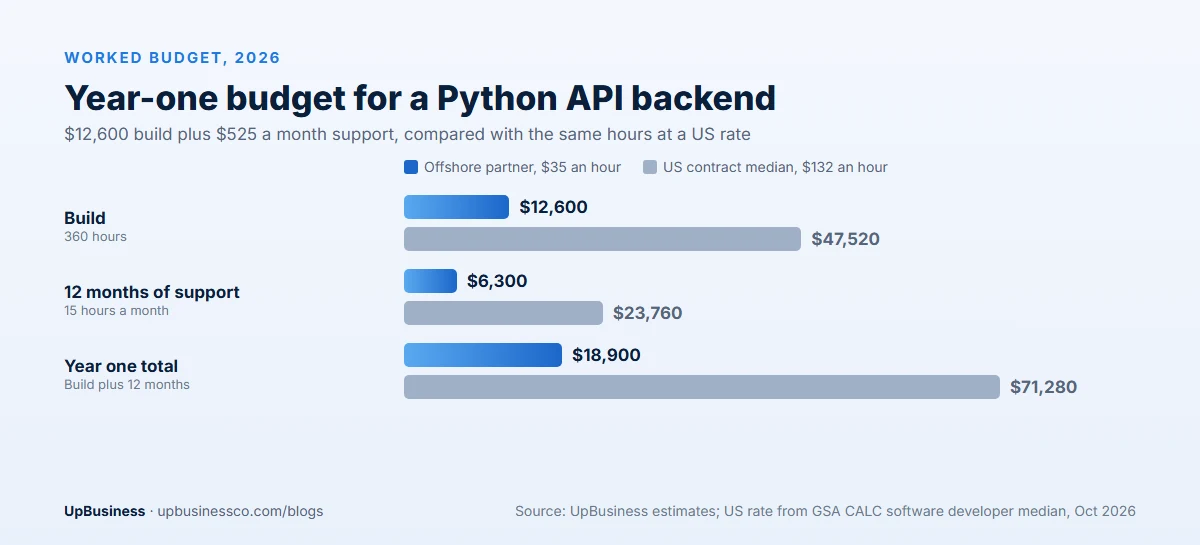
| Build total | 360 | $12,600 | $47,520 |
After launch, the company keeps 15 hours a month of support for fixes and small features, or $525 a month offshore. Year one comes to about $18,900 offshore ($12,600 build plus 12 months at $525). At the US median, the same hours cost about $71,300.
Notice that tests, the build pipeline, deployment and documentation take 96 of the 360 hours, more than a quarter. Quotes that leave these out look cheaper but cost more later, when every change risks breaking something.
What Drives Python Development Costs?
- Scope clarity. A clear feature list and examples cut hours. Vague scope adds discovery time and change requests.
- Integrations. Every outside system, such as payments, CRMs or ERPs, adds design, testing and error handling.
- Data volume and speed. Code that handles millions of records or real-time traffic needs more careful design.
- Security and compliance. Health, finance and personal data need access controls, logging and reviews.
- Existing code. Working in an old codebase without tests is slower than starting fresh.
- Seniority mix. A senior lead with two mid-level developers often costs less overall than three juniors who need rework.
Skills to Look For in a Python Developer
Python is easy to start with, which means there are many developers who know the basics but few who write code that lasts. Look for these skills, matched to your project:
| Skill | Why it matters | How to check |
|---|---|---|
| Clean, readable code | Others must maintain it after the first developer moves on | Review a real code sample together |
| Automated testing | Stops new changes from breaking old features | Ask how they test a function that calls an outside API |
| Framework depth (Django, FastAPI) | Avoids reinventing what the framework already does | Ask them to explain a past design choice |
| Databases and SQL | Slow queries are a common cause of slow apps | Give them a slow query to improve |
| Packaging and environments | Keeps builds repeatable across machines | Ask how they manage dependencies |
| Security basics | Protects user data and your business | Ask how they store passwords and API keys |
For AI work, add experience with evaluation, prompt testing and model monitoring. Our Machine Learning development cost guide and AI integration services guide explain what those projects involve.
How to Screen Python Developers
A good screening process takes a few hours of your time and saves weeks of rework. We suggest four steps.
1. Portfolio and code sample. Ask for a repository or a code sample from a real project, with names removed. Look for tests, clear names and short functions. A developer who can't show any code is hard to judge.
2. Short technical call. Ask them to walk through a project they built: what it did, what went wrong and what they would change. Good developers talk about trade-offs. Weak ones only list tools.
3. Small paid task. Give a task of two to four hours that looks like your real work, such as adding an endpoint with tests to a small sample app. Pay for it. Unpaid tests put off the best people.
4. Code review together. Review their task with them on a call. Ask why they made each choice and how they would change it if the data grew ten times. This shows how they think and how they take feedback.
If you hire through a partner company, ask them to run steps 1 to 3 and share the results. Then do step 4 yourself, with the person who will work on your project.
Interview Questions for Python Developers
- How would you structure a Django or FastAPI project for a team of five developers?
- How do you test code that calls a payment provider or another outside API?
- A page is slow. How do you find out whether the problem is the code, the database or the network?
- How do you keep secrets such as API keys out of your code?
- Tell me about a bug that reached production. How did you find it and stop it happening again?
- When would you choose a background job instead of doing work during a web request?
Red Flags When Hiring Python Developers
- No tests in any code sample. Code without tests gets slower and riskier to change every month.
- Code kept in the developer's own account. Your company should own the repository from day one.
- Rates far below the market. Very low rates often mean juniors without review, or hidden rework later.
- No questions about your business. Good developers ask what the software must do before they talk about tools.
- Vague estimates. Ask for hours by feature, not one number for the whole project.
How to Keep Python Development Costs Down
- Write a clear brief. Our software project brief template helps you list features, users and must-haves.
- Use proven frameworks. Django and FastAPI handle common needs, such as login and admin pages, without custom code.
- Build the smallest useful version first. Launch with the core features, then add more based on real use.
- Keep a senior reviewer in the loop. One senior hour of review can save many junior hours of rework.
- Compare quotes line by line. Our guide to comparing software development proposals shows how.
If you are building a full software product, our AI SaaS development guide covers running costs per user, and our software, AI and marketing cost benchmark gives wider price ranges.
The First 30 Days With a New Python Developer
A good start saves money for the rest of the project. In the first week, give the developer access to the code, a working local setup guide and a short walk-through of the business. Their first task should be small and real, such as fixing a minor bug, so they learn the codebase and your review process without pressure.
In weeks two and three, move to a small feature with clear acceptance criteria. Review the code together and agree on standards for naming, tests and pull requests. This is the point to spot problems early. If the code is hard to read or arrives without tests, raise it now, not after three months.
By week four, the developer should be shipping features at a steady pace, with tests and short notes for each change. Hold a short review with them and, if you hired through a partner, with their tech lead. Agree what is working and what should change. Most hiring problems show up in this first month, so treat it as a paid trial and act on what you see.
Why Hire Python Developers Through UpBusiness?
Every partner company on UpBusiness goes through document checks and client work verification before it appears. That means you can compare Python teams with checked track records, real client reviews and clear rates, without spending weeks on cold outreach. You still run your own screening, but you start from a shortlist of companies that have already been checked.
When you're ready, post your project on UpBusiness with your project type, timeline and budget, and we'll match you with verified software development partner companies with Python experience.