


Browse our curated list of Frontend Development Companies
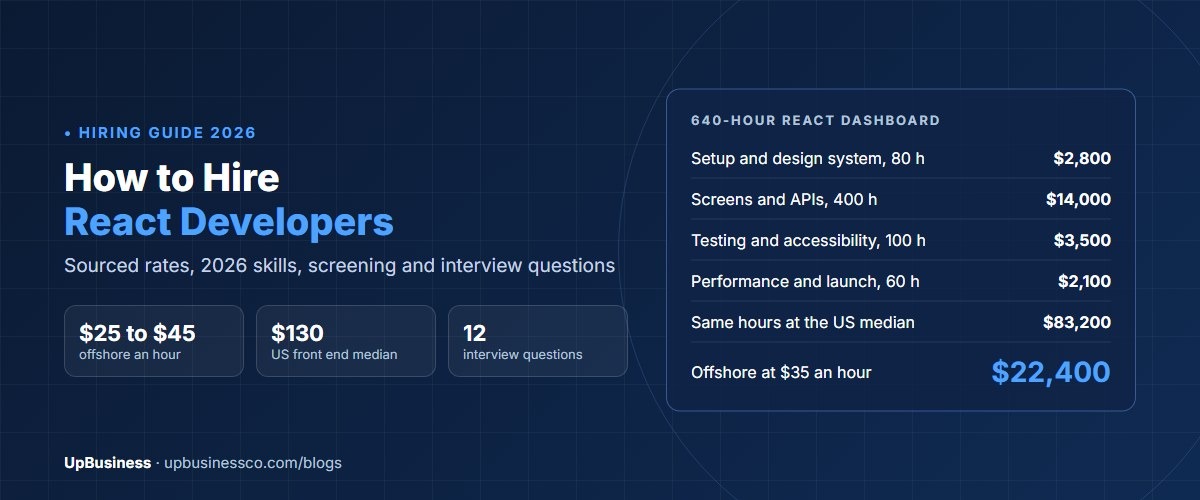
To hire React developers, decide first whether you need one person or a team, then write a one-page brief with your stack and the screens to build. Screen for TypeScript, state management, testing and performance, not just React itself. Run a short paid test task, check the code in your own repository and start with a two-week trial. In 2026, US government contract ceiling rates for front end developers have a median of $130 an hour, while offshore partner companies commonly bill $25 to $45 an hour for React work.
This guide is for buyers: founders, product owners and managers who need React work done well and need to judge people they can't fully test themselves. It covers rates with sources, the skills that matter in 2026, a screening process, 12 interview questions with good and weak answers, red flags and a cost example.
Key takeaways
- React and Node.js are the two most used web technologies in the 2025 Stack Overflow Developer Survey, so the React talent pool is huge, and quality varies widely.
- US federal contract ceiling rates for React developers have a median of $92 an hour across 26 rates, and $130 an hour across 68 front end developer rates.
- Offshore partner companies commonly charge $25 to $45 an hour for React work, with project management and testing often included.
- In 2026 a senior React developer should know Server Components, the React Compiler, TypeScript and accessibility, not just hooks.
- A paid test task of four to eight hours tells you more than any interview.
How to Hire React Developers: The Short Version
- Write a one-page brief. Say what you're building, who uses it, the screens, the back end it talks to and your deadline.
- Pick a hiring model. A freelancer, a dedicated developer from a partner company, or a full project team.
- Shortlist three to five people or companies. Ask each for two live React projects and a code sample.
- Screen in three steps. A 30-minute call, a paid test task and a review of the task with the developer.
- Start with a two-week trial. Code goes into your repository from day one.
The rest of this guide explains each step and what to look for.
React Developer Rates in 2026
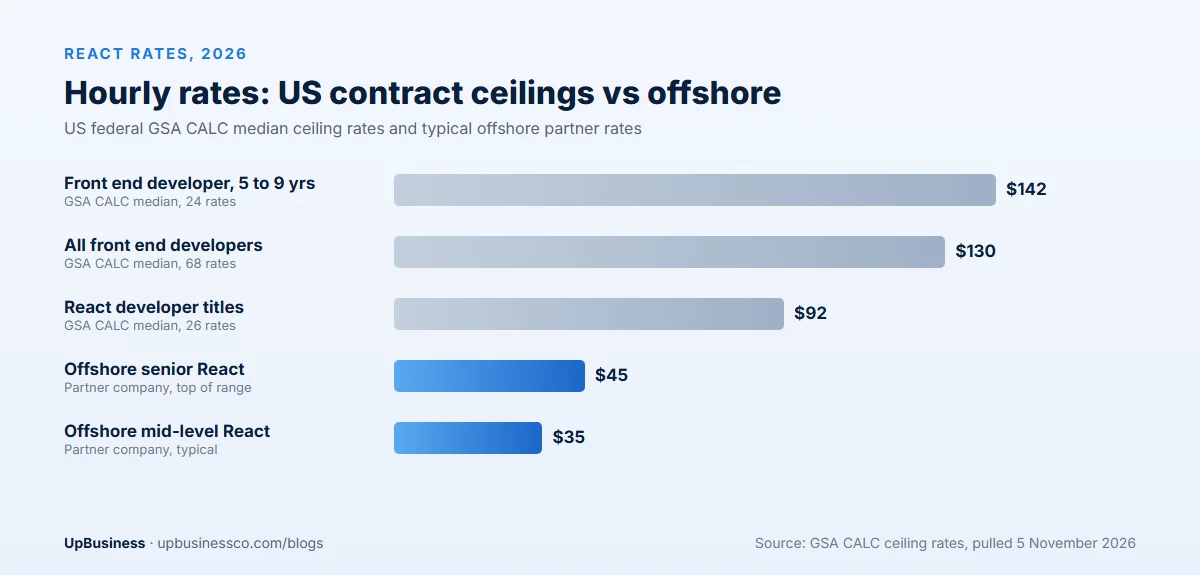
Most rate pages for React developers are written by agencies selling developers, and the numbers rarely have a source. We used two checkable sources instead.
The first is the US government's CALC tool, which lists the maximum hourly rates that contractors may charge federal buyers under GSA schedules[1]. These are ceiling rates, so private projects in the US often pay less. On 5 November 2026 we pulled every rate with "React" or "Front End Developer" in the job title.
| Role in GSA CALC | Rates found | Contractors | Median ceiling rate |
|---|---|---|---|
| React developer titles | 26 | 14 | $92 an hour |
| Front end developer, 0 to 4 years | 37 | 31 in total | $109 an hour |
| Front end developer, 5 to 9 years | 24 | $142 an hour | |
| Front end developer, 10 years or more | 7 | $143 an hour | |
| All front end developer rates | 68 | 31 | $130 an hour |
The second source is pay. The 2025 Stack Overflow Developer Survey reports median salaries for front end and full-stack developers by country[2]. Salary isn't the full cost of an employee: in US private industry, wages are about 70% of total pay and benefits, according to the Bureau of Labor Statistics[3]. So a US developer on $130,000 a year costs an employer about $185,000.
Offshore partner companies, mostly in India and Eastern Europe, usually bill:
| Level | What they can do | Typical offshore partner rate |
|---|---|---|
| Junior, 1 to 2 years | Build screens from a finished design with guidance | $20 to $28 an hour |
| Mid-level, 3 to 5 years | Own features end to end, write tests, work with APIs | $28 to $38 an hour |
| Senior, 6 years or more | Set the architecture, review code, fix performance | $38 to $45 an hour |
| Lead or architect | Plan a large app, guide a team, choose the stack | $45 to $60 an hour |
These ranges come from the proposals we see on UpBusiness and match our software development cost benchmark. A rate outside them isn't wrong, but ask why.
Hourly, Monthly or Fixed Price?
- Hourly suits small tasks, bug fixes and work where the scope isn't clear yet. Ask for weekly timesheets tied to tasks.
- Monthly dedicated developer suits ongoing product work. A full-time offshore React developer usually costs $3,500 to $7,000 a month through a partner company. Read our comparison of dedicated developers and project-based teams.
- Fixed price suits a defined project with a finished design. You pay more per hour in effect, because the company carries the risk, but your budget is fixed.
Freelancer, Partner Company or In-House?
| Freelancer | Partner company | In-house hire | |
|---|---|---|---|
| Speed to start | Days | One to three weeks | Two to four months |
| Who checks the code | You | A senior on their team | Your tech lead |
| If the person leaves | You start again | The company replaces them | You hire again |
| Design, testing, back end | Usually separate people | Often in one team | Separate hires |
| Best for | Small, clear tasks | A product or project with a deadline | Long-term core product |
If you don't have a technical person in-house, a partner company is safer, because someone senior reviews the code before you see it. Our guide to agency vs freelancer vs in-house compares the full cost of each.
Skills to Look For in a React Developer in 2026
React changed a lot in the last two years. React 19 became stable in December 2024 and added Actions, new form hooks and stable Server Components[4]. The React Compiler followed, which handles much of the memoisation developers used to write by hand[5]. A developer whose knowledge stops at class components or 2021-era hooks will write slower, harder-to-maintain code.
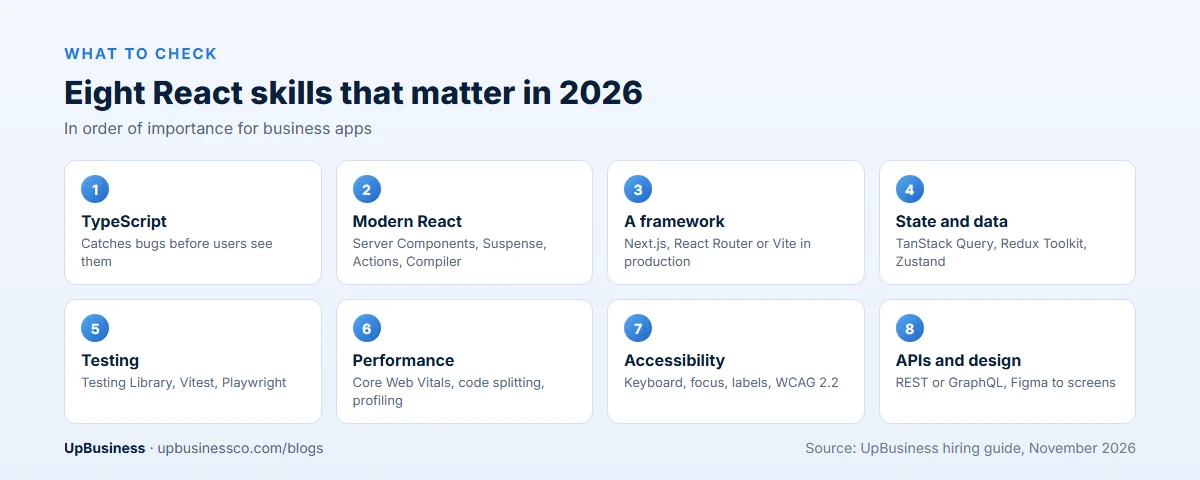
Look for these skills, in this order:
- TypeScript. Most serious React work now uses it. It catches bugs before users see them.
- Modern React. Hooks, Server Components, Suspense, Actions and knowing when the React Compiler makes manual memoisation unnecessary.
- A framework. Next.js is the most common, with React Router and Vite for single-page apps. Ask which they've shipped to production.
- State and data. When to keep state local, when to use context, and tools such as TanStack Query, Redux Toolkit or Zustand.
- Testing. Unit tests with Vitest or Jest, component tests with React Testing Library and end-to-end tests with Playwright or Cypress.
- Performance. Core Web Vitals, code splitting, image handling and finding slow renders with the React DevTools profiler.
- Accessibility. Keyboard use, labels, focus and colour contrast, measured against WCAG 2.2[6].
- Working with APIs and design. REST or GraphQL, error and loading states, and turning a Figma file into working screens.
React and React Native share ideas but not everything. If you need a mobile app, see our React Native app development cost guide instead.
How to Screen React Developers in Three Steps
Step 1: a 30-minute call. Ask about the last two React apps they shipped. What did they build, what went wrong and what would they change? Strong developers talk about trade-offs and users. Weak ones list libraries.
Step 2: a paid test task, four to eight hours. Give a small, real task: a search page that calls a public API, with loading and error states, a filter and two tests. Pay for it. Good developers don't do long unpaid work, and paying gets you their real effort.
Step 3: a review call. Ask them to walk you through the task. Why this structure? What would they add with another day? How would it work with 10,000 results? This call shows whether they wrote the code and understand it.
If you aren't technical, ask a senior developer you trust to review the task for an hour. That is cheap insurance on a hire worth tens of thousands of dollars a year.
12 Interview Questions for React Developers, With Good and Weak Answers
| Question | A good answer mentions | A weak answer |
|---|---|---|
| When does a component re-render? | State, props or context changes; parent re-renders; how the React Compiler and memo reduce waste | Only when state changes |
| What are Server Components and when would you use them? | Code that runs on the server, smaller bundles, data fetching close to the source; not for interactive parts | Never heard of them, or calls them the same as SSR |
| How do you decide where state lives? | Keep it local first, lift it when shared, server data in a data library, global state only when needed | Put everything in Redux |
| How do you handle data fetching? | TanStack Query or framework loaders, caching, loading and error states, retries | useEffect with fetch, no error handling |
| What does useEffect do, and when shouldn't you use it? | Syncs with outside systems; not for derived data or event handling | Runs code after render, use it for everything |
| How do you find a slow screen? | Profiler, Core Web Vitals, bundle analysis, then fix the cause | Add useMemo everywhere |
| How do you test a form? | React Testing Library from the user's view, test validation and submit, mock the API | Test that the state variable changed |
| How do you make a modal accessible? | Focus trap, Escape to close, return focus, aria labels, test with a keyboard | Add a role attribute |
| Why use TypeScript with React? | Catches wrong props and API shapes early, safer refactors | It's slower to write |
| How do you keep a large codebase tidy? | Feature folders, shared components, linting, code review rules | Depends on the project |
| Tell me about a bug you shipped. | Specific bug, cause, fix, what they changed in their process | I don't ship bugs |
| How would you estimate this feature? | Breaks it into tasks, flags unknowns, gives a range | A single number with no questions |
For questions to ask the company rather than the developer, use our list of questions to ask a software development company.
Where to Find React Developers
There are four common places to look, and each suits a different buyer:
- Freelance marketplaces. Fast and cheap to start, but you do all the screening and carry the risk if the person disappears mid-project.
- Developer networks that pre-screen. They test candidates for you and charge a premium on the hourly rate. Good for one senior contractor.
- Partner companies. A company supplies one developer or a full team with a project lead, testers and designers. Good when you need delivery, not just hours.
- Your own job post. Best for a long-term core team, but slowest and most expensive to get right.
Whichever route you choose, the screening steps above stay the same. The source only changes who does the first filter.
React or Another Framework?
Sometimes the real question is whether React is the right choice at all. For most business apps it is, because the large talent pool makes hiring and replacing people easier. There are a few cases where you might pick something else:
- A content website or blog. A CMS such as WordPress or Webflow is often cheaper to build and easier for your team to edit.
- A team that already knows Vue or Angular. Switching frameworks for a new project rarely pays off.
- A very simple marketing page. Plain HTML or a site builder is faster and cheaper.
If you're building an app people log into and use daily, React is a safe, well-supported choice in 2026.
Red Flags When Hiring React Developers
- The portfolio has no live links, or every app is a to-do list or a tutorial clone.
- They won't do a paid test task, or the code they send back clearly wasn't written by them.
- They use class components and old patterns for a new project.
- There are no tests at all in their samples.
- They want the code in their own repository or account.
- The company sends a senior to the interview and a junior to do the work.
- The quote is far below the ranges above with no clear reason.
What a React Project Costs: A Worked Example
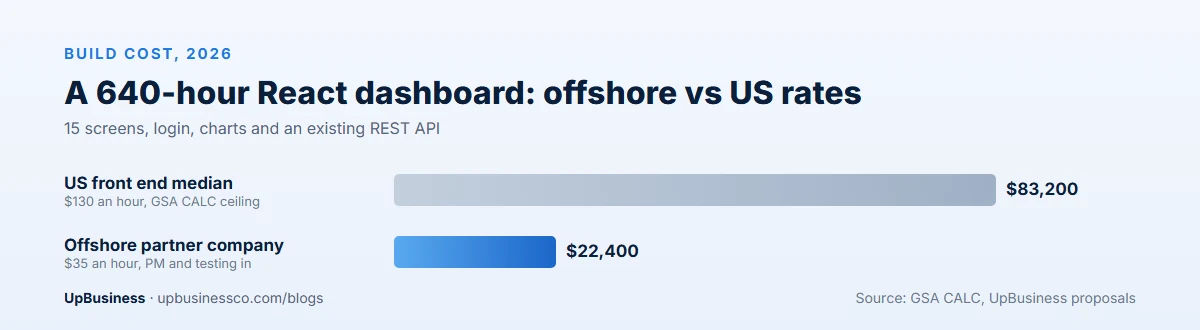
Take a customer dashboard with login, 15 screens, charts, a settings area and an existing REST API. The design is finished. A partner company estimates about 640 hours.
| Phase | Hours | Offshore partner at $35 an hour | US at the $130 front end median |
|---|---|---|---|
| Setup, architecture, design system | 80 | $2,800 | $10,400 |
| Screens and API work | 400 | $14,000 | $52,000 |
| Testing and accessibility fixes | 100 | $3,500 | $13,000 |
| Performance, launch and handover | 60 | $2,100 | $7,800 |
| Total | 640 | $22,400 | $83,200 |
The US column uses the GSA CALC median ceiling rate, so a private US agency may charge less. If the design isn't finished, add design time: our UI/UX design cost guide has prices per screen. If you're building a first version to test an idea, our MVP development cost guide shows how to cut scope.
What Pushes the Price Up
- No finished design. Developers designing as they go is slow and expensive.
- A messy back end. Missing or changing APIs cause rework on every screen.
- Real-time features. Live updates, chat and collaboration need more skill and testing.
- Old code. Upgrading a large app from old React patterns can cost more than new screens.
- Strict accessibility or security rules. Worth it, but plan the hours.
How to Keep React Costs Down
- Finish the design before the build, including empty, loading and error states.
- Use a ready component library such as MUI, Chakra or shadcn/ui instead of building every button.
- Agree the API first and get a test version early.
- Pay for tests. They cost hours now and save days later.
- Write a clear software project brief, so every company quotes the same scope.
Contract Points for React Work
- All code is assigned to you in writing, worldwide and for the full copyright term.
- Code lives in your repository, and you own the hosting and domain accounts.
- The company lists every open-source package and its licence.
- Named developers do the work, and changes need your approval.
- Acceptance tests include accessibility and agreed Core Web Vitals targets.
Our software development contract checklist has the full clause list.
The First 30 Days With a New React Developer
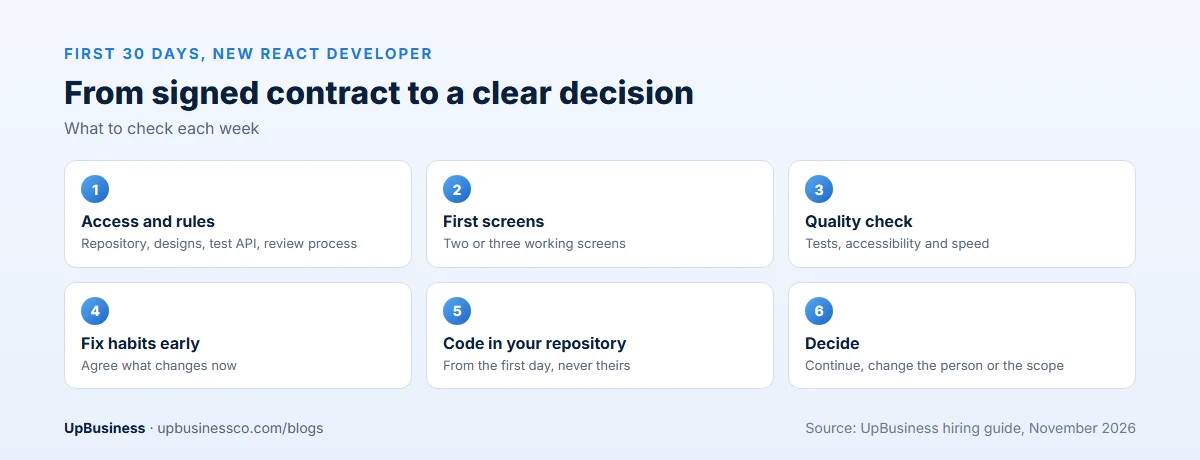
- Week 1: Give access to the repository, design files and test API. Agree coding rules, branch names and the review process.
- Week 2: They build two or three screens. You review working software, not just code.
- Week 3: Check test coverage, accessibility and speed on the first screens. Fix habits early.
- Week 4: Decide: continue, change the person or change the scope. A good trial makes this easy.
Finding React Developers on UpBusiness
UpBusiness lists verified partner companies, not individual freelancers. Every company has passed five checks reviewed by our team: company details, registration and tax papers, the founder's identity, expertise and three client projects with evidence. Only companies with a TrustScore of 70 or more are listed.
Our frontend development page lists companies that build web front ends. Not every one names React as a core service, so ask each for two React projects you can open and a code sample before you shortlist. For a mobile app, see our React Native companies. For back end and data work, our Python developer rates guide covers the other half of many React projects.
- Post your requirement with React, your budget and the timeline.
- Get three partner companies matched to your budget, service and industry.
- Compare them side by side, run the paid test task with your favourite and start a two-week trial. Buyers pay nothing, and there's no commission on the project.