


Browse our curated list of Custom Software Development Companies
To hire a software development company in India from Australia, write a short brief and shortlist three to five registered companies. Call their past clients and run a small paid discovery phase first. Then sign a contract that assigns all code to you in writing and includes moral rights consent. Put APP 8 privacy terms in place before personal data leaves Australia, and pay in Australian or US dollars against milestones. India is 4.5 to 5.5 hours behind the east coast, so you share the whole Australian afternoon with the Indian team.
This guide covers what is specific to Australian buyers: the time overlap by city, APP 8 and the Privacy Act, copyright and moral rights, GST, the tax change under the Australia and India trade agreement and a worked cost example in Australian dollars. For the general case for outsourcing, read our guide to outsourcing software development to India.
Key takeaways
- India is 5 hours 30 minutes behind Sydney and Melbourne in daylight saving time and 4 hours 30 minutes behind in winter. A normal Indian day gives you two and a half to three and a half shared hours, and an early Indian start adds more. Perth gets about five and a half.
- Under APP 8, you must take reasonable steps so an Indian company doesn't breach the Australian Privacy Principles. You also stay accountable for what it does with the data. In practice that means a binding contract.
- Since the Australia and India trade agreement, Australia no longer taxes Indian firms on technical services they deliver from India. That removes an old reason some quotes carried an Australian tax load.
- An Australian copyright assignment must be in writing and signed. Moral rights can't be waived in Australia, but the author can consent in writing, so ask for that consent.
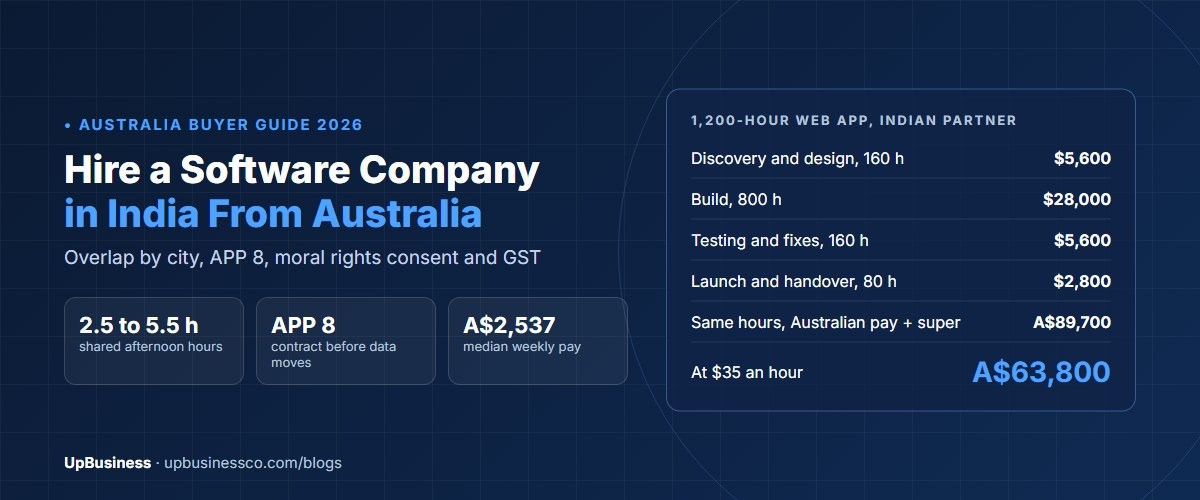
- Software programmers in Australia earn a median of A$2,537 a week. A 1,200-hour build costs about A$80,100 in pay, or about A$89,700 with 12% super. An Indian partner at $35 an hour costs about A$63,800.
Why Australian Companies Hire a Software Development Company in India
The first reason is the clock. India and Australia share most of the Australian afternoon. Your team can review work, ask questions and see demos on the same day. That makes India one of the easiest offshore partners for Australian buyers to manage.
The second reason is cost and hiring. Software and applications programmers in Australia earn a median of A$2,537 a week, according to Jobs and Skills Australia[1]. Employers pay super on top, at 12% of ordinary earnings since 1 July 2025[2]. Good developers are also slow to hire in Sydney and Melbourne. An Indian partner can start a full team in two to four weeks.
The third reason is the link between the countries. Many Indian companies already serve Australian banks, insurers, retailers, universities and startups. They know Australian English, Australian business hours and how Australian clients like to work.
The fourth reason is newer. The Australia and India Economic Cooperation and Trade Agreement led Australia to change its tax law. For income years starting on or after 29 December 2022, Australia doesn't tax certain payments to Indian firms for technical services they deliver from India[3]. Before that, court rulings had left some Indian software firms paying Australian tax on offshore work. Work done on site in Australia can still be taxed.
Partner Company, Freelancers or Your Own Team in India?
| Indian partner company | Indian freelancers | Your own team in India | |
|---|---|---|---|
| Contracts | One for the whole team | One per person | Employment through an employer of record or your own Indian company |
| Who runs the work | The company's project lead | You | Your managers |
| If someone leaves | The company replaces them | You find someone new | You hire again |
| Setup time | Two to four weeks | One to two weeks per person | Three to six months |
| Best for | A defined project or product | Small, separate tasks | A long-term team of ten or more |
For a first project, a partner company is the simplest choice. One contract covers everyone. The company handles hiring, payroll, laptops and Indian employment law. If you want people working only for you for a year or more, read our comparison of dedicated developers and project-based teams.
Working Hours: Overlap by Australian City
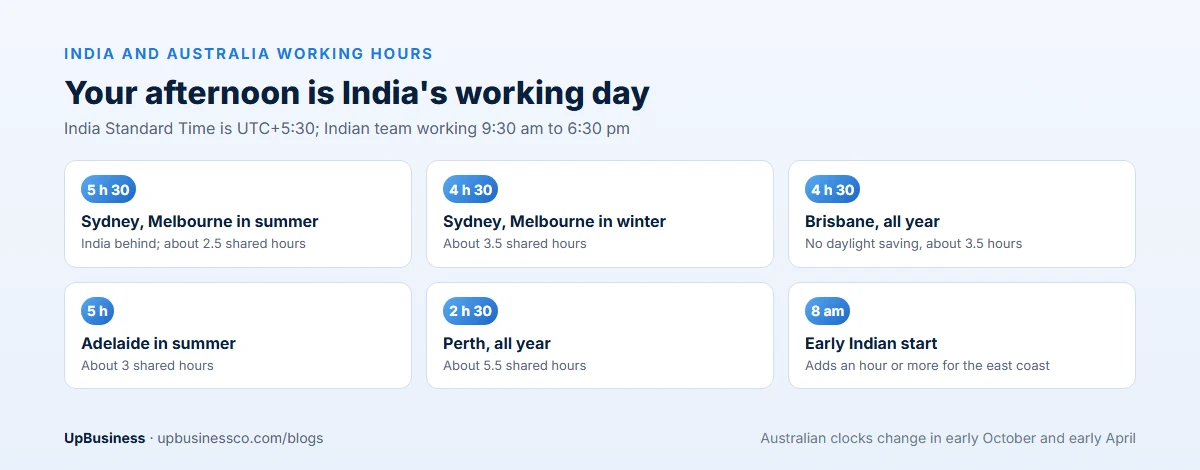
India Standard Time is UTC+5:30 all year. India doesn't change its clocks. Several Australian states do, from the first Sunday in October to the first Sunday in April. So the gap depends on your city and the season.
| City | India is behind by | Indian 9:30 am is | Shared hours, Indian 9:30 am to 6:30 pm |
|---|---|---|---|
| Sydney, Melbourne, Canberra (summer) | 5 h 30 min | 3:00 pm | About 2.5 |
| Sydney, Melbourne, Canberra (winter) | 4 h 30 min | 2:00 pm | About 3.5 |
| Brisbane (all year) | 4 h 30 min | 2:00 pm | About 3.5 |
| Adelaide (summer) | 5 h | 2:30 pm | About 3 |
| Perth (all year) | 2 h 30 min | 12:00 pm | About 5.5 |
The shared-hours column assumes your office closes at 5:30 pm. Many Indian companies that serve Australia start their day early, at 7:30 or 8:00 am India time. An 8:00 am start is 1:30 pm in Sydney in summer, which gives you four shared hours. Ask each company on your shortlist what hours its team keeps for Australian clients.
Use your morning for writing tasks and reviewing yesterday's work. Use the shared afternoon for the daily call, questions and demos. The Indian team then builds while you sleep. Check meeting times again in early October and early April, when your clocks change and India's don't.
The Privacy Act and APP 8: Sending Personal Data to India
If your business is covered by the Privacy Act, Australian Privacy Principle 8 applies when you disclose personal information to someone overseas. Most businesses with annual turnover above A$3 million are covered, and some smaller ones are too, such as health service providers.
APP 8 asks you to take reasonable steps so the overseas recipient doesn't breach the Australian Privacy Principles. Section 16C of the Act goes further. If the Indian company mishandles the data in a way that would breach the principles, you can be held accountable as if you did it. The OAIC says it generally expects an enforceable contract with the recipient[4].
The OAIC also draws a useful line between "use" and "disclosure". Giving data to an overseas contractor is usually a disclosure. But if a binding contract limits the company to set purposes and you keep effective control of the data, it may count as a use instead. Effective control means you can access, change and get back the data, and you decide who can see it. Either way, the same contract terms protect you.
Do these four things before data moves:
- Keep personal data out where you can. Developers can build and test most systems with fake or masked data.
- Sign a data handling agreement. It covers purpose, security, deletion, subcontractors and breach reporting.
- Keep control. Live data stays in your cloud accounts, under logins you can switch off.
- Plan for breaches. Under the Notifiable Data Breaches scheme, you must assess a suspected breach and, if it's eligible, notify the OAIC and the people affected[5]. The Indian company must tell you within hours, not weeks.
On the Indian side, the Digital Personal Data Protection Act 2023 exempts data about people outside India that an Indian company processes under a contract with a foreign client. So your Australian obligations and your contract do the real work.
Contracts, Code Ownership and Moral Rights
Under Australia's Copyright Act, code written by your employee belongs to you. Code written by an outside company belongs to that company, even if you paid for it. An assignment of copyright has no effect unless it's in writing and signed by or for the company that owns it[6].
Moral rights work differently in Australia from the UK or Canada. They can't be waived. Instead, the author can consent in writing to acts that would otherwise infringe them, such as changing the code or leaving out a name. Ask for written moral rights consent from the company, covering its staff, for all future changes and uses.
Indian law adds a trap. If an assignment doesn't state how long it lasts, India treats it as lasting five years. If it doesn't state where it applies, India treats it as covering India only. So write "worldwide" and "for the full term of copyright" into the clause.
Your contract should also cover:
- Disputes. India doesn't list Australia as a reciprocating country, so an Australian court judgment can't be enforced there directly. You would have to sue again in India. Arbitration avoids this, because both countries enforce awards under the New York Convention. Sydney and Singapore are common seats.
- Open source. The company lists every open-source library and its licence.
- Handover. You get source code, passwords, cloud accounts and documents at each milestone.
- Staff. The people named in the proposal do the work. Changes need your approval.
- Exit. Either side can end the contract with 30 days' notice, with help to hand over to a new team.
Our software development contract checklist has the full clause list.
GST, Tax and Invoices
The Indian company won't charge Australian GST if you're GST registered and buying for your business. Whether you must account for GST yourself depends on how you use the service.
- If you buy the service solely for a creditable purpose, as most fully taxable businesses do, the reverse charge doesn't apply.
- If you don't, for example because you make input-taxed supplies like many financial services, the reverse charge applies. You pay 10% GST on the amount and claim back any credits you're entitled to[7].
On income tax, the trade agreement change means Australia doesn't tax payments to Indian firms for technical services delivered from India. Fees for work done on site in Australia can still be taxed, so ask your accountant before Indian staff fly over to work at your office.
On the Indian side, the project is an export of services. The company normally charges no Indian GST and marks the invoice as an export. Ask for invoices with the company's legal name, address, GST number and bank details.
Paying an Indian Company From Australia
Most Indian companies invoice in US dollars, and many accept Australian dollars. Agree the currency in the contract. If you price in Australian dollars, you carry no exchange-rate risk. If you price in US dollars, a weaker Australian dollar makes the project dearer. A move of five cents in the exchange rate changes a $42,000 project by about A$2,100.
Pay by bank transfer against milestones. A common pattern is 10% to 20% up front, then a payment after each delivery you have tested. Never pay into a personal account, and confirm any change of bank details by phone.
What It Costs: A Worked Example in Australian Dollars
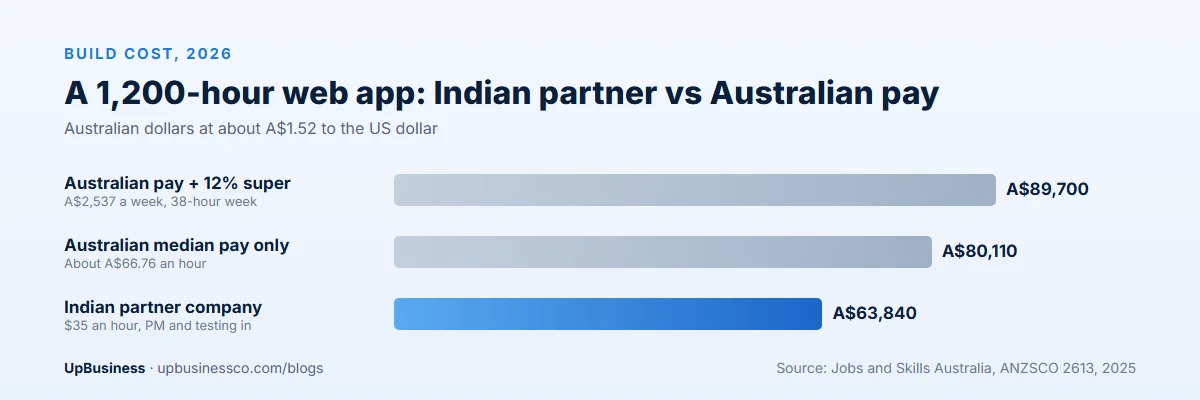
Take a web application with a customer portal, an admin area and payments. It needs about 1,200 hours of work.
| Phase | Hours | Indian partner at $35 an hour | Australian median pay, about A$66.76 an hour |
|---|---|---|---|
| Discovery and design | 160 | $5,600 | A$10,680 |
| Build | 800 | $28,000 | A$53,410 |
| Testing and fixes | 160 | $5,600 | A$10,680 |
| Launch and handover | 80 | $2,800 | A$5,340 |
| Total | 1,200 | $42,000 (about A$63,800) | A$80,110 pay, about A$89,700 with super |
The Australian figure turns the A$2,537 median weekly pay into an hourly rate over a 38-hour week. Super adds 12%. The Australian dollar figure for the Indian quote uses about A$1.52 to the US dollar. Your quotes will differ.
The Australian column still leaves out leave loading, payroll tax, recruiting, equipment and months spent hiring. It also assumes one programmer can do design, project management and testing. An Indian partner's rate includes those roles. An Australian agency will usually quote well above the pay figure, because its rate covers the same costs plus margin.
Two things eat into the saving. The first is your own time: someone must write the brief, answer questions and test the work. The second is rework when the brief is vague. A clear software project brief is the cheapest protection. Our software development cost benchmark has Indian rates by role.
Building for Australian Users
- Prices. Consumer prices must show the total price, including GST, as a single figure. Put that in the checkout brief.
- Accessibility. The Disability Discrimination Act applies to online services. Write WCAG 2.2 level AA into the brief and the acceptance tests.
- Local formats. Dates as day, month, year. Australian addresses and postcodes, ABN checks for business customers and Australian spelling.
- Payments. If you need PayTo, BPAY or a local gateway, name it in the brief. Indian teams know Stripe well, but local rails vary.
How to Check an Indian Company Before You Sign
- Check the registration. Ask for the company's CIN and look it up on India's Ministry of Corporate Affairs site. Check the GST number too. Our guide on how to verify an Indian software company shows each step.
- Call two past clients in Australia or New Zealand. Ask about the overlap hours and what went wrong.
- Meet the actual team on video. Not just the sales lead. Ask the developers to walk you through a past project.
- Ask about security. ISO 27001 is the most common certificate. If your customers ask about the Essential Eight, the Australian Signals Directorate's baseline controls, ask how the company meets them on its own laptops and systems[8].
- Run a paid discovery phase. Two to four weeks, fixed price, with a written plan at the end.
Our due diligence checklist and questions to ask a software company go deeper. When proposals arrive, use our software development company scorecard to compare finalists.
Setting Up Communication
- Hold one 15-minute call each day in the shared afternoon hours.
- Name one person on each side who can make decisions.
- Use one tool for tasks and one for chat. Keep decisions in the task tool.
- Hold a demo every two weeks where you see working software.
- List the holidays for both countries. Diwali and Holi can take a few days out of a sprint, and Australian public holidays differ by state.
Mistakes Australian Buyers Make
- Sending live customer data on day one. Sign the data terms first and use test data where you can.
- Relying on "you own everything" in the proposal. Only a signed written assignment works, plus moral rights consent.
- Choosing Australian courts for disputes. An Australian judgment isn't directly enforceable in India. Arbitration is.
- Forgetting daylight saving. Your clocks change in October and April. India's don't.
- Picking the lowest quote. A quote far below the rest usually means missed scope or junior staff.
Red Flags
- The company won't put the code assignment and moral rights consent in the contract.
- It won't sign data handling terms or report breaches quickly.
- It won't let you meet the developers before you sign.
- It asks for most of the money up front.
- It can't name a client you can call.
- It keeps the code in its own accounts.
Your First 30 Days
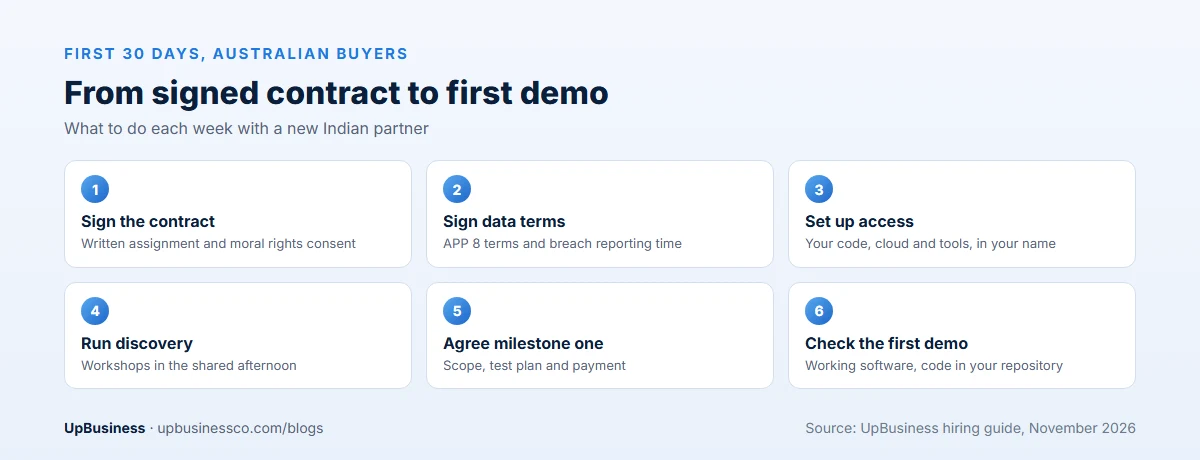
- Week 1: Sign the contract and data handling terms. Set up shared tools and give access to your code and cloud accounts.
- Week 2: Run discovery workshops in the shared afternoon hours. The company writes up the scope, plan and risks.
- Week 3: Agree the first milestone and how you'll test it. Start the first sprint.
- Week 4: See the first demo. Check the code is in your repository and the team is the one you were promised.
What UpBusiness Partner Data Shows
We looked at the 46 partner companies on our software development page on 31 October 2026, most of them based in India.
- Their TrustScores run from 70.17 to 75.85 out of 100, with a median of 71.67.
- Of the 45 that report an average project size, 22 average $5,000 or less. The median is $10,000.
- 38 of the 46 have 50 employees or fewer.
On our custom software development page, 12 companies are listed and 6 of them list custom software as a core service. Smaller companies suit a first project, because your work gets senior attention. If you also buy for a US or UK office, see our guides for US buyers and UK buyers.
How Hiring Works on UpBusiness
Every partner company on UpBusiness has passed five checks reviewed by our team: company details, registration and tax papers, the founder's identity, expertise and three client projects with evidence. Only companies with a TrustScore of 70 or more are listed.
- Post your requirement with the service, a rough budget and that you're based in Australia.
- Get three partner companies matched to your budget, service and industry.
- Compare them side by side, meet them on video and contract with the one you choose. Buyers pay nothing, and there's no commission on the project.
Then follow the steps in this guide: APP 8 terms, a written assignment with moral rights consent, milestones and a paid discovery phase. That's how Australian companies get the saving without the surprises.