


Browse our curated list of Custom Software Development Companies
To hire .NET developers in India, start with your version and your goal: a new app on .NET 10, an upgrade from an older .NET, or a rewrite of a .NET Framework system. Then screen for C#, ASP.NET Core, Entity Framework Core, SQL Server, Azure and testing. Run a short paid test task, keep the code in your own repository and start with a two-week trial. Indian partner companies commonly bill $25 to $50 an hour for .NET work, while US government contract ceiling rates for .NET developers have a median of $110 an hour.
This guide is for buyers in any country who want to hire .NET developers from India: founders, IT managers and product owners. It covers sourced rates, the version deadline many buyers miss, the skills that matter in 2026, a screening process, 12 interview questions with good and weak answers, red flags and a cost example.
Key takeaways
- Support for .NET 8 and .NET 9 ends on 10 November 2026. New work should use .NET 10, the current Long Term Support release, which is supported until November 2028.
- US federal contract ceiling rates for .NET developers have a median of $110 an hour across 195 rates from 51 contractors in GSA CALC.
- Indian partner companies commonly charge $25 to $50 an hour for .NET, with project management and testing often included.
- Many .NET projects are upgrades, not new builds. Ask every company for a migration they have finished from .NET Framework.
- A paid test task of four to eight hours, reviewed with the developer, shows more than any interview.
How to Hire .NET Developers in India: The Short Version
- Write a one-page brief. Say what the app does, its current .NET version, the database, where it's hosted and what must change.
- Pick a hiring model. A freelancer, a dedicated developer from a partner company, or a full project team.
- Shortlist three to five companies. Check registration, ask for two .NET systems they built or upgraded, and a code sample.
- Screen in three steps. A 30-minute call, a paid test task and a review call.
- Start with a two-week trial. Code goes into your repository, and cloud resources sit in your account.
The Version Deadline: .NET 8 and .NET 9 End in November 2026
Microsoft releases a new .NET every November. Even-numbered releases are Long Term Support (LTS) releases with three years of fixes. Odd-numbered releases are Standard Term Support (STS) releases with two years[1].
| Version | Type | Support ends | What to do |
|---|---|---|---|
| .NET 10 | LTS | November 2028 | Use for new projects |
| .NET 9 | STS | 10 November 2026 | Upgrade to .NET 10 now |
| .NET 8 | LTS | 10 November 2026 | Upgrade to .NET 10 now |
| .NET 6 and 7 | Ended | Already out of support | Upgrade urgently |
| .NET Framework 4.8.1 | Part of Windows | Follows the Windows version | Plan a move to modern .NET |
After the end date, Microsoft stops releasing security fixes. Apps keep running, but each new security hole stays open. If your app runs on .NET 8, an upgrade to .NET 10 is usually a small project of days or a few weeks.
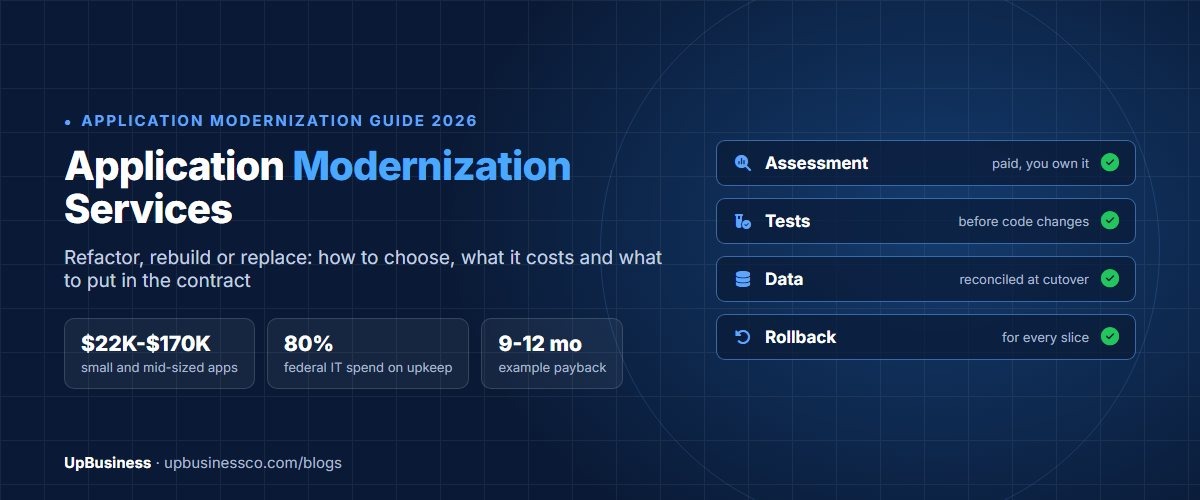
.NET Framework is different. Version 4.8.1 is still supported as part of Windows[2], but it gets no new features, and parts of it, such as Web Forms and WCF on the server, don't exist in modern .NET. Moving off it can mean rewriting parts of the app. Our guide to application modernisation services covers when to refactor, rebuild or replace.
.NET Developer Rates in 2026
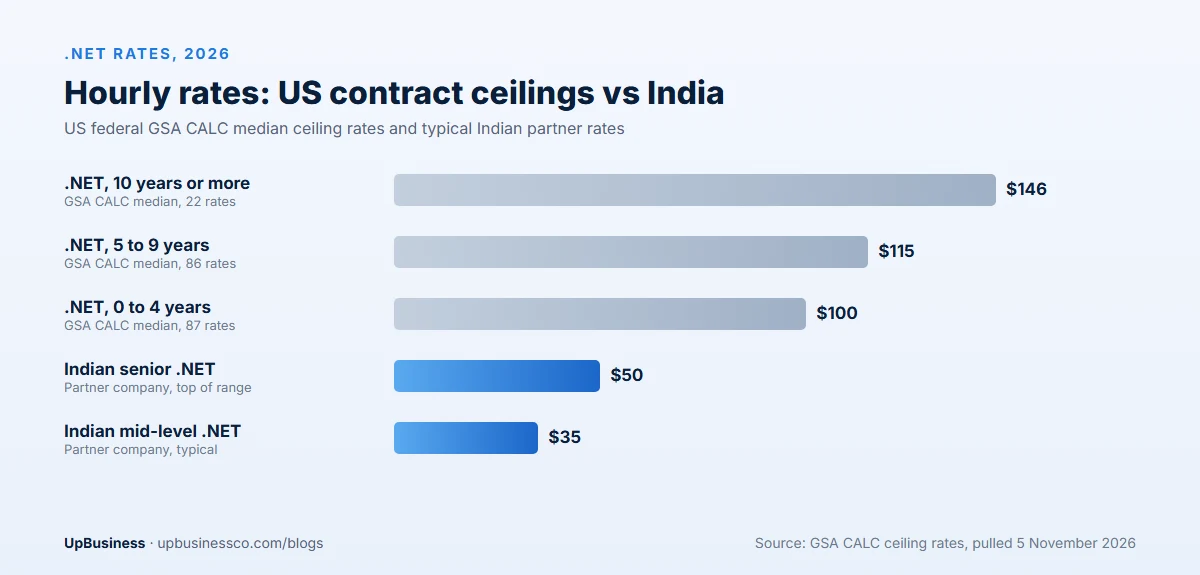
Most .NET rate pages are written by firms selling developers, and their numbers rarely agree. We used checkable sources instead.
The US government's CALC tool lists the maximum hourly rates contractors may charge federal buyers under GSA schedules[3]. On 5 November 2026 we pulled every rate with ".NET" in the job title.
| Experience in GSA CALC | Rates found | Median ceiling rate |
|---|---|---|
| 0 to 4 years | 87 | $100 an hour |
| 5 to 9 years | 86 | $115 an hour |
| 10 years or more | 22 | $146 an hour |
| All .NET developer rates, 51 contractors | 195 | $110 an hour |
These are ceiling rates for US government buyers, so private US projects often pay less. On pay, the 2025 Stack Overflow Developer Survey reports a median salary for full-stack developers in India of about $13,950 a year, against about $138,000 in the US[4]. In US private industry, wages are about 70% of an employee's total cost, according to the Bureau of Labor Statistics[5].
Indian partner companies usually bill:
| Level | What they can do | Typical Indian partner rate |
|---|---|---|
| Junior, 1 to 2 years | Build pages and APIs from a clear spec with guidance | $20 to $28 an hour |
| Mid-level, 3 to 5 years | Own features, write EF Core queries and tests | $28 to $40 an hour |
| Senior, 6 years or more | Design the system, lead upgrades, review code | $40 to $50 an hour |
| Architect | Plan migrations, Azure setup and team structure | $50 to $65 an hour |
These ranges come from the proposals we see on UpBusiness and match our software development cost benchmark. A full-time dedicated .NET developer from an Indian partner company usually costs $3,500 to $8,000 a month.
Freelancer, Partner Company or Your Own Team in India?
| Freelancer | Partner company | Your own team in India | |
|---|---|---|---|
| Speed to start | Days | One to three weeks | Three to six months |
| Who reviews the code | You | A senior on their team | Your tech lead |
| Azure, database, testing | Usually separate people | Often in one team | Separate hires |
| If someone leaves | You start again | The company replaces them | You hire again |
| Best for | Small, clear tasks | A product, upgrade or project | A long-term team of ten or more |
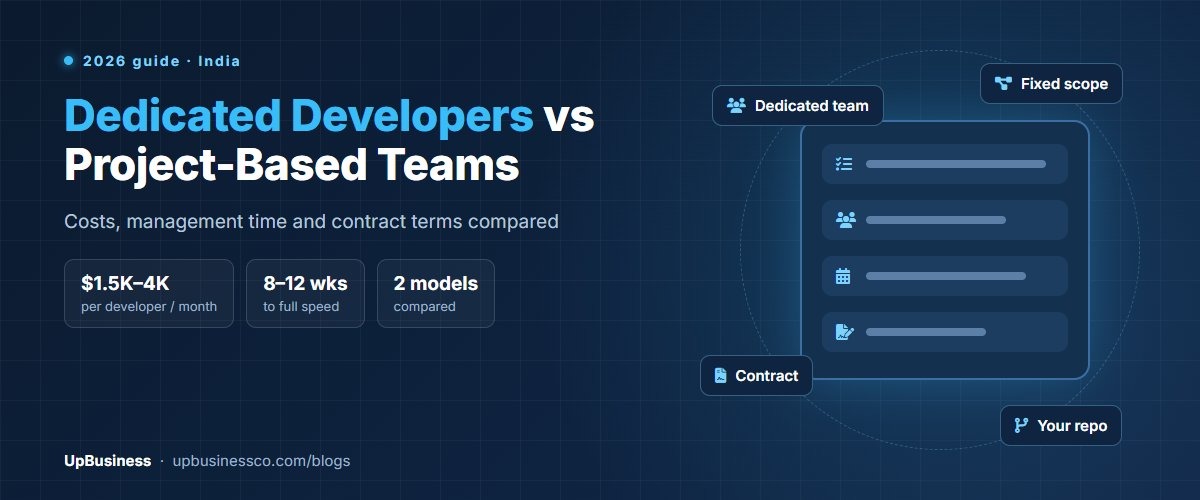
For upgrades and business systems, a partner company is usually the safer choice, because a senior reviews each change and the company covers holidays and staff changes. If you need people working only for you for a year or more, read our comparison of dedicated developers and project-based teams, and our guide to agency vs freelancer vs in-house for the full cost of each model.
Skills to Look For in a .NET Developer in 2026
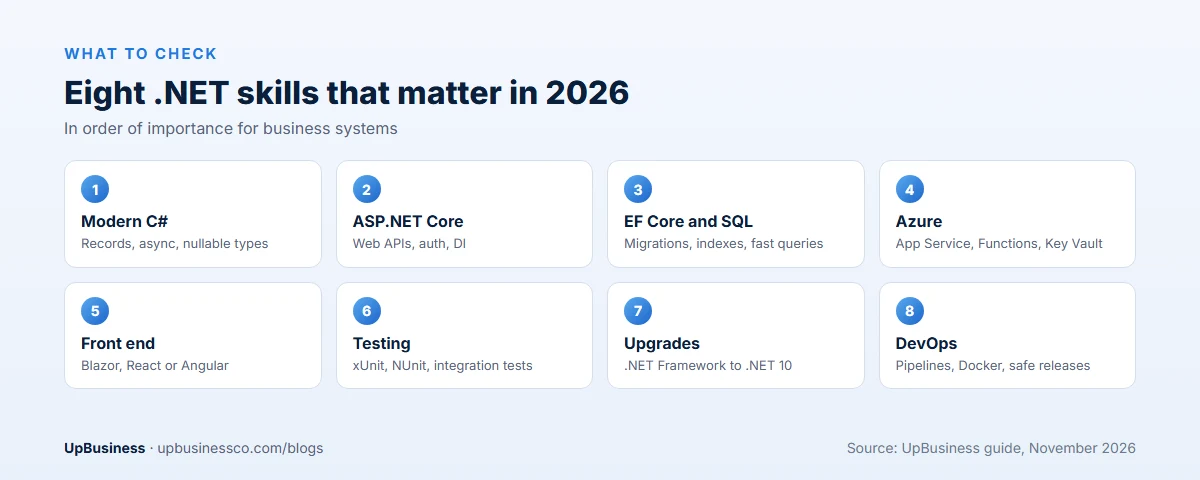
- Modern C#. Records, pattern matching, nullable reference types and async code. Ask which C# version they use day to day.
- ASP.NET Core. Web APIs, minimal APIs, middleware, authentication and dependency injection.
- Entity Framework Core and SQL. Migrations, indexes, avoiding slow queries, and plain SQL when EF Core isn't the right tool. Most .NET apps use SQL Server or PostgreSQL.
- Azure. App Service, Functions, Azure SQL, Key Vault, Entra ID sign-in and monitoring with Azure Monitor. Some teams use AWS instead, so ask.
- Front end. Blazor for teams that want C# in the browser, or React or Angular with an ASP.NET Core API.
- Testing. Unit tests with xUnit or NUnit, integration tests against a real database, and tests in the build pipeline.
- Upgrades. Moving from .NET Framework or older .NET versions, replacing unsupported packages and using Microsoft's upgrade tools.
- DevOps. Azure DevOps or GitHub Actions, Docker and safe, repeatable releases.
Some projects need specialist .NET skills: .NET MAUI for mobile and desktop apps, or SharePoint and Dynamics 365 for Microsoft business systems. Ask for these by name if you need them.
Why Buyers Hire .NET Developers in India
India has one of the largest .NET talent pools in the world. Many Indian IT companies grew up building Microsoft systems for banks, insurers, logistics firms and governments, and many of them hold Microsoft partner status. That means three things for buyers:
- Experience with old systems. Developers who have maintained .NET Framework apps for years can upgrade yours without breaking business rules nobody wrote down.
- Cost. Indian partner rates are usually a quarter to a third of US or UK rates for the same experience.
- Scale. A company can add developers, testers and a database specialist within weeks.
The common challenges are the time gap and staff turnover. Write the working hours and the named people into the contract. If you're hiring from the US, our guide for US buyers covers time overlap, contracts and payments.
How to Screen .NET Developers in Three Steps
Step 1: a 30-minute call. Ask about the last two .NET systems they worked on. What version? What did they change, and what went wrong? Strong developers talk about data, performance and users. Weak ones list technologies.
Step 2: a paid test task, four to eight hours. A small ASP.NET Core Web API on .NET 10 with two resources, EF Core and a SQL database, validation, authentication and tests. Ask for a short README on how to run it.
Step 3: a review call. Ask them to explain the structure. How would they find a slow query? How would they upgrade this to the next .NET version? What would they add with another day?
If you aren't technical, pay an independent senior .NET developer for an hour to review the task. On a hire worth tens of thousands of dollars a year, that hour is cheap insurance, and it often shows problems a sales call would hide.
12 Interview Questions for .NET Developers, With Good and Weak Answers
| Question | A good answer mentions | A weak answer |
|---|---|---|
| What is the difference between .NET Framework and modern .NET? | Windows-only and maintenance mode vs cross-platform and active, missing parts such as Web Forms | They're the same thing |
| How does async and await work, and what is a common mistake? | Frees threads during I/O; avoid .Result and .Wait, which can deadlock | It makes code run in parallel |
| How do you find a slow EF Core query? | Logging the SQL, checking the plan, adding indexes, avoiding N+1 with Include or projections | Add more memory to the server |
| How does dependency injection work in ASP.NET Core? | Registering services with lifetimes: singleton, scoped, transient, and the risks of each | I create objects with new |
| How do you store secrets? | Key Vault or user secrets, never in appsettings in the repository | In the config file |
| How would you add sign-in? | ASP.NET Core Identity or Entra ID, tokens, roles and policies | Check a username in the database |
| How do you handle errors in an API? | Central exception handling, ProblemDetails responses, logging with correlation IDs | Catch and ignore |
| How do you test an ASP.NET Core API? | Unit tests plus integration tests with WebApplicationFactory and a real database | Test it by hand |
| How would you upgrade an app from .NET 8 to .NET 10? | Check breaking changes, update packages, run tests, release in stages | Change the version number |
| How would you move a .NET Framework app to modern .NET? | Inventory, replace unsupported parts, upgrade in slices, keep it running | Rewrite everything at once |
| What is the difference between IEnumerable and IQueryable? | In-memory vs query sent to the database, and the effect on performance | No difference |
| Tell me about a production issue you fixed. | What broke, how they found it, the fix and what changed after | Never had one |
For questions to ask the company rather than the developer, use our list of questions to ask a software development company.
Red Flags When Hiring .NET Developers
- They plan a new project on .NET 8 or .NET 9, which lose support in November 2026.
- Connection strings or passwords sit in their sample code.
- No tests and no examples of a finished upgrade.
- They promise to move a large .NET Framework app in a few weeks without seeing the code.
- They want the code or Azure resources in their own accounts.
- The company sends a senior to the interview and a junior to do the work.
- A quote far below the ranges above with no clear reason.
What a .NET Project Costs: Two Worked Examples
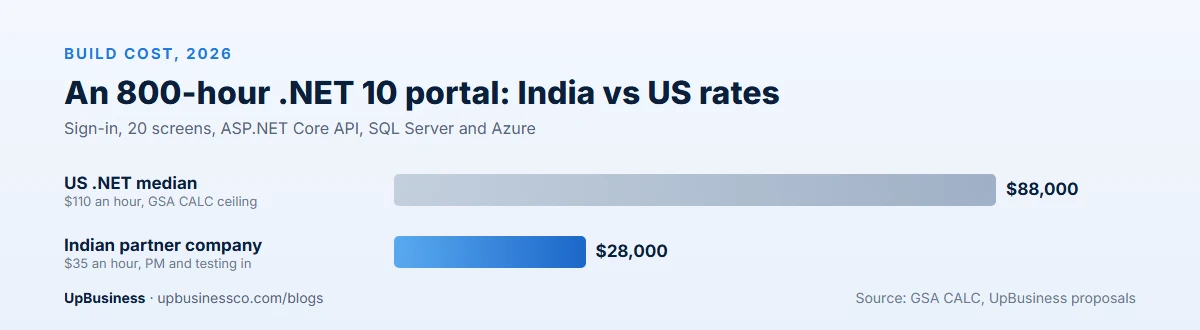
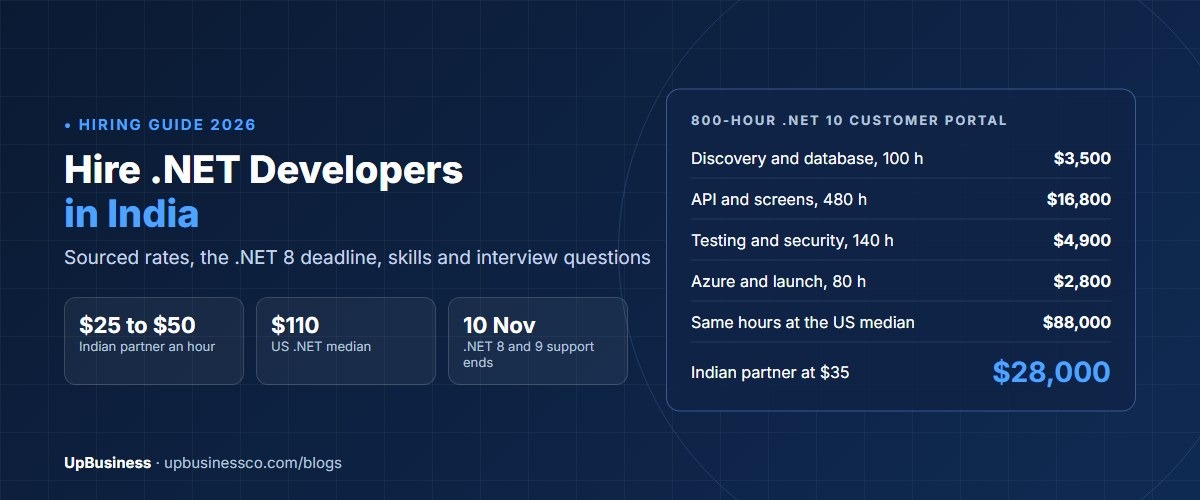
Example 1: a new web app. A customer portal on .NET 10 with sign-in, 20 screens, an ASP.NET Core API, SQL Server and Azure hosting. A partner company estimates about 800 hours.
| Phase | Hours | Indian partner at $35 an hour | US at the $110 .NET median |
|---|---|---|---|
| Discovery, design and database | 100 | $3,500 | $11,000 |
| API and screens | 480 | $16,800 | $52,800 |
| Testing and security | 140 | $4,900 | $15,400 |
| Azure setup, launch and handover | 80 | $2,800 | $8,800 |
| Total | 800 | $28,000 | $88,000 |
Example 2: an upgrade. Moving a mid-sized internal app from .NET 8 to .NET 10 usually takes 40 to 120 hours, or about $1,400 to $4,200 with an Indian partner. Moving a .NET Framework app with Web Forms pages to modern .NET can take 500 to 2,000 hours, because the screens are rebuilt. Ask for a paid assessment of one to two weeks before any company quotes a full migration.
The US column uses the GSA CALC median ceiling rate, so a private US agency may charge less. Azure hosting, SQL licences and monitoring come on top. For a small portal, hosting often starts at $100 to $400 a month.
What Pushes the Price Up
- Old .NET Framework code. Web Forms, WCF services and old packages mean rewriting, not just upgrading.
- No tests in the existing app. The team must add tests before it can change code safely.
- Many integrations. ERP, CRM, payment and identity systems each add testing.
- Strict security or compliance. Banking, health and government work adds reviews and paperwork.
- Licensing. SQL Server and some third-party components carry licence costs. Ask early.
Contract Points for .NET Work
- All code is assigned to you in writing, worldwide and for the full copyright term. Indian law treats an assignment with no stated term as five years and no stated territory as India only.
- Code lives in your repository, and Azure subscriptions sit in your name.
- The .NET version, and the plan to upgrade within the contract, are written into the scope.
- The company lists every NuGet package, its licence and any paid components.
- Named developers do the work, and changes need your approval.
Our software development contract checklist has the full clause list, and our guide on how to verify an Indian software company shows how to check registration and GST details.
The First 30 Days With a New .NET Developer
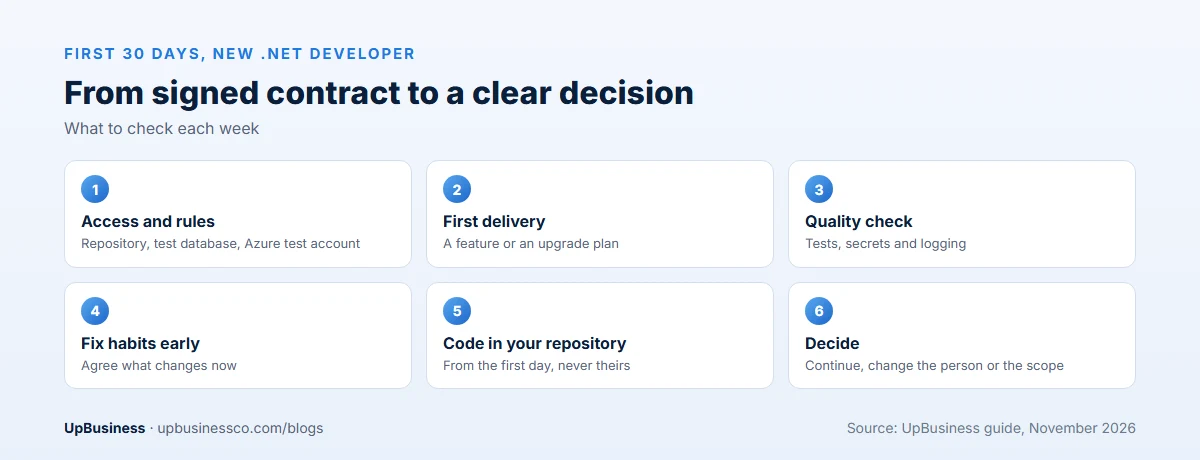
- Week 1: Give access to the repository, a test database and an Azure test subscription. Agree coding rules and the review process.
- Week 2: They deliver the first feature or the upgrade assessment. You review working software or a written plan.
- Week 3: Check tests, secrets handling and logging.
- Week 4: Decide: continue, change the person or change the scope.
Finding .NET Developers in India on UpBusiness
UpBusiness lists verified partner companies, mostly based in India. Every company has passed five checks reviewed by our team: company details, registration and tax papers, the founder's identity, expertise and three client projects with evidence. Only companies with a TrustScore of 70 or more are listed.
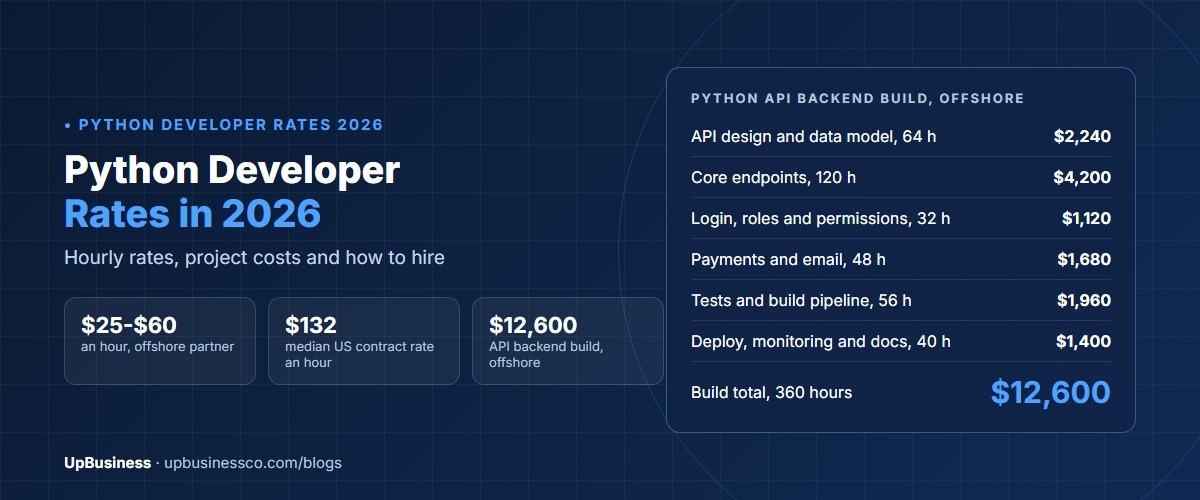
.NET work usually sits under custom and enterprise software. Our custom software development page and enterprise software page list companies that build business systems. Not every one names .NET as a core service, so ask each for two .NET systems and a code sample before you shortlist. If you're choosing a back end language for a new product, our guides on hiring Node.js developers and Python developer rates compare the other common options.
- Post your requirement with .NET, your current version, budget and timeline.
- Get three partner companies matched to your budget, service and industry.
- Compare them side by side, run the paid test task or assessment with your favourite and start a two-week trial. Buyers pay nothing, and there's no commission on the project.