


Browse our curated list of App Modernization Companies
Application modernization services take software your business already runs, often an internal system, customer portal or line-of-business app built ten or more years ago, and make it cheaper to change, safer to run and easier to connect to newer tools. The work ranges from cleaning up code to rebuilding the system piece by piece or replacing it with a SaaS product. This guide is for founders, CTOs and operations heads weighing that decision. It explains the options, how to score your code before you pick one, what modernization costs and how long it takes, and the contract terms that protect you while old and new systems run side by side.
Key takeaways
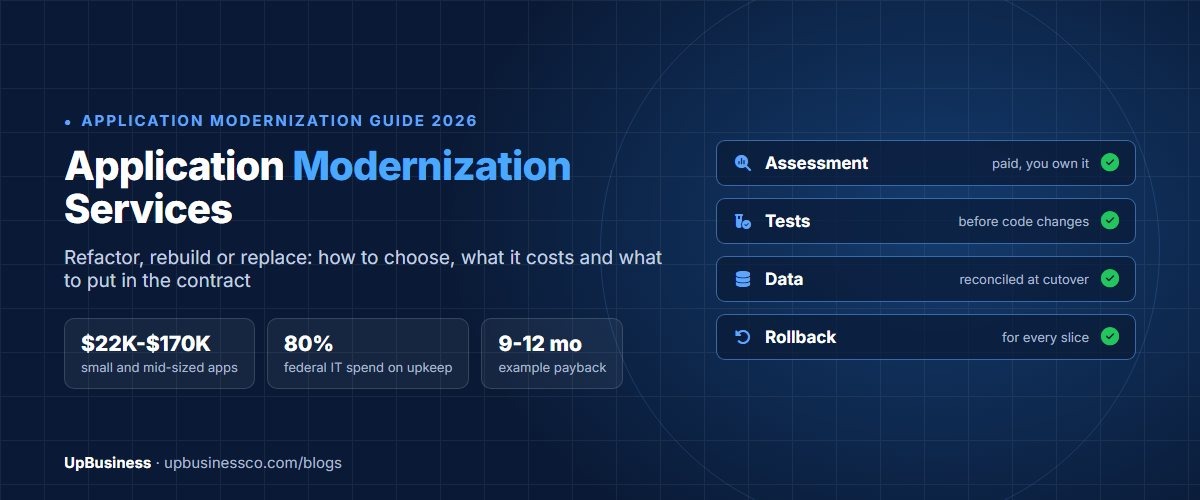
- Legacy software is expensive to keep still. US federal agencies report spending about 80% of their IT budget on operating and maintaining existing systems[1].
- There are four realistic paths: refactor, re-architect, rebuild or replace with a product. The right one depends on code health, not on how old the system is.
- Published prices run from about $22,000 for a small refactor to well over $1 million for an enterprise rebuild. Ask for a paid assessment before any fixed quote.
- The strangler fig approach replaces a system one slice at a time, so the business keeps working and every step can be rolled back.
- Data migration and missing tests cause more trouble than the new code. Put data reconciliation and behaviour parity into the contract.
What Do Application Modernization Services Include?
Most modernization engagements combine several of the services below. A good proposal names which ones apply to your system and why.
| Service | What it fixes | Typical deliverable |
|---|---|---|
| Code and architecture assessment | Nobody knows how bad the code really is | Code health report, dependency map, recommended path, rough budget |
| Refactoring | Brittle code that breaks when changed | Same features, cleaner modules, automated tests |
| Framework and runtime upgrade | Unsupported language or framework versions | App running on supported versions with security patches |
| Re-architecture | A monolith that one change can break end to end | Separate modules or services with clear interfaces |
| Database modernization | Logic buried in stored procedures, slow reporting | New schema, migrated and reconciled data |
| API layer | Other systems can't connect to the app | Documented APIs for partners, mobile apps and AI tools |
| UI modernization | Desktop-era screens staff struggle with | Web or mobile interface on top of the existing logic |
| Run and support | Fixes stop after launch | Monitoring, patching and a support agreement |
Modernization is not the same as migration. Migration moves an application to new infrastructure, usually the cloud, often with few code changes. Modernization changes the application itself. Many projects do both, but if your main goal is leaving a data centre, read our guide to cloud migration services, which covers the move and its cost. This guide covers the code.
Signs Your Application Needs Modernization
Age alone isn't the trigger. A 15-year-old system with good tests can be healthier than a five-year-old one written in a hurry. These signs matter more:
- The stack is out of support. No more security patches means every new vulnerability stays open.
- Small changes take weeks. Your team avoids touching certain modules because something else always breaks.
- Maintenance eats the roadmap. In Stripe's survey of developers and executives, the average developer spent more than 17 hours of a 41-hour week on maintenance work such as debugging and refactoring[2].
- One person holds the knowledge. If the engineer who understands the batch jobs leaves, nobody can safely change them.
- You can't connect new tools. No API means no mobile app, no partner integration and no AI assistant on top of your data.
The same pattern shows up at scale. When the US Government Accountability Office reviewed 69 federal legacy systems in 2025, it picked 11 as most in need of modernization. Eight used outdated languages, four ran on unsupported hardware or software and seven were operating with known cybersecurity vulnerabilities[1]. In the private sector, CIOs surveyed by McKinsey said 10 to 20% of the budget meant for new products was diverted to resolving tech debt, and 60% said their debt had grown over the past three years[3].
Check your stack against official support dates first. A few common examples:
| Technology | End of official support | What it means |
|---|---|---|
| Python 2[4] | 1 January 2020 | No fixes of any kind since then |
| AngularJS (1.x)[5] | January 2022 | Front ends on it get no security fixes |
| PHP 8.2[6] | 31 December 2026 | Security fixes end this year; 8.1 and older are already unsupported |
| PHP 8.3[6] | 31 December 2027 | Plan the upgrade within the next year |
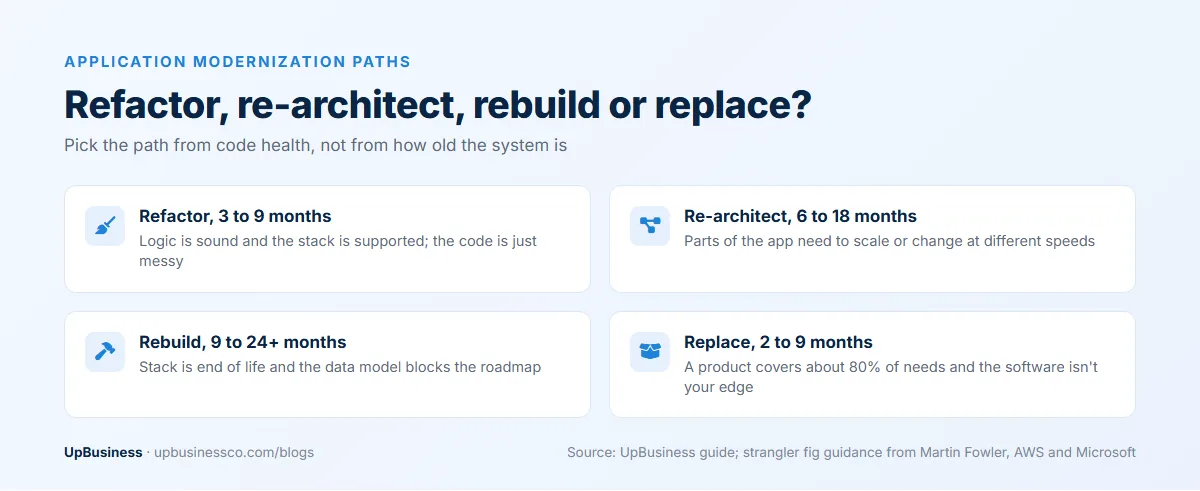
Refactor, Re-architect, Rebuild or Replace: Which One Fits?
Every application modernization services proposal you receive will recommend one of four paths, or a mix by module. Use this table to test whether the recommendation fits your situation.
| Path | What changes | Choose it when | Avoid it when | Typical timeline |
|---|---|---|---|---|
| Refactor | Internal code structure; features stay the same | The logic is sound, the stack is supported and the code is just messy | The architecture can't support what you need next | 3 to 9 months |
| Re-architect | Structure: monolith split into modules or services | Different parts need to scale or change at different speeds | The app is small; splitting adds cost with no benefit | 6 to 18 months |
| Rebuild | Everything: new code, often a new data model | The stack is dead, the data model blocks the roadmap and the logic is well understood | Nobody can explain what the current system actually does | 9 to 24+ months |
| Replace with a product | You stop owning the code | A SaaS or packaged product covers about 80% of your needs without heavy customisation | The software is how you compete | 2 to 9 months |
Timelines are typical for a single business application with a small team and vary with scope. Two patterns help. First, most real programmes mix paths: refactor the billing module, rebuild the reporting layer, replace the HR screens with a product. Second, if a partner company recommends a full rebuild without first reading your code, treat that as a sales answer, not a technical one.
Score Your Code Before You Decide
Before you ask for quotes, answer these six questions with your team or a paid assessor. They turn the decision from opinion into evidence.
| Check | Points to refactor | Points to rebuild or replace |
|---|---|---|
| Is the language and framework still supported? | Yes, with a clear upgrade path | No, end of life with no upgrade path |
| How much of the code has automated tests? | Meaningful coverage on core flows | Little or none, and no one trusts a change |
| Can someone explain the business rules? | Rules are documented or known by current staff | Rules live only in the code |
| What share of developer time goes to maintenance? | Under about a third | Most of it, and rising |
| Can the architecture support the next three years? | Yes, with cleanup | No, however clean the code gets |
| Does a product cover most of your needs? | No, your process is unusual | Yes, about 80% out of the box |
Mostly left column means refactor, possibly with some re-architecture. Mostly right column means rebuild or replace. A mix usually points to the strangler fig approach below, where you rebuild the worst parts first and keep the rest.
How the Strangler Fig Approach Lowers Risk
Martin Fowler named this pattern after a vine that grows around a host tree until it stands on its own. He notes that his colleagues have seen the simple plan of rebuilding everything at once "go down in flames most of the time", because replacements take a long time, users can't wait for features, and much of the old behaviour is hard to pin down[7]. Instead, new code grows around the old system and takes over its jobs one at a time.
In practice it works like this. A routing layer sits in front of the legacy app and at first sends every request to it. The team builds one slice in new code, such as customer accounts or invoicing, and the router sends that traffic to the new slice. Bugs in the old system still get fixed so the business stays stable. Slice by slice, the old system shrinks until it can be switched off. AWS describes the same approach for moving from a monolith to microservices and recommends an anti-corruption layer so old and new parts can talk without breaking each other[8].
It isn't always the right tool. Microsoft's architecture guidance says the pattern may not suit small systems that are simple to replace whole, cases where requests to the old system can't be intercepted, or situations where you need to switch off the old system quickly[9]. AWS also warns that the routing layer can become a single point of failure, so it needs monitoring of its own[8].
Moving Legacy Data Without Breaking Reports
Data is where modernization projects quietly go wrong. Old databases often hold business logic in stored procedures, duplicate records and fields that mean different things to different teams. Microsoft's guidance describes a three-step route: copy the data for one area into a new database with an initial load, keep the two in sync with change data capture while both systems run, then cut over once validation and consistency checks pass[9].
The key point for buyers is the rollback window. Microsoft notes that you can return to the old database until the legacy tables are removed, and that removing them should be a deliberate final step after the new system is validated[9]. Ask every partner company how it will reconcile record counts and totals, which reports it will compare before and after, and how long the rollback window stays open.
Testing is the other safety net. Before changing old code, a careful team writes tests that capture what the system does today, including its odd behaviour, then checks the new code against them. If your application has few tests, budget for this step explicitly. Our guide to software testing cost shows how QA work is usually priced.
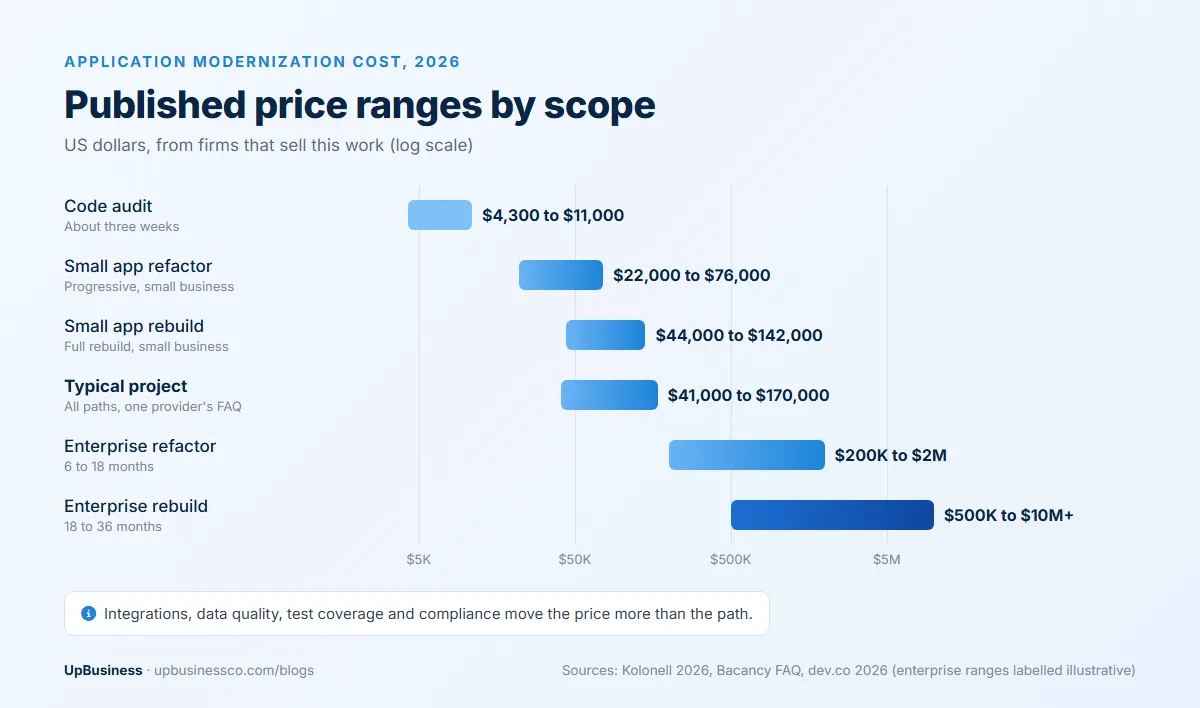
How Much Do Application Modernization Services Cost?
There is no standard price, and the published ranges show why. They come from firms that sell this work and describe very different systems, so read them as a guide to scale, not a quote.
| Published range (USD) | Scope it describes | Source |
|---|---|---|
| $4,300 to $11,000 | Code audit to decide refactor or rebuild, about three weeks | Singapore small business guide[10] |
| $22,000 to $76,000 | Progressive refactoring of a small business app | Small business guide[10] |
| $44,000 to $142,000 | Full rebuild of a small business app | Small business guide[10] |
| $41,000 to $170,000 | Typical modernization project, all paths | Service provider FAQ[11] |
| $200,000 to $2 million | Enterprise refactor, 6 to 18 months | Enterprise guide, labelled illustrative[12] |
| $500,000 to $10 million+ | Enterprise rebuild, 18 to 36 months | Enterprise guide, labelled illustrative[12] |
Five things move the price more than the choice of path:
- Integrations. Every system that reads from or writes to the app needs testing and often rework.
- Data volume and quality. Ten years of messy records take far longer to migrate than clean ones.
- Test coverage. No tests means the team must build a safety net before changing anything.
- Compliance. Health, finance and government systems add validation and audit work.
- Parallel running. Running old and new systems side by side costs money for as long as it lasts.
Hold back contingency. Research by McKinsey and the University of Oxford on more than 5,400 IT projects found that large projects ran 45% over budget and 7% over time on average, while delivering 56% less value than predicted[13]. Smaller, sliced projects carry less of that risk, which is another argument for the strangler fig route.
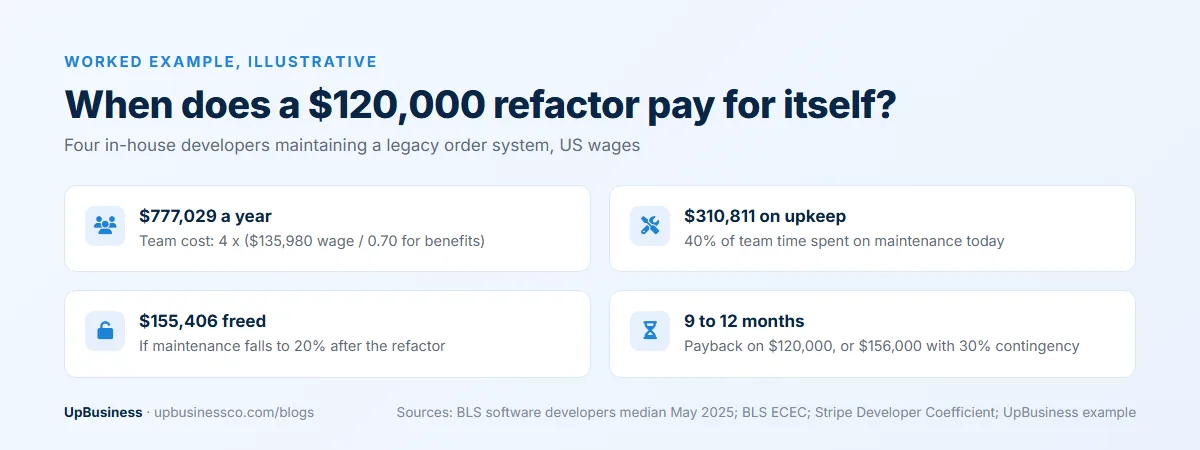
Worked Example: Is Modernizing Cheaper Than Standing Still?
Here is an illustrative case you can rerun with your own numbers. A company has four in-house developers maintaining a legacy order management system. The BLS median wage for US software developers was $135,980 in May 2025[14], and wages make up about 70% of total employee compensation[15], so each developer costs roughly $194,257 a year fully loaded. The team costs about $777,029 a year.
| Line | Figure | How it's worked out |
|---|---|---|
| Team cost per year | $777,029 | 4 x ($135,980 / 0.70) |
| Share of time on maintenance today | 40% | Close to Stripe's 17 of 41 hours |
| Maintenance cost per year today | $310,811 | $777,029 x 40% |
| Target share after a refactor | 20% | Assumption to test in the assessment |
| Capacity freed per year | $155,406 | $777,029 x 20% |
| Refactor quote from a partner company | $120,000 | Example fixed quote after a paid assessment |
| Payback | About 9 months | $120,000 / ($155,406 / 12) |
| Payback with 30% contingency | About 12 months | $156,000 / $12,950 a month |
Two cautions. The freed capacity only counts if the team spends it on work that earns money, not on more maintenance. And the 20% target is the number to challenge hardest. Ask the partner company what evidence it has that maintenance load will fall that far, and tie part of its fee to measured results such as release frequency or time to fix defects.
How Long Does Application Modernization Take?
A small refactor or framework upgrade for one application often takes three to six months. A strangler fig programme on a mid-sized system usually runs 9 to 18 months, but it delivers working slices every few weeks, so value starts early. A full enterprise rebuild can take two to three years. McKinsey's research found that each extra year on a large IT project increased cost overruns by 15%[13], so a plan that ships in slices beats one that promises everything at the end.
App Modernization Partners on UpBusiness
Our app modernization listing shows 6 partner companies verified on UpBusiness in October 2026. All six are full-service software companies based in India, in Noida, Ahmedabad and Mumbai, with teams ranging from 1-10 to 201-500 people and founding years from 2004 to 2024. None of them names modernization as a service on its profile yet, so we don't quote their project sizes here.
The honest finding is that none of the six lists modernization as one of its top three specialisations. Their listed strengths are app development, enterprise SaaS, AI solutions and digital transformation. That fits small and mid-sized modernization work well, such as a framework upgrade, an API layer or a strangler fig programme on a business app. For a large enterprise rebuild with heavy compliance, ask each partner company for a comparable modernization project and speak to that client. You can compare them on the app modernization companies page or read our guide to choosing a custom software development company in India.
Contract Terms to Agree Before You Sign
A modernization contract needs more than a standard development agreement. Our software development contract checklist covers IP, payment and exit terms. Add these clauses on top:
| Clause | What to ask for |
|---|---|
| Behaviour parity | A written list of flows the new code must reproduce, checked by agreed tests |
| Data reconciliation | Record counts, totals and named reports compared before cutover, with a signed result |
| Rollback plan | How each slice can be switched back, and how long the old system stays available |
| Paid assessment first | A fixed-fee discovery phase whose report you own, even if you hire someone else |
| Milestones by working slice | Payments tied to slices running in production, not to hours or documents |
| Decommission milestone | A dated step to switch off the old system so you stop paying for two |
| Knowledge transfer | Architecture notes, runbooks and handover sessions for your team |
| Support period | A warranty window for defects and agreed response times after each cutover |
Red Flags When Hiring an Application Modernization Partner
- A fixed price for a rebuild before anyone has looked at your code or data.
- A plan with a long "foundation" phase and nothing running in production for months.
- No mention of tests, data reconciliation or rollback.
- Every module gets the same answer, usually microservices, whatever its size.
- Case studies with no client name, no dates and no way to verify them.
- Reluctance to put the old system's switch-off date in writing.
How to Choose an Application Modernization Partner
Start with a short brief: what the system does, its stack, its integrations, rough data volume and the business result you want, such as faster releases or a supported stack. Ask two or three partner companies for a paid assessment or a detailed proposal, then compare how each one would slice the work, test it and move the data. Our guide to comparing software development proposals shows how to line them up, and if deployment is part of the problem, DevOps consulting often sits alongside modernization.
If you'd like proposals from verified partner companies, post your project on UpBusiness with your current stack, the modules that hurt most and your budget range, and compare the responses side by side.