


Browse our curated list of Custom Software Development Companies
To hire a software development company in India from Canada, write a short brief and shortlist three to five registered companies. Call their past clients and run a small paid discovery phase first. Then sign a contract that assigns all code to you in writing and waives moral rights. Put privacy terms in place before any personal data leaves Canada, and pay in Canadian or US dollars against milestones. Plan for the time gap. India is 9.5 to 13.5 hours ahead, so you get up to three shared hours a day, not a full day.
This guide covers what is different for Canadian buyers: the two-coast time gap, PIPEDA and Quebec's Law 25, copyright and moral rights, GST/HST on imported services, French-language rules and a worked cost example in Canadian dollars. For the general case for outsourcing, read our guide to outsourcing software development to India. If you also run a US entity, our guide for US buyers covers that side.
Key takeaways
- India is 10 hours 30 minutes ahead of Toronto in winter and 9 hours 30 minutes ahead in summer. Vancouver is three hours further back. Most Indian teams serving Canada shift their day later to give you two to three shared morning hours.
- PIPEDA lets you send personal data to India for processing, but you stay responsible for it. You need a contract that gives it comparable protection, and you must tell customers it may be processed abroad.
- Quebec is stricter. Under Law 25, you must do a privacy impact assessment and sign a written agreement before personal data about Quebec residents leaves the province.
- In Canada, a copyright assignment must be in writing and signed. Moral rights can't be assigned, only waived, so ask for a written waiver too.
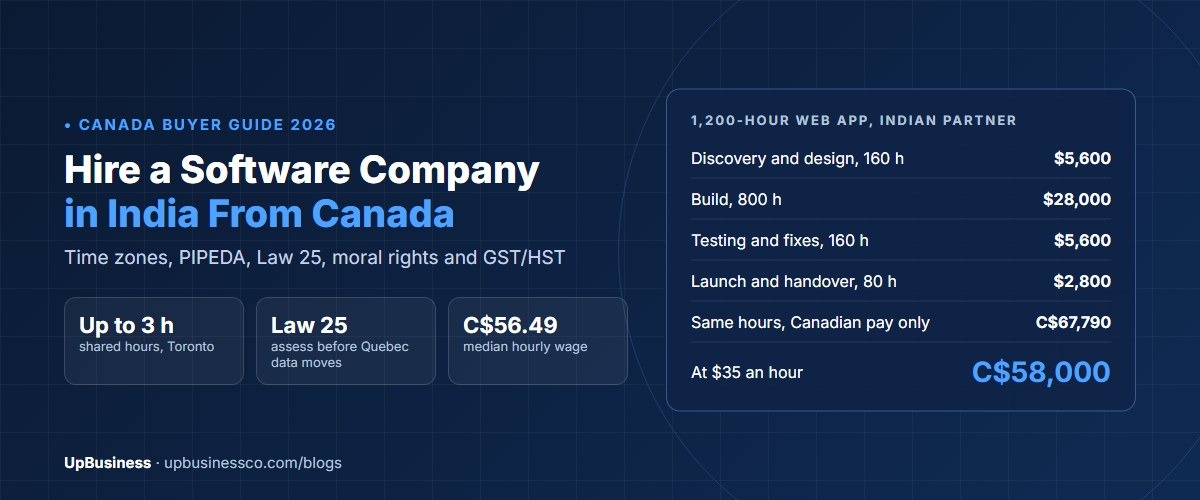
- A Canadian software design engineer's median wage is C$56.49 an hour. A 1,200-hour build costs about C$67,800 in wages alone, before benefits and hiring. An Indian partner at $35 an hour costs about C$58,000 and includes project management and testing.
Why Canadian Companies Hire a Software Development Company in India
The first reason is hiring speed. Good developers are hard to find in Toronto, Vancouver and Montreal. Hiring one person can take months. An Indian partner company can start a full team in two to four weeks.
The second reason is cost. The median wage for a software design engineer in Canada is C$56.49 an hour, and Vancouver pays more[1]. That figure is pay only. Benefits, payroll taxes, recruiting and equipment come on top. An Indian partner's hourly price already covers those, plus a project manager and a tester.
The third reason is people. Canada has one of the largest Indian communities outside India. Many Canadian founders and engineering leads have worked with Indian teams before, and many Indian companies already serve Canadian banks, retailers and software firms.
The honest catch is time. Canada is further from India in time than the UK, the Gulf or Australia. That gap shapes how the work runs, so plan for it from day one.
Partner Company, Freelancers or Your Own Team in India?
| Indian partner company | Indian freelancers | Your own team in India | |
|---|---|---|---|
| Contracts | One for the whole team | One per person | Employment through an employer of record or your own Indian company |
| Who runs the work | The company's project lead | You | Your managers |
| Late-shift cover | Built into the team's hours | Depends on each person | You set the shifts |
| If someone leaves | The company replaces them | You find someone new | You hire again |
| Best for | A defined project or product | Small, separate tasks | A long-term team of ten or more |
For a first project, a partner company is the simplest choice. One contract covers everyone. The company handles hiring, payroll, laptops and Indian employment law. It can also arrange a later shift for the people who talk to you, which is harder to ask of single freelancers.
A note on contractor status. Canada's rules on employees versus contractors look at how much control you have over one person's work. They rarely come up when you buy a project from an Indian company that employs its own team. If one named developer works only for you, full time, under your direct control, ask your accountant to review it.
Working Hours: Two Coasts, One Indian Team
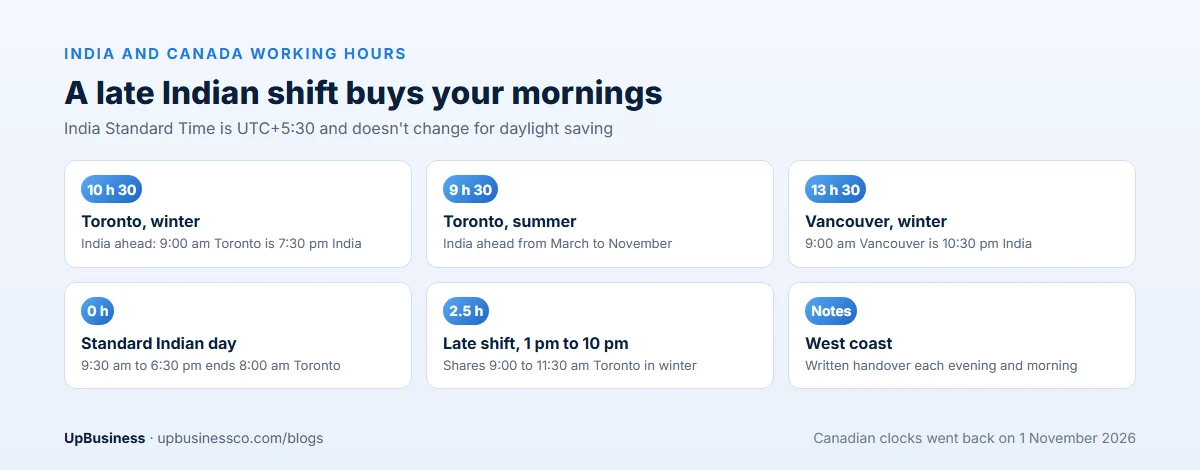
India Standard Time is UTC+5:30 all year. India doesn't change its clocks. Most of Canada does, so the gap moves twice a year:
- Toronto and Ottawa (Eastern): India is 10 hours 30 minutes ahead in winter and 9 hours 30 minutes ahead from March to November. 9:00 am in Toronto is 7:30 pm in India in winter.
- Vancouver (Pacific): India is 13 hours 30 minutes ahead in winter and 12 hours 30 minutes ahead in summer. 9:00 am in Vancouver is 10:30 pm in India in winter.
- Calgary and Edmonton (Mountain) sit in between, 12 hours 30 minutes behind India in winter.
A standard Indian day of 9:30 am to 6:30 pm ends at 8:00 am in Toronto in winter. That leaves no shared time at all. So most Indian companies that serve North America move part of the team to a later shift, such as 1:00 pm to 10:00 pm India time. That shift overlaps Toronto from 9:00 am to 11:30 am in winter, about two and a half hours. In summer you gain an extra hour.
Vancouver is harder. Even that late Indian shift ends at 8:30 am Vancouver time in winter, and gives you about 30 minutes in summer. West-coast buyers usually pick one of two setups. Either one lead on the Indian side works until midnight a few days a week, or the team works a normal day and you run a written handover. You review the work in your afternoon, leave clear notes, and wake up to finished tasks.
Ask every company on your shortlist which shift its team works and who covers your mornings. Get the answer in the proposal, not just in a sales call.
PIPEDA: Sending Personal Data to India
Canada's federal privacy law, PIPEDA, takes a different approach from the UK or the EU. It doesn't ban transfers to countries without an approval. Instead, it treats sending data to an Indian processor as a "use" of that data by you. You stay accountable for it.
The Privacy Commissioner's guidance spells out what that means. You must use contracts or other means to give the data "a comparable level of protection" while the Indian company processes it. You must also be open with customers. Tell them their data may be processed in another country, where courts and authorities there may be able to access it[2].
Do these four things before data moves:
- Keep personal data out where you can. Developers can build and test most systems with fake or masked data.
- Sign a data processing agreement. It says what data the company handles, for what purpose, how it keeps it safe, when it deletes it and how fast it reports a breach.
- Update your privacy notice. Say that service providers outside Canada, including in India, may process personal data.
- Limit access. Only the people who need live data get it, through accounts you control and can switch off.
Alberta and British Columbia have their own private-sector privacy laws, and health data has extra rules in several provinces. If you handle health or financial data, take advice first.
Quebec's Law 25: An Extra Step for Quebec Data
If you hold personal data about Quebec residents, Quebec's private-sector privacy act applies, as updated by Law 25. Since September 2023, you can't send that data outside Quebec until you have done a privacy impact assessment. The assessment must show the data will get adequate protection, including under generally accepted data protection principles. The transfer must also be covered by a written agreement[3].
In practice, that means a short written assessment for each Indian partner. It looks at how sensitive the data is, what it will be used for, how it will be protected and the legal setting in India. Keep it on file. Then attach the privacy terms to your contract. Most Indian companies that work for Canadian clients have seen these requests before.
On the Indian side, the Digital Personal Data Protection Act 2023 has an exemption for data about people outside India that an Indian company handles under a contract with a foreign client. So Canadian and Quebec law is what really protects your customers. Your contract is where that protection lives.
Contracts, Code Ownership and Moral Rights
Under Canada's Copyright Act, code written by your employee belongs to you. Code written by an outside company belongs to that company, even if you paid for it. To own it, you need an assignment in writing, signed by the company[4].
Canada adds one more step. Authors have moral rights, such as the right to be named and the right to object to changes. Moral rights can't be assigned, but they can be waived in whole or in part. Ask for a written waiver in favour of you and anyone you license the code to. Without it, a developer could in theory object to how you change their work.
Indian law adds a trap too. If an assignment doesn't say how long it lasts, India treats it as lasting five years. If it doesn't say where it applies, India treats it as covering India only. So the clause must say the assignment is worldwide and for the full term of copyright.
Your contract should also cover:
- Disputes. India doesn't list Canada as a reciprocating country, so a Canadian court judgment can't simply be enforced there. You would have to sue again in India. Arbitration avoids that, because both countries enforce arbitration awards under the New York Convention. Many Canadian buyers pick arbitration in Toronto, Vancouver or Singapore, under the law of their province.
- Open source. The company lists every open-source library and its licence.
- Handover. You get the source code, passwords, cloud accounts and documents at each milestone.
- Staff. The people named in the proposal do the work. Changes need your approval.
- Exit. Either side can end the contract with 30 days' notice, and the company must help hand over to a new team.
Our software development contract checklist has the full clause list.
Building for Canadian Users: French and Accessibility
Two Canadian rules change what you ask the Indian team to build.
The first is French. Quebec's Charter of the French Language requires software sold in Quebec to be available in French when a French version exists, and it has rules for commercial websites and product text[5]. If you sell to Quebec, put French screens, French emails and French error messages in the brief from the start. Adding a second language late is slow and costly. Ask for the text to be kept in translation files, not written into the code.
The second is accessibility. Ontario requires larger organisations to make their websites meet WCAG 2.0 level AA, and federal rules apply to federally regulated businesses. Even where no rule applies to you, accessible software reaches more customers. Write the WCAG level into the brief and the acceptance tests.
GST/HST, Tax and Invoices
The Indian company won't charge Canadian GST or HST. Who owes tax on the import depends on how you use the service.
- If you're a GST/HST registrant and you use the service at least 90% in your commercial activities, you don't need to self-assess the GST[6].
- If you use it less than that, or you make exempt supplies such as many financial services, you report the tax yourself on your return. Financial institutions face a 100% test.
- If you're not registered, you may still owe the tax on imported services, using Form GST59.
- In HST provinces, the provincial part of the HST can also apply in some cases. Ask your accountant.
On income tax, Canada's 15% withholding under Regulation 105 is for services performed in Canada. Work the Indian team does from India isn't caught by it. If Indian staff come to your Canadian office to work, check that part with your accountant before they travel.
On the Indian side, your project is an export of services. The company normally charges no Indian GST and its invoice says the supply is for export. Ask for invoices that show the company's legal name, address, GST number and bank details.
Paying an Indian Company From Canada
Most Indian companies invoice in US dollars, and many accept Canadian dollars. Agree the currency in the contract. If you price in Canadian dollars, you carry no exchange-rate risk. If you price in US dollars, a weaker loonie makes the project dearer. A swing of five cents on the exchange rate changes a $42,000 project by about C$2,000.
Pay by bank wire or a business payment service against milestones. A common pattern is 10% to 20% up front, then a payment after each delivery you have tested. Never pay into a personal account. Confirm any change of bank details by phone with someone you have already met.
What It Costs: A Worked Example in Canadian Dollars
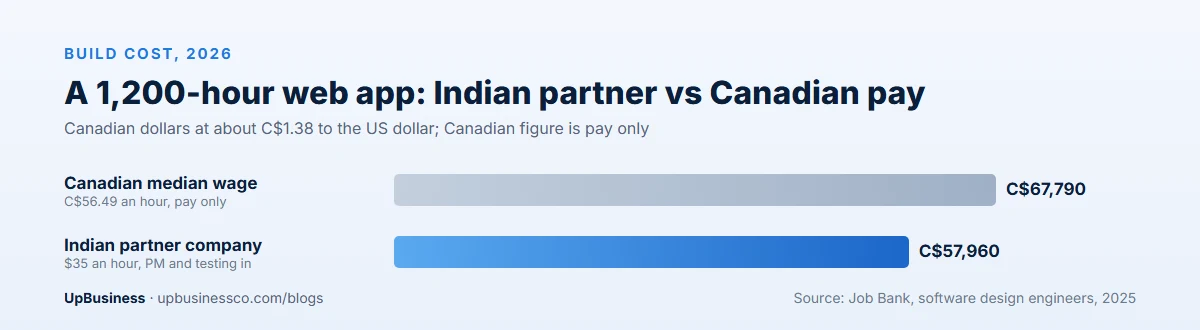
Take a web application with a customer portal, an admin area and payments. It needs about 1,200 hours of work.
| Phase | Hours | Indian partner at $35 an hour | Canadian median wage, C$56.49 an hour |
|---|---|---|---|
| Discovery and design | 160 | $5,600 | C$9,040 |
| Build | 800 | $28,000 | C$45,190 |
| Testing and fixes | 160 | $5,600 | C$9,040 |
| Launch and handover | 80 | $2,800 | C$4,520 |
| Total | 1,200 | $42,000 (about C$58,000) | C$67,790, pay only |
The Canadian dollar figure for the Indian quote uses about C$1.38 to the US dollar. Read the Canadian column with care. It's the median wage for the hours alone. It leaves out benefits, payroll taxes, recruiting, equipment and months spent hiring. It also assumes one engineer can do design, project management and testing, which rarely holds. A Canadian agency will usually quote well above that figure, because its rate covers those same costs plus margin.
So the real saving is bigger than the wage gap shows, but smaller than some sales pages claim. Two things eat into it. The first is your own time: someone must write the brief, answer questions and test the work. The second is rework when the brief is vague. A clear software project brief is the cheapest protection. Our software development cost benchmark has Indian rates by role.
How to Check an Indian Company Before You Sign
- Check the registration. Ask for the company's CIN and look it up on India's Ministry of Corporate Affairs site. Check the GST number too. Our guide on how to verify an Indian software company shows each step.
- Call two past clients in North America. Ask how the time gap worked and what went wrong.
- Meet the actual team on video, at the hour you would normally meet them. That tests the shift as well as the people.
- Ask about security. ISO 27001 and SOC 2 are common. If your customers ask you about cyber security, CyberSecure Canada is the federal certification for small and medium firms, and a partner that follows the same controls makes your answers easier[7].
- Run a paid discovery phase. Two to four weeks, fixed price, with a written plan at the end.
Our due diligence checklist and questions to ask a software company go deeper. When proposals arrive, use our software development company scorecard to compare finalists.
Setting Up Communication Across the Time Gap
- Hold one 15-minute call in your morning, inside the shared hours.
- Write everything else down. Each task has a clear goal, the acceptance test and any screenshots.
- Ask the team for a short written update at the end of its day. You read it with your coffee.
- Name one person on each side who can make decisions.
- Hold a demo every two weeks where you see working software.
- List the holidays for both countries. Diwali and Holi can take a few days out of a sprint, and Canadian statutory holidays differ by province.
Mistakes Canadian Buyers Make
- Expecting a full shared day. You get up to three hours at best, and less on the west coast. Plan the work for written handovers.
- Skipping the Quebec assessment. Law 25 needs it before Quebec data leaves the province.
- Owning the code but not the moral rights. Get the waiver as well as the assignment.
- Choosing Canadian courts for disputes. A Canadian judgment isn't directly enforceable in India. Arbitration is.
- Adding French at the end. Plan both languages in the first screens.
- Picking the lowest quote. A quote far below the rest usually means missed scope or junior staff.
Red Flags
- The company won't put the code assignment and moral rights waiver in the contract.
- It won't sign a data processing agreement.
- It can't say who covers your mornings, or the answer changes after you sign.
- It won't let you meet the developers before you sign.
- It asks for most of the money up front.
- It keeps the code in its own accounts.
Your First 30 Days
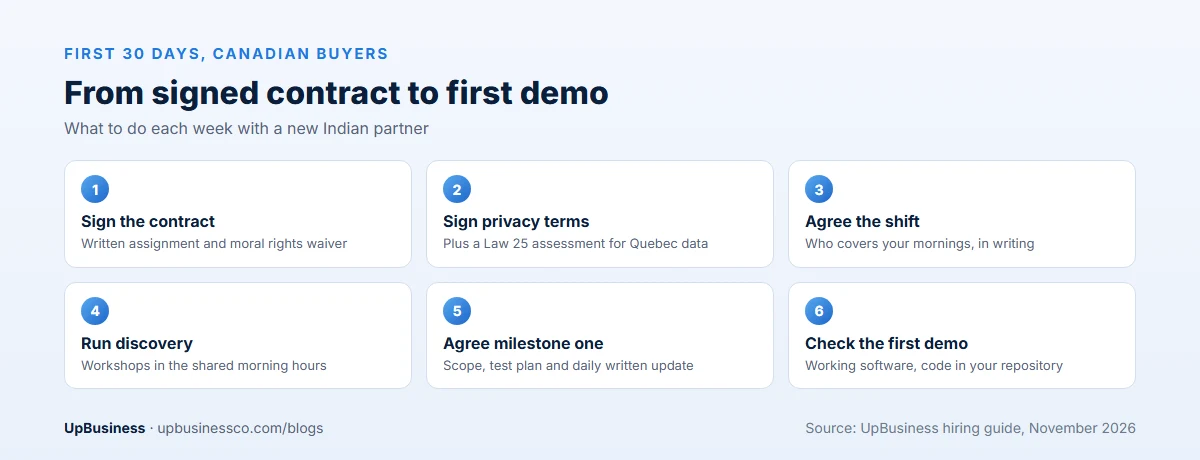
- Week 1: Sign the contract, the data processing agreement and, for Quebec data, file your privacy impact assessment. Give access to your code and cloud accounts.
- Week 2: Run discovery workshops in the shared morning hours. The company writes up the scope, plan and risks.
- Week 3: Agree the first milestone, the test plan and the daily written update. Start the first sprint.
- Week 4: See the first demo. Check the code is in your repository and the team is the one you were promised.
What UpBusiness Partner Data Shows
We looked at the 46 partner companies on our software development page on 31 October 2026, most of them based in India.
- Their TrustScores run from 70.17 to 75.85 out of 100, with a median of 71.67.
- Of the 45 that report an average project size, 22 average $5,000 or less. The median is $10,000.
- 38 of the 46 have 50 employees or fewer.
On our custom software development page, 12 companies are listed and 6 of them list custom software as a core service. Smaller companies suit a first project, because your work gets senior attention. Ask each one directly about its North American shift. For a buyer in Europe, our UK guide shows how much easier the time zone is there.
How Hiring Works on UpBusiness
Every partner company on UpBusiness has passed five checks reviewed by our team: company details, registration and tax papers, the founder's identity, expertise and three client projects with evidence. Only companies with a TrustScore of 70 or more are listed.
- Post your requirement with the service, a rough budget and that you're based in Canada.
- Get three partner companies matched to your budget, service and industry.
- Compare them side by side, meet them on video and contract with the one you choose. Buyers pay nothing, and there's no commission on the project.
Then follow the steps in this guide: privacy terms, a written assignment and waiver, a clear shift plan, milestones and a paid discovery phase. That's how Canadian companies get the speed and the saving without the surprises.