


Browse our curated list of Voicebot Development Companies
This guide is for business owners, operations heads and customer service managers thinking about an AI voice agent that answers or makes phone calls. Common examples are a receptionist that books appointments, a first line of support, or a reminder and follow-up caller. AI voice agent cost has two parts that buyers often mix up: what you pay once to build and connect the agent, and what you pay for every minute it spends on the phone.
Published guides on the topic come mostly from companies that sell voice agents or voice platforms, and their build quotes run from about $5,000 to well over $500,000. Here both parts are priced from the providers' own price lists, 2025 salary data and US wage data for the staff whose calls the agent would take. You can check each figure against its source.
Key takeaways
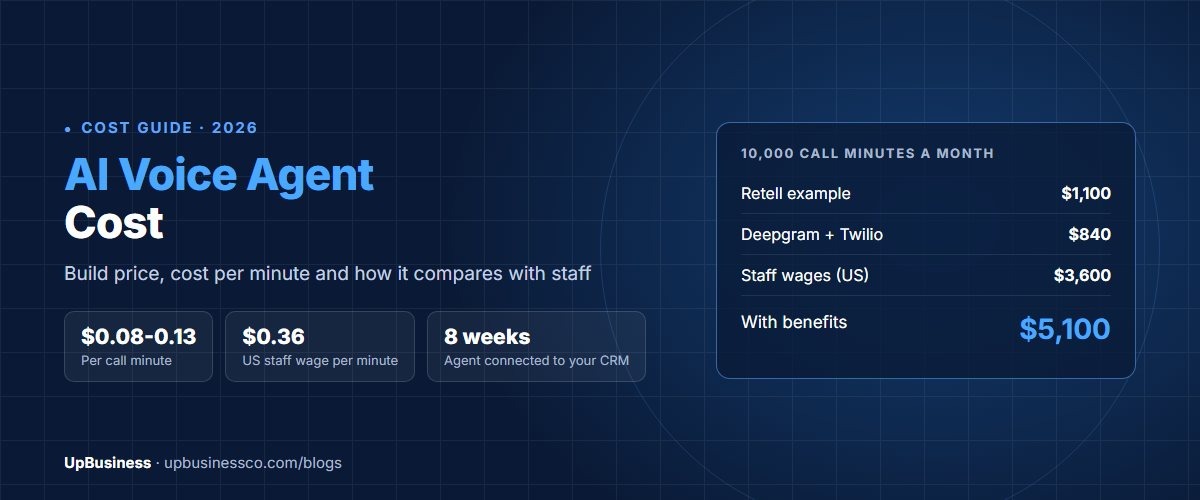
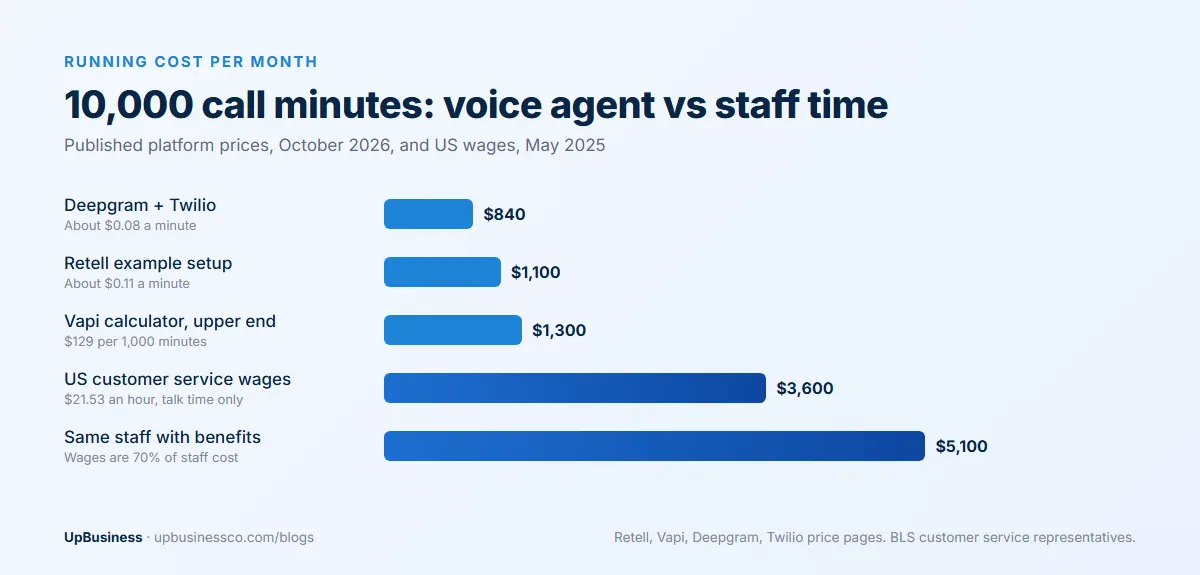
- Running costs on popular platforms come to roughly $0.08 to $0.13 a minute for a typical setup, based on Retell's, Vapi's and Deepgram's published prices in October 2026. That's about $840 to $1,300 for 10,000 call minutes a month.
- A US customer service representative on the May 2025 median wage of $21.53 an hour costs about $0.36 for every paid minute before benefits. Per minute, a voice agent costs a fraction of that.
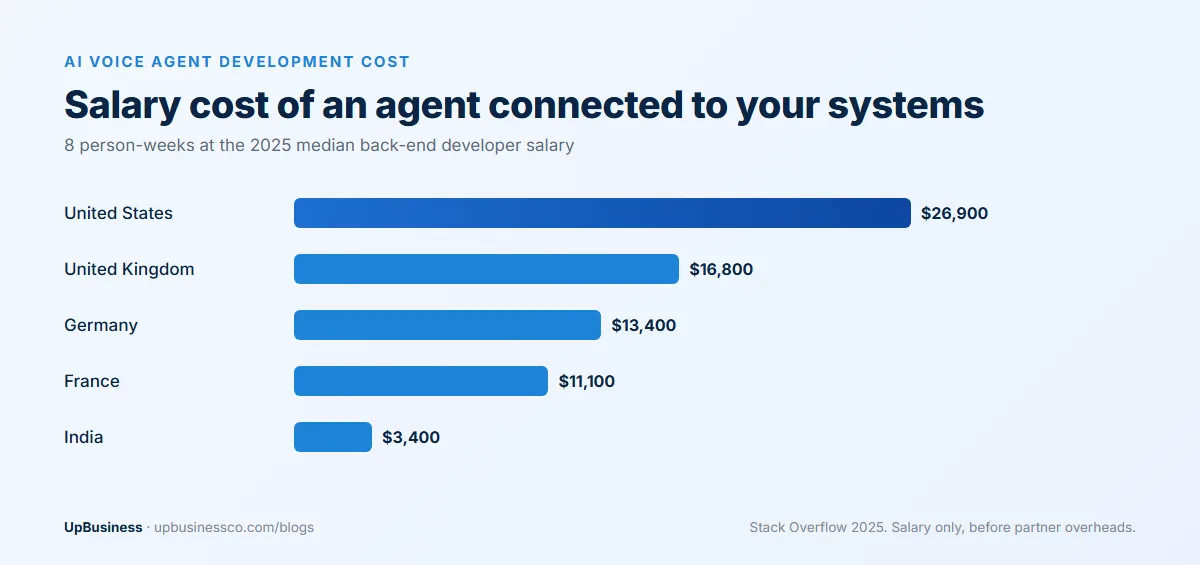
- Building an agent on a platform and connecting it to your CRM takes about 8 person-weeks, roughly $3,400 in Indian developer salary and $26,900 in US salary, before a partner's overheads.
- In the US, AI-generated voices count as an "artificial voice" under the TCPA, and outbound calls need prior express consent. In the EU, callers must be told they're talking to an AI from 2 August 2026.
How Much Does an AI Voice Agent Cost in 2026?
Based on the scopes in this guide, an AI voice agent costs about $1,300 to $67,300 to build in developer salary, depending on how much it does and where the team is based. Running it costs roughly $0.08 to $0.13 per call minute on a typical platform setup, plus a few dollars a month for each phone number. The table below shows typical effort for three kinds of agent.
| Type of voice agent | Typical effort | What's usually included |
|---|---|---|
| Agent set up on a voice platform | 3 person-weeks | Call script and prompts, one calendar or booking tool, a phone number, basic testing |
| Agent connected to your systems | 8 person-weeks | CRM or helpdesk lookups, transfer to a person, call summaries, a test set of real calls |
| Custom voice system | 20 person-weeks | Own call orchestration, several languages, strict data rules or self-hosted parts, load testing |
| Ongoing tuning and support | About 10 person-weeks a year | Reviewing calls, fixing prompts, updating answers, provider changes |
The effort figures are UpBusiness estimates for a partner working on a typical inbound or reminder use case. Several languages, complex call flows and regulated data push them up.
AI Voice Agent Development Cost by Country
| Type of voice agent | US | UK | Germany | France | India |
|---|---|---|---|---|---|
| Agent set up on a platform (3 person-weeks) | $10,100 | $6,300 | $5,000 | $4,100 | $1,300 |
| Agent connected to your systems (8 person-weeks) | $26,900 | $16,800 | $13,400 | $11,100 | $3,400 |
| Custom voice system (20 person-weeks) | $67,300 | $41,900 | $33,500 | $27,700 | $8,500 |
| Ongoing tuning and support, per year | $33,700 | $20,900 | $16,700 | $13,800 | $4,200 |
Each figure multiplies the effort by one week of the 2025 median back-end developer salary from the Stack Overflow Developer Survey. Those medians are $175,000 in the US, $108,913 in the UK, $87,011 in Germany, $71,929 in France and $22,086 in India [1]. These are salary floors. A partner company adds project management, testing, call design and margin on top.
AI Voice Agent Cost per Minute
Every minute on the phone uses several services at once. A phone line carries the call, speech recognition turns the caller's words into text, a language model decides what to say, and a voice engine speaks the reply. Platforms bundle these, while a custom build pays each provider directly.
| Service | Published price | Source |
|---|---|---|
| Phone line, inbound local call in the US | $0.0085 a minute, plus $1.15 a month per local number | Twilio [2] |
| Phone line, outbound call in the US | $0.014 a minute | Twilio [2] |
| Speech recognition (Deepgram Nova-3, streaming) | $0.0048 a minute | Deepgram [3] |
| Speech, language model and voice in one (Deepgram Voice Agent API, Standard) | $0.075 a minute | Deepgram [3] |
| Retell voice agent, all parts | $0.07 to $0.31 a minute | Retell [4] |
| Vapi platform fee, other providers passed through at cost | $0.05 a minute | Vapi [5] |
Here's how a typical setup adds up. On Retell, its voice engine at $0.055 a minute, a standard voice at $0.015, Claude 4.5 Haiku as the language model at $0.025 and telephony at $0.015 come to about $0.11 a minute [4]. Vapi's own calculator estimates $82 to $129 for 1,000 minutes once speech, model and voice providers are added to its $0.05 fee [5]. A custom build on Deepgram's Voice Agent API with an inbound Twilio line comes to about $0.08 a minute, before the cost of the server that runs your own call logic.
On the Retell price list, the language model and the voice cause the biggest swings in the price per minute. A premium voice or a larger model can more than double the bill, while a smaller model is often enough for booking and routing calls. Ask each partner which models they plan to use and why.
AI Voice Agent Cost per Month
| Call minutes a month | Retell example (about $0.11 a minute) | Vapi estimate ($0.082 to $0.129) | Deepgram plus Twilio (about $0.08) |
|---|---|---|---|
| 10,000 (about 3,300 three-minute calls) | About $1,100 | About $820 to $1,300 | About $840 |
| 50,000 | About $5,500 | About $4,100 to $6,400 | About $4,200 |
| 100,000 | About $11,000 | About $8,200 to $12,900 | About $8,400 |
Add a few dollars a month for each phone number, any extra concurrent call lines, and add-ons such as Vapi's HIPAA option at $2,000 a month [5]. Retell includes 20 concurrent calls and charges $8 a month for each extra one [4], so check how many calls your busiest hour needs at the same time.
A quick way to size this is to take the number of calls in your busiest hour and multiply by the average call length in minutes, then divide by 60. A clinic with 120 calls in its busiest hour, each lasting three minutes, has about 6 calls running at once on average. Peaks within that hour run higher, so plan for roughly double the average and confirm the figure with your partner during testing.
AI Receptionist Cost vs a Human Receptionist
A useful comparison is with the staff time the agent would replace or support. In May 2025, the median US customer service representative earned $21.53 an hour and the median receptionist $18.27 [6] [7]. That's about $0.36 and $0.30 for every paid minute in wages alone. Wages make up 70.0% of what US private employers spend on staff, so with benefits the representative's cost rises to about $0.51 a minute [8].
| Call minutes a month | AI voice agent (about $0.08 to $0.13 a minute) | Customer service wages (about $0.36 a minute) | With benefits (about $0.51 a minute) |
|---|---|---|---|
| 10,000 | About $840 to $1,300 | About $3,600 | About $5,100 |
| 50,000 | About $4,200 to $6,400 | About $17,900 | About $25,600 |
| 100,000 | About $8,400 to $12,900 | About $35,900 | About $51,300 |
The staff figures count only minutes spent talking. People are also paid between calls, during training and on breaks. Counting that time would widen the gap further. On the other side, an agent needs build and tuning work, and some calls will still need a person. The fair test is the cost per call resolved without a transfer, which you can only measure in a pilot with your own callers.
The US Bureau of Labor Statistics projects customer service representative jobs to fall 5% between 2025 and 2035 [6]. A common first step is to give the agent after-hours calls, overflow at busy times and simple requests like bookings. Complaints and sales stay with staff.
What Drives AI Voice Agent Development Cost
- Integrations are usually the biggest part of the build. Looking up a booking, an order or a customer record during the call means connecting to your calendar, CRM, helpdesk or ERP, and each connection needs error handling for when that system is slow.
- Call design matters as much as code. Someone has to write how the agent greets, confirms details, handles "I want to speak to a person" and ends calls, and then test it with real callers.
- Languages and accents add testing. An agent that handles English and Hindi, or Spanish and English, needs test calls in each language and often a different voice or speech model.
- Compliance adds work in regulated sectors. Health data in the US can require HIPAA safeguards, and recording calls needs consent rules that differ by country and state.
- Volume changes the build. A clinic taking 100 calls a day can run on a platform, while a contact centre with thousands of calls an hour may justify parts of a custom stack to cut the per-minute bill.
Platform vs Custom Build: Which Costs Less?
For many businesses, building on a voice platform such as Retell or Vapi is the cheaper start. The platform handles the hard real-time parts, so a partner spends its time on your call flows and integrations, and you can be live in weeks. The trade-off is a higher price per minute and less control over where data goes.
A custom build pays each provider directly and can bring the per-minute cost down, but it needs far more engineering and someone to keep it running. On the prices in this guide, the saving is a few cents a minute. At 100,000 minutes a month, moving from $0.11 to $0.08 saves about $3,000 a month, which takes over a year to cover the extra 12 person-weeks of a custom build at US salary rates. In India, the extra build work costs about $5,100 in salary and pays back in under two months at that volume, which is one reason many partners there offer custom voice stacks.
Compliance: Consent, Disclosure and Call Recording
Rules depend on where your callers are. Check them before launch rather than after.
- In the US, the FCC confirmed in February 2024 that AI-generated voices fall under the TCPA's rules on "artificial or prerecorded voice" [9]. Calls using them need the prior express consent of the person called, unless an exemption applies. Outbound reminder, sales and follow-up calls are the ones to check first.
- In the EU, Article 50 of the AI Act requires AI systems that talk directly with people to be designed so that people are told they're interacting with an AI. It applies from 2 August 2026 [10]. A short line at the start of each call covers it.
- Call recording and storage fall under privacy laws that differ by country and, in the US, by state, including who has to agree to a recording. Agree with your partner where recordings and transcripts are stored and for how long.
AI Voice Agent Testing and Quality Checklist
Voice agents fail in ways a demo doesn't show. Before you go live, ask your partner to test and report on each of these:
- Response delay: how long the caller waits after speaking, measured on real phone lines, not in a browser.
- Interruptions: what happens when the caller talks over the agent or changes their mind mid-sentence.
- Accents, noise and poor lines: test calls from mobiles, cars and busy rooms, in every language you support.
- Handover to a person. The agent should pass the call on with a summary when the caller asks, when it isn't sure, or when a topic is off limits.
- Wrong or made-up answers: a set of tricky questions the agent must refuse or pass on, such as prices it doesn't know or medical advice.
- Integration failures: what the caller hears when your calendar or CRM doesn't respond.
- A test set of real calls. Ask for at least a few dozen past calls, replayed or role-played, with pass and fail results you can read.
- Consent and disclosure lines: checked against the rules for each country you call.
What an AI Voice Agent Quote Should Include
- The call flows covered, and the share of calls the partner expects the agent to finish without a transfer, as a target to test rather than a promise.
- Every per-minute service, named with its price, and whose account each one is billed to.
- Each integration, with the systems and actions it covers.
- The testing above, with the results you'll receive before launch.
- Monitoring and tuning after launch, with a monthly price.
- Ownership of prompts, call flows, transcripts and recordings, and how you'd move to another platform. Our software development contract checklist covers the clauses.
Our list of questions to ask an AI development company helps you test these points in a first call. If you also want a text channel, see our guide to WhatsApp chatbot development cost.
How to Reduce AI Voice Agent Cost
- Start with one call type, such as bookings or after-hours calls, and measure it before adding more.
- Use a smaller language model for simple routing and booking calls, and keep larger ones for calls that need them.
- Keep calls short with clear prompts and quick confirmations, because you pay for every minute the line is open.
- Choose standard voices unless a premium voice measurably changes how callers respond.
- Review a sample of calls every week in the first months and fix the places callers get stuck, because a stuck caller keeps the line open longer.
What UpBusiness Partner Data Shows
On UpBusiness, 8 verified companies are listed for voice AI work, 7 of them on the voicebot development page. All 8 are based in India, in cities including Bengaluru, Noida, Surat and Indore, and their TrustScores run from 70 to 77. Five have 11 to 50 people and three have 51 to 200.
| Service page | Verified companies | Median average project size | Range of average project sizes |
|---|---|---|---|
| Voice AI solutions | 8 | $25,000 | $2,500 to $50,000 |
| Voicebot development | 7 | $25,000 | $10,000 to $50,000 |
A median project of $25,000 sits close to the US salary cost of an agent connected to your systems ($26,900), and well above the Indian salary floor for the same build ($3,400). That gap covers call design, testing, project management and margin, and many projects include more than one call flow. One of the eight is a telephony company with its own call centre and phone system products, which helps when an agent has to plug into an existing contact centre. The figures are self-reported project sizes shown on each company's listing, so use them as a reference point when you compare quotes.
Find a Voice AI Partner on UpBusiness
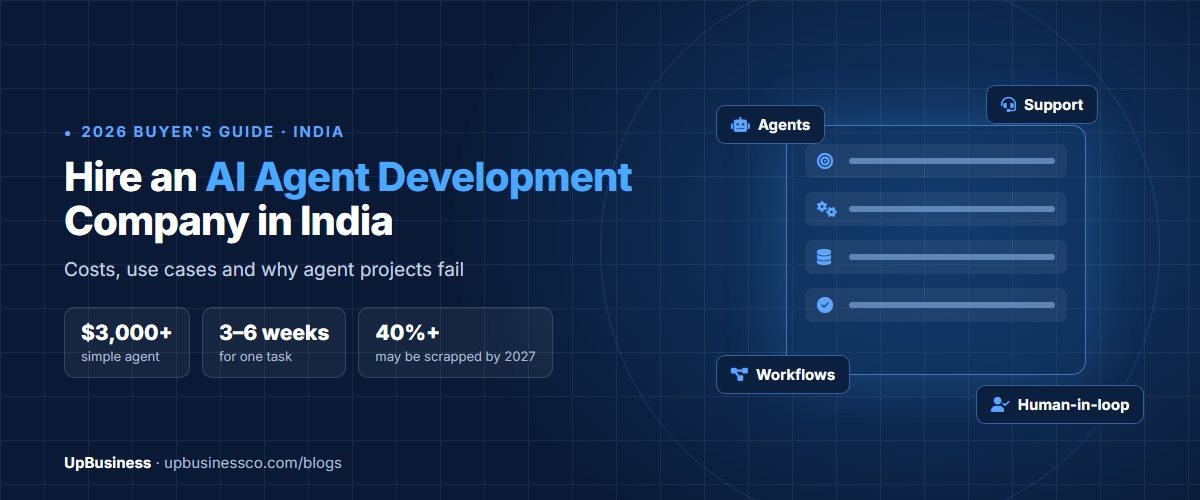
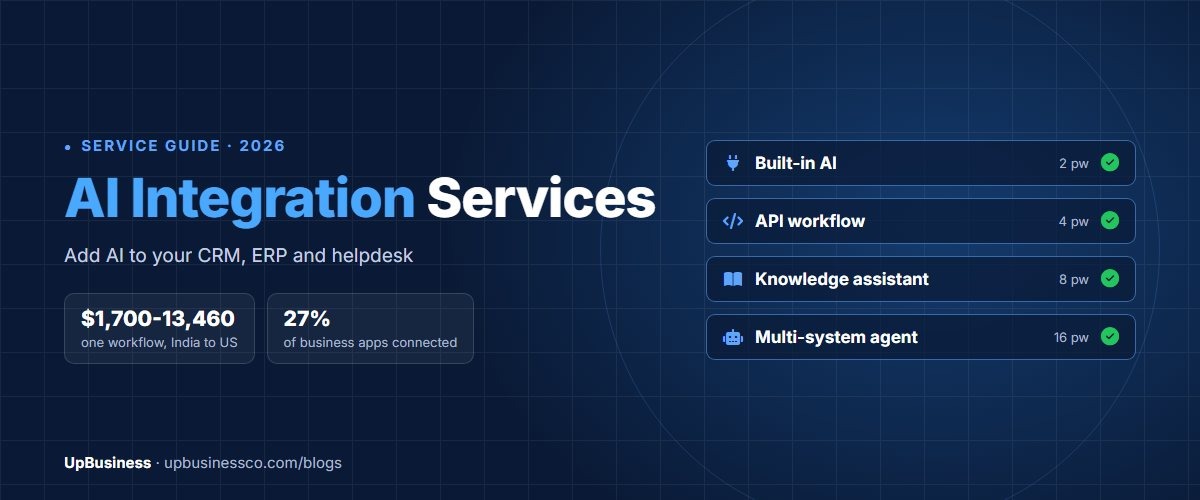
You can compare verified voicebot development companies and voice AI solution providers on UpBusiness by TrustScore, team size, location and project size, or browse all artificial intelligence companies. For agents that also act inside your systems, see our guides to AI agent development and AI integration services. Or post your project once, with your call types and monthly call minutes, and compare the replies line by line.
The Bottom Line
AI voice agent cost has a build part and a running part. Building an agent on a platform and connecting it to your systems takes about 8 person-weeks, roughly $3,400 in Indian developer salary and $26,900 in US salary. Running it costs about $0.08 to $0.13 a minute on today's platform prices, against roughly $0.36 a minute in US customer service wages. Start with one call type, test it with real callers, and check consent and disclosure rules for every country you call.