


Browse our curated list of Digital Marketing Agencies
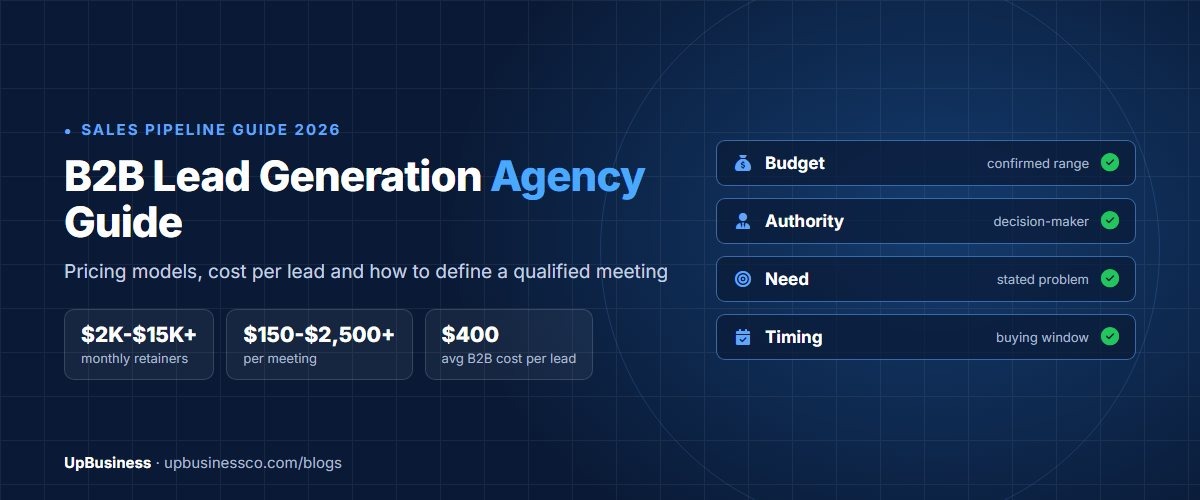
A B2B lead generation agency finds and contacts companies that match your ideal buyer, then hands your sales team leads or booked meetings. Prices run from about $2,000 to more than $15,000 a month on a retainer[1], and the same word "lead" can mean a raw contact record or a decision-maker who has agreed to a call. This guide is for founders, sales heads and marketing leads deciding whether to hire one. It covers what the work includes, how agencies charge and what a lead should cost. It also shows how to define a qualified lead in the contract, and which email and data rules apply when someone else contacts buyers in your name.
Key takeaways
- Monthly retainers for outbound lead generation commonly run $2,000 to $15,000+, and pay-per-appointment pricing ranges from about $150 for a small-business meeting to $2,500+ for an enterprise one.
- First Page Sage puts the average blended B2B cost per lead at $400 in 2026, with IT and managed services at $505 and software development at $627.
- A US in-house SDR has a median on-target salary of $80,000 and takes about 3 months to ramp, according to the Bridge Group's 2025 study of 351 B2B companies.
- Outreach sent on your behalf is still your legal responsibility. The FTC says CAN-SPAM has no exception for business email, and Gmail requires bulk senders to keep reported spam below 0.3%.
What Does a B2B Lead Generation Agency Do?
A B2B lead generation agency builds a list of target companies and contacts, reaches them through email, LinkedIn, phone or ads, and passes interested prospects to your sales team. Some stop at a qualified lead. Others book the first meeting and hand over notes, so your account executives only speak to buyers who said yes.
Many agencies sell outbound work, meaning they start the conversation rather than wait for buyers to find you. A smaller group runs inbound programmes (content, search and paid ads) that bring prospects to your website. The channels below appear in many proposals.
| Channel | What the agency does | Best suited to |
|---|---|---|
| Cold email | Builds the list, writes sequences, sends from dedicated domains, handles replies | Clear offers to a well-defined buyer group |
| LinkedIn outreach (LinkedIn lead generation) | Connection requests, messages and content from a named person's profile | Senior buyers who ignore cold email |
| Calling and appointment setting | SDRs phone prospects, qualify them and book meetings into your calendar | Higher-value deals and markets where phone is normal |
| Account-based marketing (ABM) | Coordinated ads, email and calls aimed at a short list of named accounts | Large deals with a few hundred target companies |
| Inbound and paid | Content, search, LinkedIn and Google ads, landing pages and lead scoring | Products people already search for |
The people doing the work matter as much as the channel. A typical outbound team includes a researcher who builds the list, a copywriter, one or more SDRs (sales development representatives) and an account manager who reports to you. If a proposal doesn't say who does each job and how many hours they give your account, ask.
How Much Do Lead Generation Companies Charge?
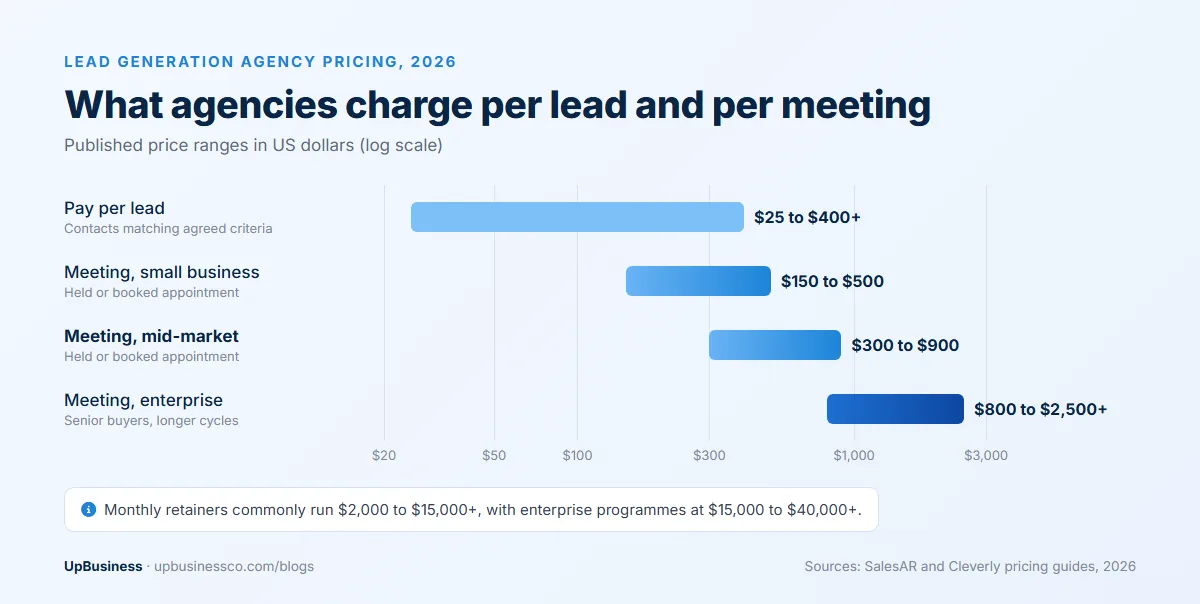
Lead generation companies usually charge a monthly retainer, a fee per lead or a fee per meeting. Some mix a smaller retainer with performance fees. Published price ranges come mostly from agencies that sell these services, so read them as market signals rather than fixed rates.
| Pricing model | Typical price (USD) | What you're paying for | Main risk |
|---|---|---|---|
| Monthly retainer[1] | $2,000 to $15,000+ a month; enterprise programmes $15,000 to $40,000+ | A team's time across one or more channels | Paying for activity that doesn't turn into meetings |
| Retainer plus setup fee[2] | Retainer plus $5,000 to $15,000 setup | Domains, data, messaging and tools built before launch | Large upfront spend before you see results |
| Per-lead pricing[3] | $25 to $400+ per lead | Contacts that match agreed criteria | Leads that fit the profile on paper but have no interest |
| Per-appointment pricing[1] | $150 to $500 (small business), $300 to $900 (mid-market), $800 to $2,500+ (enterprise) | A meeting with a person who meets your criteria | Arguments over whether a meeting counted |
| Hybrid | Lower retainer plus a fee per meeting or a commission | Shared risk between you and the agency | Complex invoices if definitions are loose |
What changes the price
Belkins, which sells outbound services, describes four rough tiers. Around $2,000 a month usually covers one channel or an offshore team. $3,000 to $4,000 buys more experienced SDRs, $6,000 to $8,000 adds more channels, and $10,000 to $12,000 or more pays for dedicated senior SDRs based in the US[2]. The other big drivers are buyer seniority (a CFO costs more to reach than an office manager), how many countries you target, and how strict your qualification rules are.
Commission-only deals exist but are rare. Agencies take on all the risk, so they tend to accept only clients with very easy offers, or they push volume over quality. If someone offers to work for commission alone, ask how they choose clients and what happens to the domains and data if you stop.
Average Cost per Lead in B2B: 2026 Benchmarks
The average blended B2B cost per lead was $400 across 30 industries in First Page Sage's 2026 report, which tracks data collected between January 2022 and August 2026[4]. Technology sectors sit above that average.
| Industry (First Page Sage, 2026) | Paid cost per lead | Organic cost per lead | Blended |
|---|---|---|---|
| B2B SaaS | $318 | $186 | $249 |
| IT and managed services | $600 | $418 | $505 |
| Software development | $691 | $573 | $627 |
| Technology sector average | $518 | $414 | $464 |
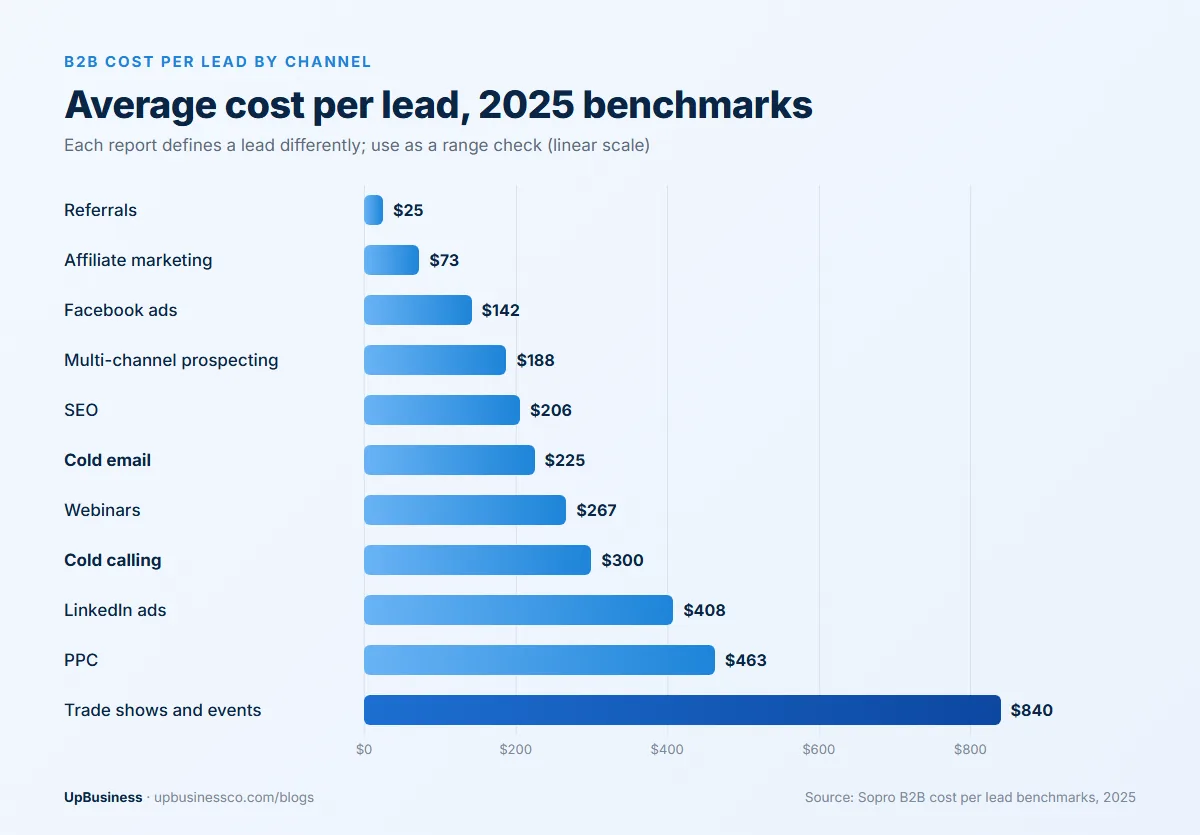
By channel, Sopro's 2025 benchmarks put cold email at $225 per lead, cold calling at $300, paid LinkedIn at $408, PPC at $463 and trade shows at $840, with multi-channel prospecting averaging $188[5]. Sopro sells outbound prospecting, so its low multi-channel figure is worth checking against your own data.
The sources also disagree. Metadata, which studied 153 B2B advertisers and $57.6 million of 2025 ad spend, found LinkedIn ads cost $202 per lead and Google Ads $524[6], roughly the reverse of Sopro's ranking. Each report defines a lead differently, and First Page Sage counts a lead as a direct connection with an interested prospect. Use these numbers to spot a quote that's far off the market, then judge agencies on cost per qualified meeting and cost per opportunity in your own pipeline.
What Counts as a Qualified Lead?
A qualified lead is a person who fits your target profile and has shown a real reason to talk, checked against rules you agree in writing. Without those rules, a $100 lead and a $600 lead can't be compared. SalesAR describes a common ladder, starting with the cheapest[3]:
- Raw lead: a contact record matching your criteria that hasn't shown any interest.
- Marketing qualified lead (MQL): someone who fits your profile and engaged, for example by replying or downloading a guide.
- Sales qualified lead (SQL): a contact your sales team has checked for fit, need and budget.
- Qualified meeting: a scheduled call with a decision-maker who confirmed interest and meets the agreed criteria.
- Opportunity: a deal opened in your CRM with a realistic chance of closing.
Many sales teams test an SQL with BANT, short for budget, authority, need and timing. It's a blunt tool. A prospect who is six months from buying can still be worth a call for a large deal, so decide which of the four you require and which you only record.
Write the lead definition into the contract
A written definition of what you're paying for heads off many billing disputes. A workable version covers these points.
- Job titles or seniority levels that count, and the ones that don't (interns, students, job seekers, people at your competitors).
- Company size, industry and countries, plus a list of existing customers and open deals to exclude.
- Whether the fee is for a booked meeting or a held one. Pay for held meetings where you can.
- A review window, often a few business days, in which your team can reject a lead that doesn't meet the definition, with a replacement or credit.
- Who owns the contact data, email domains and call recordings when the contract ends.
In-House SDR or B2B Lead Generation Agency?
Hiring your own SDR looks cheaper on a salary sheet, yet the full cost and the time to results tell a different story. The Bridge Group's 2025 study of 351 B2B companies, mostly North American SaaS firms, gives a useful baseline[7].
| Factor | In-house SDR (Bridge Group 2025) | B2B lead generation agency |
|---|---|---|
| Pay | Median on-target earnings $80,000 ($55,000 base, $25,000 variable) | $2,000 to $15,000+ a month retainer, or per-meeting fees |
| Time to productive | Average ramp of 3.0 months | Often a few weeks for setup and domain warm-up |
| Staying power | Average tenure 1.9 years; median annual attrition 40% | The agency replaces people, but your account may change hands |
| Monthly meeting target | Median quota of 10 held meetings | Set in the contract, if the agency agrees to one |
| Extra costs | Manager time, data, LinkedIn Sales Navigator, sequencing and CRM seats | Usually inside the fee; check the contract |
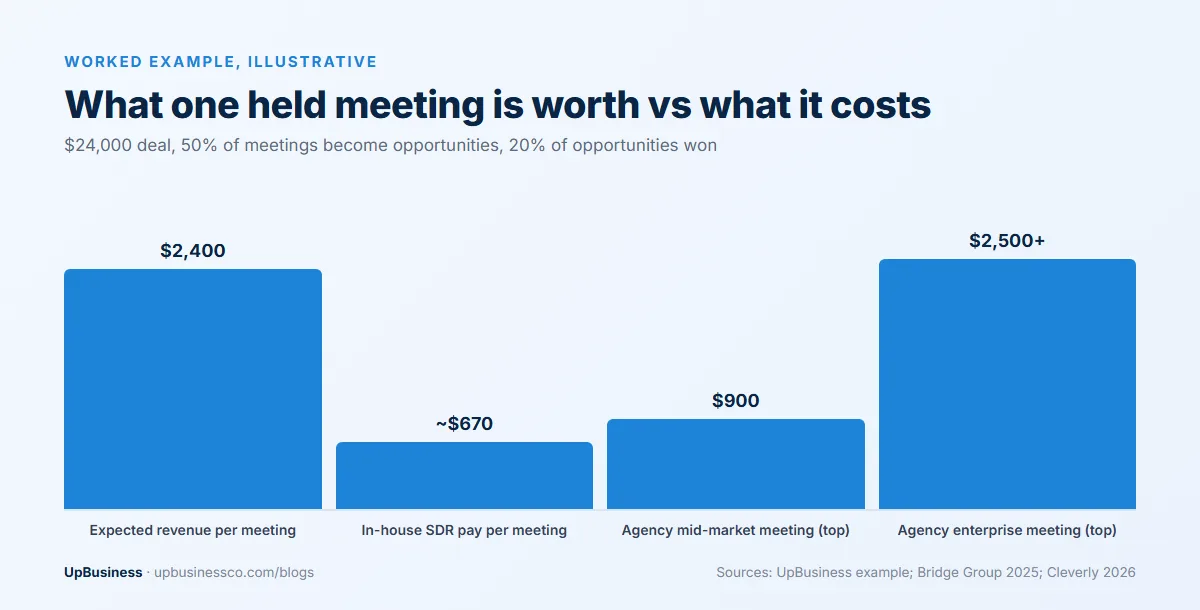
A rough calculation shows why the comparison is closer than it looks. $80,000 a year is about $6,670 a month. An SDR hitting the median quota of 10 held meetings costs roughly $670 per meeting in pay alone, before benefits, tools, data and a manager's time. That sits inside the mid-market range agencies quote per appointment. In-house teams usually win once you need several SDRs and already have a sales manager to run them. An agency usually wins when you're testing a new market, need meetings within a quarter, or can't yet justify a full-time hire.
A Worked Example: What Can You Afford to Pay per Meeting?
The right price per meeting depends on your deal size and close rates, not on what the agency charges other clients. Here's an illustration with assumptions you'd replace with your own numbers.
- Average first-year deal value: $24,000.
- Share of held meetings that become real opportunities: 50%.
- Share of opportunities your team wins: 20%.
Each held meeting is then worth about $24,000 × 0.5 × 0.2 = $2,400 in expected first-year revenue. Paying $300 to $900 per mid-market meeting leaves room for your sales costs and margin. Paying $2,500 for an enterprise meeting doesn't work at this deal size, even if the meeting is excellent. Halve the deal value and the sums change fast, which is why small-ticket products often do better with inbound marketing than with paid appointment setting.
Run the same sum before you sign. Say the agency's price per held meeting is more than a third of your expected revenue per meeting. Ask what would have to be true for the programme to pay back, and whether the agency will share that risk.
Compliance: Who Is Responsible for the Outreach?
You are, along with the agency. Hiring someone to send messages doesn't move the legal duty away from the company whose product is being promoted. The rules differ by the country of the person you contact, not where the agency sits.
| Market | Rule | What it means for B2B outreach |
|---|---|---|
| United States[8] | CAN-SPAM Act | No exception for business email. Messages need accurate sender details, a non-misleading subject, a physical postal address and an opt-out honoured within 10 business days. Both the advertiser and the agency can be held responsible. |
| United Kingdom[9] | PECR and UK GDPR | You may email companies, LLPs and government bodies without prior consent, but sole traders and some partnerships count as individuals and need consent. Keep a do-not-contact list. |
| European Union[10] | GDPR | Recital 47 says direct marketing may be a legitimate interest, but people can object at any time under Article 21, and national e-privacy laws can require consent. |
| India[11] | DPDP Act 2023 and DPDP Rules 2025 | Rules notified on 14 November 2025 with an 18-month phased compliance period. A named person's work email is personal data, so ask how the agency collects it and records the basis. |
| LinkedIn[12] | User Agreement, section 8.2 | Bans bots and unauthorised automation to add contacts or send messages, and bans scraping profiles. Accounts can be restricted or closed. |
This isn't legal advice, and the rules change. Ask the agency where its contact data comes from, which countries it will email, how opt-outs reach your CRM, and who acts as data controller. A good agency answers in writing without hesitation.
Email Deliverability Rules Your Agency Must Follow
Since February 2024, Google has required anyone sending more than 5,000 messages a day to Gmail accounts to authenticate with SPF, DKIM and DMARC. They must also offer one-click unsubscribe on marketing messages and keep reported spam below 0.3%[13]. Yahoo sets the same 0.3% limit, asks for a valid DMARC policy and expects unsubscribes to be honoured within 2 days[14].
Cold outreach rarely hits 5,000 emails a day from one domain, but the spam threshold still matters, because a burned domain can drag down your normal company email. Agencies commonly send from separate lookalike domains and mailboxes that they warm up for a few weeks first. Ask who registers and pays for those domains, how many emails each mailbox sends per day, and who can see the bounce and spam figures. If the plan is to send from your main company domain on day one, push back.
Red Flags When Hiring a Lead Generation Agency
General agency warning signs, such as long lock-ins and vague reports, are covered in our digital marketing agency red flags guide. These are the ones specific to lead generation:
- A guaranteed number of meetings quoted before anyone has asked about your buyer, deal size or past results.
- No clear answer on where the contact data comes from, or a list bought in bulk and loaded straight into sequences.
- Reports that show emails sent, open rates and connection requests, but not held meetings, rejected leads or opportunities.
- Billing for booked meetings with no review window, so no-shows and wrong-fit prospects are still charged.
- LinkedIn automation tools running on your executives' personal accounts, which breaks LinkedIn's terms and risks the accounts.
- Messages written in your name that you never approved, or claims about your product you can't back up.
- A six- or twelve-month contract with no pilot period or exit point.
Questions to Ask a B2B Lead Generation Agency Before You Sign
| Question | A good answer sounds like |
|---|---|
| Who exactly will work on our account, and for how many hours? | Named roles, a time allocation and who you contact day to day |
| How do you define a qualified meeting, and can we reject one? | A written definition and a review window with replacement or credit |
| Where does your contact data come from? | Named sources, verification steps and how often lists are refreshed |
| Which domains and mailboxes will you send from, and who owns them? | Separate warmed domains, authentication in place, ownership passing to you |
| Can we see results from a client with a similar deal size? | Cost per held meeting and opportunity rate as well as reply rates |
| How do opt-outs and replies reach our CRM? | A described sync, with a shared do-not-contact list |
| What happens if the pilot misses its targets? | A clear exit or a credit, agreed before launch |
How to Run a 90-Day Pilot
Treat the first three months as a test with agreed measures rather than a commitment. Belkins argues that pipeline needs 9 to 12 months to judge fully[2], and for long sales cycles that's a fair point. Even so, 90 days usually shows whether the agency can reach the right people and book meetings your team accepts.
| Weeks | Work | What you should see |
|---|---|---|
| 1 to 2 | Target profile, exclusion lists, messaging approval, domain setup | A sample of 50 to 100 contacts for you to check before sending starts |
| 3 to 6 | Outreach live on the agreed channels, weekly calls | Replies, first meetings and a list of rejected leads with reasons |
| 7 to 12 | Messaging and targeting changes based on what worked | Cost per held meeting, share accepted by sales and early opportunities |
Check the contact sample in week two closely. If a fifth of the names are the wrong seniority or the wrong kind of company, the targeting needs fixing before a single email goes out.
Hiring a B2B Lead Generation Agency in India, the US or the UK
Location changes the price more than the method. Belkins notes that the lowest retainers often mean offshore SDR teams, while US-based dedicated teams cost $10,000 a month or more[2]. Agencies in India can research lists, write copy and run email at lower monthly fees. Companies selling into several regions often start there. For phone-led appointment setting, check that the callers' working hours overlap with your buyers and listen to recorded calls before you sign. Whatever the location, the compliance rules follow the person you're contacting, so an Indian agency emailing UK sole traders still needs consent.
If your pipeline also depends on paid search or organic traffic, compare this guide with our pages on Google Ads management cost and SEO agency pricing. SaaS companies weighing outbound against product-led growth can start with our B2B SaaS marketing strategy.
What UpBusiness Data Shows
Our analysis of verified partner companies on UpBusiness in October 2026 is small, and we'd rather say so than stretch it. Three verified partner companies are listed for B2B lead generation services, based in Pune, New Delhi and Indore. Their TrustScores range from 70.33 to 75.33, and the average project sizes they report run from $500 to $5,000. None lists lead generation as its only specialisation; their profiles also cover digital marketing, brand strategy, business consulting and content.
Across all digital marketing partner companies on UpBusiness, 19 are verified, with TrustScores from 70.0 to 75.33 (median 71.0) and average reported project sizes from $250 to $50,000, with a median of $2,500. That median sits at the low end of the retainer ranges quoted by outbound agencies, and suggests many of these firms run smaller, single-channel programmes. Companies need a TrustScore of 70 or more to be listed, and every listing passes verification of company registration, the founder's identity and client projects.
Find a B2B Lead Generation Partner on UpBusiness
Write down your target buyer, deal size, countries and what a qualified meeting means to you before you speak to any agency. Then post your project on UpBusiness with that brief and a budget range. We match it with verified partner companies whose services and project sizes fit, and you can compare them side by side before you agree a pilot.