


Browse our curated list of Performance Marketing Agencies
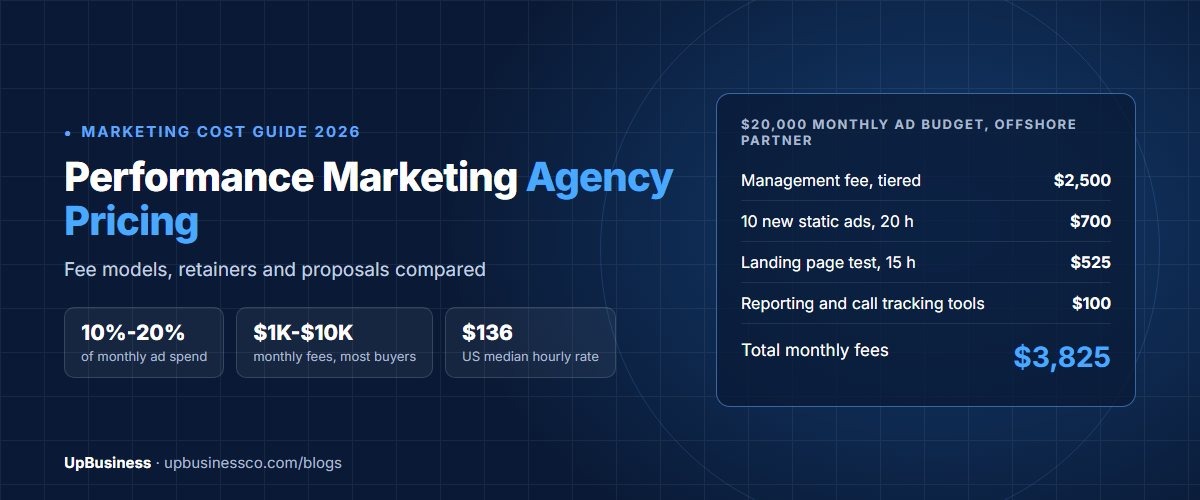
Performance marketing agency pricing in 2026 usually lands between $1,000 and $10,000 a month in fees, on top of your ad budget. The agency price pages we reviewed mostly charge 10% to 20% of what you spend on ads, a flat monthly retainer, or a mix of the two. A few will work on pay per lead or a share of revenue.
This guide is for the person who signs the contract: a founder, a marketing head or an ecommerce manager hiring an outside team to run paid ads. You'll see each fee model with worked numbers at three budget levels. You'll also see the extra costs outside the monthly fee, the hourly rates behind a fair quote, and a checklist for comparing proposals.
Performance marketing means paid advertising where you pay for, and judge, measurable results: clicks, leads, sales. Think Google Ads, Meta ads on Facebook and Instagram, LinkedIn ads and shopping ads. The agency plans the campaigns, buys the media, writes or briefs the ads, and reports on cost per result.
Key takeaways
- Most agency price pages we reviewed quote 10% to 20% of monthly ad spend, often with a minimum fee of about $1,000 a month.
- At $20,000 a month in ad spend, the common fee models land between $2,000 and $3,000 a month in our worked examples.
- Creative, landing pages and tracking often sit outside the fee. In our example they add $1,325 a month, or about 7% of spend.
- US government contract data puts the median ceiling rate for a digital marketing specialist at $136 an hour.
- Our analysis of 5 performance marketing partner companies on UpBusiness found average project sizes from $500 to $5,000, with a median of $2,500.
How Much Does a Performance Marketing Agency Cost?
A performance marketing agency costs about $1,000 to $10,000 a month in management fees for most small and mid-size businesses. The fee grows with your ad budget and the number of channels. Ad spend is paid on top, usually straight to Google, Meta or LinkedIn, not to the agency.
The table shows our estimates by budget tier. We built them from the hours an account needs each month. We then used two rates: $35 an hour for an offshore partner company, and $136 an hour, the US contract median covered later in this guide.
| Monthly ad spend | Typical scope | Hours per month | Offshore partner fee | US-rate fee |
|---|---|---|---|---|
| $2,000 to $5,000 | 1 channel, 2 to 4 campaigns | 10 to 20 | $350 to $700 | $1,360 to $2,720 |
| $5,000 to $20,000 | 2 channels, weekly changes | 20 to 40 | $700 to $1,400 | $2,720 to $5,440 |
| $20,000 to $50,000 | 2 to 3 channels, testing plan | 40 to 70 | $1,400 to $2,450 | $5,440 to $9,520 |
| $50,000 to $150,000 | 3+ channels, several markets | 70 to 120 | $2,450 to $4,200 | $9,520 to $16,320 |
Most published agency price pages we reviewed quote higher numbers than the offshore column and close to the US column. That gap is normal. The work is the same. The hourly rate and the agency's overheads change.
If you only run one channel, our guides to Google Ads management cost and Meta ads cost go deeper on that platform. For a whole marketing budget, including SEO and content, see our digital marketing cost guide.
Performance Marketing Agency Pricing Models
Agencies price paid media work in five main ways. Each one moves risk between you and the agency. The right one depends on your budget, how stable your spend is, and how well you can track results.
| Model | How it works | Typical range | Best for |
|---|---|---|---|
| Percentage of ad spend | Fee is a share of what you spend on ads each month | 10% to 20%, often with a $1,000+ minimum | Growing budgets that change month to month |
| Tiered percentage | Rate drops as spend rises, such as 15% of the first $10,000 and 10% above | Falls to 5% to 10% at high spend | Spend above $20,000 a month |
| Flat monthly retainer | Fixed fee for an agreed scope | $1,000 to $10,000 a month | Stable budgets and clear scope |
| Hybrid | Lower base fee plus a percentage or a bonus for hitting targets | Base $1,000 to $3,000 plus 3% to 8% or a bonus | Buyers who want shared goals |
| Pay per lead or per sale | You pay for each lead, call or sale. The agency often pays the ad costs | Set per result, such as $50 per qualified lead | Simple products with clean tracking |
Percentage of ad spend is the most common model. It is easy to budget and it scales with the work. The weak spot is the incentive. The agency earns more when you spend more, even if results don't improve. Ask for a cap, or a tiered rate once spend passes a set level.
A flat retainer breaks that link. You pay the same fee whether you spend $15,000 or $25,000. That suits a steady budget. The risk is scope creep. Write down how many channels, campaigns, ads and reports the fee covers.
Hybrid pricing pairs a lower base fee with a reward for results. The reward might be a bonus when cost per lead drops below a target. It only works when you both trust the numbers. Agree on the tracking first.
What Each Model Costs at $5,000, $20,000 and $50,000 a Month
Here is how the same budget looks under four models. We used common terms. The percentage deal is 15% of spend with a $1,000 minimum. The tiered deal is 15% on the first $10,000 and 10% above it. The retainer is sized to the work, and the hybrid is $1,000 plus 5% of spend.
| Model | $5,000 ad spend | $20,000 ad spend | $50,000 ad spend |
|---|---|---|---|
| 15% of spend, $1,000 minimum | $1,000 (minimum applies) | $3,000 | $7,500 |
| Tiered: 15% to $10,000, then 10% | $750 | $2,500 | $5,500 |
| Flat retainer | $1,500 | $3,000 | $5,000 |
| Hybrid: $1,000 + 5% of spend | $1,250 | $2,000 | $3,500 |
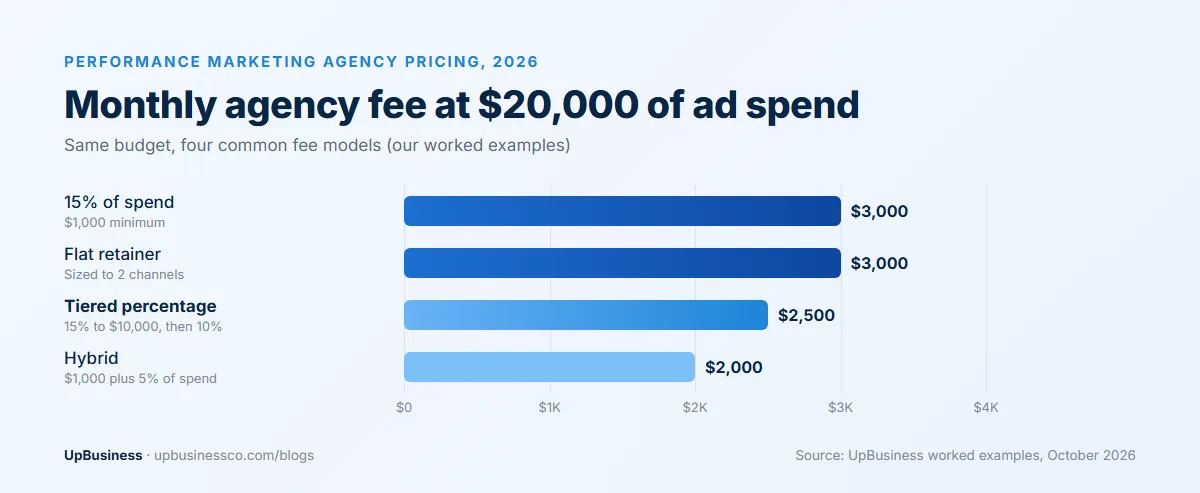
Look at the right-hand column. At $50,000 a month, a flat 15% costs $2,000 more than the tiered deal and $4,000 more than the hybrid. Over a year, that is $24,000 to $48,000 for the same account. Managing a $50,000 account does not take 2.5 times the hours of a $20,000 one.
At $5,000 a month, the picture flips. The minimum fee does the work. A $1,000 fee on $5,000 of spend is 20%. Small budgets pay a higher share because a campaign needs a base level of setup and checking, however small it is.
Fees Outside the Monthly Rate
The monthly fee rarely covers everything. Read each proposal for these lines. Some agencies include them. Others bill them on top.
- Setup or onboarding. An account audit, tracking checks and a campaign rebuild. Expect 20 to 40 hours, or $700 to $1,400 offshore, billed once.
- Ad creative. New images and videos for each test. A static ad takes about 2 hours. A short video takes 6 to 10.
- Landing pages. Pages built to turn clicks into leads. Our landing page cost guide prices these in detail.
- Tracking and analytics. Conversion tags, call tracking and dashboards. Without them, no fee model can be judged fairly.
- Minimum spend. Some agencies won't take accounts below a set budget, such as $3,000 a month.
- Tools. Reporting, call tracking or feed tools. Ask who pays the licence and who owns the data.
Here is a worked month for an online store spending $20,000 on Google and Meta ads with an offshore partner company at $35 an hour.
| Line | Hours | Cost |
|---|---|---|
| Management fee (tiered: 15% to $10,000, then 10%) | Fixed | $2,500 |
| 10 new static ads for testing | 20 | $700 |
| One landing page test | 15 | $525 |
| Reporting and call tracking tools | - | $100 |
| Total monthly fees | $3,825 | |
| Ad spend, paid to Google and Meta | $20,000 | |
| Total monthly cost | $23,825 |
Fees here come to 19% of ad spend once you count creative and tools, not the 12.5% the headline rate suggests. That is why you should compare the full monthly cost, not just the management fee.
What Is Pay for Performance Marketing, and When Does It Work?
Pay for performance marketing means you pay per result, such as $50 per qualified lead or a share of each sale, instead of a monthly fee. It works for simple offers with clean tracking. It is hard to set up for long B2B sales cycles or brands with many sales channels.
In most pay-per-lead deals, the agency pays the ad costs and sells you the leads. Its profit is the gap between what a lead costs it and what it charges you. Say the agency buys leads at $30 and sells them to you at $50. You pay $20 a lead for its skill and risk.
That can be a fair trade. But check three things before you sign:
- What counts as a lead. A form fill, a call over 60 seconds, a booked meeting? Write it down.
- Who owns the account. If the agency runs the ads in its own account, you lose the data when you leave.
- Lead quality. Ask how fake or duplicate leads are refunded.
Revenue share works the same way for online stores. The agency takes, say, 5% to 10% of ad-driven sales. It suits stores with clear order tracking. One partner company on UpBusiness, PERFOZI, says on its profile that it works with revenue-linked fees. Smaller agencies offer these deals too. For pure lead buying in B2B, our B2B lead generation agency guide covers that model.
The Hourly Rates Behind an Agency Fee
Every fee model hides an hourly rate. Knowing it helps you test a quote. Take the fee, divide by the hours the agency says it will spend, and compare the result with real rates.
US federal contract data gives a public benchmark. The GSA's CALC tool lists the maximum hourly rates that contractors can charge US government buyers[1]. We pulled the rates for marketing roles in October 2026.
| Role | Median ceiling rate | Rates in sample | Contractors |
|---|---|---|---|
| Digital marketing specialist | $136 | 40 | 24 |
| Media buyer | $124 | 23 | 19 |
| Social media specialist | $117 | 47 | 25 |
| Graphic designer | $103 | 782 | 354 |
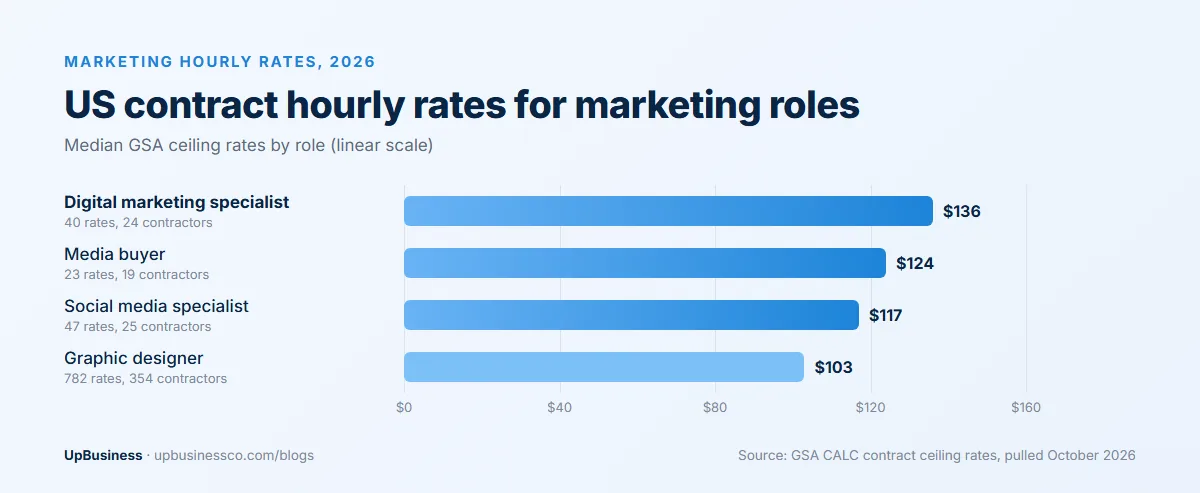
These are ceiling rates. Many contracts bill less. Still, they set a fair top line for US-based work. By our estimates, offshore partner companies in India and Eastern Europe charge about $25 to $50 an hour for the same tasks. A US retainer of $5,000 a month buys about 37 hours at $136. The same fee buys about 140 hours at $35.
More hours are not always better. Ask who does the work. A senior media buyer for 20 hours can beat a junior team for 80.
What Pushes Performance Marketing Fees Up or Down
Two agencies can quote $2,500 and $7,500 for the same budget. These are the factors behind the gap.
- Number of channels. Each platform has its own tools and rules. Google plus Meta plus LinkedIn costs more to run than Google alone.
- Number of markets. Ads in three countries or three languages need separate campaigns and reports.
- Testing pace. Weekly creative tests take far more hours than a monthly check-in.
- Sales cycle. A $50 product sold online is easy to track. A $50,000 B2B deal that closes in six months needs CRM links and sales team input.
- Reporting needs. A one-page monthly summary is cheap. A live dashboard joined to your CRM is not.
- Who does the work. Senior specialists cost more per hour but often need fewer hours.
Google's own Partner program is one sign of scale. To earn the badge, an agency's manager account must keep $10,000 in ad spend over 90 days across its clients[2]. It shows activity and certified staff. It does not prove the agency will do well for your account.
How to Compare Performance Marketing Agency Proposals
Ask every agency to price the same brief. Give your monthly budget, channels, markets, goal (leads, sales or calls) and current cost per result. Then lay the replies side by side.
| Check | What to ask | Why it matters |
|---|---|---|
| Full monthly cost | Fee plus creative, landing pages and tools | A low fee can hide costly extras |
| Hours and people | Who works on the account, and for how many hours | Turns the fee into a real hourly rate |
| Scope | Channels, campaigns, ads per month, reports | Stops arguments about what is included |
| Fee at higher spend | What happens to the fee if you double the budget | Shows whether a cap or tier applies |
| Tracking plan | Which conversions they will track, and how | Without it, no result can be checked |
| Account ownership | Whose name the ad accounts are in | Protects your data if you leave |
| Notice period | How many days to end the deal | 30 days is common; 90 days locks you in |
Ask each agency for an example monthly report, with client names hidden. It shows how they define success. Good reports show cost per lead or return on ad spend, not just clicks and impressions.
For warning signs during the pitch, our list of digital marketing agency red flags goes through them stage by stage.
Contract Terms to Agree Before You Sign
The contract matters as much as the fee. Agree on these points in writing.
- You own the ad accounts. Create the Google Ads and Meta accounts in your company's name. Then give the agency access. Google Ads has access levels such as admin, standard and read only, so you can add and remove people without handing over ownership[3]. Meta lets you give a partner access to your business assets in the same way[4].
- Ad spend goes on your card. Pay the platforms directly where you can. You'll see every charge and the agency can't mark it up.
- Budgets are capped. Google says a campaign can spend up to twice its average daily budget on a busy day. Across a month, it spends no more than 30.4 times the daily budget[5]. Agree on daily budgets so there are no surprises.
- The fee has a ceiling. On percentage deals, set a maximum monthly fee or a tier.
- You keep the creative. Ads, images and landing pages made for you should belong to you.
- Short notice period. Aim for 30 days after an initial three-month test.
What Performance Marketing Partner Companies on UpBusiness Charge
Seven companies appear on the UpBusiness performance marketing listing. We checked each company's profile to see which ones actually list performance marketing as a service. Five do. The other two are broader digital marketing firms.
| Partner company | City | Team size | Share of work in performance marketing | Average project size |
|---|---|---|---|---|
| Blugem Studio | Hyderabad | 1 to 10 | 40% | $5,000 |
| Brandbear Marketing | Pune | 1 to 10 | 40% | $1,000 |
| Consult Kay Digital | Pimpri-Chinchwad | 1 to 10 | 25% (incl. consulting) | $2,500 |
| PERFOZI | Ahmedabad | 11 to 50 | 20% | $2,500 |
| Sampark Sutra | Indore | 1 to 10 | 20% | $500 |
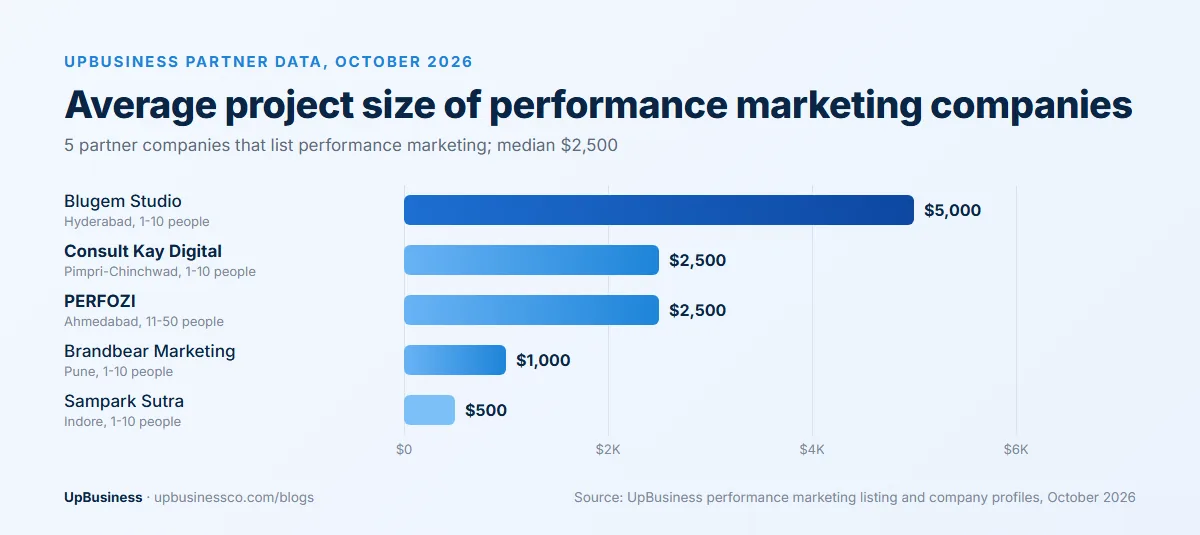
Average project size is what a typical engagement with that company is worth. It is not a monthly fee. A $2,500 average fits about one to three months of management for a small account at offshore rates. Their TrustScores, our rating built from verification and profile checks, run from 70.0 to 75.3.
Most of these firms are small teams. That suits budgets under $20,000 a month, where a senior person often runs the account directly. Larger, multi-market budgets may need a bigger team, so ask about cover for holidays and staff changes.
How to Get a Clear Performance Marketing Quote
Send the same brief to three agencies. Include your monthly budget, channels, markets, goal and current results. Ask each one to split the price into management, creative, landing pages, tools and setup. Then compare the full monthly cost and the real hourly rate.
Start with a three-month test on a clear goal, such as cost per qualified lead. Review the numbers together each month. If the agency hits the target, move to a longer deal or a hybrid fee with a bonus.
Related costs to plan for: SEO agency pricing if you also want organic traffic, and content marketing agency pricing for blog and video work.
When you're ready, post your project on UpBusiness with your ad budget, channels and goal, and we'll match you with verified performance marketing partner companies that fit.