
AI Development Services 2026
Artificial intelligence has moved past the experimentation phase. Businesses across every size bracket are investing to automate workflows, personalize customer experiences, cut costs, and open new revenue lines. What's still unclear to a lot of decision-makers: exactly what "AI development services" includes, and how to tell whether a given investment is actually going to pay off.
This guide covers what these services span, how a real implementation runs end to end, what different project types cost in 2026 with real numbers, how to measure whether the investment worked, and how to choose a partner without gambling the budget.
Why 2026 Is the Year AI Investment Got Serious
Healthcare, finance, retail, logistics, education, and manufacturing are all scaling AI adoption simultaneously, driven by a fairly consistent set of motivations: automating work that used to require a person, personalizing customer experience at a scale manual segmentation never could, forecasting demand and risk more accurately, and cutting operational cost without cutting output.
A representative example of the kind of return businesses are chasing a retail chain using AI-powered inventory forecasting to meaningfully reduce stockouts and lift revenue is a commonly cited outcome pattern in retail AI case studies industry-wide — the specific percentages vary project to project, but the shape of the win (fewer stockouts, more captured demand) shows up consistently enough to be a realistic target, not a one-off fluke.
The Work Behind an AI Development Engagement
AI development services cover designing, building, deploying, and maintaining AI systems aligned to a specific business goal — recommendation engines, fraud detection systems, AI-powered support platforms, predictive maintenance tools, and generative AI content systems all fall under this umbrella, even though the underlying engineering looks quite different from one to the next.
The Eight Categories of AI Development Work
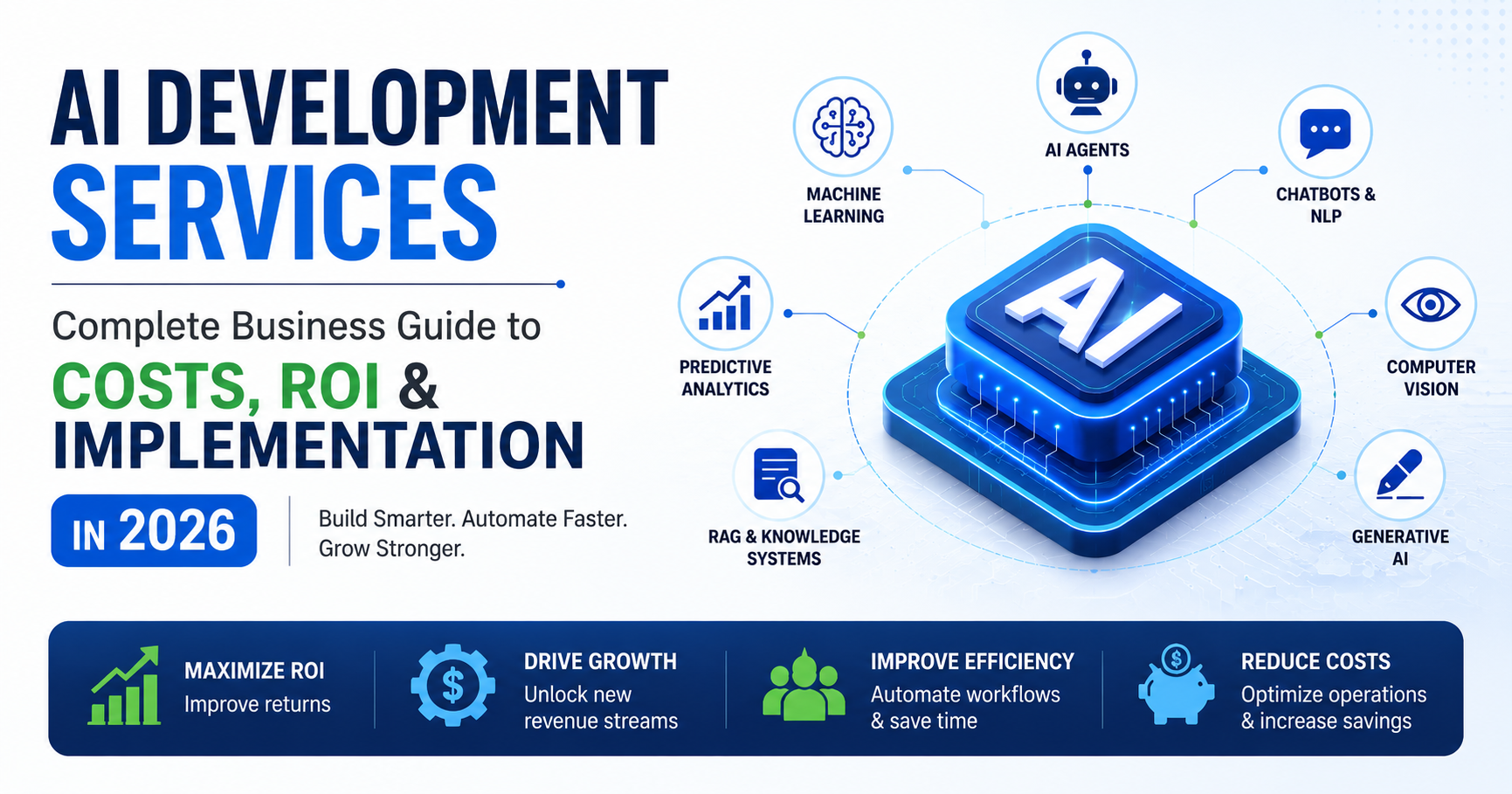
Custom AI development — tailored systems built around unique business requirements rather than adapted from generic software.
Machine learning development — predictive models trained on business-specific data for forecasting, risk scoring, and pattern detection.
Generative AI development — systems that produce text, code, images, or audio rather than just analyzing existing data.
AI chatbot development — conversational systems for customer engagement, ranging from simple FAQ bots to LLM-powered assistants.
AI agent development — autonomous systems that plan, decide, and execute multi-step tasks with limited human oversight, a meaningfully different (and pricier) discipline than a standard chatbot.
Computer vision development — image and video recognition for use cases like quality inspection, medical imaging, or security monitoring.
Natural language processing — language interpretation, sentiment analysis, and text understanding underlying most chat and document-analysis products.
Predictive analytics — forecasting demand, risk, and performance from historical and real-time data.
AI Agents: The Layer Beyond Chatbots
A chatbot replies to a prompt. An AI agent reasons through a problem, plans a sequence of steps, uses tools, and completes a task with minimal human involvement — a meaningfully different capability, which is exactly why agent development costs more and takes longer than a standard chatbot build. Common applications include customer support agents that resolve issues rather than just answering FAQs, sales assistants that qualify and route leads, recruitment agents that screen candidates, and finance assistants that handle routine review work.
A representative example of what this class of system is being used for fintech companies are increasingly deploying AI agents specifically for fraud review, since the pattern-matching and multi-step verification work agents do well maps closely onto what human fraud analysts spend most of their time on — real deployments in this category commonly report meaningful reductions in manual review time, though the exact percentage depends heavily on transaction volume and existing process maturity.
Generative AI and Machine Learning Aren't the Same Thing
Generative AI creates new content — text, images, code — from a prompt or input. Machine learning identifies patterns in existing data and makes predictions from them. They're often discussed interchangeably, which causes real confusion when scoping a project: a business that needs demand forecasting needs machine learning, not generative AI, even though both get marketed under the same "AI" umbrella. Most serious enterprise implementations end up combining both — a generative layer for interaction, a predictive layer underneath driving the actual decisions.
The Lifecycle: From Strategy to Ongoing Optimization
A real AI engagement runs through several stages regardless of provider: discovery and strategy to define the actual business problem, requirement analysis to translate that into technical scope, data assessment and engineering since the system is only as good as what it's trained on, model selection and training, validation and deployment, integration and governance into existing business systems, and ongoing monitoring and optimization — because an AI system's performance drifts as real-world data diverges from what it was originally trained on, and skipping this last stage is one of the most common reasons a good launch turns into a mediocre system a year later.

Browse our curated list of Top AI Development Companies
Also Read, Types of AI Development Services: 2026 Guide
Where AI Is Actually Being Deployed, Industry by Industry
Healthcare uses AI for diagnostics and patient monitoring. Finance relies on it for fraud detection and risk assessment. Retail leans on recommendation engines and inventory optimization. Manufacturing uses predictive maintenance and quality control. Logistics applies it to route optimization and demand forecasting. Education is building personalized learning experiences. Marketing uses it for content generation, segmentation, and campaign optimization. The common thread across all of them isn't the technology — it's that each industry is applying AI to whatever repetitive, data-heavy decision was previously bottlenecking on a person.
The Frameworks and Infrastructure Behind Real AI Systems
Most production AI systems in 2026 are built on some combination of TensorFlow or PyTorch for model development, LangChain for orchestrating LLM-based applications, Hugging Face for accessing and fine-tuning pre-trained models, and a cloud AI platform — Azure AI, AWS AI, or Google Vertex AI — for infrastructure and scaling. Vector databases like Pinecone or Weaviate have become standard for any system doing retrieval-based search rather than relying purely on a model's training data. Which combination makes sense depends on scalability needs, compliance requirements, and how the system needs to integrate with what a business already runs — there's no single "best" stack, only the one that fits the specific constraints.
RAG, Explained: Why Enterprises Are Betting On It
Retrieval-augmented generation (RAG) systems combine a large language model with an external knowledge source, so the model's answers are grounded in a business's actual, current data rather than only what it learned during training. This matters enormously for accuracy: a standard LLM can confidently generate a wrong answer about your product catalog; a well-built RAG system pulls from the actual catalog before answering.
Common use cases include internal knowledge assistants that let employees query company documentation conversationally, customer support systems that answer from real product and policy data, and enterprise search platforms that make scattered internal knowledge actually findable. Current 2026 pricing for RAG systems runs roughly $10,000–$25,000 for a basic, single-source implementation, $25,000–$80,000 for a production system spanning multiple sources with proper evaluation and authentication, and $100,000–$300,000+ for enterprise-grade agentic retrieval that can choose its own retrieval strategy across many sources.
Also Read, AI Consulting Services Guide: How to Choose the Right Partner
What You Gain By Hiring an AI Partner
Working with an established AI development company generally means faster development cycles than building the expertise in-house from scratch, access to specialists across ML, generative AI, and AI agents that most businesses can't justify hiring full-time, infrastructure that's already built to scale, stronger security and governance practices baked in from experience with prior clients, and long-term support once the system is live. The trade-off is less direct control and a dependency on the vendor's availability and institutional knowledge — which is exactly why the vendor selection process below matters as much as it does.
What This Actually Costs to Build in 2026
Cost estimates in this space vary enormously between sources, mostly because vendors quietly scope different levels of complexity under the same project label. Cross-referencing multiple independent 2026 cost guides gives a more realistic picture than any single source:
| Project Type | Realistic 2026 Cost Range | What Drives the Range |
|---|---|---|
| AI chatbot | $10,000 – $100,000 | Rule-based FAQ bot vs. LLM-powered assistant with integrations |
| AI assistant | $40,000 – $200,000 | Number of workflows and depth of tool/system integration |
| RAG system (knowledge search) | $10,000 – $80,000 (basic to production); $100,000 – $300,000+ (enterprise agentic) | Number of data sources, retrieval sophistication, compliance needs |
| AI agent | $15,000 – $400,000+ | Autonomy level: single-workflow agent vs. multi-agent orchestration system |
| Recommendation engine | $30,000 – $150,000 | Data volume and personalization sophistication |
| Computer vision | $40,000 – $500,000+ | Custom training data requirements and real-time inference needs |
| Enterprise AI platform | $400,000 – $1,000,000+ | Governance, multi-system integration, organization-wide rollout |
What almost nobody budgets for upfront: ongoing operating costs. Once live, an AI system typically runs $500–$15,000+ per month depending on complexity — covering LLM API usage, vector database hosting, monitoring, and periodic retraining. A widely cited 2025 Gartner analysis found that a majority of AI projects exceed their initial budget, and the operating-cost gap is one of the most common reasons why: the build price gets planned for; the meter that keeps running afterward often doesn't.
Measuring Whether the Investment Actually Worked
The metrics that actually matter are the ones tied to a business outcome, not a technical one: cost reduction from automated work, revenue growth from better targeting or forecasting, customer retention improvements, productivity gains measured in hours saved, and faster decision-making where a forecast or recommendation used to require manual analysis.
A representative example of what a strong ROI case looks like logistics companies using AI-driven route optimization commonly report meaningful annual fuel cost savings — a well-established u se case in the industry precisely because route optimization is a bounded, data-rich problem AI is genuinely well suited to. The exact savings depend on fleet size and existing routing efficiency, but the pattern is consistent enough that it's a reasonable benchmark to set expectations against, not an outlier result.
The discipline that separates a real ROI story from a vague one: defining the specific metric and baseline before the project starts, not backfitting a success narrative onto whatever numbers come out afterward.
Also Read, Enterprise AI Development: Guide for Modern Businesses 2026
The Five-Point Check Before Signing a Contract
Case studies and industry expertise — has this vendor actually solved a problem structurally similar to yours, not just "AI" in a loosely related industry. Technical depth across ML, generative AI, and AI agents — a team strong in one area but thin elsewhere will hit a wall the moment your project needs something outside their comfort zone. Cloud and enterprise integration experience — can they actually connect the system into your existing CRM, ERP, or data infrastructure without a costly redo. Security and governance practices — especially critical if the system touches customer or financial data. Communication transparency and support — how clearly they scope, report, and explain trade-offs predicts how the entire engagement will feel, more than any pitch deck does.
Where This Leaves Businesses in 2026
AI development has moved from experimental spend to strategic investment, but the businesses seeing real returns aren't the ones adopting the most AI — they're the ones that scoped the right project, budgeted honestly for data prep and ongoing operating costs, and picked a partner whose expertise actually matches the specific type of system being built. Whether the focus is AI agents, generative AI, predictive analytics, or enterprise automation, the businesses building real capability now — with realistic budgets and clearly defined success metrics — are the ones positioned to lead as the technology keeps maturing.
Browse our curated list of Top AI Development Companies