

Browse our curated list of CI/CD Pipeline Setup Companies
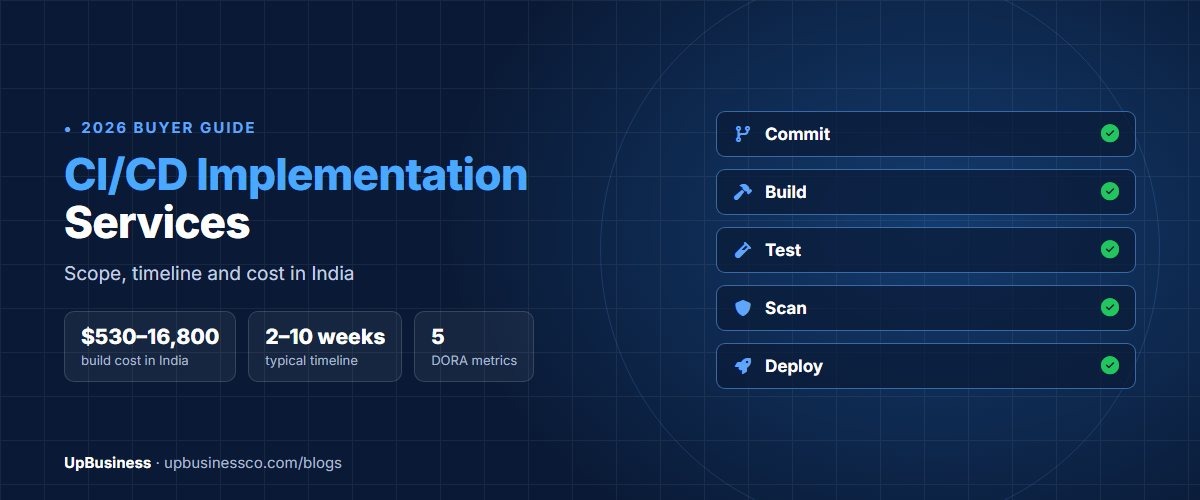
CI/CD implementation services set up the automated pipeline that tests, builds and deploys your software every time a developer pushes code, so releases stop depending on one person running commands by hand on a Friday evening. In India, a basic pipeline for a single application from an independent consultant costs roughly $530 to $1,050[1], a DevOps firm quotes about $4,200 to $8,400 to design and build a pipeline with architecture work behind it, and multi-application setups with GitOps and security gates run $8,400 to $16,800[2].
We’ve written this for the person who has to hire the help: a CTO or engineering manager at a growing company, or a founder whose product team has outgrown manual deployments. It covers what a CI/CD partner company actually builds, what it costs to build and to run, how long it takes, which tools make sense, and what to write into the statement of work so you can tell at the end whether the job was done. If you’re still deciding whether you need wider DevOps help, our guide to DevOps consulting services in India covers that bigger picture.
If you only have a minute
- A basic pipeline for one application usually takes two to four weeks, and a full setup with test automation, security scanning and progressive deployment six to ten weeks, according to one DevOps firm’s Indian price list[2].
- Running costs are small next to the build cost for most teams. GitHub includes 3,000 Actions minutes a month on its Team plan and charges $0.006 a minute after that for a standard Linux runner[3].
- Measure the result with the DORA metrics, such as change lead time, deployment frequency and change fail rate[4], and record a baseline before the work starts.
- Ask for short-lived cloud credentials through OIDC instead of long-lived keys stored as pipeline secrets[5].
What CI/CD Implementation Services Include
A CI/CD project turns the steps your developers do by hand into a pipeline that runs on every change. Continuous integration means every push is built and tested automatically, and continuous delivery means a change that passes can be deployed to staging or production with one approval, or none.
| Pipeline stage | What the partner company sets up | What you should see at the end |
|---|---|---|
| Source and branching | A branching strategy, protected main branch, pull request checks | No one can push untested code straight to main |
| Build | Automated builds, dependency caching, container images if you use Docker | A build on every pull request, finishing in minutes rather than tens of minutes |
| Test | Unit and integration tests wired into the pipeline, test reports | A failed test blocks the merge |
| Security checks | Dependency and container scanning, static code analysis, secret detection | Known vulnerable packages are flagged before release |
| Deploy | Scripts or GitOps for staging and production, blue-green or canary releases where needed | A one-click (or automatic) deploy, and a tested rollback |
| Infrastructure as code | Terraform or similar for the environments the pipeline deploys to | Environments you can rebuild from code |
| Monitoring and handover | Build and deploy dashboards, runbooks, training for your developers | Your team can change the pipeline without calling the partner company |
Not every project needs every row. A small web app on a single server may only need build, test and deploy stages, while a team running a dozen services on Kubernetes will want GitOps, image scanning and staged rollouts. The tools Opsio lists for this kind of work, from Jenkins and GitHub Actions to ArgoCD, Trivy and HashiCorp Vault[2], give a sense of how wide the range is.
Signs You Need Outside Help With CI/CD
Companies usually bring in a CI/CD partner once release problems start costing them customers or developer time, and the triggers tend to look like this:
- Deployments are done by one or two people who log into servers and run commands, and nobody else knows the steps
- Releases happen once a fortnight or less because each one takes half a day and something usually breaks
- Tests exist but only run on developers’ laptops, if they run at all
- A hotfix for a production bug takes a day to get out because staging and production are set up differently
- An enterprise customer’s security questionnaire asks how code reaches production, and there’s no good answer
If two or more of these sound familiar, a short assessment from a CI/CD specialist is usually worth more than another month of trying to fix it alongside feature work.
CI/CD Implementation Cost in India
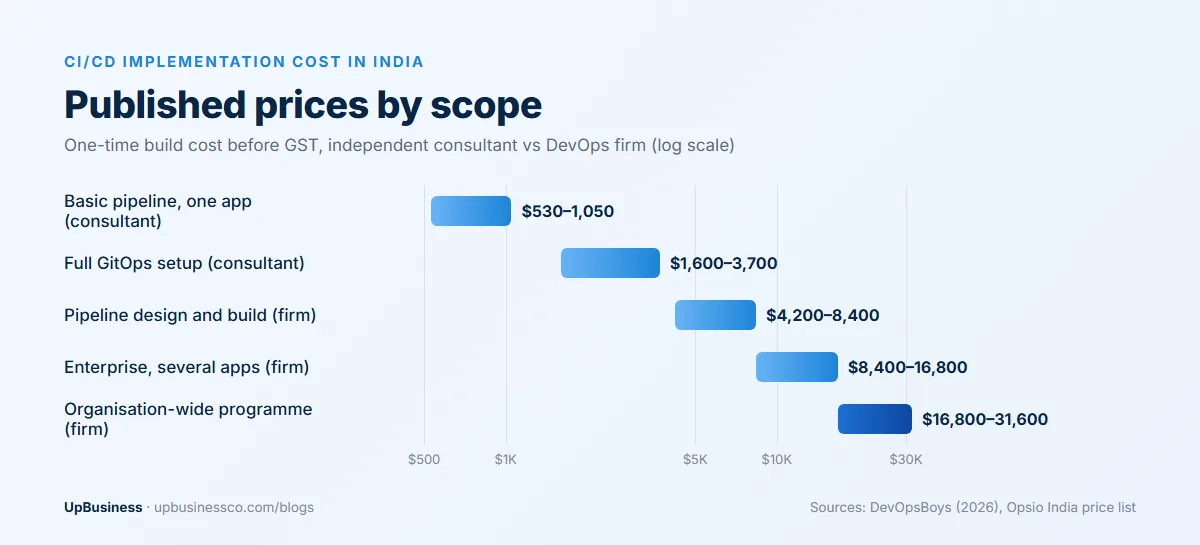
Prices depend mostly on how many applications and environments are involved and how much security and testing work comes with the pipeline. These are published Indian prices from an independent consultant and a DevOps firm, so treat them as reference points rather than a market survey.
| Scope | Typical price in India | Quoted by |
|---|---|---|
| Basic CI/CD for one app (GitHub Actions, Docker, container registry) | $530–1,050 | Independent consultant[1] |
| Full GitOps setup (ArgoCD, Helm, several environments) | $1,600–3,700 | Independent consultant[1] |
| CI/CD pipeline design and build for one application | $4,200–8,400 | DevOps firm[2] |
| Enterprise CI/CD across several apps with GitOps and security gates | $8,400–16,800 | DevOps firm[2] |
| Organisation-wide CI/CD standardisation with team training | $16,800–31,600 | DevOps firm[2] |
| Ongoing pipeline optimisation retainer | From $1,300 a month | DevOps firm[2] |
The jump from $1,050 to $4,200 isn’t only about who’s quoting. A freelancer’s basic setup usually covers one pipeline for one application, while a firm’s project normally includes an assessment, architecture documents, test automation and a team behind the work, so compare the scope line by line before you compare the numbers.
If you’d rather pay for time, DevOps consultants working with Indian clients charge roughly $84 to $130 a day at two to four years of experience, $130 to $210 at cloud architect level, and $190 to $320 for platform engineering and SRE specialists[1]. Ten working days with an architect-level consultant therefore come to about $1,300 to $2,100 before GST.
What CI/CD Costs to Run After Go-Live
For most small and mid-sized teams the monthly bill for the CI/CD platform is small compared with the build cost, but it isn’t zero, and it grows with the number of developers and builds.
GitHub Actions is free for public repositories and for self-hosted runners. For private repositories, GitHub Free includes 2,000 minutes a month, Pro and Team include 3,000, and Enterprise Cloud includes 50,000, after which a standard Linux 2-core runner costs $0.006 a minute[3]. Take a team on the Team plan running 20 builds a day at 10 minutes each over 22 working days: that’s 4,400 minutes, of which 1,400 are billed, or about $8.40 a month.
GitLab prices by seat instead. Its Free tier includes 400 compute minutes a month, and Premium costs $29 per user a month, billed annually, with 10,000 compute minutes included[6]. A ten-person team on Premium pays about $3,480 a year before any extra minutes.
Self-hosted runners avoid per-minute charges, but you pay for the servers and someone has to patch and maintain them. They make sense when builds are heavy (large Android apps, big test suites) or when code can’t leave your own network. Ask the partner company to estimate the monthly running cost of whatever it builds, including runners, container registry storage and any paid scanning tools, as a separate line from the implementation fee.
How Long CI/CD Implementation Takes
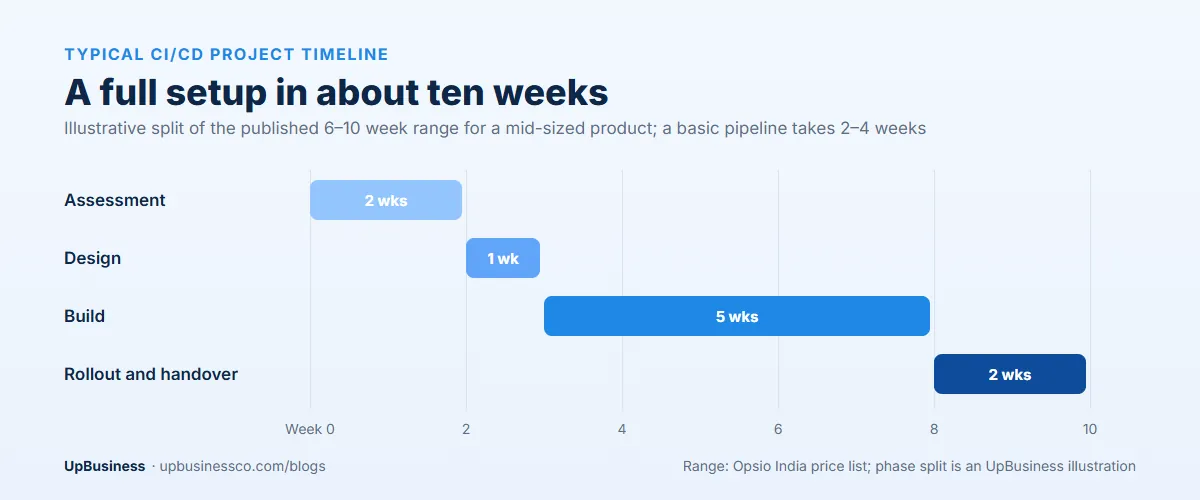
Opsio, a DevOps firm that publishes Indian prices, puts basic pipeline automation at two to four weeks and a full setup with test automation, SAST and DAST security testing and progressive deployment at six to ten weeks, and it offers a two-week pilot assessment before larger projects[2]. In practice the timeline looks something like this for a mid-sized product:
| Phase | Typical length | What happens |
|---|---|---|
| Assessment | 1–2 weeks | Map the current release process, environments, tests and pain points; agree target metrics |
| Design | 1 week | Choose tools, branching and deployment strategy; write the pipeline architecture document |
| Build | 2–5 weeks | Pipelines for each application, test and security stages, deployment automation, infrastructure as code |
| Rollout and handover | 1–2 weeks | Move teams onto the new pipeline, run real releases, write runbooks, train developers |
These phase lengths are our own illustration of how the published two-to-ten-week range usually breaks down. The timeline stretches when tests have to be written from scratch, when environments are configured by hand and nobody has documented them, or when a security review needs sign-off from another team.
Choosing CI/CD Tools
For most teams the right CI tool is the one built into the platform where the code already lives. If your repositories are on GitHub, GitHub Actions is the default choice, and if they’re on GitLab, GitLab CI is. Azure Pipelines fits teams already invested in Azure DevOps, and Jenkins still makes sense where there’s a lot of existing Jenkins work or a need to run everything on your own servers, though it needs more upkeep than a hosted service.
For deploying to Kubernetes, many partner companies now use GitOps tools such as ArgoCD or FluxCD, where the cluster pulls its desired state from a Git repository[2]. That’s worth the extra setup if you run several services, but it’s unnecessary for a single app on a virtual machine. Be a little wary of a partner company that recommends the same full toolset for every client regardless of size.
Security in the Pipeline
A CI/CD pipeline can deploy to production, which makes it one of the most sensitive systems you own. Ask the partner company to use OpenID Connect (OIDC) to connect the pipeline to your cloud account wherever it’s supported. GitHub’s documentation explains that with OIDC you don’t need to store cloud credentials as long-lived secrets, because the cloud provider issues “a short-lived access token that is only valid for a single job, and then automatically expires”[5].
Beyond that, the pipeline should scan dependencies and container images for known vulnerabilities, block secrets from being committed, require a reviewed pull request before anything merges to main, and require an approval step before production deploys if your business needs one. Keep the CI/CD platform, cloud accounts and container registry in your company’s name, and give the partner company access, so ending the contract doesn’t mean losing control of your release process. Our software development contract checklist covers the handover terms to include.
How to Measure Whether CI/CD Worked
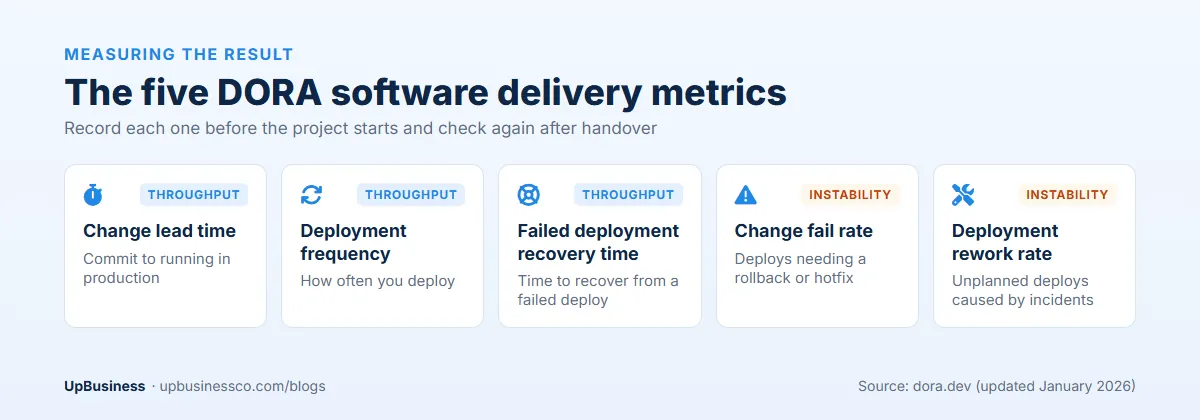
Agree how success will be measured before the work starts, and record where you are today. The DORA research programme, which studies software delivery performance, uses five metrics[4]:
| DORA metric | What it measures | Example target to discuss |
|---|---|---|
| Change lead time | Time from a commit to that change running in production | From days to under a day |
| Deployment frequency | How often you deploy | From fortnightly to several times a week |
| Failed deployment recovery time | Time to recover from a deployment that needs immediate action | From hours to under an hour |
| Change fail rate | Share of deployments that need an immediate fix such as a rollback or hotfix | Falling month on month |
| Deployment rework rate | Share of deployments that are unplanned and caused by a production incident | Falling month on month |
The targets column is an example of the kind of goal to agree, not a benchmark. A practical acceptance test for the project might be that a merge to main deploys to staging automatically within an agreed number of minutes, that a production release needs one approval and no manual steps, and that a rollback has been demonstrated on a real release.
What to Put in the Statement of Work
Write the deliverables so you can check each one on the last day. A good statement of work for a CI/CD project lists:
- The applications, repositories and environments in scope, and the ones that aren’t
- The CI/CD tool and hosting choice, with estimated monthly running costs
- Which tests will run in the pipeline, and who writes any missing tests
- Security checks included, and how secrets and cloud access are handled
- The deployment method for each environment, and a demonstrated rollback
- The pipeline architecture document, runbooks and the number of training sessions
- Acceptance criteria tied to measurable results, and a warranty period for fixes after handover
Questions to Ask a CI/CD Partner Company
- What did you find in the assessment, and which three changes would make the biggest difference to our release process?
- Will you use OIDC for cloud access, and where will any remaining secrets be stored?
- What will the pipeline cost to run each month once it’s live?
- Who on your team will do the work, and how many days will each person spend?
- How will our developers make changes to the pipeline after you hand over?
- Can you show a pipeline you’ve built for a team of a similar size and stack (with client details removed)?
UpBusiness Data: CI/CD and DevOps Partner Companies
The 6 approved CI/CD pipeline setup companies on UpBusiness report a median minimum project of about $4,000 and a median average project of $10,500, which lines up with the $4,200 to $8,400 DevOps firm range for a single-application pipeline above. Two of the six take on projects under $530, so smaller one-pipeline jobs are possible too.
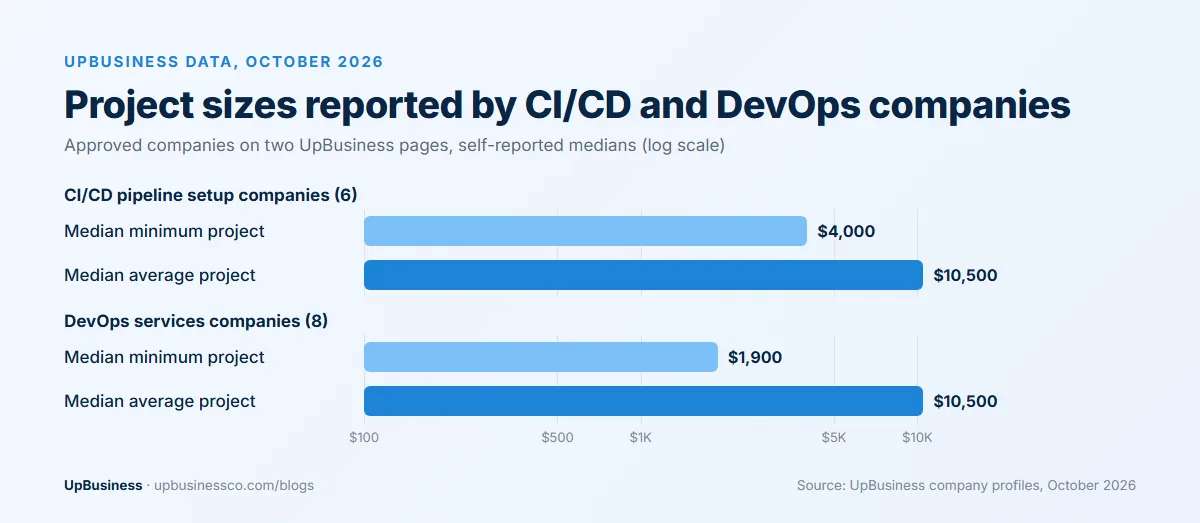
The 8 approved DevOps services companies start a little lower, with a median minimum project of about $1,900 and the same $10,500 median average project. Both groups lean towards established firms: the CI/CD companies have a median of twelve and a half years in business and the DevOps companies nine, most have between 11 and 200 people, and Noida is the most common base (four of the six CI/CD companies and five of the eight DevOps companies). The two pages overlap, since many firms offer both services, and the figures are self-reported, so use them to find partner companies that work at your project size.
Find CI/CD Partner Companies on UpBusiness
Browse verified CI/CD pipeline setup companies and DevOps services companies on UpBusiness, compare their team sizes and the project sizes they take on, and shortlist two or three for an assessment. Or post your project with your stack, environments and release pain points, and compare the proposals that come back against the scope table above.