

Browse our curated list of Cybersecurity Companies
One stolen password or one weak app can cost a business millions. Cybersecurity consulting services are outside experts you hire to find your security gaps and fix the most dangerous ones first. They also get you ready for audits, customers' security questionnaires or a regulator's questions. This guide is for the founder, CTO or IT head who has to pick that partner, often with no security team to check the work. It covers what the services include and which credentials mean something. It also gives you a weighted scorecard for real proposals, and the contract terms that protect you if the provider itself becomes the weak point.
It doesn't repeat prices. If you need numbers for a penetration test, our VAPT testing cost guide breaks them down by scope.
Key takeaways
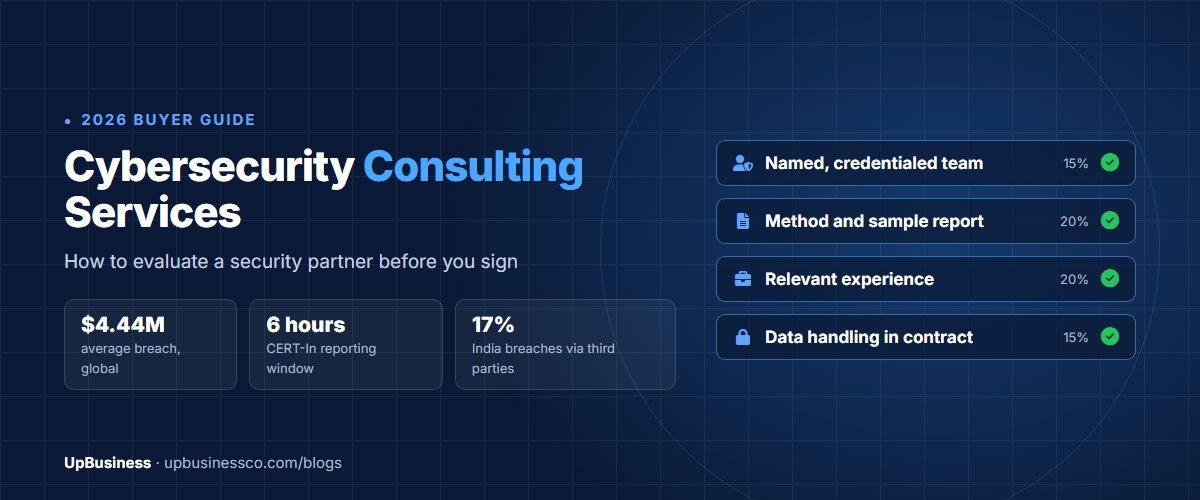
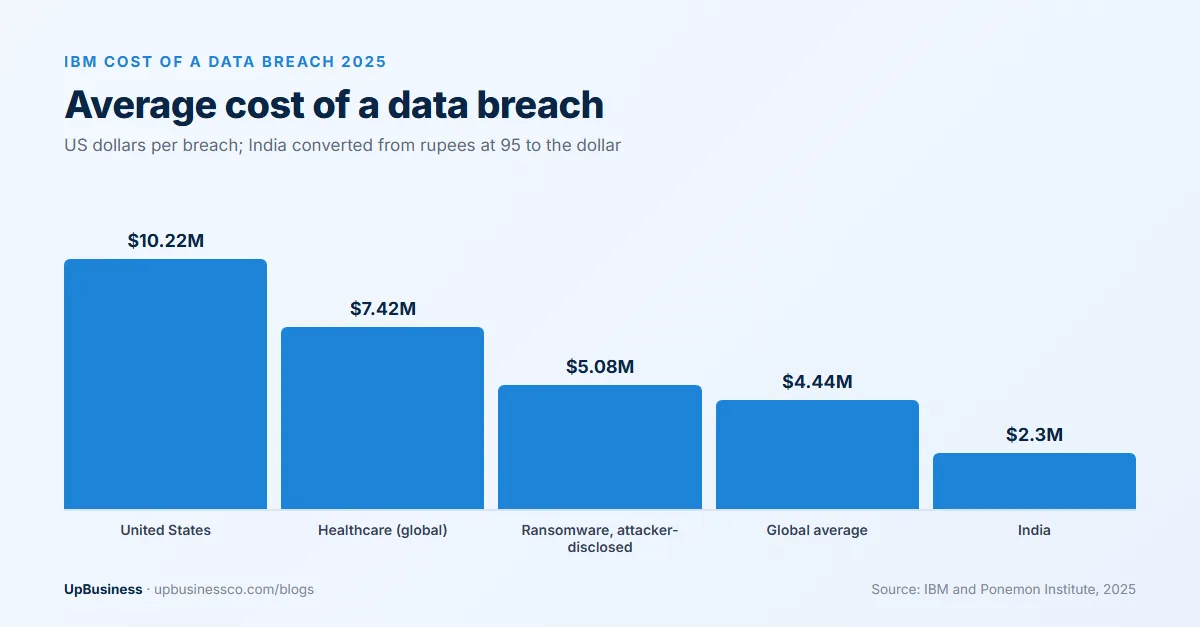
- The average data breach cost $4.44 million worldwide, and a record $10.22 million in the US, in IBM's 2025 study. India's average hit a record of about $2.3 million.
- Attacks through outside suppliers caused 17% of breaches in India, almost as many as phishing at 18%. So the partner you let into your systems is part of your risk.
- Indian rules give little time. CERT-In expects cyber incidents to be reported within 6 hours, and logs must be kept for a rolling 180 days.
- Credentials only help when they match the job. CERT-In empanelment, CREST, a PCI QSA listing or a CPA firm for SOC 2 each prove something different. None proves the person on your project is skilled.
What Do Cybersecurity Consulting Services Include?
Cybersecurity consulting covers advice and testing, not round-the-clock monitoring. A typical project reviews your risks, tests systems for weak spots, writes or fixes policies, and gets you ready for audits such as ISO 27001 or SOC 2. It may also plan how you respond to an attack and train staff. You get a ranked list of fixes and, ideally, help making them.
Many firms sell these as separate projects. Knowing which one you need stops you comparing a two-week test with a six-month compliance programme.
| Service | What you get | Typical length |
|---|---|---|
| Risk or gap assessment | A review of your systems, policies and people against a framework such as NIST CSF 2.0 or ISO 27001, with a ranked list of gaps | 2 to 6 weeks |
| Penetration testing and VAPT | Testers try to break into your web apps, mobile apps, APIs, network or cloud and report what worked | 1 to 4 weeks per scope |
| Compliance readiness | Policies, evidence collection and control fixes before an ISO 27001 certification, SOC 2 audit or PCI DSS assessment | 3 to 9 months |
| Cloud security review | Checks of identity, network, logging and storage settings in AWS, Azure or Google Cloud | 1 to 4 weeks |
| Incident response planning | A written plan, contact lists, reporting steps and a tabletop exercise with your team | 2 to 6 weeks |
| Virtual or fractional CISO | A senior security lead for a few days a month who owns your security roadmap and reports to the board | Ongoing, usually monthly |
| Security awareness training | Phishing simulations and short training for staff | Ongoing or yearly |
NIST's Cybersecurity Framework gives everyone the same words to use. Version 2.0, released in February 2024, added a sixth function, Govern, to the first five: Identify, Protect, Detect, Respond and Recover[1]. A good consultant can tell you which functions are weakest in your business. They can also explain why that should decide where the first money goes.
Consulting, Managed Security or One-Off Testing: Which Do You Need?
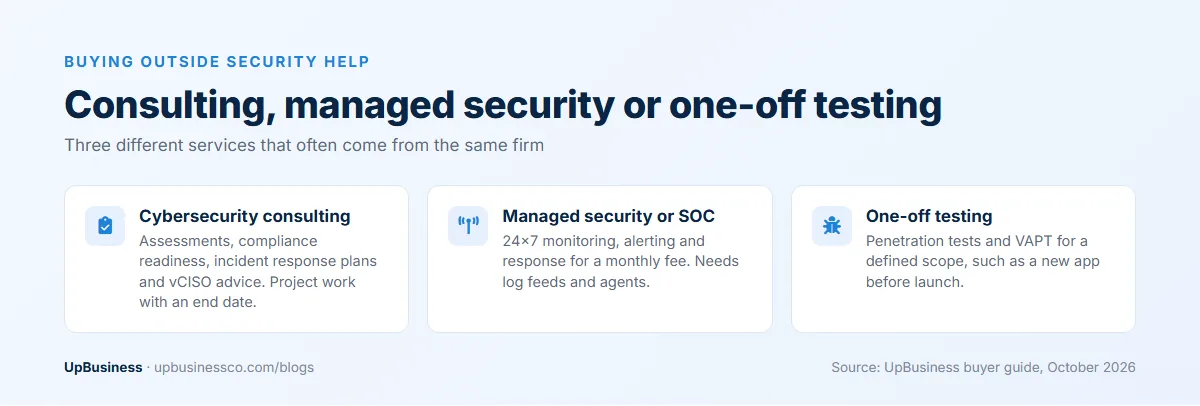
These three get mixed up in sales calls, and many firms sell all of them. They solve different problems.
- Consulting is for decisions and fixes. You want to know where you stand, what to do first and how to pass an audit. It has a start and an end.
- Managed security watches your systems day and night, raises alerts and responds to them. It's sold as a managed security service provider (MSSP) or a managed security operations centre (SOC). It runs month after month and usually needs software and log feeds from your systems.
- One-off testing answers a narrow question. Can a new app be broken into before launch? Were last year's findings fixed?
For a company of 20 to 200 people with no security hire, a common order is: review first, then test the systems that matter most, then decide on monitoring. Buying 24x7 monitoring before basic gaps are closed tends to create lots of alerts nobody can act on. If you already know you need monitoring, compare managed cybersecurity providers or managed SOC providers on their own. For an ongoing service, response times and staffing matter more than report quality.
Note that SOC also means a SOC 2 report, an audit of controls under AICPA standards. That has nothing to do with running a security operations centre. Ask which one a provider means.
What a Wrong Choice Can Cost
IBM's 2025 Cost of a Data Breach study, run by Ponemon Institute across 600 organisations, put the average breach worldwide at $4.44 million. That was the first fall in five years. The US average rose to a record $10.22 million, and healthcare stayed the most costly sector at $7.42 million[2]. Breaches took an average of 241 days to find and contain. Firms that found the breach themselves, rather than hearing about it from the attacker, saved about $900,000.
In India, IBM's average was about $2.3 million per breach (reported in Indian currency and converted at 95 to the dollar). That's 13% more than the year before. Phishing started 18% of Indian breaches. Attacks through outside suppliers started 17%[3].
That second number is why you must choose carefully. A security consultant gets admin passwords, network diagrams, test accounts and a written list of every weak spot you have. If their laptop is stolen or their staff are careless, that report is a map for an attacker. Choosing a partner is partly about skill and partly about how they handle what you give them.
Credentials That Tell You Something
Certificates are easy to list on a website. What matters is whether the credential fits your job, and whether it belongs to the firm, the person or neither.
| Credential | Who holds it | What it shows | When to ask for it |
|---|---|---|---|
| CERT-In empanelment[4] | The firm | Listed by India's national CERT as an information security auditing organisation; the list ran to 236 entries in 2026 | Indian government work, regulated sectors and audits where a CERT-In empanelled auditor is required |
| CREST accreditation[5] | The firm, with tested individual staff | Independent accreditation of penetration testing, incident response or threat intelligence services | Testing and incident response, especially for UK, Australian and Asian buyers |
| PCI QSA[6] | The firm and its qualified employees | Qualified by the PCI Security Standards Council to validate PCI DSS compliance | Only if you store, process or transmit card data |
| SOC 2 attestation[7] | A licensed CPA firm issues the report | SOC 2 reports are issued under AICPA standards; consultants can prepare you but a CPA firm signs | If customers ask for your SOC 2 report |
| ISO/IEC 27001 lead auditor or implementer | Individuals | Training in the standard; the certification of your company comes from an accredited certification body | ISO 27001 projects |
| OSCP[8] | Individuals | Passed OffSec's hands-on penetration testing exam | Testing work: ask whether the named testers hold it |
| CISSP[9] | Individuals | Broad security knowledge plus five years of relevant work experience | Advisory, vCISO and programme work |
| CISA | Individuals | Information systems audit and control | Audit and compliance projects |
Two checks matter more than the badge itself. First, confirm the claim at the source. CERT-In publishes its empanelled list as a PDF, and CREST and the PCI Council have public lists. Second, ask if the credentialed people will work on your project, by name. Five OSCP holders on the payroll mean little if two interns run your test.
The UK's National Cyber Security Centre runs its own assured scheme for incident response providers[10]. UK companies, and anyone selling into the UK public sector, should check that list too.
How to Evaluate Cybersecurity Consulting Services: A Weighted Scorecard
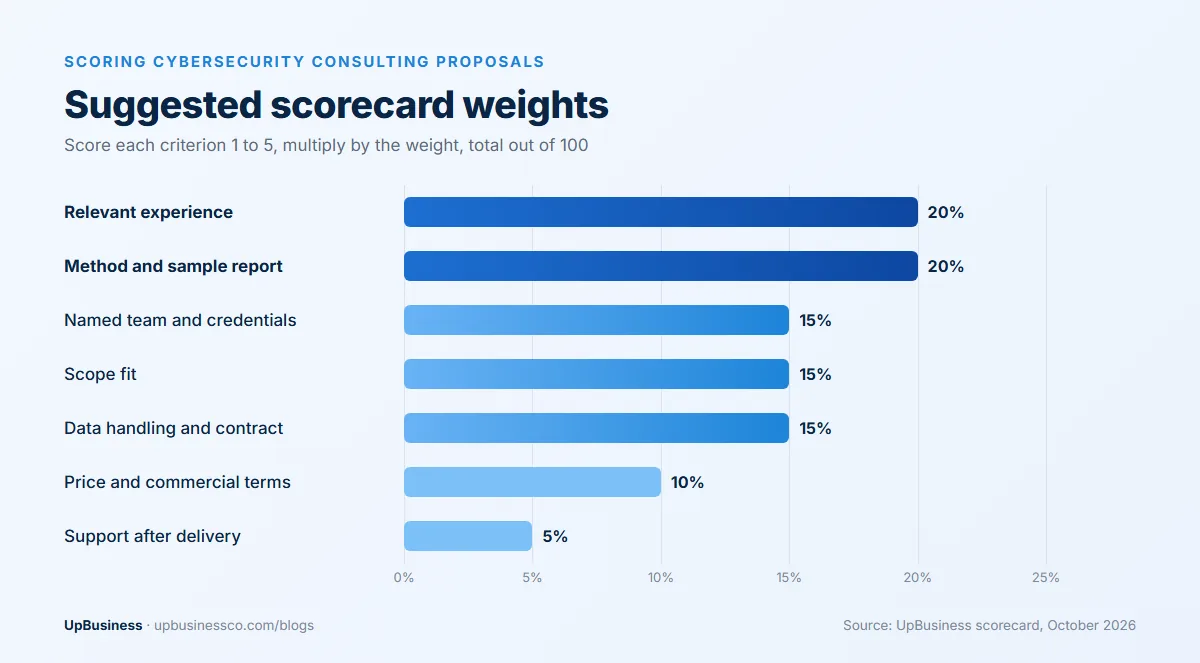
Send the same written scope to three providers. Score each proposal against fixed weights before you look closely at the price. Weights stop a polished sales call or a low quote from deciding for you. These weights suit a review or testing project. Change them if your need is different.
| Criterion | Weight | What earns a high score |
|---|---|---|
| Relevant experience | 20% | Similar projects in your industry and on your technology, with references you can call |
| Method and sample report | 20% | A clear method tied to a recognised standard, and an anonymised sample report with real findings and fix guidance |
| Named team and credentials | 15% | CVs of the people who will do the work, with credentials that fit the job |
| Scope fit | 15% | The proposal restates your scope accurately, lists what's excluded and asks sensible questions |
| Data handling and contract terms | 15% | Written rules for storing your data, deleting it afterwards, staff screening, liability and insurance |
| Price and commercial terms | 10% | A fixed price for a defined scope, with retesting included or priced clearly |
| Support after delivery | 5% | A walkthrough of findings, help with fixes and a retest of what you repaired |
Score each line from 1 to 5, multiply by the weight, add the results and divide by 5 to get a score out of 100. Anything under about 60 deserves a hard look, whatever the price.
One expert guide says accurate scoping is the best sign of skill. It suggests asking how many of a firm's last 50 projects needed change orders[11]. It's a good question because the answer is hard to fake. Accurate scoping comes from having done the work many times.
A worked example with two proposals
Here's an example case, not a real client. A software company with 80 staff wants a review of its cloud setup and a penetration test of its customer app before a big enterprise deal. Proposal A arrives the same day. It's about 40% cheaper and doesn't name its testers. Proposal B takes a week. It asks six questions about the app and includes a sample report and three CVs.
| Criterion (weight) | Proposal A score | Proposal B score |
|---|---|---|
| Relevant experience (20%) | 3 | 4 |
| Method and sample report (20%) | 2 | 5 |
| Named team and credentials (15%) | 2 | 4 |
| Scope fit (15%) | 2 | 4 |
| Data handling and contract terms (15%) | 2 | 4 |
| Price and commercial terms (10%) | 5 | 3 |
| Support after delivery (5%) | 3 | 4 |
| Weighted total out of 100 | 51 | 82 |
The cheaper quote wins on price and loses almost everywhere else. A same-day quote with no scoping questions usually means a standard package, often an automatic scan with a branded cover page. That can still help for a quick check. But it won't satisfy an enterprise customer's security team. If the budget can't stretch to B, cut the scope (test the customer app now and the internal tools later). Don't cut the depth.
What to Check in the Proposal and Sample Report
A proposal tells you how a firm thinks. Read it for these points:
- Your scope in their words, with every system, URL, app and IP range listed and anything excluded named as excluded.
- The standard they test or assess against, such as the OWASP testing guides, NIST CSF 2.0 or ISO 27001 Annex A.
- How much of the work is manual. Ask for the split between automated scanning and hands-on testing in days.
- Test windows, rules of engagement and who to call if something breaks during testing.
- Whether one retest after your fixes is included.
Then ask for a sample report with client names removed. A useful one has a short summary a board member can read. It ranks findings by severity, with proof (screenshots or request logs). It gives clear steps to repeat each issue, and fix advice written for your developers. Be careful with a report padded with scanner output, where hundreds of pages of minor items hide how few real attack paths were proven.
For software products, our SaaS security checklist lists the controls a tester is likely to probe.
Contract Terms That Protect Your Data
Your contract should treat the consultant as someone holding very sensitive information, because they will be. Agree these terms in writing before you grant any access:
| Clause | What to ask for |
|---|---|
| Confidentiality | An NDA covering findings, credentials, network details and reports, lasting beyond the end of the contract |
| Data handling | Where your data and reports are stored, who can see them, encryption, and deletion within a set number of days after the project |
| Staff | Background checks for anyone with access, and your approval before team members change |
| Subcontracting | No subcontracting of testing without your written consent |
| Authorisation | A signed letter defining what may be tested, when and from which IP addresses |
| Incident duty | Immediate notice if the provider suspects your data or systems were exposed through them |
| Liability and insurance | A liability cap that reflects the risk, plus professional indemnity and cyber insurance certificates |
| Ownership | You own the reports and can share them with customers, auditors and insurers |
Indian rules raise the stakes on two of these. Under CERT-In's April 2022 directions, service providers, data centres, companies and government bodies must report listed cyber incidents within 6 hours of noticing them[12]. They must also keep logs of their IT systems for a rolling 180 days within India. When you hire help for an attack, the contract should say who prepares and sends that report.
India's Digital Personal Data Protection Act holds the company that decides how personal data is used responsible for protecting it. That's true even when another firm handles the data for it. Failing to take reasonable security steps can bring a fine of up to about $26 million[13]. The DPDP Rules, notified in November 2025, give 18 months to comply in phases. They require affected people to be told about a breach in plain language[14]. So a consultant who touches customer data sits inside your compliance chain. For the wider contract, our software development contract checklist covers payment, IP and exit terms.
Questions to Ask a Cybersecurity Consulting Company
Ask these on the first call and again in writing.
- Who exactly will work on our project, and can we see their CVs and credentials?
- What share of the testing is manual, in person-days?
- Can we see an anonymised report from a similar project?
- Which standard or framework will you assess us against, and why that one?
- How many projects like ours have you completed in the last 12 months?
- How often do your projects need change orders, and what usually triggers them?
- Where will our data and reports be stored, and when will you delete them?
- Do you subcontract any part of the work?
- Is a retest included, and how soon after our fixes?
- If you also sell security products or monitoring, how do you keep your advice independent?
- What insurance do you carry, and what is the liability cap in your standard contract?
- Can we speak to two clients from the last year?
The independence question matters more than it looks. A firm that designs your controls and then audits them is grading its own homework. That's common for a first certification, but it should be a deliberate choice.
Red Flags When Choosing a Cybersecurity Consultant
- A fixed price sent within the hour, before anyone has asked about your systems.
- No named testers, or CVs that arrive only after you sign.
- A "full VAPT" that turns out to be an automated scan over one or two days.
- Guarantees such as "100% secure" or "we will find every vulnerability".
- Pressure to sign quickly because of a "recent attack in your industry".
- A refusal to put data handling and deletion terms in the contract.
- Requests for permanent admin access when the job only needs a test account.
- Advice that keeps ending in the firm's own product or monitoring service.
- No sample report, or a sample that is mostly copied scanner output.
One red flag can have an innocent reason. Two or three together are a reason to walk away. Our due diligence checklist explains how to confirm a company's registration, directors and track record before you share anything sensitive.
How Cybersecurity Consulting Firms Charge
How a firm charges matters as much as the price. It decides who carries the risk if the scope grows.
| Model | How it works | Suits |
|---|---|---|
| Fixed price per project | One price for a defined scope and deliverables | Assessments and penetration tests with a clear scope |
| Day rate or time and materials | You pay for days worked | Open-ended advisory work or incident response |
| Monthly retainer | A set fee for a block of hours or a vCISO role each month | Ongoing advice and compliance upkeep |
| Per device, user or log volume | A monthly price based on what is monitored | Managed security and SOC services |
| Subscription testing | Repeated testing through the year for a yearly fee | Teams that release new features often |
For a clear review or test, push for a fixed price. If a firm insists on billing by time for standard work, ask why it can't estimate the effort. For current price ranges by scope, see our VAPT cost guide.
Specialist Firm or Full-Service Software Company? What Our Data Shows
Our cybersecurity on UpBusiness page lists 8 verified partner companies as of October 2026. Only one, Cyberous Private Limited in Jaipur, names cybersecurity as a main service (40% of its work). It's a 1-10 person team with an average project of $1,000 and a TrustScore of 73.05. The other companies are full-service software firms whose main work is apps, AI, enterprise SaaS and digital transformation, with security offered on the side. So we don't quote their project sizes here.
Neither type is better by default. A full-service company that built your app already knows how it works. It can fix what a test finds, often faster than an outside expert. The risk is that the same team checks its own code, and a general firm may have only one or two security people. A specialist brings independence and depth, but needs time to learn your systems.
Before giving security work to a full-service company, ask how many people work on security full time, and which of them hold testing credentials. Ask how many security-only projects it ran last year. A telling question is whether its testers are separate from the developers who wrote your code. For an independent test before a big customer deal or an audit, a specialist is usually the safer pick (or a CREST or CERT-In empanelled firm where required). For hardening an app the partner company is already building, the full-service route can work well, with a specialist retest at the end.
Every partner company on UpBusiness passes checks on registration, founder identity and client projects, and holds a TrustScore of 70 or more. That's a first filter, not a substitute for the scorecard.
Find a Cybersecurity Partner on UpBusiness
Browse the verified cybersecurity companies. If testing is the main need, see the web penetration testing companies. To get matched proposals you can score side by side, post your project with your scope, deadline and budget. Then use the questions and scorecard in this guide to compare what comes back.