


Browse our curated list of Email Marketing Agencies
An email marketing agency plans, writes, builds and sends the emails your business sends to people who opted in, from welcome series and abandoned cart reminders to newsletters, launches and win-back emails. Full-service retainers usually start around $1,000 a month and climb past $10,000 for large programmes[1], and platform fees come on top. This guide is for founders, ecommerce managers and marketing heads deciding whether to hire one. It explains what the work covers, how agencies price it, which numbers to judge them on, and the contract terms that keep your list and your sending reputation safe in every country you mail.
Key takeaways
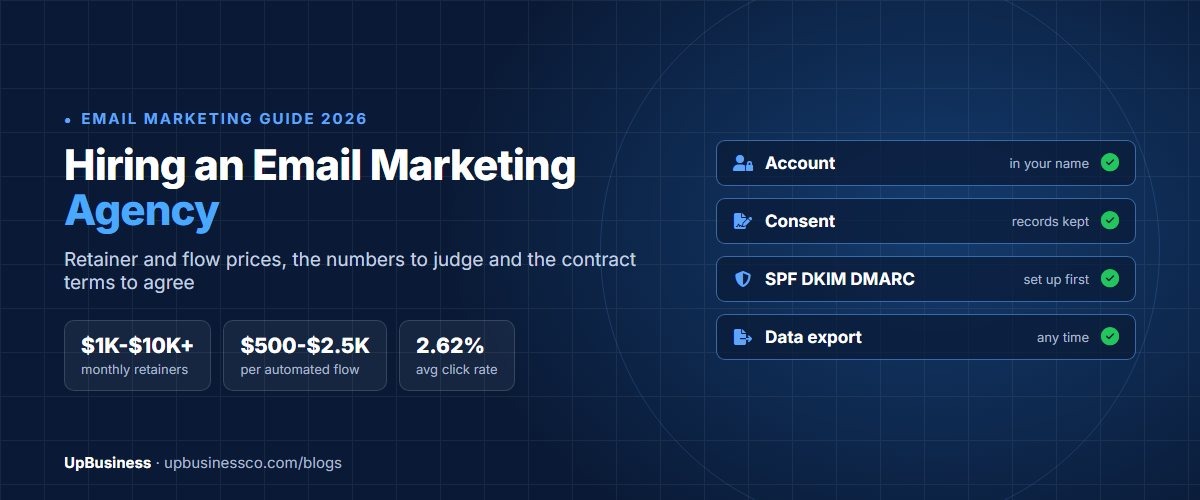
- Agency retainers for email marketing commonly run $1,000 to $10,000+ a month, with one-time setup at $1,000 to $3,000 and each automated flow at $500 to $2,500 to build.
- Platform fees are a separate bill. Klaviyo charges by active profiles and Brevo by emails sent, so the same list can cost very different amounts depending on the tool.
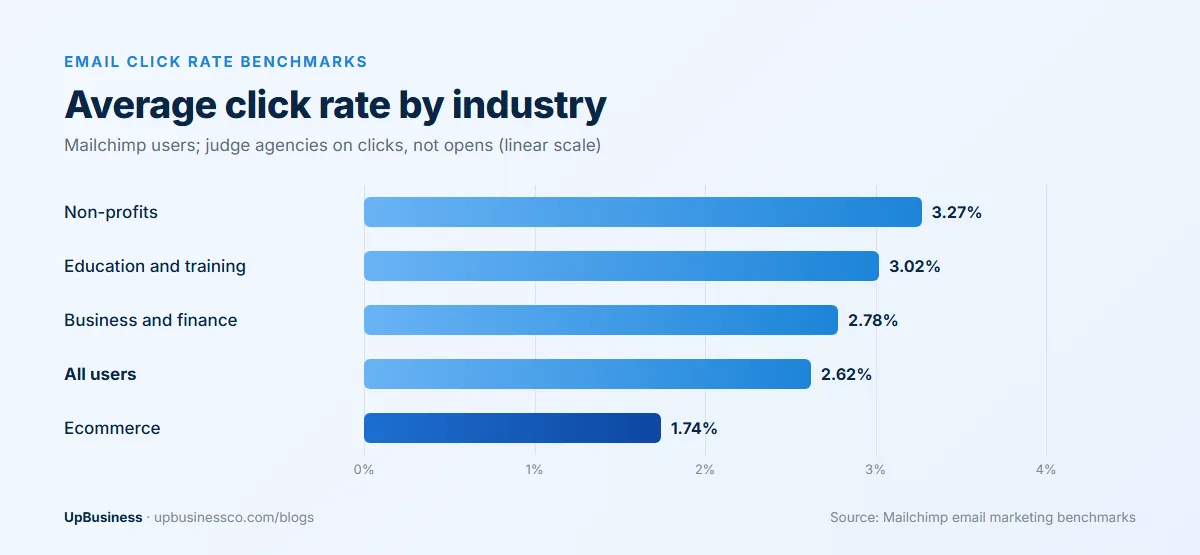
- Mailchimp's benchmark data puts the average click rate at 2.62% across all users and 1.74% for ecommerce, a fairer yardstick than open rates since Apple's privacy changes.
- Consent rules differ by market. The UK, EU, Canada, Australia and India all expect permission before marketing email, and the US requires a working opt-out on every message.
What Does an Email Marketing Agency Do?
The agency runs your permission-based email programme from strategy to send. The work splits into automated flows that trigger on customer behaviour and scheduled campaigns that go to segments of your list. A good agency also handles the technical side that decides whether emails reach the inbox at all.
| Service | What the agency does | Who needs it most |
|---|---|---|
| Lifecycle flows | Welcome series, browse and cart abandonment, post-purchase, replenishment, win-back and sunset flows | Ecommerce brands and subscription businesses |
| Campaigns and newsletters | Monthly calendar, copy, design, testing and sending to chosen segments | Any business with a list it mails at least monthly |
| Segmentation | Groups by purchase history, engagement, location or lead stage, plus suppression rules | Lists above a few thousand contacts |
| Platform setup or migration | Account build, integrations with your store or CRM, moving lists, templates and flows between tools | Teams outgrowing a starter tool |
| Deliverability | SPF, DKIM and DMARC records, list cleaning, sending schedules and complaint monitoring | Anyone sending in volume to Gmail or Yahoo addresses |
| Reporting | Revenue by flow and campaign, list growth, click and unsubscribe trends | Owners who need email tied to sales |
One line worth drawing early: this guide covers email to people who opted in. Cold outreach to buyers who never signed up is a different service with different rules, and our guide to hiring a B2B lead generation agency covers it. Some agencies sell both. Check which of the two a proposal is actually pricing.
How Much Does an Email Marketing Agency Cost?
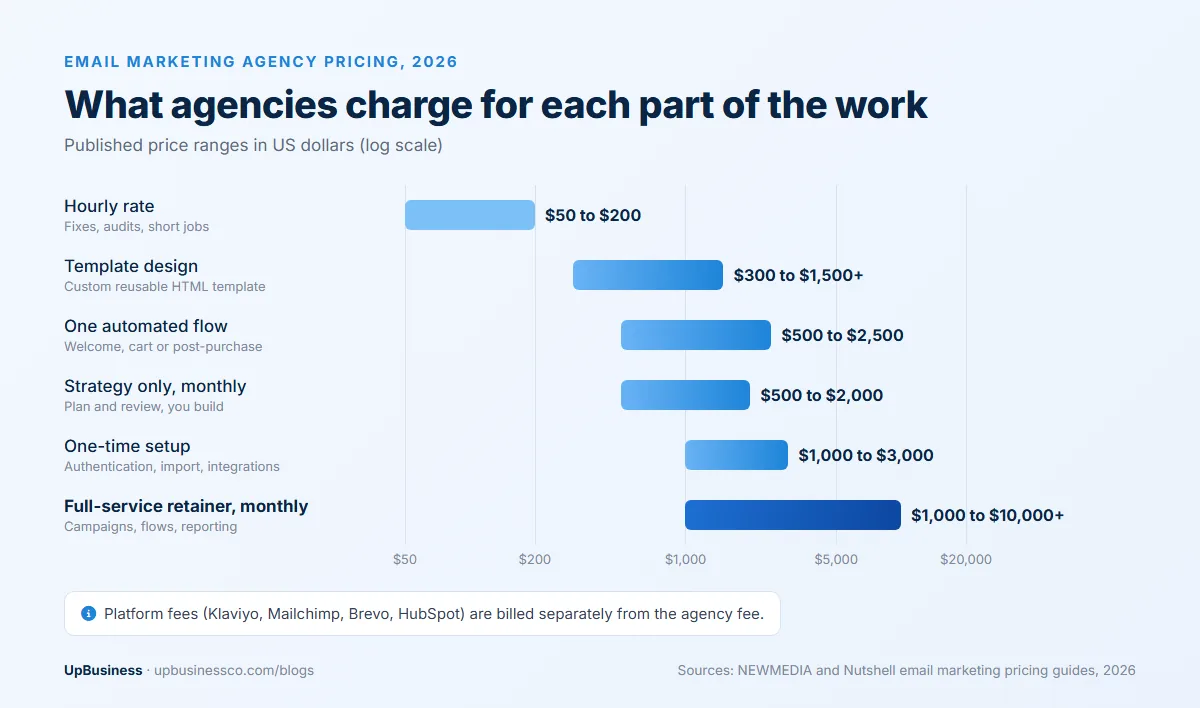
An email marketing agency usually costs $1,000 to $10,000 a month on retainer, depending on list size, how many campaigns go out and how complex the automation is. Expect a one-time setup fee of $1,000 to $3,000 on top. The email platform is a separate budget line, as agencies rarely include it in their fee.
Published ranges differ because the sources measure different things. Nutshell puts full-service retainers at $1,000 to $10,000+ and says a small agency handling 2 to 3 campaigns a month for a mid-sized business might charge $1,500 to $3,000[1]. A WebFX survey of more than 250 marketers found the most common agency spend was only $51 to $500 a month[2]. That suggests many small businesses buy light, partial help rather than a managed programme. A survey of email agencies found the most common first-year contract is worth $5,000 to $49,000, and 49% of agencies want at least $5,000[3].
| Pricing model | Typical price (USD) | What it covers | Watch for |
|---|---|---|---|
| Monthly retainer[1] | $1,000 to $10,000+ a month | Calendar, copy, design, sends, testing, reporting | A fixed number of sends, with extra campaigns billed separately |
| One-time setup[4] | $1,000 to $3,000 | Domain authentication, list import and cleaning, integrations | Setup that skips DMARC or leaves the account in the agency's name |
| Flow build[4] | $500 to $2,500 per flow | Copy, design and trigger logic for one automated sequence | Flows built without a test plan or holdout group |
| Template design[4] | $300 to $1,500+ | A custom, mobile-friendly HTML template you can reuse | Templates that break in dark mode or Outlook |
| Strategy only[4] | $500 to $2,000 a month | Calendar, segment plan and performance review; your team builds | Advice your team has no time to execute |
| Hourly[4] | $50 to $200 an hour | Fixes, audits and short projects | Routine sends billed by the hour, which adds up fast |
What each budget level usually buys
At $1,500 to $3,000 a month you should expect 2 to 3 campaigns a month plus upkeep of your core flows[1]. Enrich Labs describes a $2,500 to $10,000 retainer as 4 to 8 campaign sends a month, regular flow copy updates, segmentation rules and platform admin[5]. Large programmes with many segments, several brands or markets and detailed revenue reporting reach $5,000 to $15,000 a month[1].
Ask every agency to put the monthly deliverables in the proposal as numbers, covering campaigns sent, flows built or refreshed, tests run and reports delivered. Two quotes at $2,500 can hide a fourfold difference in output.
Platform Fees Are a Separate Bill
The agency fee pays for people. The email platform (ESP) is a second cost, and the pricing logic varies by tool. Klaviyo bills by active profiles and offers a free plan for up to 250 profiles and 500 emails a month[6]. Brevo bills by emails sent, with a free plan capped at 300 emails a day and paid plans from 5,000 emails a month[7]. A large list you mail rarely can be cheaper on a send-based plan. A smaller list you mail often can be cheaper on a profile-based one.
Prices also change by country. When we checked Mailchimp's and HubSpot's pricing pages in October 2026, both showed local-currency prices that changed with the visitor's location, so a quote copied from a US article may not match what you pay. Ask the agency to price the platform from your own account at your real list size. Hidden extras such as list verification, custom HTML and DNS setup can add 20% to 30% over a basic platform subscription, according to Ranktracker[8].
Keep the platform contract in your company's name and on your company card. If the agency resells the platform inside its own account, you may lose your flows, templates and subscriber history when the relationship ends.
Agency, Freelancer or In-House?
For many small businesses the real choice is between a freelancer and an agency. Nutshell lists freelance email marketers at $15 to $150 an hour, with ongoing support of 10 to 20 hours a month costing $500 to $2,000[1]. That buys a capable person, but rarely a designer, a developer and a deliverability specialist in one.
| Option | Monthly cost (USD) | Strengths | Weak spots |
|---|---|---|---|
| Freelancer[1] | $500 to $2,000 for 10 to 20 hours | Low cost, direct contact with the person doing the work | One person covers copy, design, data and deliverability; holidays stop the programme |
| Agency[1] | $1,000 to $10,000+ | A team across strategy, design, build and reporting | Account managers in the middle; junior staff on smaller retainers |
| In-house hire | Salary plus tools | Full knowledge of your product and customers | Hard to hire for every skill; slow to start |
| Strategy-only agency[4] | $500 to $2,000 | Expert plan while your team builds | Needs someone internal with time to execute |
A sensible pattern for growing brands is an agency to build the flows and the foundations, then a freelancer or an internal marketer to run campaigns once the system works. Our comparison of agency, freelancer and in-house costs sets out the full cost of each route.
Email Marketing Agency Partners on UpBusiness
Our analysis of the 5 email marketing partner companies verified on UpBusiness in October 2026 shows a clear pattern. All five are digital marketing agencies based in India (Bengaluru, Pune, New Delhi and Indore) that offer email as one service inside a wider marketing package. None runs email alone, and the two that state a share of their work put email at 5%. Their TrustScores run from 70.33 to 75.33 (median 71.67). Three have 1 to 10 employees and two have 11 to 50, and the average project sizes they report range from $500 to $5,000, with three at $5,000.
That matters for buyers anywhere. A generalist agency can run a sound newsletter and a few core flows for less per month than a specialist email shop. For many small and mid-sized businesses that is enough. For a store where email drives a large share of revenue, ask a generalist to show flows it has built and the revenue reporting behind them before you compare price. You can see the verified profiles on our email marketing agencies page.
Which Numbers Should You Judge an Email Marketing Agency On?
Judge an email marketing agency on clicks, revenue or leads per email, list growth and complaint rates, not open rates. Apple's Mail Privacy Protection loads images automatically, which inflates opens, and Mailchimp itself warns that open rate data is affected[9]. Clicks and sales are harder to fake.
| Industry (Mailchimp users) | Average open rate | Average click rate | Unsubscribe rate |
|---|---|---|---|
| All users | 35.63% | 2.62% | 0.22% |
| Business and finance | 31.35% | 2.78% | 0.15% |
| Ecommerce | 29.81% | 1.74% | 0.19% |
| Education and training | 35.64% | 3.02% | 0.18% |
| Non-profits | 40.04% | 3.27% | 0.18% |
Source: Mailchimp email marketing benchmarks[9]. Use them as a sanity check, not a target in the contract, because list quality and send frequency move every number.
A useful monthly report shows revenue (or qualified leads) for each flow and each campaign, along with click rate by segment and the unsubscribe and spam complaint rates. It should also track list growth after removals and the share of revenue coming from automated flows. Litmus reports that 35% of companies see $10 to $36 back for every $1 spent on email[10]. That is a survey of email teams, not a promise, and an agency should explain how it will measure your own return.
Deliverability: What the Agency Must Set Up
A message that lands in spam earns nothing, so deliverability belongs in the scope, not in a later upsell. Since February 2024 Google has required anyone sending more than 5,000 messages a day to Gmail accounts to meet three rules[11]. Senders must authenticate with SPF, DKIM and DMARC, offer one-click unsubscribe in marketing email and keep reported spam below 0.3%.
- DNS records for SPF, DKIM and DMARC on the domain you send from, checked before the first campaign.
- One-click unsubscribe plus a visible unsubscribe link in every marketing email.
- Regular list cleaning that removes hard bounces and suppresses contacts who haven't engaged for a set period. Bought lists should never be imported.
- A warm-up plan when moving to a new platform or domain, starting with your most engaged contacts.
- Monthly reporting on spam complaints and bounces, with Google Postmaster Tools access shared with you.
Ranktracker puts typical agency onboarding at 2 to 4 weeks before full campaigns start, including authentication and platform integration[8]. If an agency promises to mail your whole list in week one after a platform move, ask how it plans to protect your sender reputation.
Email Marketing Laws by Region
Hiring an agency doesn't move the legal risk off your business. The FTC states that both the company whose product is promoted and the company that sends the message can be held responsible under CAN-SPAM[12]. The maximum civil penalty rose to $53,088 per violation in January 2025[13]. Other markets set the bar at consent rather than opt-out.
| Market | Main rule | What it means for your list |
|---|---|---|
| United States[12] | CAN-SPAM Act | No consent needed, but honest headers and subject lines, a postal address and an opt-out honoured within 10 business days |
| European Union[14] | GDPR plus national ePrivacy laws | Consent must be freely given, specific, informed and unambiguous, and you must be able to prove it |
| United Kingdom[15] | PECR and UK GDPR | Specific consent, or the soft opt-in for your own previous customers about similar products; never for bought lists |
| Canada[16] | CASL | Express or implied consent, sender identification and a working unsubscribe; penalties up to C$10 million per violation for organisations |
| Australia[17] | Spam Act 2003 | Consent, accurate sender details and an unsubscribe honoured within 5 working days |
| India[18] | DPDP Act 2023 and DPDP Rules 2025 | A clear consent notice stating the purpose; most Rules take effect in phases over 18 months from November 2025 |
If you sell into several of these markets, ask the agency to store where and when each contact gave consent, and to segment by country so each group is mailed under the right rule. An agency that can't explain the soft opt-in or CASL's implied consent periods is not ready to mail a UK or Canadian list.
Is an Email Marketing Agency Worth It? A Worked Example
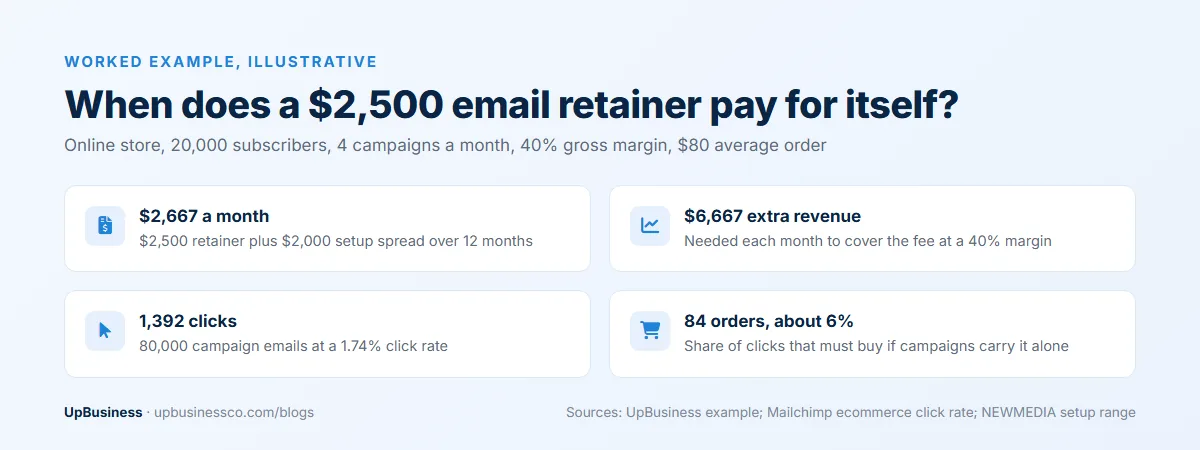
Here is a rough, illustrative calculation using the ranges above. Take an online store with 20,000 subscribers that pays a $2,500 monthly retainer and a $2,000 setup fee. Spread over 12 months, the setup adds about $167 a month, so the agency costs roughly $2,667 a month before platform fees.
If the store keeps 40% of each sale as gross profit, it needs about $6,667 of extra monthly revenue to cover that fee. Four campaigns a month to 20,000 people is 80,000 emails. At Mailchimp's ecommerce click rate of 1.74%[9], that is about 1,392 clicks. With an $80 average order, the store needs 84 extra orders, or about 6% of those clicks turning into a purchase, from campaigns alone.
That is a high bar for campaigns, which is why automated flows decide whether the fee pays off. Welcome, cart and post-purchase emails reach people at the moment they are most likely to buy, and they keep working without a new send. When you compare proposals, ask each agency which flows it would build first and how it will report the revenue each one brings in. For a smaller list, the same arithmetic usually points to a freelancer or a strategy-only engagement.
Contract Terms to Agree Before You Sign
Many disputes with an email agency come down to access and ownership, not creative quality. Put these points in writing.
| Clause | What to ask for |
|---|---|
| Account ownership | The platform account, sending domain and DNS stay in your company's name; the agency gets user access you can remove |
| Data and consent records | Your list, consent timestamps and suppression lists belong to you and can be exported at any time |
| Creative and code | Templates, flows and copy paid for become yours, with editable files handed over on exit |
| Deliverables | A fixed number of campaigns, flows and tests per month, with the price for extra work stated |
| Reporting | A monthly report with revenue or leads by flow and campaign, complaint rates and list growth |
| Compliance | The agency follows the consent and unsubscribe rules for each market you mail and never adds bought or scraped contacts |
| Term and exit | A short first term or 90-day pilot, a 30-day notice period and a handover checklist |
| Platform fees | Billed to your card directly, with no hidden markup inside the retainer |
How to Choose an Email Marketing Agency
Start with an audit. Give two or three shortlisted agencies read-only access to your platform and ask what they would fix first. Strong answers name specific flows, segments and deliverability problems in your account. Weak answers repeat a template pitch about "engaging content".
Then ask for evidence that matches your business model. An ecommerce brand should see flows built on the same platform, with revenue reporting. A B2B company should see lead nurture sequences tied to a CRM such as HubSpot, with results measured in meetings or pipeline. Ask who will write and build your emails, how many hours a month they will give your account, and whether the people on the sales call will work on it.
The warning signs to look for include guaranteed open rates, offers to "grow your list" with bought data, samples with no unsubscribe link or postal address, and reluctance to put the platform in your name. Our checklist of digital marketing agency red flags covers more of them, and our digital marketing cost guide shows how email fees compare with SEO, ads and social. B2B software companies can see where email fits in a wider plan in our B2B SaaS marketing strategy guide.
If you'd like quotes from verified partner companies, post your project on UpBusiness with your platform, list size, markets and monthly budget, and compare the proposals side by side.