


Browse our curated list of Custom E-Commerce Development Companies
Headless commerce development means building your shop front as a separate app that talks to your e-commerce platform through APIs. The platform still runs products, carts, checkout and orders, but the pages customers see are custom code, usually built with React. A headless build with an Indian partner company typically takes 800 to 2,000 hours, or $28,000 to $70,000 at $35 an hour, and running costs rise too. It pays off for stores that need custom experiences, many channels or markets, or complex B2B buying. Most small stores are better off with a fast theme.
This guide is for e-commerce owners, heads of digital and CTOs anywhere in the world who are deciding whether to go headless and what it will cost. It covers when headless makes sense and when it doesn't, the main platforms, the architecture in plain words, costs by project type, a worked example, how to choose a development partner and the questions to ask.
Key takeaways
- Headless separates the shop front from the commerce engine. You get full design freedom and control over speed, and you take on more code to build and maintain.
- A headless store usually takes 800 to 2,000 hours to build, or $28,000 to $70,000 with an Indian partner at $35 an hour. A theme-based store of similar size often takes half the hours.
- Shopify includes Oxygen hosting for Hydrogen storefronts at no extra charge on paid plans. Basic, Grow and Advanced allow one headless storefront, and Plus allows 25.
- Go headless for a clear reason: several channels or markets, a custom buying experience, B2B rules, or a content-heavy brand. Don't go headless just for speed, which a good theme can often deliver.
- Plan for a team that can maintain React code after launch. Without one, a headless store ages badly.
What Is Headless Commerce Development?
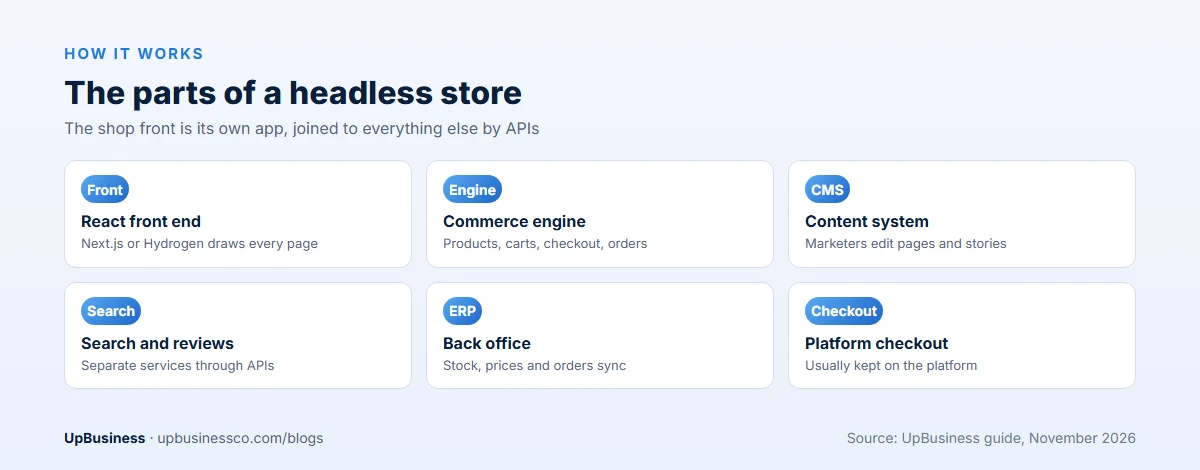
In a normal online store, the platform does everything: it stores products, runs checkout and draws the pages through a theme. In a headless store, the "head", meaning the pages customers see, is removed from the platform and built as its own app.
A typical headless setup has four parts:
- The commerce engine. Shopify, BigCommerce, Adobe Commerce, commercetools or an open-source engine such as Medusa or Saleor. It holds products, prices, carts, orders and customers.
- The front end. A React app, usually built with Next.js or Shopify's Hydrogen, that draws every page and calls the engine's APIs.
- A content system (CMS). Contentful, Sanity, Storyblok or Strapi, where marketers edit landing pages, stories and banners without a developer.
- Other services. Search, reviews, personalisation, ERP and email tools, each connected through its own API.
Checkout often stays on the platform. On Shopify, for example, most headless stores still send shoppers to Shopify's own checkout, which keeps payments and card security simple.
When to Go Headless, and When Not To
Headless is a tool for specific problems. Agencies that sell headless builds rarely say this plainly, but many stores spend more and get little extra. Use this table as a first check.
| Your situation | Headless? | Why |
|---|---|---|
| Under 1,000 products, one market, small team | Usually not | A fast theme does the job for far less |
| You sell through web, app, kiosks or marketplaces from one catalogue | Often yes | One engine feeds every channel through APIs |
| Several countries with different content and prices | Often yes | Separate front ends per market share one back end |
| Content-heavy brand with stories, lookbooks and guides | Often yes | A CMS plus custom pages beats theme limits |
| B2B with company accounts, quotes and approval steps | Sometimes | Custom buyer screens on top of platform B2B features |
| Store is slow on its current theme | Rarely the first fix | Fix images, apps and scripts first |
| No developers after launch | No | Every change then needs a paid developer |
A useful rule: if you can't name the business result headless gives you, such as a new channel, a new market or a buying flow your theme can't support, stay on a theme. Our guide to website speed optimisation services covers the speed fixes that often remove the main reason buyers ask about headless.
Headless Commerce Platforms Compared
| Platform | How headless works | Best fit | Cost notes |
|---|---|---|---|
| Shopify with Hydrogen | Storefront API plus Hydrogen, a React framework, hosted on Oxygen | D2C brands already on Shopify | Oxygen hosting included on paid plans |
| BigCommerce | Storefront APIs with Next.js or other front ends | Mid-market stores, B2B | Plan fee by sales volume |
| Adobe Commerce or Magento | GraphQL API with a custom React or PWA front end | Large catalogues, complex B2B | Licence quoted by Adobe; Open Source is free |
| commercetools | API-only engine, every part chosen separately | Large enterprises, many markets | Quote only, usually enterprise budgets |
| Medusa or Saleor | Open-source API engines you host | Teams that want full control | No licence; you pay for hosting and upkeep |
Shopify's pricing page lists how many headless storefronts each plan allows: one on Basic, Grow and Advanced, and 25 on Plus[1]. Its developer docs say Oxygen, Shopify's hosting for Hydrogen storefronts, is available at no extra charge on paid plans[2]. That makes Shopify the cheapest way into headless for many brands.
If you run Magento, check your version before planning a new front end. Adobe stops patches for each release line on a published date[3], and a headless project on an engine that is about to lose support is money in the wrong order. Our Magento development cost guide covers upgrade costs and dates.
Headless Commerce Development Cost in 2026
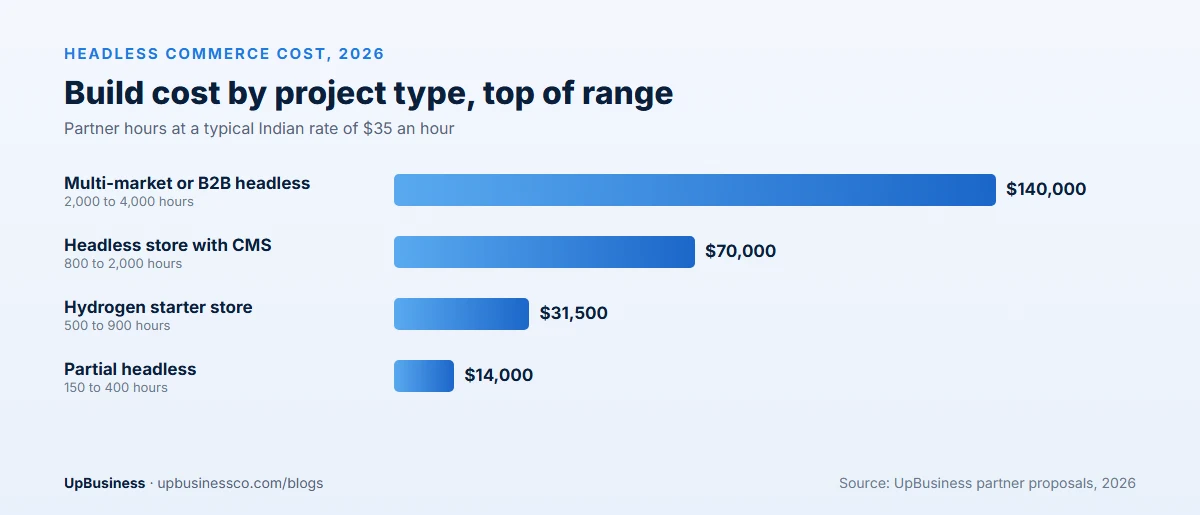
Costs below are partner-company estimates we see on UpBusiness, priced at $35 an hour for an Indian partner and at the US web developer median ceiling rate of $121 an hour from GSA CALC[4].
| Project | What it includes | Hours | Indian partner at $35 | At $121 an hour |
|---|---|---|---|---|
| Hydrogen starter store | Shopify engine, Hydrogen front end, 10 to 15 page types, Shopify checkout | 500 to 900 | $17,500 to $31,500 | $60,500 to $108,900 |
| Headless store with CMS | Next.js or Hydrogen, CMS, search, reviews, 2 to 4 integrations | 800 to 2,000 | $28,000 to $70,000 | $96,800 to $242,000 |
| Multi-market or B2B headless | Several storefronts, languages, price lists, ERP link | 2,000 to 4,000 | $70,000 to $140,000 | $242,000 to $484,000 |
| Partial headless | Headless landing pages or blog, theme for the rest | 150 to 400 | $5,250 to $14,000 | $18,150 to $48,400 |
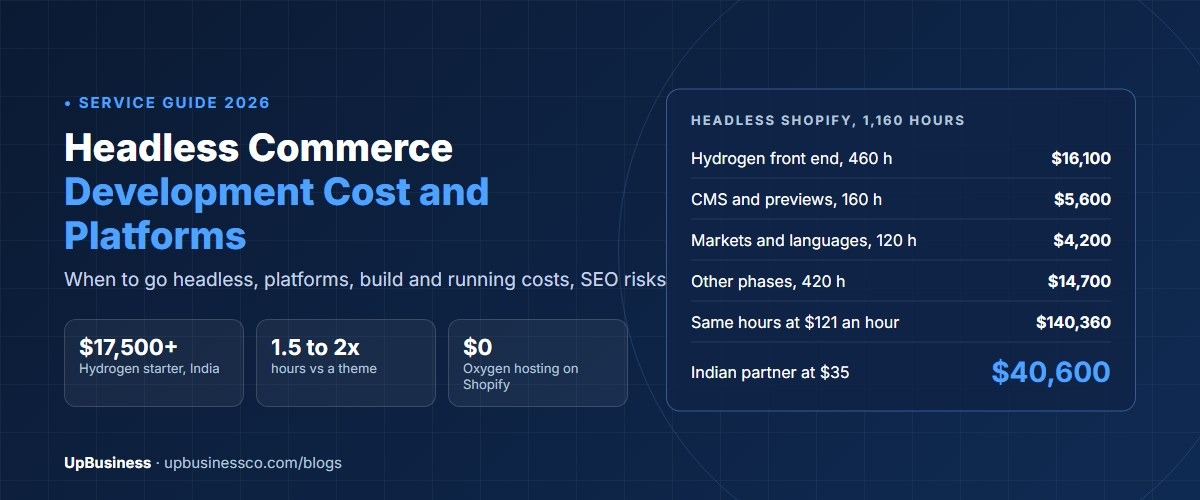
The headless store with CMS row matches the custom or headless tier in our e-commerce website development cost guide, which also prices theme-based stores. As a rough rule, a headless build of the same store takes 1.5 to 2 times the hours of a theme build, because the team builds pages, caching and previews that a theme gives you for free.
Running Costs After Launch
| Cost | Typical range | Notes |
|---|---|---|
| Front end hosting | $0 to $1,000 a month | Free on Oxygen for Shopify; Vercel or Netlify plans on others |
| Headless CMS | $0 to $3,000 a month | Free tiers exist; paid plans grow with editors and traffic |
| Search and personalisation | $0 to $2,000 a month | Often priced by searches or records |
| Development retainer | $1,400 to $5,600 a month | 40 to 160 hours with an Indian partner |
| Platform fee | Depends on the engine | Shopify plan, BigCommerce plan or Adobe licence |
The retainer is the cost most buyers underestimate. On a theme, a marketer can add a section or install an app. On a headless store, many changes need a developer, so budget a monthly block of hours from day one.
Worked Example: A Fashion Brand Moving to Headless Shopify
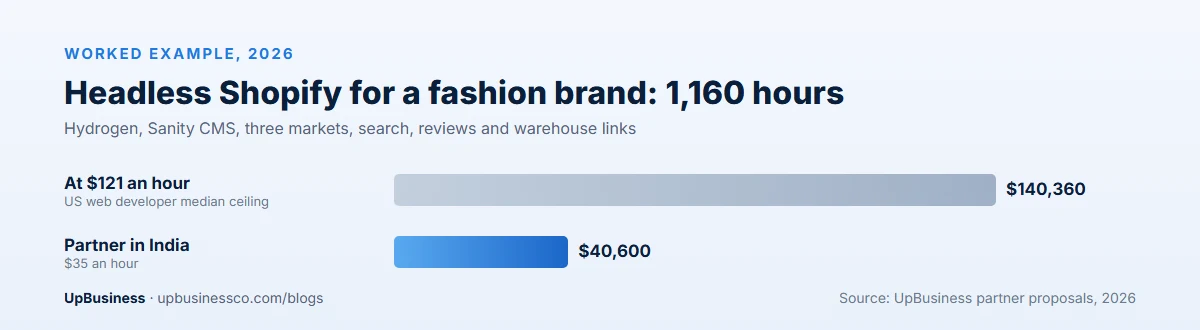
A fashion brand on Shopify sells in the US, UK and EU, publishes lookbooks and style guides, and wants faster product pages and one content system for all three markets. A partner company proposes Hydrogen on Oxygen, Sanity as the CMS, Shopify checkout and links to reviews, search and the warehouse.
| Phase | Hours | Indian partner at $35 | At $121 an hour |
|---|---|---|---|
| Discovery, architecture and design system | 120 | $4,200 | $14,520 |
| Hydrogen front end, 14 page types | 460 | $16,100 | $55,660 |
| CMS setup, content models and previews | 160 | $5,600 | $19,360 |
| Markets, languages and prices | 120 | $4,200 | $14,520 |
| Search, reviews and warehouse links | 140 | $4,900 | $16,940 |
| Testing, speed, SEO and launch | 160 | $5,600 | $19,360 |
| Total | 1,160 | $40,600 | $140,360 |
Hosting stays on Oxygen at no extra charge. Add the CMS plan, search tool and a retainer of about 60 hours a month, or $2,100, for changes. Over three years, the brand should plan roughly $110,000 to $130,000 in total with an Indian partner. A theme rebuild of the same store would likely cost $20,000 to $30,000 to build and less to run. The brand should go ahead only if the content system and multi-market setup will bring in more than that difference.
Before signing, the brand should write down how it will judge the project after six months. Sensible measures are conversion rate on mobile product pages, the share of sales from the UK and EU stores, time taken to publish a new lookbook, and Core Web Vitals scores on product pages. Record each number before the build starts, so the comparison is honest. If the measures don't move after six months, the brand has learned something useful: the retainer can shrink, and future spend can go to marketing or stock rather than more front end work. A good partner will agree these measures with you up front and report on them, not just on hours used.
How a Headless Project Runs
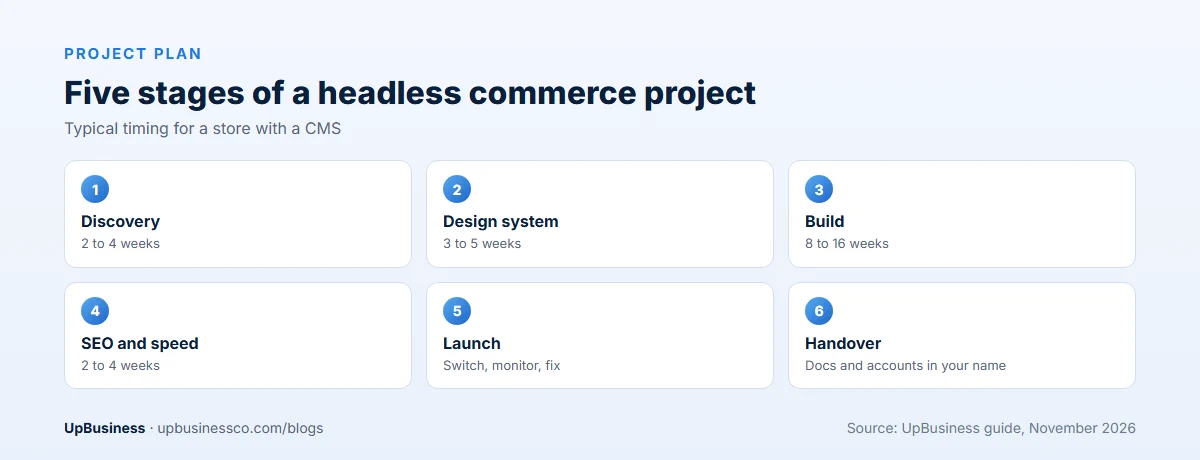
- Discovery, two to four weeks. Agree the reason for going headless, the engine, the CMS, every integration and how SEO, analytics and consent will work.
- Design system, three to five weeks. Reusable components such as product cards, filters and banners, built once and used everywhere.
- Build, eight to sixteen weeks. Pages, cart, account area, CMS content models and integrations, released to a staging site every week or two.
- SEO and speed, two to four weeks. Server rendering, metadata, structured data, redirects from old URLs and checks against Core Web Vitals[5].
- Launch and handover. A planned switch, monitoring, a bug-fix period and written handover so another team could take over.
SEO Risks in Headless Builds
Headless stores can rank very well, but a badly built one can lose traffic overnight. The most common problems:
- Pages drawn only in the browser. Search engines may see empty pages. Insist on server-side rendering for product, category and content pages.
- Missing redirects. Every old URL needs a redirect to its new home. Ask for the redirect map before launch.
- Lost metadata. Titles, descriptions, canonical tags and product structured data must be rebuilt, because the theme no longer adds them.
- Slow pages after all. Large JavaScript bundles and third-party scripts can make a headless store slower than the theme it replaced. Set speed targets in the contract.
Headless vs Theme: A Side-by-Side View
| Theme-based store | Headless store | |
|---|---|---|
| Build hours, same store | 400 to 1,000 | 800 to 2,000 |
| Design freedom | Within the theme's limits | Any layout or flow |
| Who edits pages | Marketers in the theme editor | Marketers in the CMS, developers for new sections |
| Apps and plugins | Install and go | Many need custom work on the front end |
| Speed | Good if images, apps and scripts are kept lean | Very good if built well, poor if not |
| Monthly upkeep | Low | Medium to high |
| Risk | Low | Higher: more code, more parts |
The app point catches many buyers out. On a theme, a review or upsell app adds itself to your pages. On a headless store, the front end team must call that app's API and build the display, so each new tool costs development hours. List every app you rely on before you get quotes, and ask how each will work after the move.
Start Small: Phased and Partial Headless
You don't have to rebuild the whole store at once. Many brands start with a partial setup and grow it:
- Headless content first. Build landing pages, lookbooks or the blog as a separate app with a CMS, and keep the product pages and checkout on the theme. This costs 150 to 400 hours and shows whether your team can run a CMS well.
- Headless product pages next. Move product and category pages once the first phase proves its value.
- Full headless last. Move the account area and remaining pages, still keeping the platform's checkout.
A phased plan spreads the cost over a year or more and lets you stop if the numbers don't add up. Ask every partner to price the phases separately, so you can compare them fairly.
The Team You Need After Launch
A headless store needs people who can work on it after the build team leaves. At minimum, plan for a front end developer who knows React and your framework, part of a back end developer's time for integrations, and a content editor trained on the CMS. Most brands rent this through a monthly retainer with the partner company that built the store. Larger brands hire one in-house developer and keep the partner for bigger releases. Either way, write the support hours, response times and hourly rate into the contract before launch, not after.
How to Choose a Headless Commerce Development Partner
- Ask for two live headless stores they built, the engine and front end used, and a client you can call.
- Ask them to explain, in plain words, why your store should or shouldn't go headless. A partner that never says "not yet" is selling hours.
- Check React and Next.js or Hydrogen skills. Our guide to hiring React developers has interview questions you can reuse.
- Check SEO knowledge: server rendering, redirects and structured data.
- Ask who maintains the store after launch, at what monthly cost, and how fast urgent fixes happen.
- Keep the code, hosting, CMS and domain in your own accounts from day one.
Our guides to comparing software development proposals and the software development contract checklist cover scoring quotes and the clauses to include.
Questions to Ask Before You Sign
| Question | A good answer | A warning sign |
|---|---|---|
| Why should we go headless? | Names a business result such as a new market or channel | Faster and more modern, nothing specific |
| Which pages are server-rendered? | All product, category and content pages | We use client-side rendering |
| How will marketers edit pages? | CMS with live preview and reusable sections | Send changes to our team |
| What happens to checkout? | Platform checkout, or a clear plan for card security | We will build our own checkout |
| What are the monthly running costs? | Itemised hosting, CMS, search and retainer | Very low, nothing to worry about |
| What does handover include? | Docs, code walkthrough, all accounts in your name | We host and maintain everything |
If your main goal is moving off an old platform rather than a new front end, read our guide to Shopify migration services. If you're still choosing a platform, our Shopify vs WooCommerce comparison and our guide to B2B ecommerce website development are better first reads.
Finding Headless Commerce Developers on UpBusiness
UpBusiness lists verified partner companies, mostly based in India. Every company has passed five checks reviewed by our team: company details, registration and tax papers, the founder's identity, expertise and three client projects with evidence. Only companies with a TrustScore of 70 or more are listed.
Our custom e-commerce development page and Shopify development page list companies that build online stores. Headless work is a smaller skill set than theme work, so ask each company for a live headless store and its front end code approach before you shortlist.
- Post your requirement with your platform, store size, markets, budget and the reason you're considering headless.
- Get three partner companies matched to your budget, service and industry.
- Compare their plans side by side, using the questions above. Buyers pay nothing, and there's no commission on the project.