


Browse our curated list of Magento Development Companies
Magento development cost in 2026 runs from about $10,000 for a small Magento Open Source store built by an Indian partner company to $100,000 or more for a large Adobe Commerce build with B2B features and ERP links. The same work at US agency rates often costs three to four times as much. The software is free on Open Source, while Adobe Commerce adds a yearly licence that Adobe prices by quote. Hosting, extensions, upgrades and security patches come on top every year.
This guide is for store owners and e-commerce managers anywhere in the world who are pricing a new Magento store, a rebuild or an upgrade. It covers build costs by store size, licence and hosting costs, the version deadlines that drive many 2026 budgets, yearly running costs, a worked example and how to compare quotes.
Key takeaways
- A small Magento Open Source store takes about 300 to 700 hours, or $10,500 to $24,500 with an Indian partner at $35 an hour.
- A custom mid-sized store takes 700 to 1,500 hours, and a large Adobe Commerce B2B store 1,500 to 3,000 hours or more.
- Regular support for Adobe Commerce 2.4.6 ended on 11 August 2026, and 2.4.7 regular support ends on 31 May 2027. Many 2026 Magento budgets are upgrade budgets.
- Magento Open Source has no licence fee. Adobe Commerce has a yearly licence that Adobe quotes based on your sales.
- Plan 15% to 25% of the build cost each year for upgrades, patches, extensions and support.
Magento Development Cost by Store Type
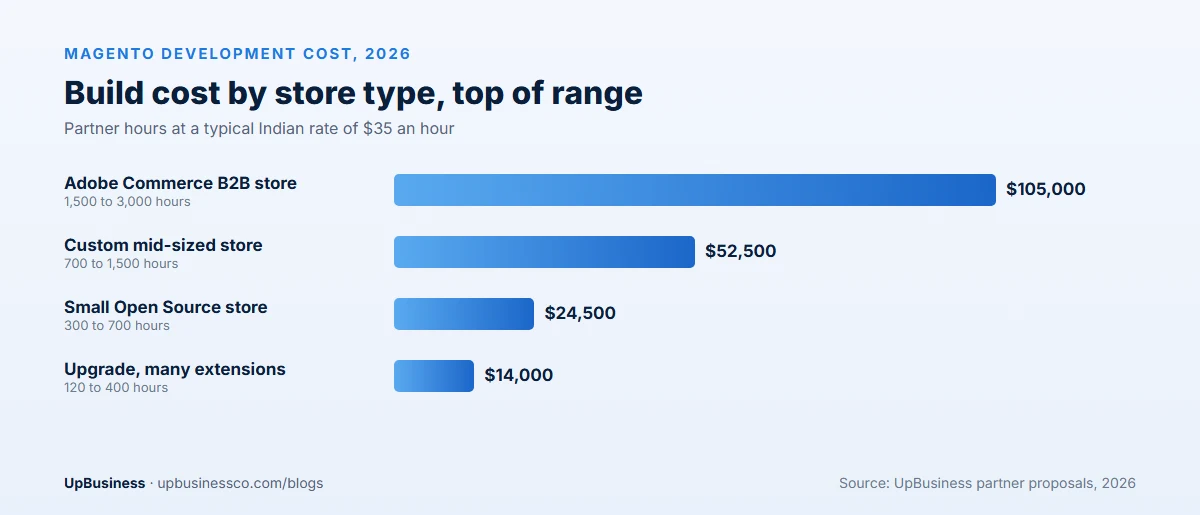
Most Magento quotes come down to hours times an hourly rate. The table below uses partner-company estimates we see on UpBusiness, priced at $35 an hour for an Indian partner and at the US web developer median ceiling rate of $121 an hour from GSA CALC[1].
| Store type | What it includes | Hours | Indian partner at $35 | At $121 an hour |
|---|---|---|---|---|
| Small Open Source store | Theme customisation, up to 1,000 products, payments, shipping | 300 to 700 | $10,500 to $24,500 | $36,300 to $84,700 |
| Custom mid-sized store | Custom design, 1,000 to 20,000 products, 3 to 6 integrations | 700 to 1,500 | $24,500 to $52,500 | $84,700 to $181,500 |
| Adobe Commerce B2B store | Company accounts, quotes, price lists, ERP link | 1,500 to 3,000 | $52,500 to $105,000 | $181,500 to $363,000 |
| Multi-store or multi-country | Several brands, languages, currencies, warehouses | 2,000 and up | $70,000 and up | $242,000 and up |
These ranges sit in line with our wider e-commerce website development cost guide, which compares Magento with Shopify, WooCommerce and custom builds. The US column uses a ceiling rate for government buyers, so a private agency in the US or UK may quote lower, but rarely close to Indian rates.
Magento Open Source vs Adobe Commerce: What Each Costs
Magento comes in two editions. Both share the same core code, but cost and support differ a lot.
| Magento Open Source | Adobe Commerce | |
|---|---|---|
| Licence | Free | Yearly licence, quoted by Adobe based on sales |
| Hosting | You choose and pay for it | Your own servers, or Adobe's cloud plan |
| B2B features | Through extensions or custom work | Built in: company accounts, quotes, shared catalogues |
| Support from Adobe | None, community only | Adobe support and extended support on some versions |
| Typical fit | Small and mid-sized stores | Large catalogues, B2B, several brands |
Adobe doesn't publish Adobe Commerce prices. Ask for the licence quote early, because for some stores it costs more each year than the original build. If the licence is the main reason you're unsure, compare the full three-year cost against a hosted platform. Our Shopify vs WooCommerce guide and Shopify development cost guide cover the most common alternatives.
The Version Deadlines Behind Many 2026 Magento Budgets
Adobe publishes an end-of-support date for every release line[2]. After it, security patches stop for that line. For Adobe Commerce customers, Adobe offers one extra year of support at no extra cost on 2.4.6 and 2.4.7.
| Release | Released | Regular support ends | Extended support ends |
|---|---|---|---|
| 2.4.9 | 12 May 2026 | 31 May 2029 | Not set |
| 2.4.8 | 8 April 2025 | 31 May 2028 | Not set |
| 2.4.7 | 9 April 2024 | 31 May 2027 | 31 May 2028 |
| 2.4.6 | 14 March 2023 | 11 August 2026 | 31 August 2027 |
| 2.4.5 | 9 August 2022 | 12 August 2025 | 11 August 2026 |
| 2.4.4 | 12 April 2022 | 12 April 2025 | 14 April 2026 |
Adobe has also said that from 1 June 2027 it will stop maintaining Adobe Commerce Cloud environments that run unsupported versions, and may suspend traffic to them, which takes the store offline. Release 2.4.10 is already in early testing[3].
PHP matters too. PHP 8.2 loses security support on 31 December 2026[4], so a store on an older Magento release that only runs on PHP 8.2 or below is out of support twice over.
| Upgrade job | Typical hours | Indian partner at $35 |
|---|---|---|
| Patch release within a line, such as 2.4.8-p4 to p5 | 8 to 30 | $280 to $1,050 |
| 2.4.7 or 2.4.8 to 2.4.9, few custom modules | 40 to 120 | $1,400 to $4,200 |
| 2.4.4 to 2.4.6 to 2.4.9, many extensions | 120 to 400 | $4,200 to $14,000 |
| Magento 1 to Magento 2 | Treat as a new build | See the store types above |
The biggest upgrade cost is rarely Magento itself. It's the third-party extensions and custom modules, each of which must work on the new version. Ask for a paid upgrade audit that lists every extension and its status before you accept a fixed price.
What You Pay For in a Magento Build
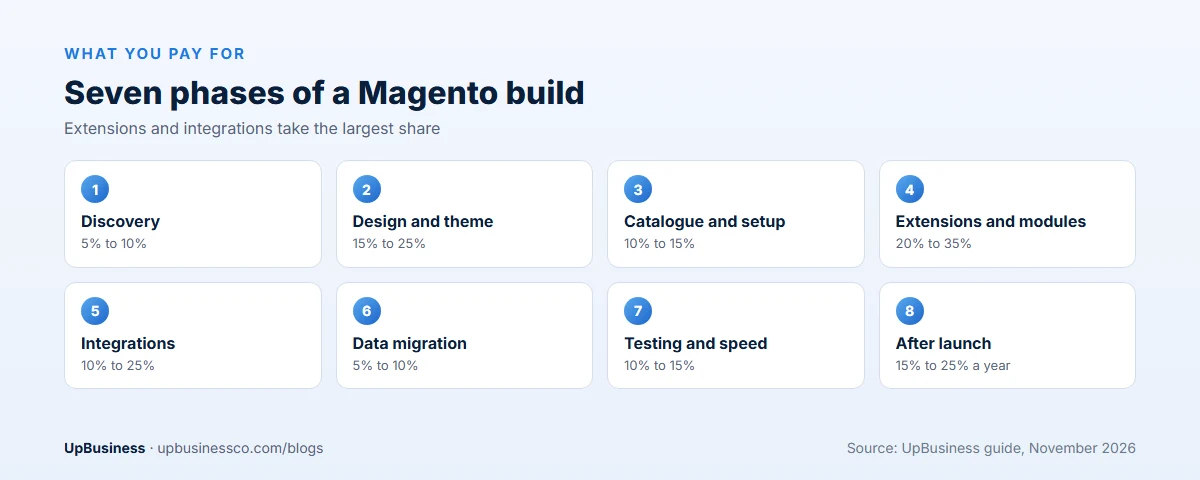
- Discovery and planning, 5% to 10%. Catalogue structure, customer groups, payments, shipping rules and integrations, written down before design starts.
- Design and theme, 15% to 25%. Most new builds use the Luma theme as a base or a Hyva theme, which many teams now choose for faster pages. The Hyva theme became free and open source in November 2025[5], so ask whether the quote still includes a theme licence. Hyva Checkout is still a paid add-on.
- Catalogue and setup, 10% to 15%. Attributes, categories, tax rules, store views and currencies.
- Extensions and custom modules, 20% to 35%. Payment, shipping, search, reviews and anything Magento doesn't do out of the box.
- Integrations, 10% to 25%. ERP, CRM, warehouse, marketplace and accounting links. One ERP link alone can take 100 to 300 hours.
- Data migration, 5% to 10%. Products, customers and orders from the old store, with old URLs redirected so search rankings carry over.
- Testing, speed and security, 10% to 15%. Checkout tests on real devices, page speed work, security scans and load tests before peak season.
Yearly Running Costs After Launch
| Cost | Small store | Mid-sized or B2B store |
|---|---|---|
| Hosting | $100 to $400 a month | $500 to $3,000 a month |
| Paid extensions | $500 to $2,000 a year | $2,000 to $10,000 a year |
| Patches, upgrades and support | $2,000 to $6,000 a year | $8,000 to $30,000 a year |
| Search, CDN, monitoring | $0 to $1,200 a year | $2,000 to $12,000 a year |
| Adobe Commerce licence | Not needed on Open Source | Quoted by Adobe |
A simple rule: plan 15% to 25% of the original build cost every year to keep a Magento store safe and current. Stores that skip this spend more later, when an urgent security patch or a forced upgrade lands at a bad moment. Our guide to website speed optimisation services covers the speed work many Magento stores need after a few years of added extensions.
Magento Developer Rates in 2026
| Level | What they do | Typical Indian partner rate |
|---|---|---|
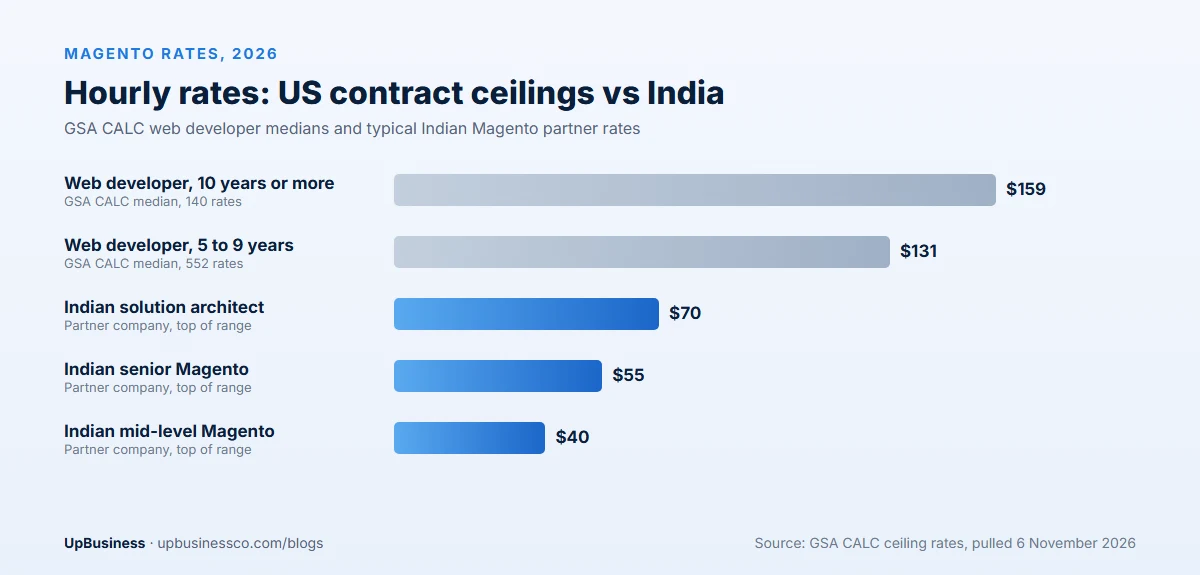
| Junior Magento developer | Theme changes, simple extensions, content | $20 to $28 an hour |
| Mid-level Magento developer | Custom modules, checkout changes, integrations | $28 to $40 an hour |
| Senior or certified developer | Architecture, upgrades, performance | $40 to $55 an hour |
| Solution architect | B2B design, ERP planning, multi-store setup | $50 to $70 an hour |
For US comparison, GSA CALC web developer ceiling rates have a median of $109 an hour at 0 to 4 years of experience, $131 at 5 to 9 years and $159 at 10 years or more, across 1,420 rates pulled on 6 November 2026[1]. Magento skills are narrower than general web work, so certified Magento developers often charge above a company's standard web rate. Our software development cost benchmark shows how Indian rates compare across other skills.
Worked Example: A Mid-Sized Magento Open Source Store
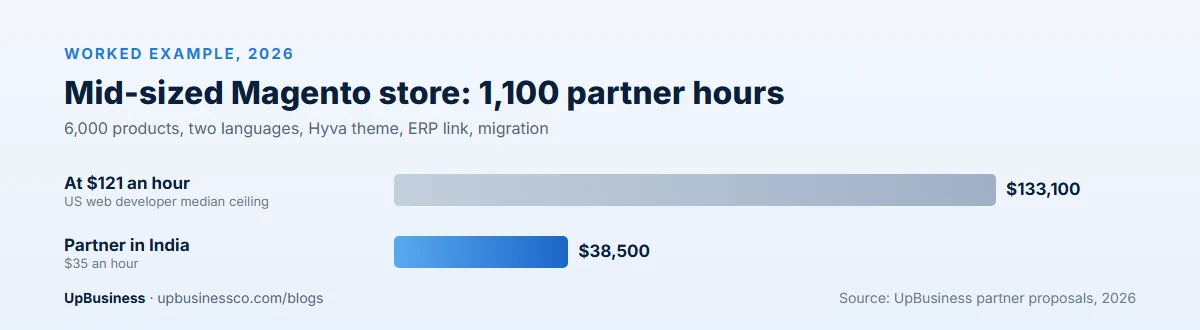
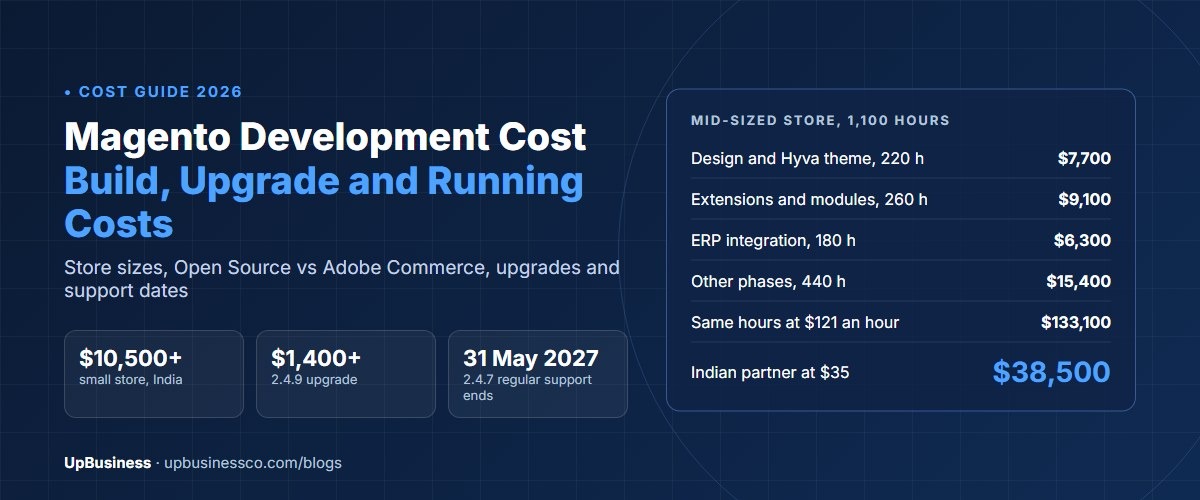
A home goods brand with 6,000 products, two languages, a custom design on Hyva, an ERP link and migration from an older Magento 2.4.4 store. A partner company estimates about 1,100 hours.
| Phase | Hours | Indian partner at $35 | At $121 an hour |
|---|---|---|---|
| Discovery and planning | 80 | $2,800 | $9,680 |
| Design and Hyva theme | 220 | $7,700 | $26,620 |
| Catalogue, store views and setup | 120 | $4,200 | $14,520 |
| Extensions and custom modules | 260 | $9,100 | $31,460 |
| ERP integration | 180 | $6,300 | $21,780 |
| Data migration and redirects | 100 | $3,500 | $12,100 |
| Testing, speed and security | 140 | $4,900 | $16,940 |
| Total | 1,100 | $38,500 | $133,100 |
Add hosting at about $300 to $800 a month and $4,000 to $10,000 a year for upkeep. Over three years, this store costs roughly $60,000 to $80,000 in total with an Indian partner, before any Adobe licence.
On timing, a team of four or five people usually delivers a store of this size in five to six months. A sensible payment plan ties money to finished work: 10% to 15% at the start, then payments when the design is approved, when the catalogue and extensions pass testing, when the ERP sync runs cleanly for a full week, and the last 10% to 15% after launch and a short bug-fix period. Keep the final payment until old URLs redirect correctly and orders flow into the ERP without manual fixes.
The biggest risk in this example is the ERP link. If the ERP has no modern API, the team may need to build a middle layer or work with file exports, which can double those 180 hours. Ask the company to test a connection to your ERP in the first two weeks, before design work is far along, so a surprise shows up while it's still cheap to change the plan.
What Pushes the Price Up
- Too many extensions. Each one adds licence fees, upgrade work and possible conflicts. Many stores run 40 or more.
- Custom checkout. Changes to checkout touch payments, tax and shipping, and need heavy testing.
- ERP and warehouse links. Stock and price syncs that must run every few minutes without errors.
- B2B rules. Customer-specific prices, quote requests, credit limits and approval steps.
- Old data. Messy product attributes and duplicate customers slow migration.
- Peak traffic. Sales events need caching, load tests and stronger hosting.
How to Cut Magento Costs Without Hurting the Store
- Remove extensions you don't use before any upgrade. Fewer modules means fewer hours.
- Use Magento's built-in features first. Many extensions duplicate them.
- Upgrade on a schedule, one release at a time, rather than skipping several years.
- Agree a fixed price for clear work, such as the theme, and hourly billing for open-ended work, such as the ERP link.
- Ask whether Magento is still right for you. If your catalogue is small and you have no B2B needs, a hosted platform may cost less over three years. Our guide to Shopify migration services covers that move, and our headless commerce guide covers keeping Magento as the engine behind a new front end.
Magento vs Shopify vs WooCommerce: Three-Year Cost for a Mid-Sized Store
Many buyers asking about Magento development cost are really asking whether Magento is the right platform. The fairest way to compare is a three-year total for the same store: about 5,000 products, a custom design, an ERP link and one market. The figures below use Indian partner rates and typical running costs.
| Cost over three years | Magento Open Source | Shopify (Advanced plan) | WooCommerce |
|---|---|---|---|
| Build | $30,000 to $45,000 | $15,000 to $30,000 | $12,000 to $25,000 |
| Platform fees | None | Monthly plan fee for 36 months | None |
| Hosting | $10,000 to $25,000 | Included in the plan | $3,000 to $10,000 |
| Apps and extensions | $3,000 to $15,000 | $5,000 to $20,000 | $2,000 to $8,000 |
| Upgrades, patches, support | $12,000 to $30,000 | $5,000 to $15,000 | $6,000 to $18,000 |
| Best fit | Large catalogue, B2B, many store views | Fast launch, small team, D2C | Stores already on WordPress |
Magento usually costs the most to run, and it pays off when you need what it does well: complex catalogues, customer-specific pricing, several store views on one install, or full control of the code and data. If none of those apply, a hosted platform is often cheaper over three years. Check current Shopify plan prices for your country before you compare, because they vary by region.
Costs Buyers Often Miss
- Payment and card security. A self-hosted store must meet PCI DSS card security rules. Hosted payment pages lower the burden, but someone still has to fill in the yearly self-assessment and run scans.
- Payment fees. Gateway fees of about 2% to 3% a sale often cost more each year than hosting. They're the same on any platform, but build them into the comparison.
- Privacy and cookies. Stores selling into the EU, UK or California need a consent banner, a privacy policy and data deletion steps. Plan 20 to 60 hours.
- Accessibility. Retailers selling into the EU now face the European Accessibility Act. Fixing an inaccessible theme later costs more than building it right.
- Search. Magento 2.4 needs OpenSearch, which adds a server or a paid managed service.
- Content and photos. Product copy, images and translations are often left out of development quotes entirely.
Fixed Price, Hourly or a Dedicated Team?
For a new store with a clear written scope, a fixed price per phase works well and caps your risk. For upgrades and ERP links, where the unknowns sit in old code and other systems, hourly billing with a weekly cap is fairer to both sides. After launch, many stores move to a monthly retainer of 20 to 60 hours, which usually costs $700 to $2,100 a month with an Indian partner and covers patches, small changes and urgent fixes. A dedicated Magento developer for larger stores usually costs $3,500 to $7,500 a month.
How to Compare Magento Quotes
Ask each company to price the same written scope, split into the phases above with hours for each. Then check:
- Which Magento version and PHP version they will build on. Anything below 2.4.8 for a new store is a red flag.
- Every extension they plan to use, with its licence cost and who pays it.
- Whether testing, speed work and data migration are included or extra.
- How many hours of support after launch are included, and the rate after that.
- Two live Magento stores they built, and a client you can call.
Our guide to comparing software development proposals has a scoring sheet, and our contract checklist covers code ownership, server access and payment milestones.
Finding Magento Developers on UpBusiness
UpBusiness lists verified partner companies, mostly based in India. Every company has passed five checks reviewed by our team: company details, registration and tax papers, the founder's identity, expertise and three client projects with evidence. Only companies with a TrustScore of 70 or more are listed.
Our Magento development page and custom e-commerce development page list companies that build online stores. Not every company names Magento as a core service, so ask each for two live Magento stores and the versions they run before you shortlist.
- Post your requirement with your Magento version, catalogue size, integrations, budget and timeline.
- Get three partner companies matched to your budget, service and industry.
- Compare their quotes side by side using the checklist above. Buyers pay nothing, and there's no commission on the project.