

Browse our curated list of DevOps Companies
DevSecOps services add security checks to the way your software is built, tested and released. A partner sets up automatic scans for code flaws, risky open-source packages, leaked passwords, cloud settings and containers, inside the pipeline your developers already use. A one-time assessment costs about $2,400 to $20,000. A full setup for one product costs about $10,000 to $35,000 with an Indian partner, and managed DevSecOps runs $1,600 to $4,800 a month. Below is what DevSecOps services include, what they cost, and how to pick a partner.
This guide is for CTOs, founders and engineering managers at software companies, and for buyers who need to pass a security review, SOC 2 audit or customer questionnaire. If you need a general DevOps setup first, start with our DevOps consulting services guide.
Key takeaways
- DevSecOps services cover eight areas: assessment, code scanning, dependency scanning, secrets detection, infrastructure as code checks, container security, runtime monitoring and team training.
- Most of the work is setting up and tuning tools in your pipeline. Good partners cut false alarms so developers don't ignore the results.
- US government ceiling rates for DevSecOps engineers have a median of $164 an hour across 445 GSA rates. Indian partners typically charge $30 to $50 an hour.
- The average data breach cost $4.44 million worldwide in IBM's 2025 report. New rules, such as the EU Cyber Resilience Act, now require software makers to report exploited flaws.
What Are DevSecOps Services?
DevOps joins development and operations so teams release software quickly and often. DevSecOps adds security to that same process. Instead of a security review at the end, every code change is checked automatically before it reaches users. Problems show up while the developer still remembers the code, when they're cheapest to fix.
DevSecOps services are what an outside partner does to set this up and keep it running. Some companies buy a one-time assessment. Others pay for a full setup, or a monthly managed service where the partner watches scan results and fixes the pipeline.
| DevOps | DevSecOps | |
|---|---|---|
| Main goal | Ship software faster and more reliably | Ship fast without shipping security holes |
| Pipeline checks | Build, unit tests, deploy | Build, tests, plus code, package, secret, container and cloud scans |
| Who owns security | A separate team, often at the end | Shared by developers, with a security lead |
| Typical output | Automated releases | Automated releases, scan reports, software bill of materials, audit evidence |
If your releases are still manual, fix that first. DevSecOps works best on top of a working CI/CD pipeline. Our guide to CI/CD implementation services covers that step.
What DevSecOps Services Include
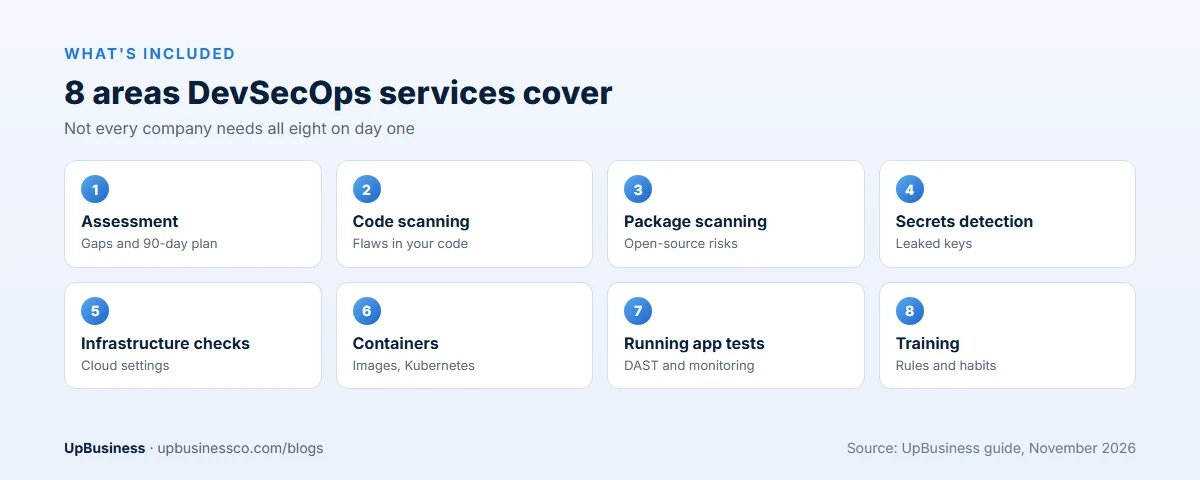
A complete DevSecOps service covers eight areas. Not every company needs all eight on day one.
| Area | What it catches | Common tools |
|---|---|---|
| 1. Assessment and roadmap | Gaps in your current pipeline, cloud and policies | Interviews, NIST SSDF or OWASP checklists |
| 2. Code scanning (SAST) | Flaws like SQL injection in your own code | Semgrep, SonarQube, CodeQL |
| 3. Dependency scanning (SCA) | Known flaws in open-source packages; licence risks | Dependabot, OWASP Dependency-Check, Snyk |
| 4. Secrets detection | Passwords and API keys committed to code | Gitleaks, TruffleHog, GitHub secret scanning |
| 5. Infrastructure as code checks | Open storage buckets, wide firewall rules | Checkov, tfsec, cloud policy tools |
| 6. Container and Kubernetes security | Vulnerable base images, risky cluster settings | Trivy, Grype, Kubernetes admission policies |
| 7. Running app tests and monitoring (DAST) | Flaws visible only when the app runs; attacks in production | OWASP ZAP, cloud threat detection, logging |
| 8. Training and policies | Repeat mistakes; unclear rules on who fixes what | Secure coding sessions, fix-time rules |
Most of these tools have free, open-source versions. The cost of DevSecOps is mostly people: choosing tools, plugging them into your pipeline, tuning out false alarms and setting rules for what blocks a release. A pipeline that flags 400 issues on day one gets ignored. A good partner starts by blocking only critical issues and raises the bar over time.
A partner should also produce a software bill of materials (SBOM) for each release. It's a list of every package inside your software. Large customers and regulators now ask for one.
What a DevSecOps Assessment Covers
Most DevSecOps work starts with an assessment. It's the cheapest step, and it tells you where the real gaps are before you buy any tools. A good assessment takes two to three weeks and covers:
- Code and repositories: who can push code, whether changes need review, and whether secrets sit in the code history.
- Pipeline: which checks run on each change, who can change the pipeline, and whether builds can be traced to a commit.
- Open-source packages: how many you use, how old they are, and how many have known flaws today.
- Cloud and infrastructure: open storage, wide network rules, admin accounts without two-step sign-in, missing logs.
- Containers: base images, how often they're rebuilt, and who can deploy to production.
- Process: how flaws are reported, who fixes them, and how long fixes take.
The output should be a short risk list ranked by impact, a 90-day plan, and a rough cost for each step. If an assessment report is 80 pages of tool output with no priorities, it hasn't done its job.
Why Companies Are Buying DevSecOps Now
Three things are pushing demand. First, breaches are expensive. IBM's 2025 Cost of a Data Breach report puts the global average at $4.44 million[1]. Second, attackers keep going after software flaws and suppliers. Verizon's 2025 Data Breach Investigations Report found that exploiting vulnerabilities was the first step in 20% of breaches, and that third parties were involved in 30%[2].
Third, rules now ask for proof. The EU Cyber Resilience Act requires makers of software sold in the EU to report actively exploited vulnerabilities from 11 September 2026, with full obligations from 11 December 2027[3]. The US NIST Secure Software Development Framework, SP 800-218, is the standard that US federal software suppliers attest to[4]. Payment businesses must meet PCI DSS v4 secure development rules[5]. SOC 2 and ISO 27001 auditors want evidence of the same practices.
A DevSecOps pipeline produces much of that evidence automatically: scan reports, fix times, SBOMs and release approvals.
DevSecOps Service Models
| Model | What you get | Best for | Typical cost with an Indian partner |
|---|---|---|---|
| Assessment | Gap report, risk list, 90-day roadmap | First step, audits, board questions | $2,400 to $4,800 |
| Pipeline setup | Scans added to CI/CD for one product, tuned, documented | Teams with working CI/CD | $6,400 to $12,800 |
| Full implementation | All eight areas across several teams, plus policies and training | Companies preparing for SOC 2, ISO 27001 or the EU CRA | $24,000 to $60,000 |
| Managed DevSecOps | Partner runs tools, triages alerts, reports monthly | Teams without a security engineer | $1,600 to $4,800 a month |
| Dedicated engineer | One DevSecOps engineer in your team | Fast-growing teams | $5,000 to $8,000 a month |
These ranges use 60 to 1,500 partner hours at about $40 an hour. Commercial scanning tools are extra and are often priced per developer per month. Ask every partner to list tool licences separately.
How Much Do DevSecOps Services Cost?
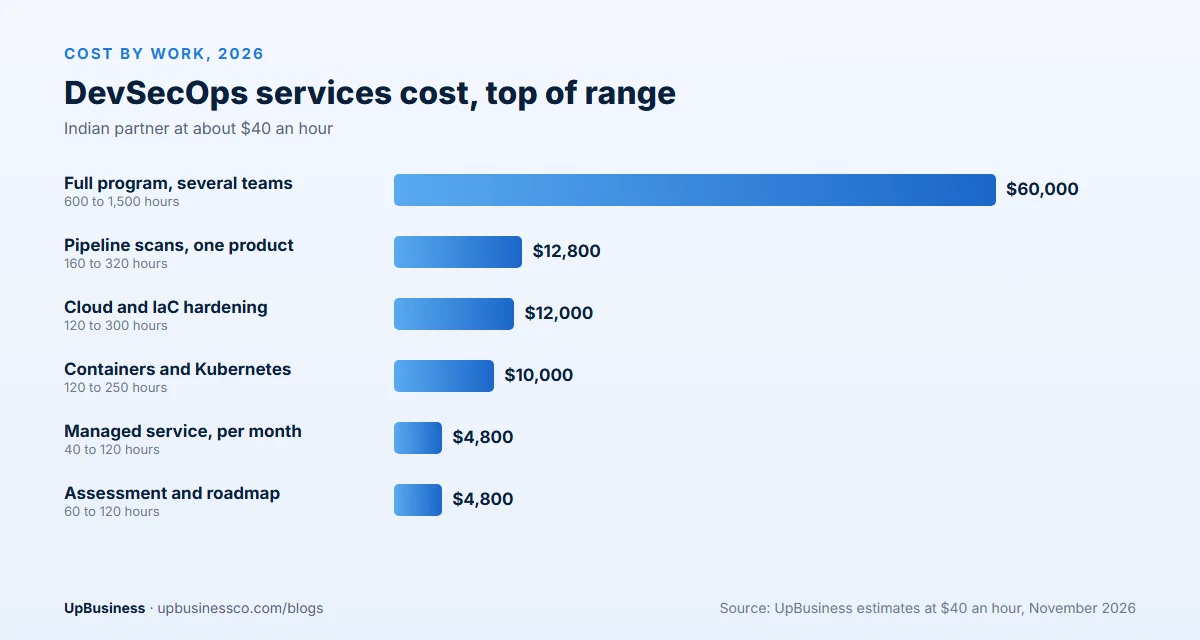
Price depends on how many code repositories and teams you have, which cloud you use, whether you run containers, and which audit or rule you need to meet. Here are typical hours by piece of work:
| Work | Hours | Indian partner at $40/h | At US GSA median $164/h |
|---|---|---|---|
| Assessment and roadmap | 60 to 120 | $2,400 to $4,800 | $9,840 to $19,680 |
| Pipeline scans for one product (SAST, SCA, secrets) | 160 to 320 | $6,400 to $12,800 | $26,240 to $52,480 |
| Cloud and infrastructure as code hardening | 120 to 300 | $4,800 to $12,000 | $19,680 to $49,200 |
| Container and Kubernetes security | 120 to 250 | $4,800 to $10,000 | $19,680 to $41,000 |
| Full program across several teams | 600 to 1,500 | $24,000 to $60,000 | $98,400 to $246,000 |
| Managed service, per month | 40 to 120 | $1,600 to $4,800 | $6,560 to $19,680 |
DevSecOps engineer rates
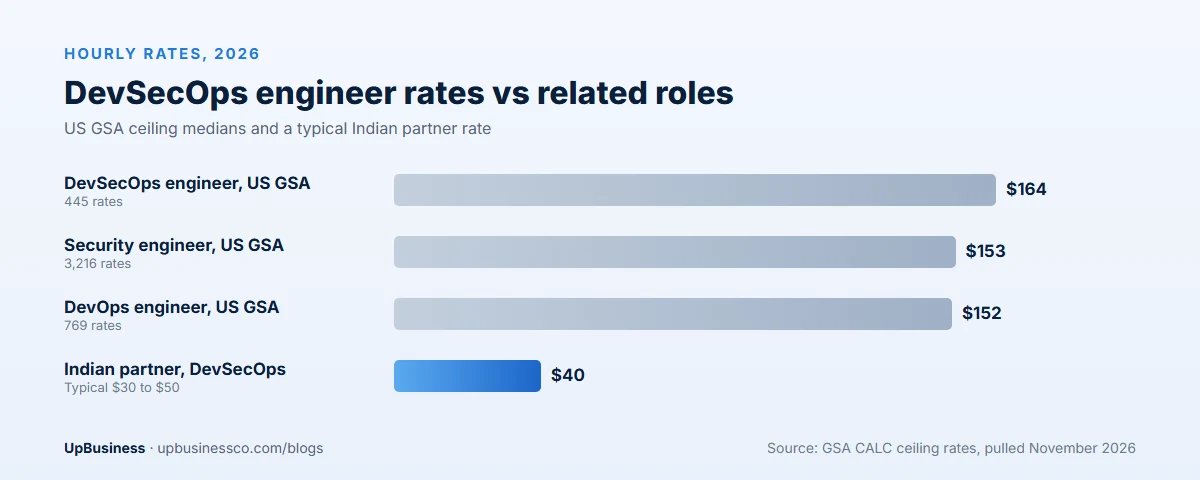
For a checkable US benchmark, we pulled the US government's GSA CALC database of contract rates in November 2026. These are ceiling rates, the maximum a contractor can charge US federal buyers[6].
| Role (GSA CALC, Nov 2026) | Rates | Median per hour | 0 to 4 years | 5 to 9 years | 10+ years |
|---|---|---|---|---|---|
| DevSecOps engineer | 445 | $164 | $143 | $171 | $218 |
| DevOps engineer | 769 | $152 | $130 | $160 | $202 |
| Security engineer | 3,216 | $153 | $131 | $160 | $188 |
DevSecOps engineers cost about 8% more than DevOps engineers at the median. Indian partner companies typically charge $30 to $50 an hour for the same work, depending on seniority and cloud certifications.
Worked Example: DevSecOps for a 25-Developer SaaS Company
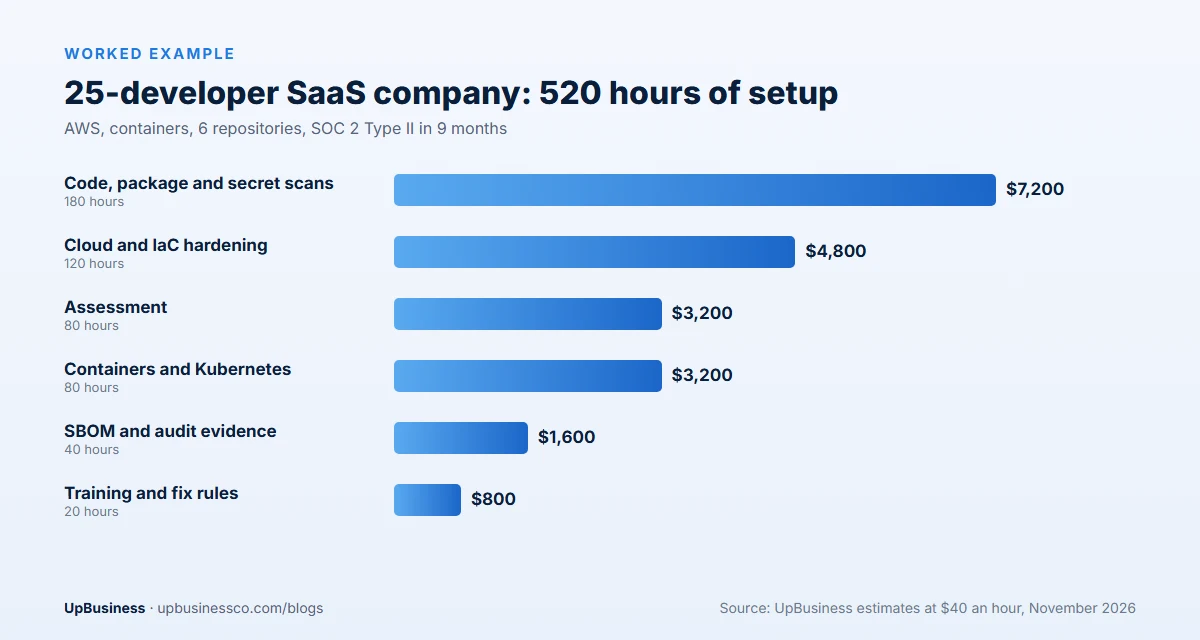
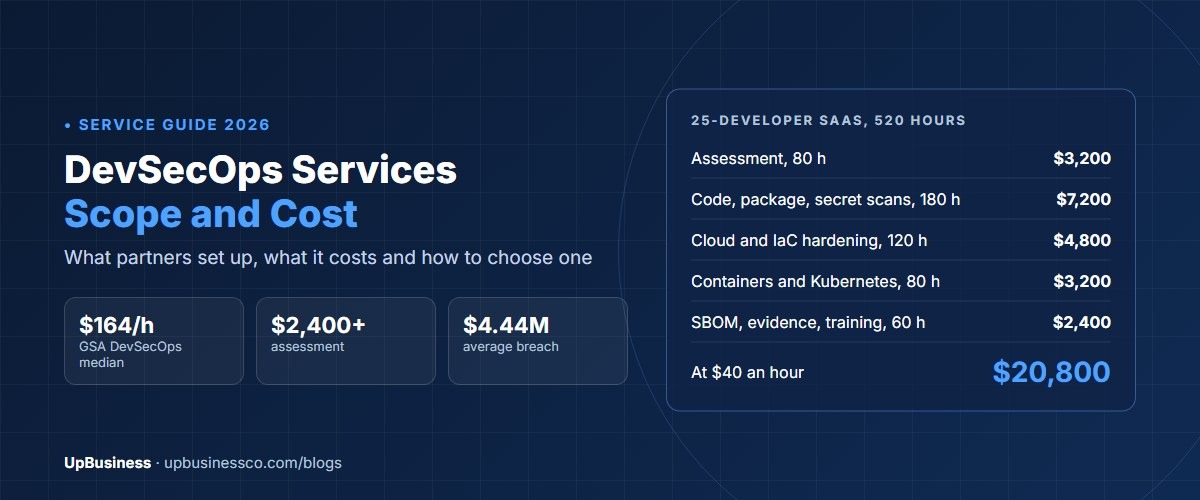
A SaaS company has 25 developers, 6 code repositories, runs on AWS with containers, and must pass a SOC 2 Type II audit in 9 months. Here's a realistic plan:
| Work | Hours | Cost at $40/h |
|---|---|---|
| Assessment against NIST SSDF and SOC 2 controls | 80 | $3,200 |
| Code, dependency and secrets scans in 6 repositories | 180 | $7,200 |
| Terraform and AWS hardening, policy as code | 120 | $4,800 |
| Container image scanning and Kubernetes policies | 80 | $3,200 |
| SBOM per release and audit evidence reports | 40 | $1,600 |
| Developer training and fix-time rules | 20 | $800 |
| Total setup | 520 | $20,800 |
After setup, a managed service of about 60 hours a month ($2,400) covers alert triage, tool updates and monthly reports for the auditor. The same 520 hours at the GSA DevSecOps median would be about $85,000.
Before the audit, pair the pipeline with an outside penetration test. Our VAPT testing cost guide shows what that costs. DevSecOps catches flaws continuously, while a penetration test checks the finished system the way an attacker would. You need both.
In-House Team vs DevSecOps Partner
You can hire DevSecOps engineers yourself, or buy the work from a partner. Here's how the two compare for a company with 20 to 50 developers.
| In-house | Partner | |
|---|---|---|
| Yearly cost | One US security analyst: median pay $124,910, before benefits and tools | Setup $10,000 to $35,000, then $19,000 to $58,000 a year managed |
| Time to start | 2 to 4 months to hire | 2 to 4 weeks |
| Knowledge of your product | Deep, over time | Grows during the contract |
| Range of experience | One person's background | Patterns from many clients |
| Risk | Single point of failure if they leave | Depends on the contract and handover |
The US pay figure is the median for information security analysts from the Bureau of Labor Statistics[7]. Many companies use both: a partner sets up the pipeline and trains the team, then one internal engineer owns it, with the partner on a small monthly retainer for reviews and upgrades.
DevSecOps Metrics to Ask For
Ask your partner to report these numbers every month. They show whether security is getting better or just generating alerts.
| Metric | What it shows | Good direction |
|---|---|---|
| Open critical and high flaws | Current risk in your code and packages | Falling month on month |
| Time to fix critical flaws | How fast the team responds | Under 15 days, ideally under 7 |
| Secrets found in new code | Whether developer habits have changed | Close to zero |
| Share of repositories scanned | Coverage of the program | 100% |
| False alarm rate | Whether developers trust the tools | Falling after tuning |
| Releases blocked, and why | Whether rules are too strict or too loose | Few blocks, each with a clear reason |
A 90-Day DevSecOps Rollout Plan
- Days 1 to 15: assess. List repositories, pipelines, cloud accounts and current tools. Agree which rule or audit you're working toward.
- Days 16 to 45: scan in report-only mode. Add secrets, dependency and code scans. Don't block releases yet. Clean up false alarms.
- Days 46 to 75: block critical issues. Releases with critical flaws or leaked secrets stop. Add infrastructure and container checks.
- Days 76 to 90: measure and hand over. Track how long fixes take, produce SBOMs, train developers and document who owns what.
How to Choose a DevSecOps Partner
Ask every partner these questions, and get the answers in writing:
- Which of our pipelines and clouds have you secured before? Ask for two past projects on the same CI tool and cloud.
- How do you handle false alarms? A good answer includes tuning rules and a report-only start.
- Which tools are open-source and which need licences? And who pays for them.
- Will you fix the flaws you find, or only report them? Many quotes exclude code fixes.
- What evidence will we get for our auditor? Ask for a sample monthly report.
- Who gets access to our code and cloud, and how? Expect named people, least-privilege roles and access removed at the end.
- Do you follow a framework? NIST SSDF and the OWASP DevSecOps Guideline are common[8].
Put access rules, confidentiality and ownership of all scripts and pipeline code in the contract. Our software development contract checklist lists the clauses.
Red Flags in DevSecOps Proposals
- "We'll install a tool." Tools without tuning and process just make noise.
- No mention of false alarms. Developers will learn to ignore the scanner.
- Blocking every issue from day one. Releases stop and the team turns the scans off.
- Tool licences hidden in the monthly fee. You can't compare quotes or switch partners later.
- Shared admin accounts. Every person should have their own access that you can remove.
- No exit plan. Pipeline code and policies must stay with you if you end the contract.
A strong proposal does the opposite. It names the repositories and clouds in scope, lists every tool with its licence cost, starts in report-only mode, sets a date for blocking critical issues, and shows a sample monthly report. If two proposals have the same price, pick the one that explains how developers will be trained to fix what the scans find.
DevSecOps for AI and LLM Applications
If your product uses large language models, the pipeline needs a few extra checks. Model files and AI packages are open-source dependencies too, so scan them like any other. Keep API keys for AI providers out of code and rotate them. Test prompts and outputs for leaks of personal data, and log what the model was asked and what it answered, so you can investigate problems later. Add checks that block a release if test prompts start returning data they shouldn't. Most DevSecOps partners can add these to the same pipeline in 20 to 60 extra hours. Our LLM security checklist lists the risks to cover.
DevSecOps vs Cybersecurity Consulting vs Penetration Testing
| Service | Focus | How often | Read more |
|---|---|---|---|
| DevSecOps services | Security inside the build and release process | Every code change | This guide |
| Cybersecurity consulting | Company-wide risk, policies, networks, people | Ongoing or yearly | Cybersecurity consulting guide |
| Penetration testing (VAPT) | Attack the finished system to find holes | Once or twice a year, and before big launches | VAPT cost guide |
| Managed cloud services | Running and patching your cloud | Ongoing | Managed cloud services guide |
If you build SaaS products, our SaaS security checklist covers the risks specific to them.
Find DevSecOps Help on UpBusiness
UpBusiness lists verified partner companies, mostly based in India and serving buyers worldwide. Every company has passed checks reviewed by our team: company details, registration and tax papers, the founder's identity, expertise and three client projects with evidence. Only companies with a TrustScore of 70 or more are listed.
On our DevOps companies page, SPEQTO Technologies, Dextrous Infosolutions and Dexinprime Technologies list DevOps among their services. None names DevSecOps as a separate service yet, so ask each for two past projects where they added security scans to a pipeline.
- Post your requirement with your cloud, CI tool, team size and audit goal.
- Get three partner companies matched to your budget, service and industry.
- Send each the same questions from this guide and compare answers side by side. Buyers pay nothing, and there's no commission on the project.