

Browse our curated list of Digital Marketing Companies
Here's how to measure marketing ROI: take the gross profit your marketing brought in, subtract the full marketing cost, and divide by that cost. The formula is marketing ROI = (gross profit from marketing − marketing cost) ÷ marketing cost × 100. Count every cost: ad spend, agency fees, tools, content and staff time. Then check how much of the result your marketing actually caused, not just what it touched.
This guide is for founders, marketing heads and finance teams who pay for marketing, often through an agency. It covers the main formulas, three worked examples and ROI by channel. You also get Excel formulas, what a good ROI looks like, and how to measure ROI now that AI answers are changing search. It sits next to our guide to marketing attribution models, which covers how to split credit between channels.
Key takeaways
- Measure ROI on gross profit, not revenue. On revenue, a campaign can show 271% ROI while it earns only 48% on profit, as our first example shows.
- Your break-even ROAS is 1 divided by your gross margin. At a 40% margin you need $2.50 of sales for every $1 of ad spend just to break even, before agency fees.
- Platform reports count sales that would have happened anyway. Holdout tests, such as Google Ads Conversion Lift, show the extra sales your ads caused.
- Match the time window to the channel. Paid ads can be judged in weeks. SEO and content need 6 to 12 months.
What Marketing ROI Means
ROI stands for return on investment. Marketing ROI, also called ROMI (return on marketing investment), shows how much profit your marketing earned for each dollar it cost. An ROI of 100% means every $1 spent brought back $2 of gross profit: the $1 you spent plus $1 more. An ROI of 0% means you broke even. A negative ROI means the marketing cost more than it earned.
Finance teams like ROI because it puts marketing on the same scale as any other spend, such as a new machine or a new hire. That only works if marketing measures it the same way finance does, with profit and the full cost.
How to Measure Marketing ROI in Six Steps
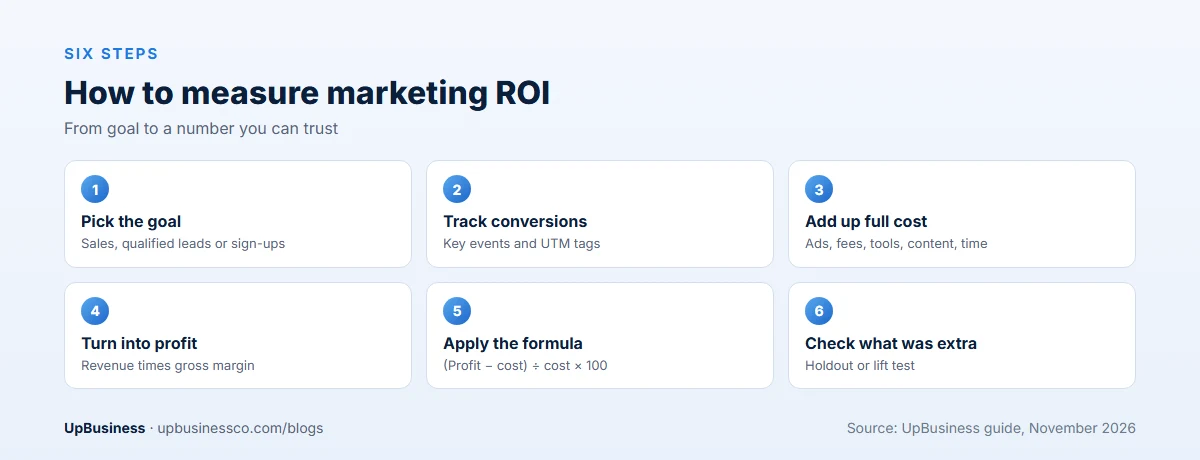
- Pick the goal. Sales, qualified leads or sign-ups. Decide what one conversion is worth to you.
- Track every conversion. Set up key events in Google Analytics and tag every campaign link with UTM codes.
- Add up the full cost. Ad spend, agency and freelancer fees, tools, content, and the time your own team spends.
- Turn results into gross profit. Multiply revenue by your gross margin. For leads, use your close rate and deal size.
- Apply the formula. ROI = (gross profit − cost) ÷ cost × 100, over a time window that suits the channel.
- Check what was extra. Use a holdout test or a before-and-after comparison to see how much your marketing really added.
Marketing ROI Formulas You Need
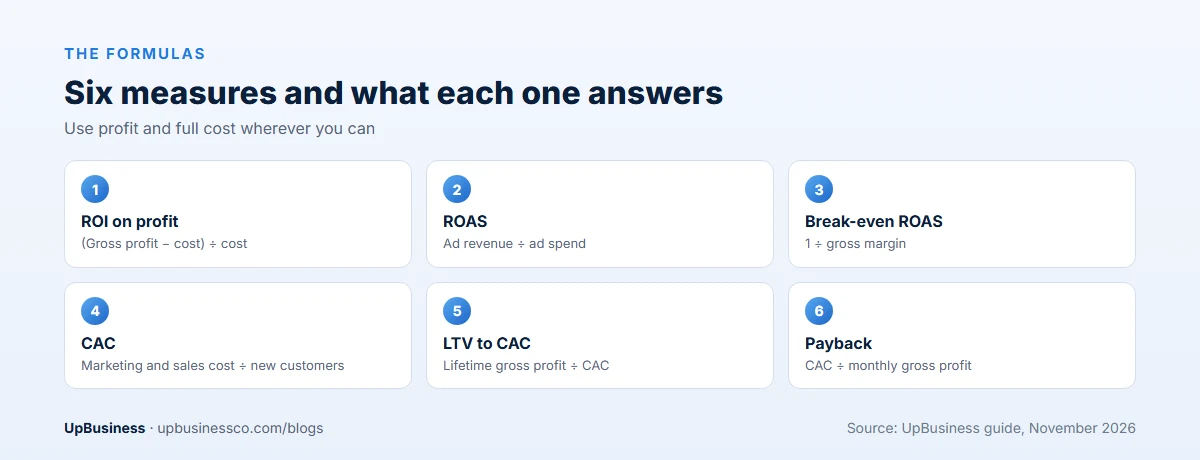
Most guides give one formula. In practice you need five, because each answers a different question.
| Measure | Formula | What it tells you |
|---|---|---|
| Marketing ROI (profit) | (Gross profit − marketing cost) ÷ marketing cost × 100 | Did marketing make money after all costs? |
| Simple ROI (revenue) | (Revenue − marketing cost) ÷ marketing cost × 100 | A quick view, but it overstates the return |
| ROAS | Revenue from ads ÷ ad spend | How hard each ad dollar works |
| Break-even ROAS | 1 ÷ gross margin | The lowest ROAS that doesn't lose money |
| Customer acquisition cost (CAC) | Marketing and sales cost ÷ new customers | What one new customer costs you |
| LTV to CAC | Customer lifetime gross profit ÷ CAC | Whether customers are worth what you pay to win them |
| Payback period | CAC ÷ monthly gross profit per customer | How many months until a customer pays back |
Why profit and not revenue? Revenue includes the cost of the product itself. If you sell a $100 item that costs you $60 to make and ship, only $40 is left to pay for marketing. A revenue-based ROI ignores that, so it can look healthy while the business loses money on every sale.
ROAS and ROI are often mixed up. ROAS uses revenue and ad spend only. ROI uses profit and the full cost, including the agency. A 4x ROAS can still be a loss if your margin is thin and the fees are high.
Worked Example 1: An Online Store Running Google Ads
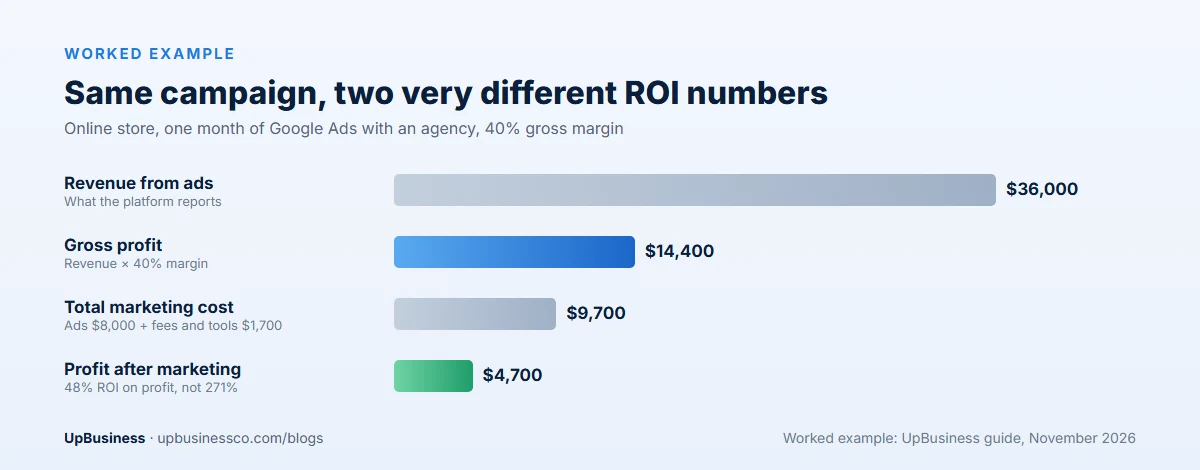
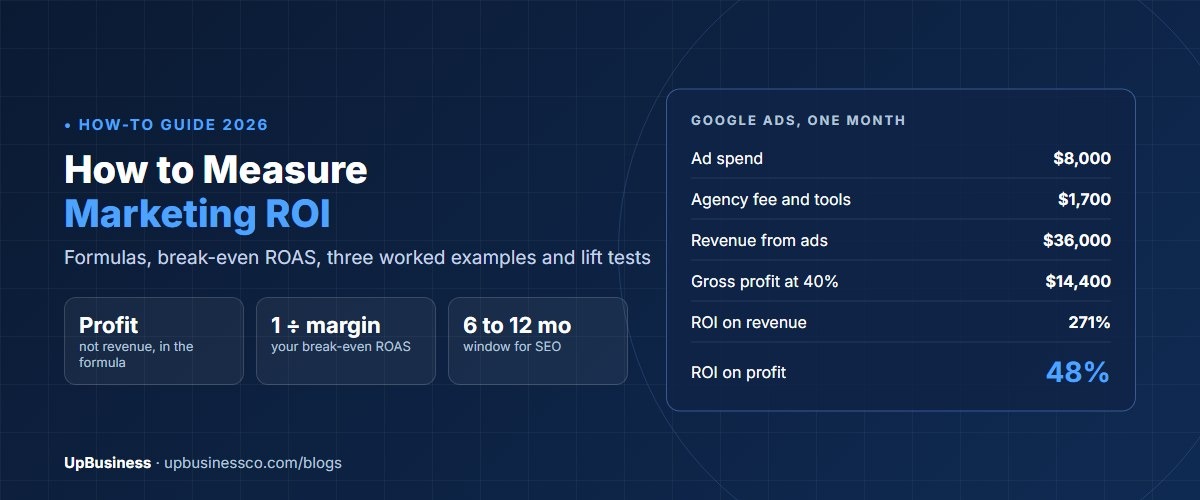
Say an online store spends one month on Google Ads with an agency.
| Item | Amount |
|---|---|
| Ad spend | $8,000 |
| Agency management fee | $1,500 |
| Tools and feeds | $200 |
| Total marketing cost | $9,700 |
| Revenue from the ads | $36,000 |
| Gross margin | 40% |
| Gross profit from the ads | $14,400 |
Now the numbers. ROAS is $36,000 ÷ $8,000 = 4.5. Simple ROI on revenue is ($36,000 − $9,700) ÷ $9,700 = 271%. That looks great. But ROI on profit is ($14,400 − $9,700) ÷ $9,700 = 48%. Still good, but a very different story.
The break-even point matters too. At a 40% margin, break-even ROAS on ad spend alone is 1 ÷ 0.40 = 2.5. Once you add the $1,700 of fees and tools, the store needs $9,700 ÷ 0.40 = $24,250 in sales to break even. That's a ROAS of about 3.0 on the $8,000 of ad spend. Any month below that loses money, even though the ad platform shows a "positive" ROAS.
Paying an agency for paid ads? Our guides to Google Ads management cost and Meta ads cost show what fees to expect. Plug those real numbers into this sum.
Worked Example 2: A B2B Company Paying for SEO
B2B marketing rarely sells online. It produces leads, and sales closes them weeks later. So you work from leads to customers to profit.
| Item | Amount |
|---|---|
| SEO retainer, 12 months at $2,500 | $30,000 |
| Extra content and design | $6,000 |
| Total marketing cost | $36,000 |
| Qualified leads from organic search | 200 |
| Close rate | 10%, so 20 new customers |
| Average first-year contract | $9,000 |
| Gross margin | 70% |
| First-year gross profit | 20 × $9,000 × 70% = $126,000 |
First-year ROI is ($126,000 − $36,000) ÷ $36,000 = 250%. CAC is $36,000 ÷ 20 = $1,800 per customer. Each customer brings $9,000 × 70% ÷ 12 = $525 of gross profit a month, so payback takes $1,800 ÷ $525 = about 3.4 months. If customers stay three years on average, lifetime gross profit is $18,900, and LTV to CAC is 10.5 to 1.
Two cautions. SEO results build slowly, so judge it after 6 to 12 months, not in month two. And make sure your CRM records where each lead came from, or you'll be guessing. Our SEO agency pricing guide and B2B lead generation agency guide cover what these services cost.
Worked Example 3: Measuring the Extra Sales, Not All Sales
Platform reports give your marketing credit for sales it touched. Some of those buyers would have bought anyway. The sales your marketing actually caused are called incremental sales, and they're what ROI should be based on.
Say an email campaign to past customers shows $50,000 in sales. You held back 10% of the list as a control group and sent them nothing. People in the control group bought at 60% of the rate of people who got the email. So only 40% of the email sales were extra: $20,000.
| Reported | Incremental | |
|---|---|---|
| Sales credited to the email | $50,000 | $20,000 |
| Gross profit at 50% margin | $25,000 | $10,000 |
| Campaign cost | $3,000 | $3,000 |
| ROI on profit | 733% | 233% |
Both numbers are real, but they answer different questions. 733% says how much the email touched. 233% says what it was worth. The second is the one to use when you decide where the next dollar goes.
You can run the same test on paid ads. Google Ads Conversion Lift splits your audience into people who see your ads and a control group who don't, then measures the difference in conversions[1]. It isn't available on every account. Smaller advertisers can pause ads in a few matched cities or regions for a few weeks and compare sales with the regions where ads kept running.
How to Calculate Marketing ROI in Excel
Put your inputs in column B, one per row, and the formulas in the rows below:
| Cell | What goes in it | Example |
|---|---|---|
| B2 | Revenue from marketing | 36000 |
| B3 | Gross margin as a decimal | 0.40 |
| B4 | Total marketing cost | 9700 |
| B5 | Ad spend only | 8000 |
| B6 | Marketing ROI on profit | =(B2*B3-B4)/B4 |
| B7 | ROAS | =B2/B5 |
| B8 | Break-even ROAS on ad spend | =1/B3 |
| B9 | Break-even revenue | =B4/B3 |
Format B6 as a percentage. Copy the block across columns to compare months or channels side by side. For B2B, add rows for leads, close rate and deal size, and work out revenue as leads × close rate × deal size.
How to Measure ROI by Channel
Each channel needs its own time window and its own idea of what counts as a result. Here's a practical starting point:
| Channel | Count as cost | Count as return | Judge it after |
|---|---|---|---|
| Google Ads and PPC | Ad spend, agency fee, landing pages | Profit from tracked sales or leads | 2 to 4 weeks |
| Meta and social ads | Ad spend, creative, agency fee | Profit from tracked sales; check with a lift test | 2 to 6 weeks |
| SEO | Retainer, content, technical fixes | Profit from organic leads and sales | 6 to 12 months |
| Content marketing | Writing, design, promotion | Leads and sales from content pages, assisted sales | 6 to 12 months |
| Email marketing | Platform, design, writing | Extra sales against a holdout group | Each campaign |
| Influencer marketing | Fees, free products, agency fee | Sales from unique codes and links | 4 to 8 weeks |
| Organic social media | Staff or agency time, content | Tracked leads, plus brand search growth | 3 to 6 months |
Influencer and social media are the hardest to track, because many people see a post on their phone and buy later on a laptop. Give each influencer a unique discount code and link, and ask new customers how they found you. For content, look at "assisted" conversions in your analytics too, since content often starts a purchase that another channel finishes. Our content marketing agency pricing guide and email marketing agency guide show typical costs for those channels.
Set Up Tracking Before You Measure
No formula helps if the data is wrong. Before you judge any campaign, check these four things:
- Key events in Google Analytics. GA4 now calls the actions you count, such as a purchase or a form sent, "key events"[2]. Mark only real business actions, not page views.
- UTM tags on every link. Add source, medium and campaign tags to every ad, email and social link. Google's URL builder makes them[3].
- Lead source in your CRM. Save the UTM data with each lead, so you can link closed deals back to campaigns weeks later.
- One attribution model, used every time. GA4 offers three: data-driven, paid and organic last click, and Google paid channels last click[4]. Pick one and stick with it, or month-to-month numbers won't compare.
Choosing between models is a topic of its own. Our marketing attribution models guide explains each one and when to use it.
What Is a Good Marketing ROI?
A good marketing ROI is any return on profit above zero that beats what the same money would earn elsewhere in your business. There's no single number for every company, because it depends on your margin.
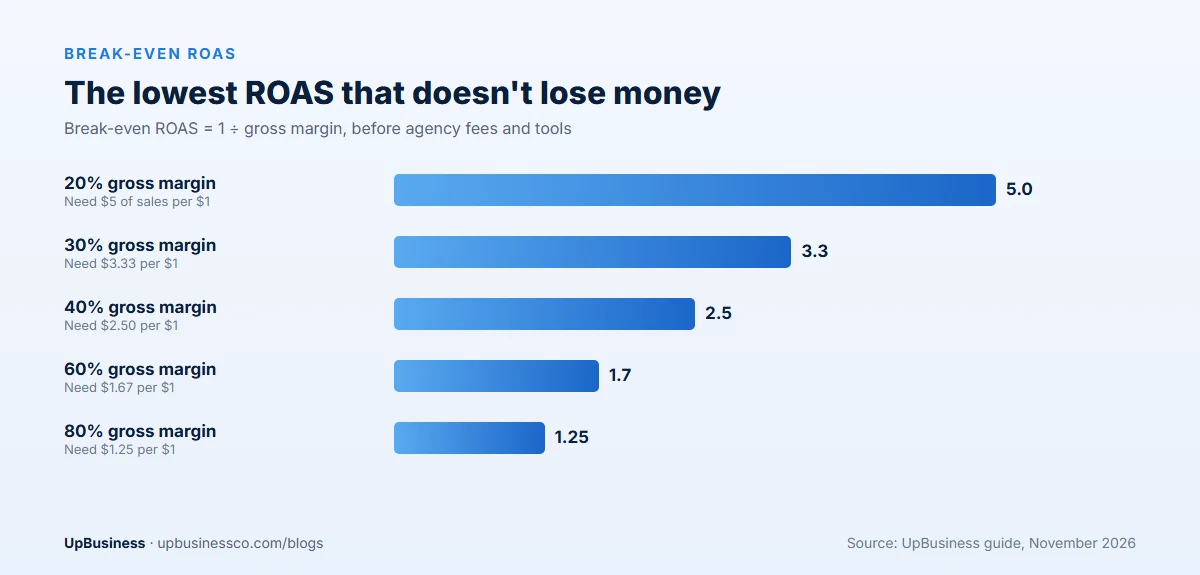
You'll often see a "5 to 1" rule: $5 of revenue for every $1 of marketing. Check it against your margin before you trust it. At a 20% gross margin, $5 of sales makes only $1 of profit, which is exactly break-even. At a 60% margin, the same 5 to 1 makes $3 of profit for every $1 spent, a 200% ROI. So work out your own target:
| Gross margin | Break-even ROAS | Revenue per $1 for 100% ROI |
|---|---|---|
| 20% | 5.0 | $10.00 |
| 30% | 3.3 | $6.67 |
| 40% | 2.5 | $5.00 |
| 60% | 1.7 | $3.33 |
| 80% | 1.25 | $2.50 |
For B2B and subscription businesses, LTV to CAC is often the better test. A ratio of 3 to 1 or higher is a common target, and a payback period under 12 months keeps cash flow safe. Treat both as rules of thumb, not laws.
How Often Should You Measure Marketing ROI?
Look at it on three time scales, each for a different decision:
- Weekly: spend, cost per lead and ROAS for paid ads. This catches problems early, such as a broken form or a campaign spending on the wrong searches.
- Monthly: full ROI on profit for each channel, with agency fees and tools included. This is where you move budget between channels.
- Quarterly or yearly: ROI for slow channels like SEO and content, LTV to CAC, and a holdout or lift test. This is where you decide what to keep, grow or stop.
Keep the same formulas, cost list and attribution model across every report. A change in method can look like a change in results, and that leads to bad budget calls.
Common Marketing ROI Mistakes
- Using revenue instead of profit. It makes thin-margin products look far better than they are.
- Leaving out costs. Agency fees, tools, content and your own team's time all belong in the cost.
- Trusting platform numbers alone. Google and Meta each count the same sale when both ads were seen. Add them up and you can get more sales than you made.
- Judging slow channels too early. Cutting SEO after three months often throws away work that was about to pay off.
- Ignoring repeat purchases. First-order ROI can look weak for products people buy again and again.
- Counting brand searches as paid wins. People who search your company name often would have found you anyway.
How to Measure Marketing ROI When AI Changes Search
More buyers now get answers from AI tools and AI summaries in search, and some never click a link. That makes last-click tracking miss part of what your content and SEO do. Four habits help:
- Add a "How did you hear about us?" field to forms and sales calls. Self-reported answers catch AI tools, podcasts and word of mouth.
- Watch branded search and direct visits over time. Growth there often follows content and PR work.
- Check referral traffic from AI tools such as ChatGPT and Perplexity in your analytics.
- For larger budgets, use a marketing mix model. It estimates each channel's effect from spend and sales over time, without tracking users. Google's Meridian[5] and Meta's Robyn[6] are free, open-source options, though both need a data analyst to run.
How to Hold a Marketing Agency to ROI
Most of our buyers measure ROI because they pay an agency. Agree on these points before you sign:
| Agree on | Good answer | Warning sign |
|---|---|---|
| Main result | Profit, qualified leads or sales | Clicks, reach or impressions only |
| Cost in the ROI sum | All costs, including their own fee | Ad spend only |
| Data source | Your Google Analytics and CRM | Their own dashboard only |
| Account ownership | Ad and analytics accounts in your name | Accounts in the agency's name |
| Reporting | Monthly report with ROI, ROAS and CAC | A screenshot of platform numbers |
| Testing | A holdout or lift test at least once a year | No way to check extra sales |
An agency that resists any of these is worth a second look. Our list of digital marketing agency red flags covers more warning signs. For fee levels, see our guides to digital marketing cost and performance marketing agency pricing. If you want ROI reports built automatically, our marketing automation services guide explains the setup.
Find a Digital Marketing Partner on UpBusiness
UpBusiness lists verified partner companies, mostly based in India and serving buyers worldwide. Every company has passed checks reviewed by our team: company details, registration and tax papers, the founder's identity, expertise and three client projects with evidence. Only companies with a TrustScore of 70 or more are listed.
- Post your requirement with your channels, goals, budget and how you want ROI reported.
- Get three partner companies matched to your budget, service and industry.
- Compare them side by side on our digital marketing page and ask each to walk you through a real ROI report. Buyers pay nothing, and there's no commission on the project.