

Browse our curated list of AI Development Companies
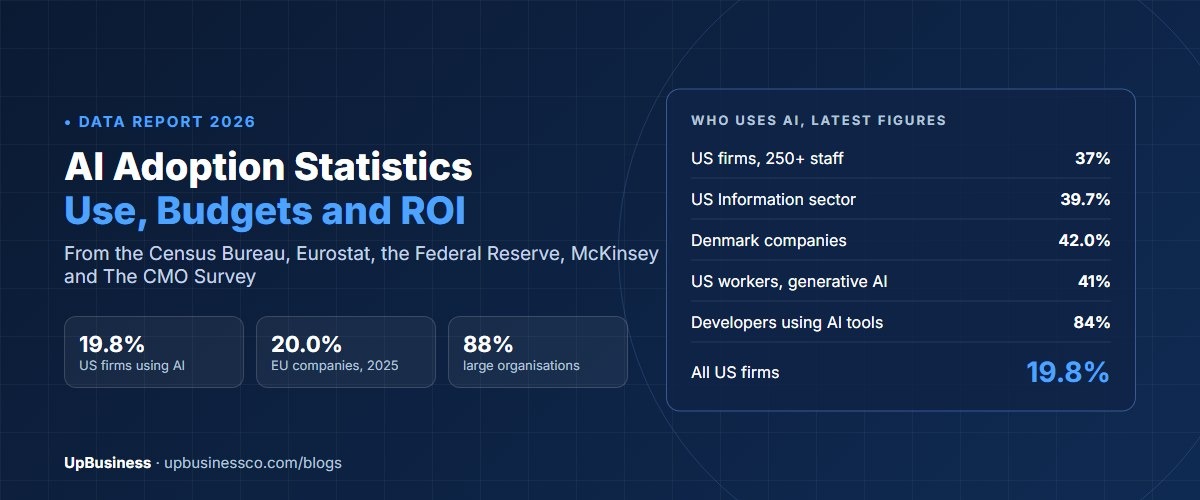
AI adoption statistics depend on who is counted. About one in five businesses now uses AI. The US Census Bureau puts it at 19.8% of US firms in May 2026. Eurostat puts it at 20.0% of EU companies with 10 or more staff in 2025. Among large companies, the share is far higher: McKinsey's 2025 survey found 88% of organisations use AI in at least one business function. But few have scaled it, and results vary widely.
This report is for founders, IT heads and operations leaders deciding whether and how to invest in AI. We pulled every figure from the original source, government statistics offices first, and we explain why the numbers differ so much. You'll find adoption by country, company size and industry, how workers use AI, what companies spend and what results they report.
Key takeaways
- About 18% to 20% of all US firms use AI, according to Census Bureau surveys. Larger firms use it far more: 37% of firms with 250 or more employees.
- In the EU, 20.0% of companies used AI in 2025, up from 13.5% in 2024 and 7.7% in 2021. Denmark led at 42.0%; Romania was lowest at 5.2%.
- Large companies are mostly testing, not scaling. 62% are at least experimenting with AI agents, but no more than 10% scale agents in any single function.
- In marketing, companies report AI raised sales productivity by 14.1% and cut overhead costs by 14.6% in 2026, according to The CMO Survey.
AI Adoption Statistics 2026: The Headline Numbers
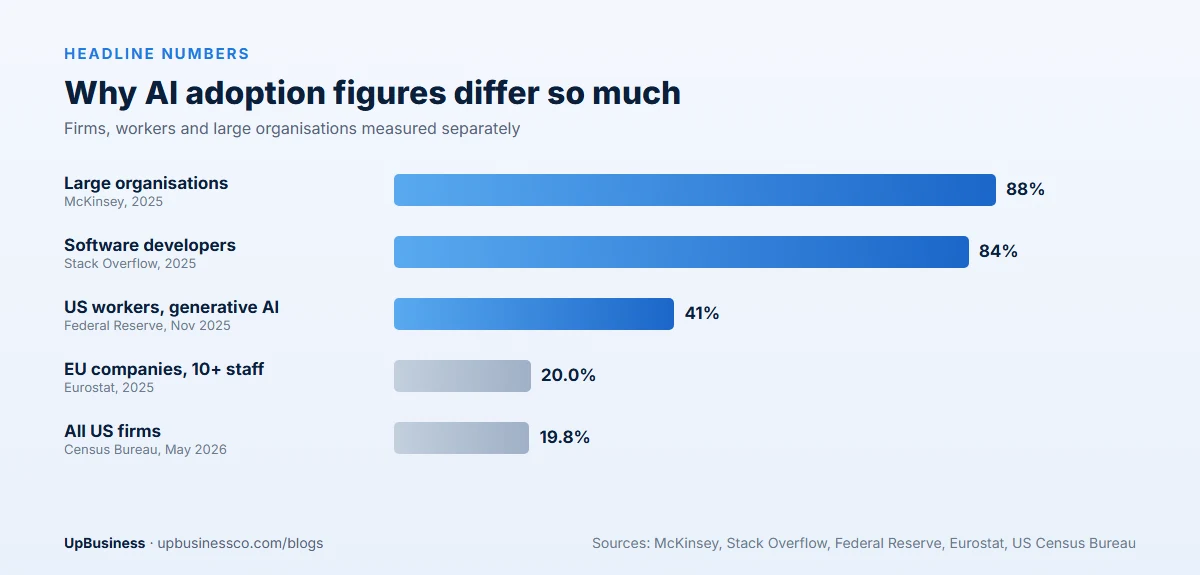
| Source | Who was counted | AI adoption figure |
|---|---|---|
| US Census Bureau, May 2026 | All US employer businesses | 19.8% used AI in the past two weeks |
| Federal Reserve note, April 2026 | US firms, Census data | About 18% at the end of 2025 |
| Eurostat, December 2025 | EU companies with 10 or more employees | 20.0% used AI in 2025 |
| McKinsey, November 2025 | Organisations of all sizes, 1,993 respondents | 88% use AI in at least one function |
| Federal Reserve note, April 2026 | US workers | About 41% use generative AI for work |
| Stack Overflow, 2025 | Software developers | 84% use or plan to use AI tools |
Why AI Adoption Numbers Disagree So Much
You'll see AI adoption quoted as 18%, 41%, 78% and 88%, sometimes in the same week. They're not all wrong. They measure different things.
- Firms or workers. The Census Bureau counts businesses. A worker survey counts people. Many people use ChatGPT at work even when their company has no AI plan.
- Small or large companies. Most businesses are small, and small firms use AI less. Surveys of big companies, like McKinsey's, find much higher rates.
- What counts as use. One survey counts any use in the past two weeks. Another counts regular use in at least one business function.
- When the question changed. The Census Bureau changed its question in late 2025, from AI used "in producing goods or services" to AI used "in any business function". Figures before and after aren't directly comparable[1].
The Federal Reserve showed how much this matters. A November survey of senior leaders found that 78% of the US labour force works at firms that have adopted AI. Yet only about 18% of firms use it[2]. Large employers adopt first, and they employ most workers.
AI Adoption Rate in the US
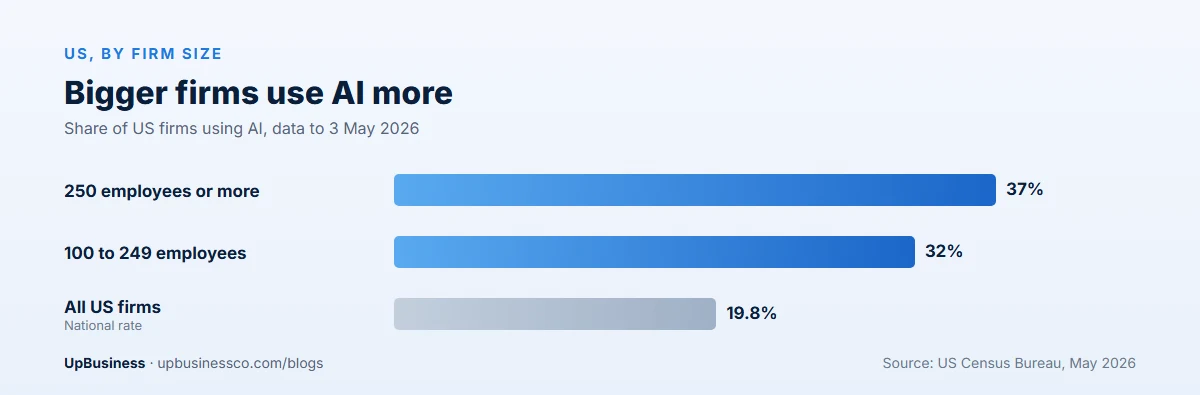
The US Census Bureau's Business Trends and Outlook Survey asks businesses every two weeks whether they used AI recently. Between December 2025 and May 2026, the share that did stayed between 17% and 20%. Another 20% to 23% expected to use AI within six months. As of 3 May 2026, the national rate was 19.8%[1].
Growth has been fast. The Federal Reserve found the Census adoption rate rose 68% in the year to September 2025, before the question changed. Growth had slowed in the second quarter of 2025[2].
AI adoption rate by firm size
| Firm size | Share using AI, data to 3 May 2026 |
|---|---|
| 250 employees or more | 37% |
| 100 to 249 employees | 32% |
| 4 employees or fewer | Less than 20% |
| All US firms | 19.8% |
Source: US Census Bureau[1]. Between December 2025 and May 2026, AI use rose among firms with 20 or more employees, but didn't change much among smaller ones. Small firms face the same problem every time: no spare staff to learn the tools, and no data team to connect them to existing systems.
AI adoption rate by industry
Two sectors stand well above the national 19.8%: Information, which includes software, media and telecoms, at 39.7%, and Finance and Insurance at 33.9%[1]. Both handle large amounts of text and data, which today's AI tools are best at.
AI Adoption in Europe and by Country
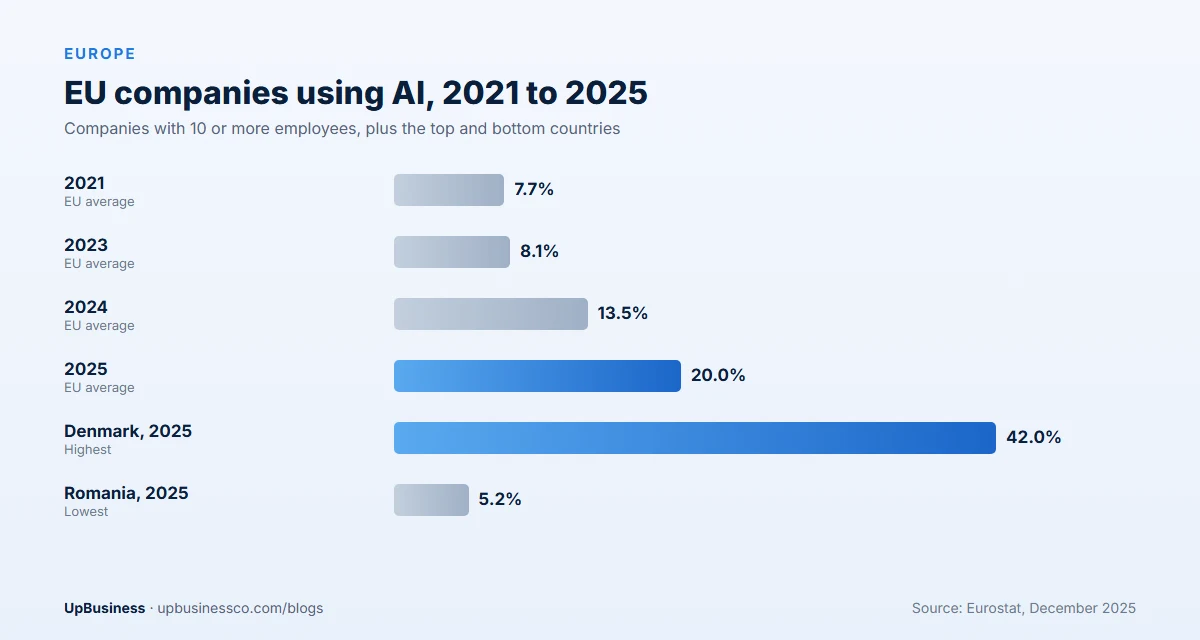
Eurostat surveys companies with 10 or more employees across the EU every year. In 2025, 20.0% used at least one AI technology, a jump of 6.5 percentage points in a year[3].
| Year | EU companies using AI |
|---|---|
| 2021 | 7.7% |
| 2023 | 8.1% |
| 2024 | 13.5% |
| 2025 | 20.0% |
The gap between countries is wide. Denmark led at 42.0%, followed by Finland at 37.8% and Sweden at 35.0%. At the other end were Romania at 5.2%, Poland at 8.4% and Bulgaria at 8.5%. Almost every country grew. Denmark grew the most, by 14.5 points in one year[3].
What did EU companies use AI for? The most common use was analysing written language, at 11.8% of companies. Next came generating pictures, video or audio (9.5%), generating written or spoken language (8.8%) and turning speech into text (7.2%)[3]. In plain terms, most business AI today reads, writes and summarises.
AI Adoption in Large Companies
McKinsey's survey of 1,993 people, run in June and July 2025 and published in November 2025, found that 88% of organisations regularly use AI in at least one business function, up from 78% a year earlier[4]. Its sample leans toward larger companies.
The same survey shows how early most of them still are:
- 62% are at least experimenting with AI agents, software that carries out multi-step tasks on its own.
- 23% are scaling agents somewhere in the business, but no more than 10% scale agents in any single function.
- 51% have seen at least one negative consequence from AI. The most common is inaccurate output, reported by 30%.
So "using AI" often means a few teams using a chatbot or a pilot project, not AI built into how the company runs. If you're comparing yourself with big companies, compare against what they've scaled, not what they've tried. Our guide to AI agent development explains what moving from a pilot to production involves.
How Many Workers Use AI?
People adopt AI faster than their companies do. About 41% of US workers used generative AI for work as of November 2025, the Federal Reserve reports. Growth was strongest in the most recent quarter[2].
Software developers are ahead of everyone. In the 2025 Stack Overflow survey, 84% of developers used or planned to use AI tools in their work, up from 76% a year earlier. 51% of professional developers use them daily[5].
That gap creates a risk. When staff use free AI tools on their own, company data can end up in places the company doesn't control. A clear policy on which tools staff may use, and with what data, is often the cheapest first AI project. Our LLM security checklist covers the main risks.
AI Budgets: How Much Companies Spend
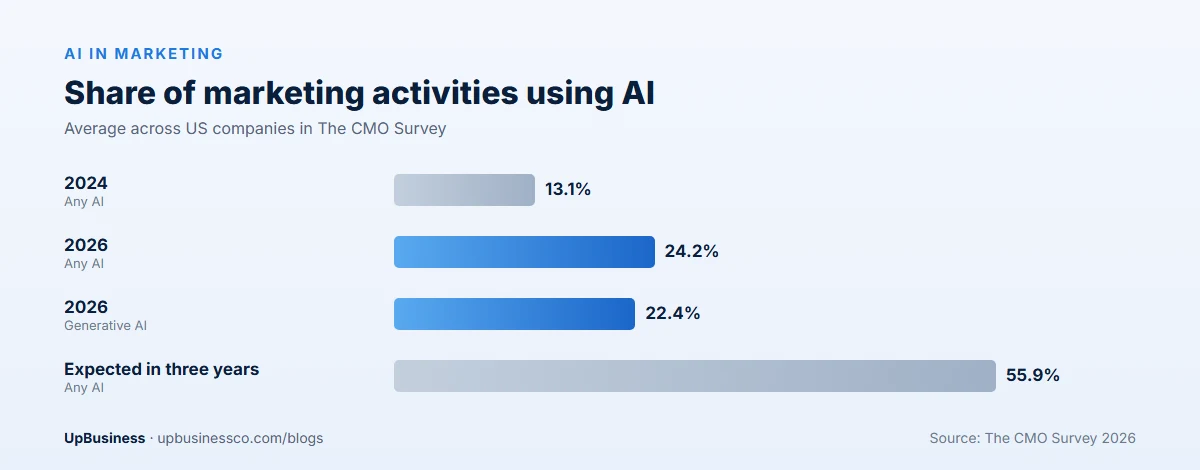
Marketing gives the clearest view of AI spending, because two large surveys track it.
- Gartner's 2026 CMO Spend Survey found marketing leaders put 15.3% of their marketing budgets toward AI[6].
- The CMO Survey found AI is now used in 24.2% of marketing activities, up from 13.1% in 2024. Generative AI rose from 7.0% to 22.4% over the same two years. Companies expect AI to cover 55.9% of marketing activities within three years[7].
Spending isn't the hard part, though. The CMO Survey asked what stops marketing technology from paying off. The top answers were lack of budget (20.1%), integration and data setup (19.1%), lack of time (14.1%) and talent (13.1%)[7]. Integration is where many AI projects stall. Our guide to AI integration services explains what that work involves.
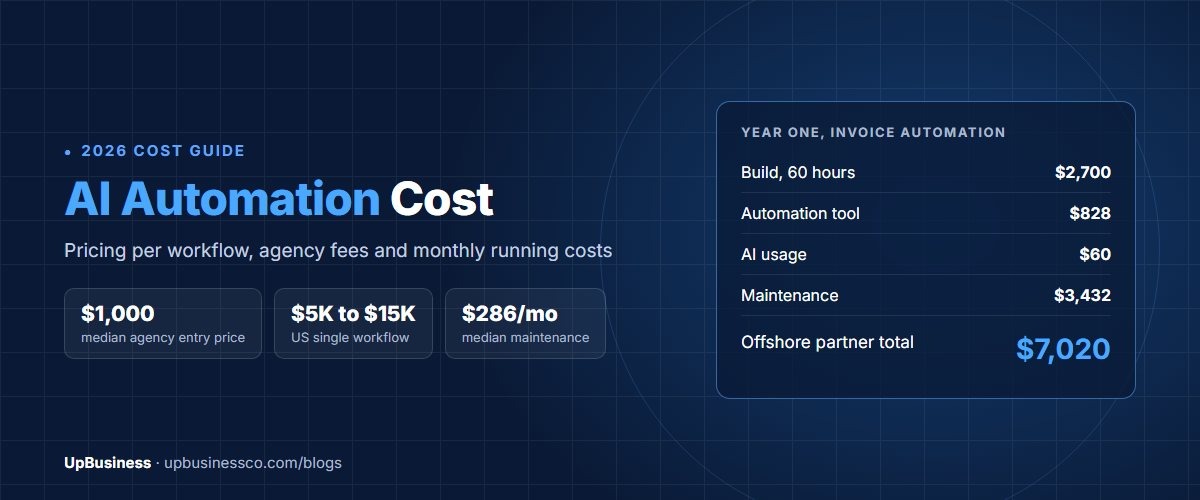
For project budgets, see our guides to AI automation cost and AI developer rates in India.
Where Companies Use AI Most
In marketing, The CMO Survey found the most common AI uses in 2026 were content creation (73.9% of companies), content personalisation (65.4%), automation (48.9%), data analysis (46.3%) and targeting (45.2%). A new one has appeared too: 41.5% already work on getting their content into AI-generated search answers[7].
Across the whole economy, the Eurostat data points the same way: most use is reading and writing text. Common business uses fall into five groups:
- Customer support. Chatbots and email drafting that answer common questions.
- Documents. Reading invoices, contracts and forms, and pulling out the data.
- Sales and marketing. Content drafts, personalised emails and lead scoring.
- Internal knowledge. Search across company files and policies.
- Operations. Forecasting, scheduling and spotting unusual transactions.
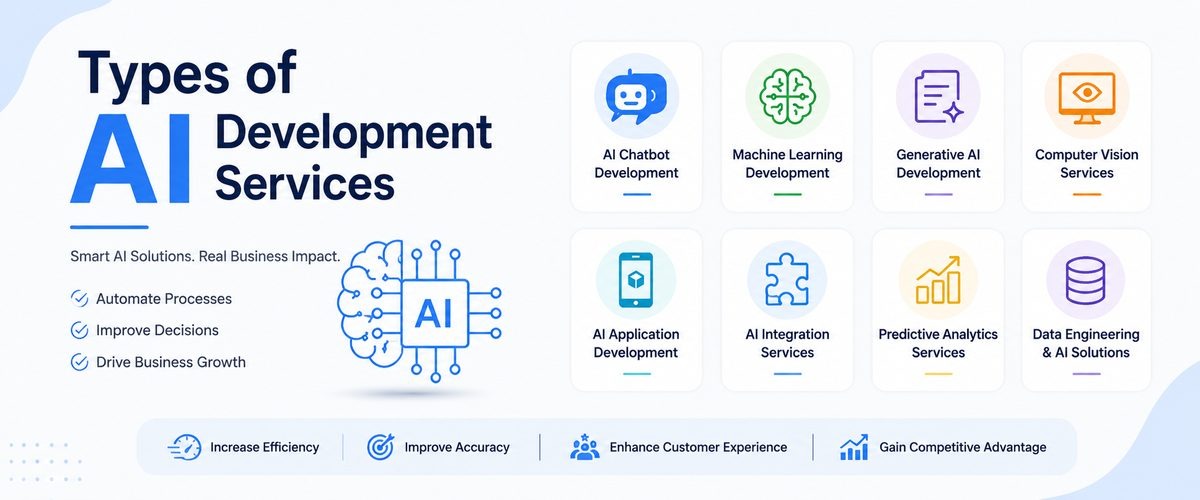
Our guide to types of AI development services explains each one, and AI in digital marketing covers the marketing side in depth.
AI ROI Statistics: What Results Companies Report
| Result of AI in marketing | 2025 | 2026 |
|---|---|---|
| Sales productivity | +8.6% | +14.1% |
| Customer satisfaction | +8.5% | +10.8% |
| Marketing overhead costs | −10.8% | −14.6% |
Source: The CMO Survey 2026, average improvement reported by companies using AI in marketing[7]. All three results improved from 2025 to 2026. B2B services firms reported the biggest gains.
Two cautions. First, these are what companies report, not audited results. Second, the same survey found no marketing technology activity scored above 5 on a 7-point performance scale, and scores haven't improved in two years. Companies are adopting faster than they're learning to use the tools well.
McKinsey's numbers point the same way. Most organisations use AI somewhere, but only a minority have scaled it, and half have seen a negative result such as wrong answers[4]. The return comes from fitting AI into a real workflow, with clean data and someone checking the output, not from the tool alone.
Why Some Companies Hold Back on AI
If AI helps, why do four in five firms still not use it? The surveys point to five reasons:
- Wrong answers. Inaccurate output is the most common bad result McKinsey found. Many firms won't let AI near customers until they trust it.
- Data and systems. AI needs clean data and links to the tools you already use. Integration is a top barrier in The CMO Survey.
- Budget. Lack of budget was the single most cited barrier in the same survey, at 20.1%.
- Skills and time. Small teams rarely have someone free to test tools, write rules and train others.
- Privacy and rules. Firms in finance, health and law worry about where their data goes and what regulators expect.
Each of these has a simple first step. Start with internal tasks, where a mistake is cheap. Use one approved tool with a clear data policy. Give one person a few hours a week to own the rollout. Small, safe wins build the trust that bigger projects need.
How Fast AI Adoption Is Growing
Every major survey shows the same direction. Here is how the main measures moved, using only the original sources:
| Measure | Earlier | Latest |
|---|---|---|
| EU companies using AI (Eurostat) | 7.7% in 2021 | 20.0% in 2025 |
| Organisations using AI in a function (McKinsey) | 78% in 2024 | 88% in 2025 |
| Developers using or planning AI tools (Stack Overflow) | 76% in 2024 | 84% in 2025 |
| Marketing activities using generative AI (CMO Survey) | 7.0% in 2024 | 22.4% in 2026 |
| US firms using AI (Federal Reserve on Census data) | Up 68% in the year to September 2025 | About 18% at the end of 2025 |
The EU share nearly tripled in four years. Generative AI in marketing more than tripled in two. Growth among the smallest firms is the one place it has stalled.
Expect the next round of figures to rise again. In the Census survey, more firms say they expect to use AI in six months than use it today. That gap has held for months, so adoption should keep climbing.
How to Measure AI Adoption in Your Own Company
National figures tell you where the market is. To manage your own rollout, track three simple numbers each month:
- Adoption rate. People who used an approved AI tool this month, divided by people who could use it. If 45 of 150 eligible staff used it, your adoption rate is 30%.
- Task coverage. Target tasks where AI is now part of the normal process, divided by all target tasks. If you picked 10 tasks and AI is built into 4, coverage is 40%.
- Value per task. Time or cost per task before and after. If a support reply took 8 minutes and now takes 5, you save 3 minutes on every reply.
Adoption without value is just activity. Value without adoption doesn't scale. You need both numbers going up. Add a quality check too, such as the share of AI output that needed fixing, because wrong answers are the most common problem companies report.
A practical target for a first project: half of the eligible team using the tool within three months, and a clear time or cost saving on the target task. If you can't get there, the tool or the task is probably the wrong fit.
What These Statistics Mean If You're Planning AI
- You're not late. Four in five businesses don't use AI yet. Starting now, with one well-chosen task, still puts you ahead of most.
- Start where AI is proven. Text-heavy, repetitive work, such as support emails, documents and content drafts, is where adoption and results are strongest.
- Plan for integration, not just a tool. Budget for connecting AI to your CRM, help desk or ERP. That's where projects stall.
- Measure before and after. Track time per task, cost per task or error rate before you start, so you can show a real return.
- Keep a person in the loop. Inaccurate output is the most common problem. Check AI work until you trust it.
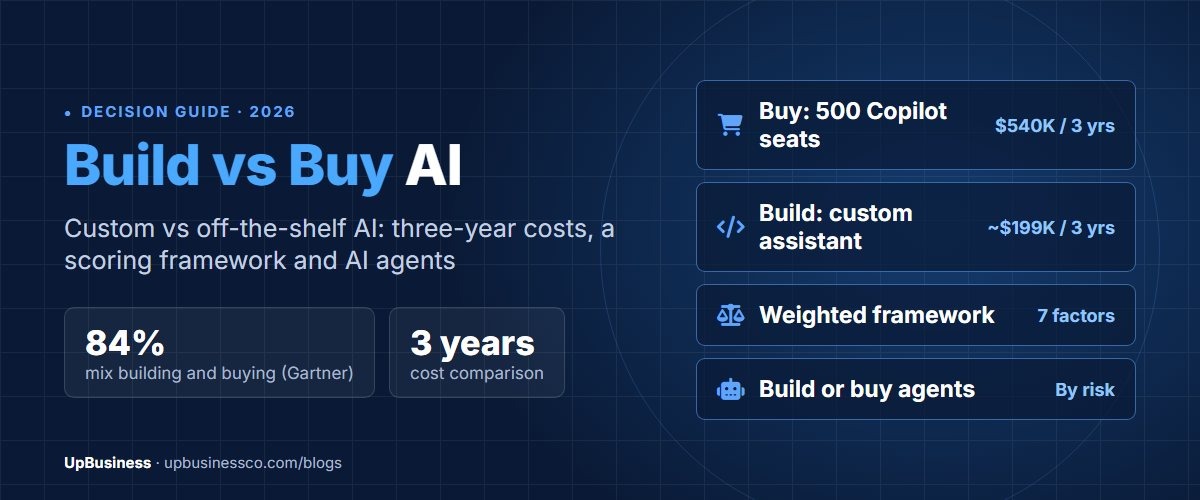
- Decide build or buy. Off-the-shelf tools suit common tasks. Custom AI suits work that's unique to your business. Our comparison of custom AI vs off-the-shelf AI helps you choose.
If you need outside help, an AI consulting partner can pick the first use case and estimate the return before you commit to a build. Before you sign, use our questions to ask an AI development company.
Find an AI Development Partner on UpBusiness
UpBusiness lists verified partner companies, mostly based in India and serving buyers worldwide. Every company has passed checks reviewed by our team: company details, registration and tax papers, the founder's identity, expertise and three client projects with evidence. Only companies with a TrustScore of 70 or more are listed.
- Post your requirement with the task you want AI to handle, your systems and your budget.
- Get three partner companies matched to your budget, service and industry.
- Compare them side by side on our AI development page, and ask each for a similar project they've delivered. Buyers pay nothing, and there's no commission on the project.