

Browse our curated list of Custom Software Development Companies
Insurance software development is building custom systems for insurers, brokers, agencies and insurtech startups: claims management, policy administration, quoting and rating, underwriting, agent portals and customer apps. With an Indian partner company at about $35 an hour, a focused tool such as a claims portal or agent app typically costs $21,000 to $60,000. A full claims system costs $42,000 to $105,000, and a policy administration system $70,000 to $175,000 or more. Security and regulation shape every project, so plan for them from day one.
This guide is for insurance companies, MGAs, brokers and insurtech founders deciding whether to build, buy or extend software. It covers the main types of insurance software and what each costs, with a worked example. It also covers the rules your partner must follow, the systems you will need to connect, and how to choose a company.
Key takeaways
- Most insurers don't rebuild everything. They buy a core platform and build custom portals, apps, integrations and automation around it.
- In the US, an NAIC model law requires a written security plan and checks on outside providers. In certain cases, insurers must tell the regulator within 72 hours of a cybersecurity event.
- In the EU, the Digital Operational Resilience Act has applied to insurers since 17 January 2025, including rules on outside technology providers.
- Estimated build cost at $35 an hour: $21,000 to $42,000 for a customer self-service app, up to $175,000 or more for a policy administration system.
Types of Insurance Software
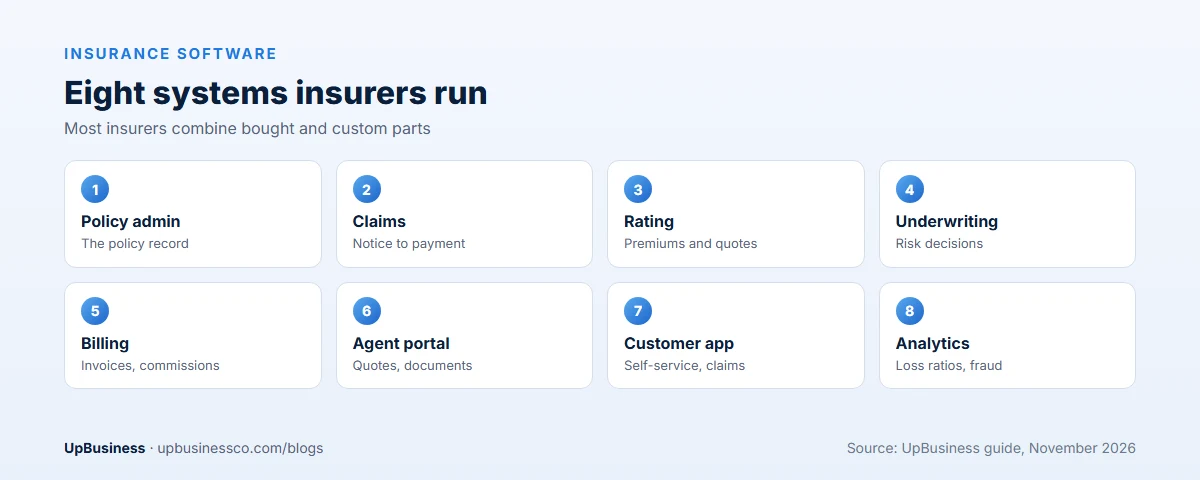
| System | What it does | Who uses it |
|---|---|---|
| Policy administration system (PAS) | Creates, changes, renews and cancels policies; holds the policy record | Operations, underwriting |
| Claims management system | Takes first notice of loss, assigns adjusters, tracks, approves and pays claims | Claims teams, adjusters |
| Rating and quoting engine | Calculates premiums from rules and data, issues quotes | Agents, brokers, customers online |
| Underwriting workbench | Gathers data, scores risk, routes cases for decisions | Underwriters |
| Billing and payments | Invoices, instalments, collections, commissions | Finance |
| Agent and broker portal | Quotes, policy lookups, documents and commissions for intermediaries | Agents, brokers |
| Customer self-service app | Policy documents, payments, claims filing, chat | Policyholders |
| Analytics and reporting | Loss ratios, claims trends, fraud signals, regulatory reports | Management, actuaries |
Health insurers add member enrollment, provider networks and claims adjudication rules. Life insurers add illustrations, medical underwriting and long policy terms. The core idea is the same: a policy record in the middle, with processes for selling, servicing and paying around it.
Build, Buy or Extend?
Large insurance platforms for policy, billing and claims exist and are widely used. Building your own core system from scratch is rarely the cheapest path. Most companies combine options:
| Approach | When it fits | Watch out for |
|---|---|---|
| Buy a core platform | Standard products, many lines, need to launch quickly | Licence fees, long setup, limits on custom features |
| Build custom on top | Portals, apps, workflows and integrations that set you apart | Needs a strong partner and clear requirements |
| Build a full custom core | New product types, niche lines, insurtechs with unusual models | Highest cost and risk; regulation falls on you |
| Modernise a legacy system | Old mainframe or desktop system still holds the policy data | Data migration and running two systems side by side |
Our comparison of custom and off-the-shelf software applies here too, and our guide to application modernisation explains how to replace a legacy system in stages.
Insurance Software Development Cost
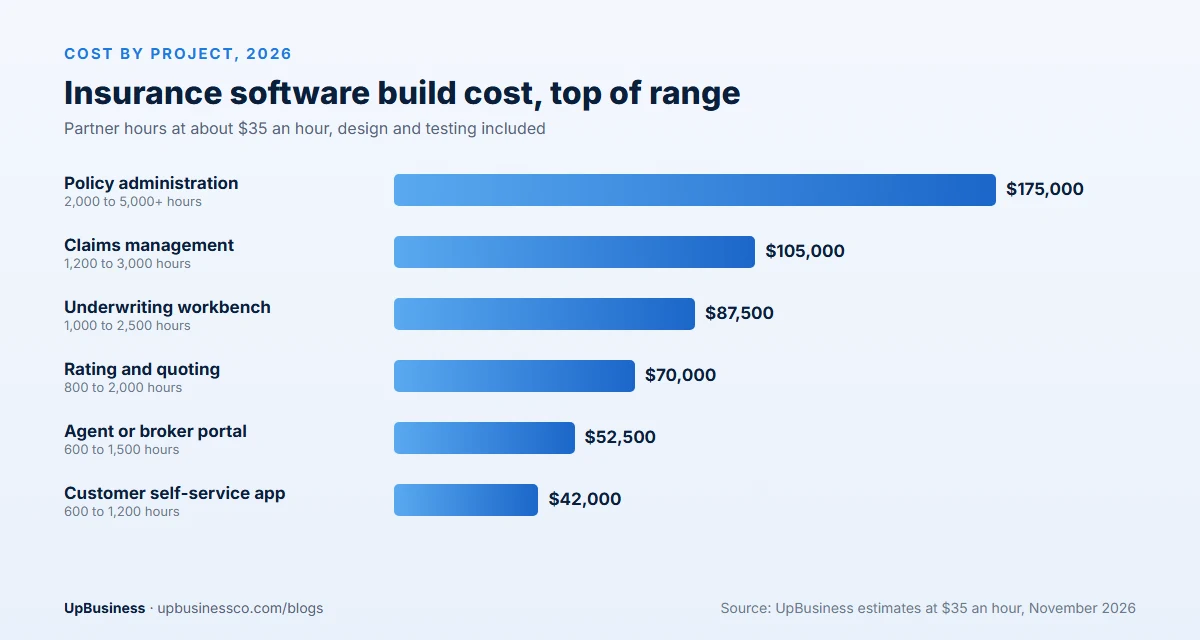
These are our estimates for custom builds by an Indian partner company at about $35 an hour, including design, testing and project management. Real quotes depend on product lines, integrations and rules.
| Project type | Typical hours | Estimated cost at $35 an hour |
|---|---|---|
| Customer self-service app (web and mobile) | 600 to 1,200 | $21,000 to $42,000 |
| Agent or broker portal | 600 to 1,500 | $21,000 to $52,500 |
| Rating and quoting engine | 800 to 2,000 | $28,000 to $70,000 |
| Underwriting workbench | 1,000 to 2,500 | $35,000 to $87,500 |
| Claims management system | 1,200 to 3,000 | $42,000 to $105,000 |
| Policy administration system | 2,000 to 5,000+ | $70,000 to $175,000+ |
For comparison, US federal contract ceiling rates for web developers have a median of $121 an hour[1]. The same 1,200-hour claims project would cost about $145,200 at that rate. Our guide to choosing a custom software development company in India explains how rates and quality vary.
What drives the cost up
- Number of product lines. Each line has its own rating rules, forms and documents.
- Integrations. Core platforms, payment gateways, document systems, credit and identity checks, reinsurers.
- Rules and calculations. Complex rating, commissions and claims reserves take careful testing.
- Data migration. Moving years of policies and claims from an old system is often a project of its own.
- Security and audit needs. Encryption, access logs, penetration tests and evidence for regulators.
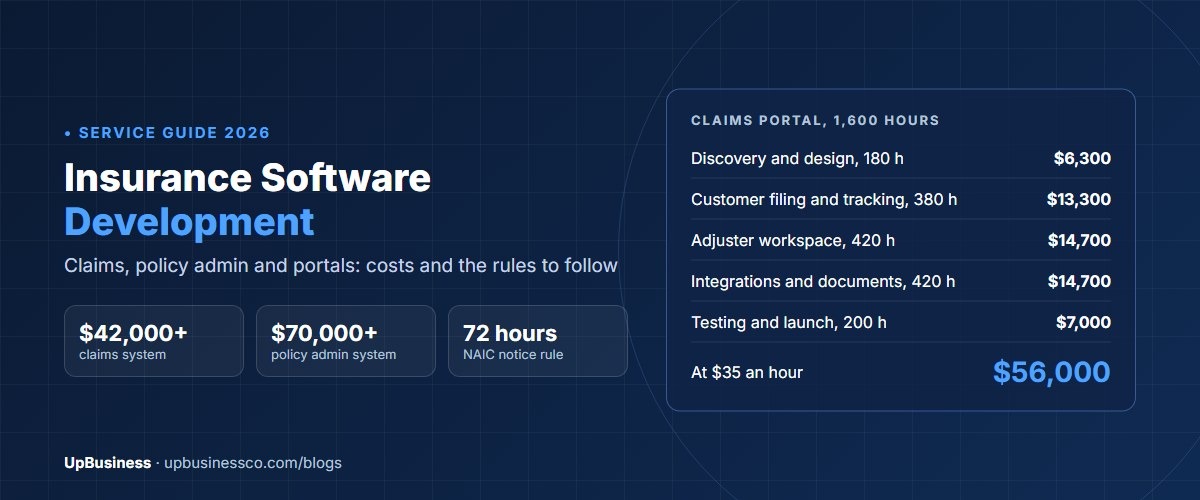
Worked Example: A Claims Portal for a Regional Insurer
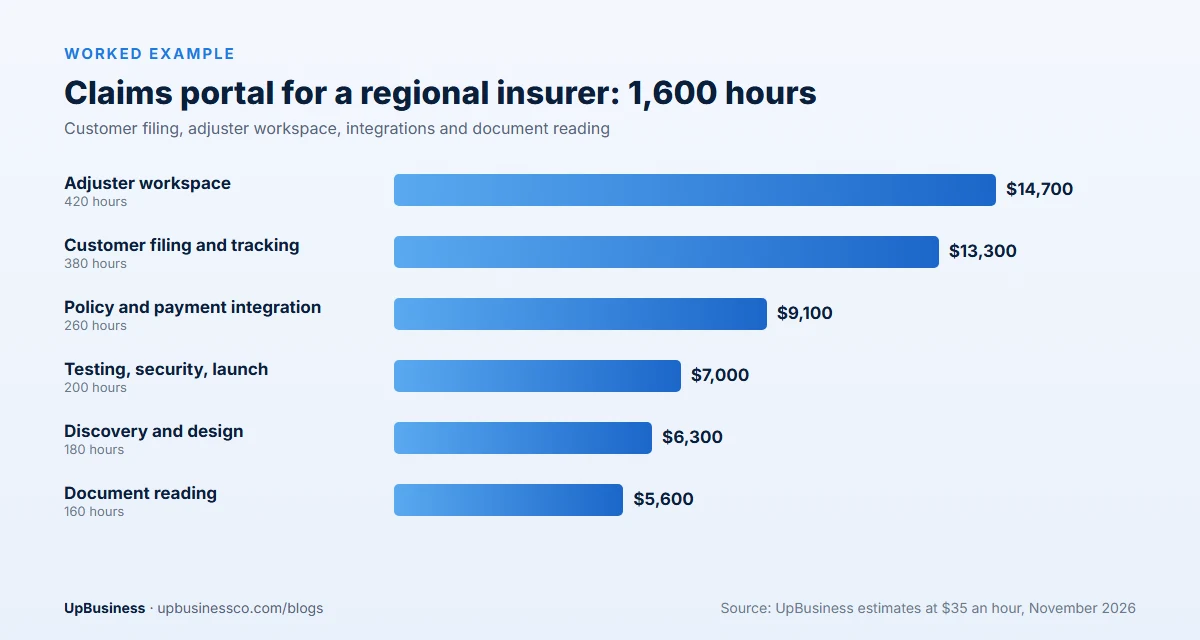
Say a regional property insurer wants customers to file and track claims online, and wants adjusters to work claims in one place instead of email and spreadsheets.
| Work | Hours | Cost at $35 an hour |
|---|---|---|
| Discovery, requirements and design | 180 | $6,300 |
| Customer claim filing and tracking (web and mobile) | 380 | $13,300 |
| Adjuster workspace: queues, notes, documents, approvals | 420 | $14,700 |
| Integration with the policy system and payments | 260 | $9,100 |
| Document upload with automatic data reading | 160 | $5,600 |
| Testing, security review and launch | 200 | $7,000 |
| Total | 1,600 | $56,000 |
Plan 15% to 25% of the build cost each year for support, updates and small changes: about $8,400 to $14,000 for this project. Reading claim documents automatically is a good place to use AI; our guide to intelligent document processing explains how it works and what it costs.
Regulations and Security Your Partner Must Handle
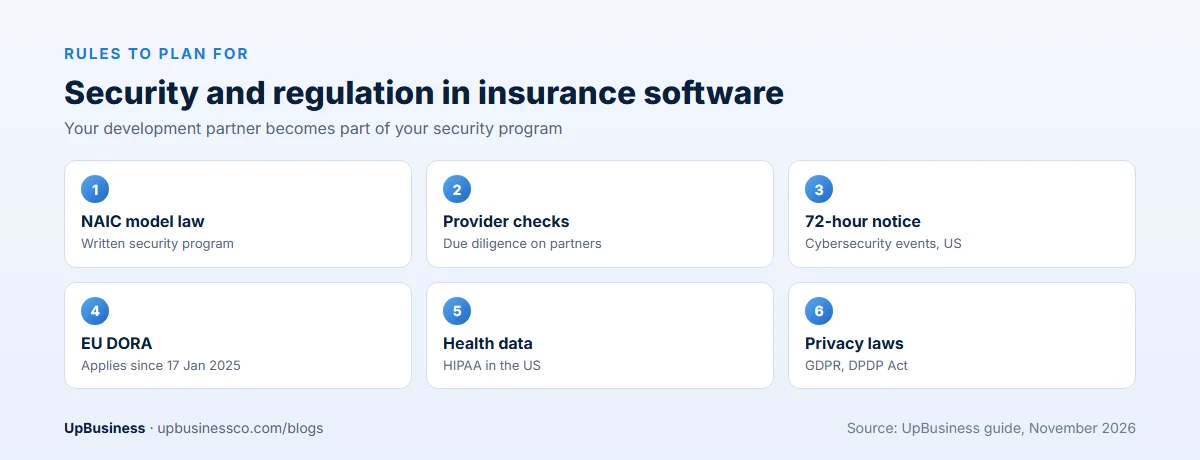
Insurance holds sensitive personal, health and financial data, and regulators expect strong controls, including over the companies you hire. Key rules include:
- United States: NAIC Insurance Data Security Model Law. The NAIC model law, adopted in many states, requires each licensee to keep a written information security program based on a risk assessment. It requires due diligence when selecting a third-party service provider, and requires that provider to protect the systems and data it can access. It also requires notice to the insurance commissioner no later than 72 hours after determining a cybersecurity event occurred, when certain conditions are met[2].
- European Union: Digital Operational Resilience Act (DORA). DORA applies to insurance and reinsurance undertakings and has applied since 17 January 2025[3]. It sets rules on technology risk, incident reporting, testing and the management of outside technology providers.
- Health data. Health insurance projects in the US must handle protected health information under HIPAA rules.
- Privacy laws. Data protection laws such as the GDPR in Europe and India's DPDP Act govern how personal data is collected, stored and shared.
What this means for your project: your development partner becomes part of your security program. Ask for their own security policies, background checks, access controls and incident process. Put them in the contract. NIST's Secure Software Development Framework is a useful checklist for secure building practices[4]. Our software development contract checklist lists the clauses to include.
Integrations and Data Standards
Insurance software rarely stands alone. Plan for links to:
- Your core policy, billing and claims platforms.
- Payment gateways and bank transfers for premiums and claim payouts.
- Identity checks, credit data and fraud screening services.
- Document generation and e-signature.
- Agent and broker systems, reinsurers and comparison sites.
- Your ERP or accounting system for finance. Our ERP software development guide covers that side.
ACORD publishes widely used data standards for exchanging insurance information between carriers, agents and partners[5]. If your partners already use them, ask your development company whether they've worked with ACORD formats.
Features Insurers Ask For Most
- Online quote and buy for simple products, with rules that refer harder cases to underwriters.
- Digital first notice of loss with photos, location and document upload.
- Claims triage that routes simple claims for fast payment and complex ones to experienced adjusters.
- Agent portals with quotes, policy lookups, documents and commission statements.
- Self-service for policy changes, renewals, payments and certificates.
- Fraud signals that flag unusual claims for review.
- Chat and messaging for common questions. Our AI chatbot development cost guide shows typical prices.
- Dashboards for loss ratios, claim times and sales by channel.
How Long Does Insurance Software Development Take?
| Project | Typical timeline |
|---|---|
| Customer app or agent portal | 3 to 6 months |
| Rating and quoting engine | 4 to 8 months |
| Claims management system | 6 to 12 months |
| Policy administration system | 9 to 18 months or more |
Regulated projects need extra time for security reviews, audits and user acceptance testing with real staff. Releasing in stages, starting with one product line or one region, lowers risk. Our guide to the SDLC phases explains what should happen at each stage.
The Insurance Software Development Process
- Discovery, 2 to 6 weeks. Map how policies, claims and payments work today. List the rules for each product. Agree goals and a fixed estimate.
- Design, 3 to 6 weeks. Draw the screens and test them with agents, adjusters or customers. Plan the links to your other systems and the security set-up.
- Build in stages. Start with one product line or one region. Show working screens every two weeks.
- Test hard. Check every rule with real past cases. Run security tests. Let your own staff try it.
- Move the data. Copy old policies and claims, then check totals match before you switch.
- Launch and support. Run old and new side by side for a short time if needed. Then fix, improve and add the next product line.
Each stage should end with something you can see and sign off. Our guide to the SDLC phases explains this in more detail.
Software for Brokers, Agencies and MGAs
Brokers and agencies need different tools from insurers. They work with many carriers, so they need to compare quotes, keep client records, track renewals and manage commissions. MGAs, which write policies on behalf of insurers, also need rating, document creation and reports for the carriers they work with.
Common custom builds here are quote comparison tools, client portals, renewal reminder systems and commission trackers. These are smaller projects, often 600 to 1,500 hours, about $21,000 to $52,500 at $35 an hour.
Health Insurance Software
Health is the most data-heavy line of insurance, and mistakes are costly for members. Plan more time for testing here than for any other kind of insurance project.
Health insurance adds its own needs. Members enrol and change plans. Doctors and hospitals join networks. Claims come in large numbers and follow detailed rules on what is covered. Members want to find a doctor, check a claim and see what they owe.
In the US, any system that holds health data must follow HIPAA. In other markets, local health and privacy laws apply. Ask your partner for past health projects and how they kept data safe.
Life Insurance Software
Life insurance policies last for decades, so the software must handle long histories, changes to cover and payments over many years. Sales tools show customers how a policy may grow over time. Underwriting often needs medical details and checks. A good first project for many life insurers is a digital application that cuts paperwork and speeds up decisions.
How to Choose an Insurance Software Development Company
- Ask for regulated-industry work. Insurance, banking or healthcare projects they can show and explain.
- Check insurance knowledge. They should understand policies, endorsements, claims reserves and commissions without long explanations.
- Review security practices. Written policies, access controls, background checks and incident handling.
- Test integration skills. Ask how they'd connect to your core platform and payment systems.
- Start with paid discovery. Two to six weeks to map processes and produce requirements and a fixed estimate.
- Keep ownership. Code, cloud accounts and data stay in your company's name.
Our guide on how to verify a software development company in India shows how to check registration and references. For a similar regulated, integration-heavy industry, see our guide to logistics software development.
Insurance Software Development Companies in India
Many insurers and insurtechs in the US, UK, Europe and the Gulf hire development partners in India. The main reasons are cost, a large pool of developers with banking and insurance experience, and teams used to working with overseas clients.
Rates are the obvious draw. At about $35 an hour, the 1,600-hour claims portal in our example costs about $56,000. At the $121 US web developer median, the same hours cost about $193,600. But the cheapest quote is rarely the best value in a regulated industry.
When you compare Indian partner companies, check four things. Have they built software that handles personal, health or financial data? Can they show their own security policies and how they control access to client systems? Will they sign the data protection and audit terms your regulator expects? And will the people you meet in the sales call actually work on your project?
Where an Insurtech Should Start
Insurtech startups rarely need a full policy system on day one. Most start with one product, one market and a partner insurer or MGA that holds the licence. The first build is usually a quote-and-buy flow, a customer app and simple claims filing, linked to the partner's systems.
That first release often takes 1,000 to 2,000 hours, about $35,000 to $70,000 at $35 an hour. It lets you test demand before you spend on a full core. Build the parts that make you different, and rent or license the rest.
Running Costs After Launch
Plan for these yearly costs on top of the build:
- Support, updates and small changes: 15% to 25% of the build cost.
- Cloud hosting, backups and monitoring.
- Licences for any platforms, data services or document tools you connect to.
- Security tests, such as a yearly penetration test, and audit support.
What to Decide Before You Start
- Which product lines and markets come first.
- Which systems stay, which go and which the new software must connect to.
- Who owns the rules for rating, underwriting and claims, and who signs them off.
- Where data will be stored, and which privacy and security rules apply.
- How you'll move old policies and claims, and how long both systems run together.
- What success looks like in numbers, such as days to settle a claim or cost per policy.
Clear answers to these cut weeks from discovery and make quotes far easier to compare.
Red Flags
- No experience with regulated data, or vague answers about security.
- A fixed price for a claims or policy system without a discovery phase.
- They want to host your data in their own accounts.
- No plan for migrating existing policies and claims.
- No user acceptance testing with your claims or underwriting staff.
Find an Insurance Software Partner on UpBusiness
UpBusiness lists verified partner companies, mostly based in India and serving buyers worldwide. Every company has passed checks reviewed by our team: company details, registration and tax papers, the founder's identity, expertise and three client projects with evidence. Only companies with a TrustScore of 70 or more are listed.
Insurance work usually sits under custom software development. Not every company on our custom software development page names insurance as a specialty, so ask each for regulated-industry projects before you shortlist.
- Post your requirement with your product lines, current systems, budget and timeline.
- Get three partner companies matched to your budget, service and industry.
- Compare them side by side and start with a paid discovery phase. Buyers pay nothing, and there's no commission on the project.