

Browse our curated list of Custom Software Development Companies
Logistics software development means building software that plans, moves, stores and tracks goods: transport management, warehouse management, fleet tracking, last-mile delivery apps and freight marketplaces. A focused custom build, such as a driver app with a dispatch dashboard, usually takes 600 to 1,200 hours. A full transport or warehouse system takes 1,500 to 4,000 hours or more. With an Indian partner company at about $35 an hour, that's roughly $21,000 for a small build and $50,000 to $140,000 for a full system.
This guide is for logistics companies, distributors, manufacturers and ecommerce brands deciding whether to build their own logistics software and who to hire. It explains what logistics software is, the main types, what software logistics companies actually use, features, costs by type with a worked example, buy versus build, the rules your software must handle in India, the US and the Gulf, and how to choose a development partner.
Key takeaways
- Most logistics companies run several systems together: a transport management system (TMS), a warehouse management system (WMS), fleet tracking, an ERP and customer tracking pages. Custom software usually fills the gaps between them.
- Build cost depends on the number of apps (driver, customer, dispatcher, admin) and integrations far more than on screens. Integrations often take a quarter of the hours.
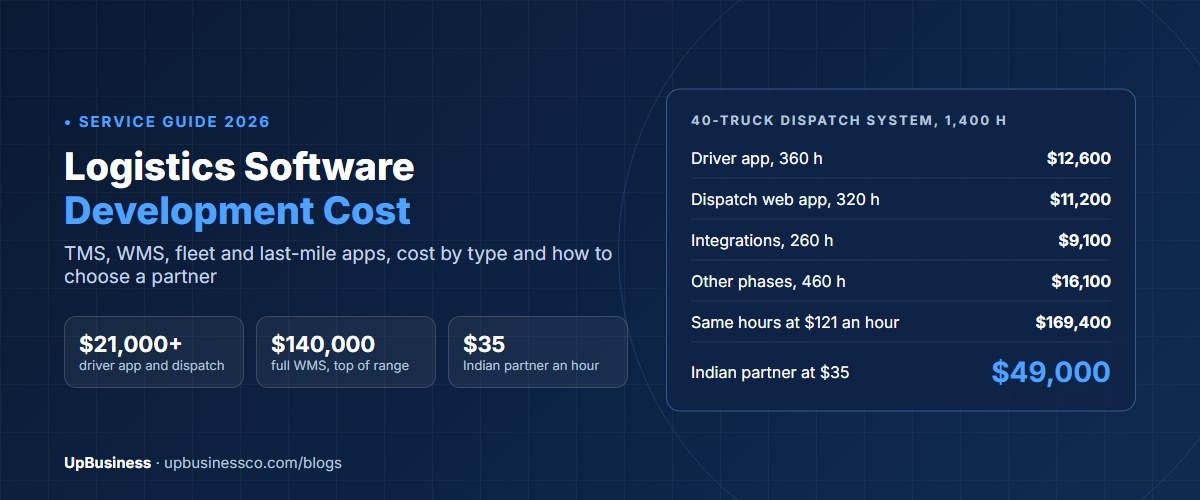
- An Indian partner company at about $35 an hour builds a 1,400-hour dispatch and tracking system for about $49,000. The same hours at the $121 US web developer median cost about $169,400.
- Local rules shape the software: e-way bills in India, electronic logging devices for US trucking, and customs and free zone paperwork in the Gulf.
- Buy off-the-shelf software for standard work. Build custom software when your process is your edge, or when packaged tools don't talk to each other.
What Is Logistics Software?
Logistics software is any system that helps a business move goods from where they are to where they need to be, at the right time and cost. It covers planning loads and routes, booking carriers, running warehouses, tracking vehicles and shipments, proving delivery, and billing. Logistics software development is the work of building or extending those systems for a specific business, instead of only buying a packaged product.
A small courier might need just a driver app and a dispatch screen. A national distributor needs route planning, warehouse picking, ERP links, invoicing and customer tracking working together. The bigger the operation, the more the work shifts from building screens to connecting systems.
Types of Logistics Software
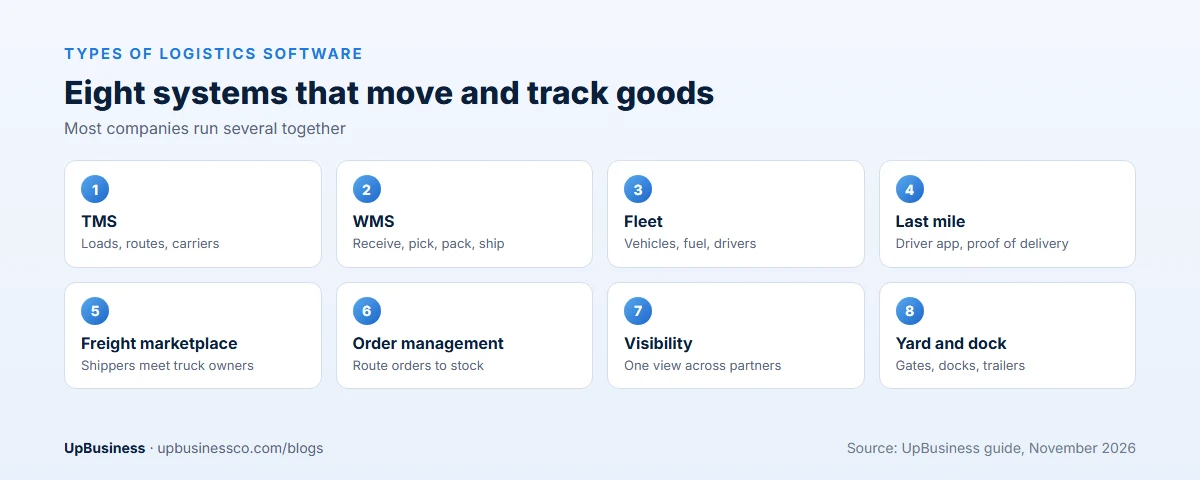
| Type | What it does | Who uses it |
|---|---|---|
| Transport management system (TMS) | Plans loads and routes, books carriers, tracks shipments, audits freight bills | Shippers, 3PLs, freight forwarders |
| Warehouse management system (WMS) | Receiving, put-away, picking, packing, stock counts, dispatch | Warehouses, ecommerce fulfilment, distributors |
| Fleet management | Vehicle tracking, fuel, maintenance, driver behaviour, documents | Trucking companies, own-fleet distributors |
| Last-mile delivery | Driver app, route sequencing, proof of delivery, customer tracking links | Couriers, ecommerce, food and grocery delivery |
| Freight marketplace | Matches shippers with truck owners, quotes, bookings, payments | Freight brokers, digital freight startups |
| Order management | Takes orders from all channels and decides where to ship from | Brands selling online and offline |
| Supply chain visibility | One view of orders, stock and shipments across partners | Manufacturers, large retailers |
| Yard and dock management | Gate entry, dock booking, trailer moves | Large warehouses, factories, ports |
Many projects combine two or three of these. A distributor with its own trucks often needs light TMS and fleet features plus a driver app, linked to an existing ERP. If you're running ERP work at the same time, our ERP software development guide covers that side.
What Software Do Logistics Companies Use?
A typical mid-sized logistics company uses:
- An ERP or accounting system such as SAP, Oracle, Microsoft Dynamics, Odoo, Zoho or Tally for finance, billing and stock.
- A TMS, often a packaged product, for planning and carrier management.
- A WMS in each warehouse, sometimes a module of the ERP.
- Telematics: GPS devices in vehicles with their own tracking portal.
- Spreadsheets and messaging apps filling the gaps, which is usually where the custom software project starts.
The common problem isn't missing software. It's that these systems don't share data, so staff re-type orders, call drivers for updates and build reports by hand. Custom logistics software often starts as a layer that connects what already exists: a dispatch screen that reads ERP orders, a driver app that sends GPS and delivery photos, and a customer page that shows live status.
Features Most Logistics Software Needs
- Orders and shipments: create, import from ERP or ecommerce, split and merge loads.
- Dispatch and planning: assign vehicles and drivers, plan routes, handle changes during the day.
- Driver app: job list, navigation handover, status updates, photos, signatures, offline mode for weak network areas.
- Live tracking: GPS from phones or telematics devices, arrival estimates, alerts for delays.
- Proof of delivery: photo, signature or one-time code, stored against the order.
- Customer tracking: tracking links by SMS, email or WhatsApp.
- Warehouse: barcode or QR scanning, picking lists, stock by location.
- Billing: freight charges, driver payments, invoices pushed to the accounting system.
- Documents and compliance: e-way bills, delivery notes, customs papers, vehicle and driver documents with expiry alerts.
- Reports: on-time delivery, cost per drop, vehicle use, warehouse accuracy.
Route planning is often bought, not built. Maps and routing APIs charge per request[1], so a busy fleet's map bill needs its own line in the budget. Advanced planning, such as many vehicles with time windows and load limits, usually uses a specialised routing service or solver rather than custom maths.
Logistics Software Development Cost in 2026
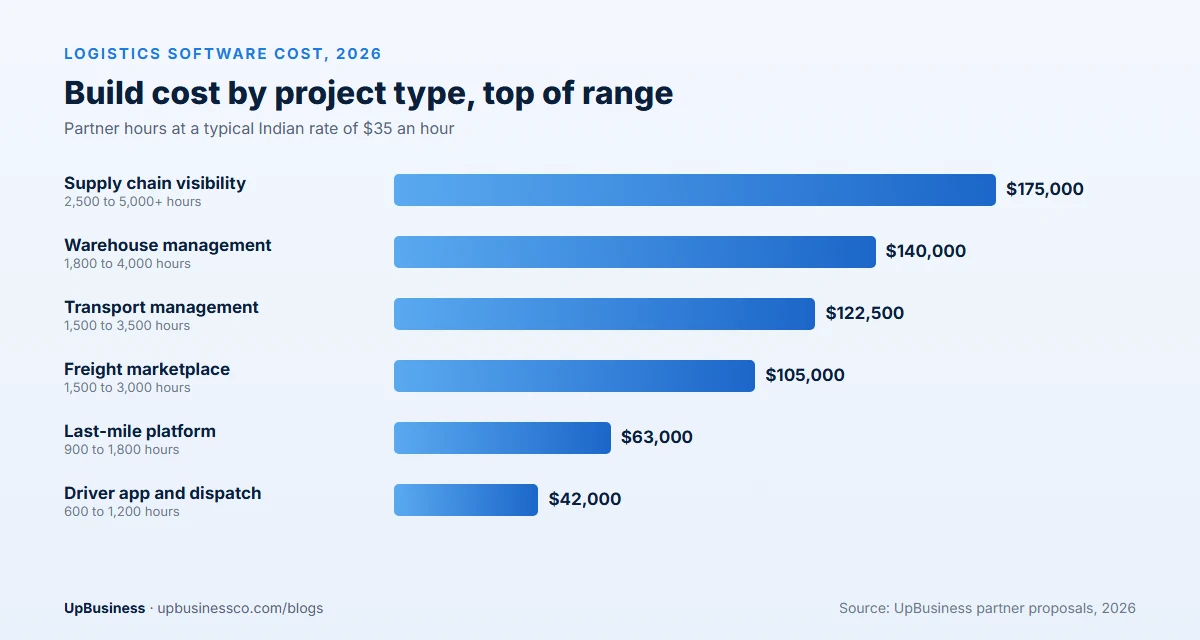
Published cost guides from development firms quote anywhere from $30,000 to $500,000, usually at US or European rates and with no source. We priced common project types by hours instead, at a typical Indian partner rate of $35 an hour, the middle of the $25 to $45 range we see in proposals on UpBusiness. Our software development cost benchmark explains how rates vary by role.
| Project type | Typical hours | Cost at $35 an hour | Timeline |
|---|---|---|---|
| Driver app and dispatch dashboard | 600 to 1,200 | $21,000 to $42,000 | 3 to 5 months |
| Last-mile delivery platform (customer, driver, admin) | 900 to 1,800 | $31,500 to $63,000 | 4 to 7 months |
| Freight marketplace | 1,500 to 3,000 | $52,500 to $105,000 | 6 to 10 months |
| Transport management system | 1,500 to 3,500 | $52,500 to $122,500 | 6 to 12 months |
| Warehouse management system | 1,800 to 4,000 | $63,000 to $140,000 | 6 to 12 months |
| Supply chain visibility platform | 2,500 to 5,000+ | $87,500 to $175,000+ | 9 to 15 months |
For comparison, US federal GSA contract ceiling rates for web developers have a median of $121 an hour across 1,420 rates, pulled on 6 November 2026[2]. These are maximum rates for US government buyers, so private US projects often pay somewhat less, but the gap to Indian partner rates is still large.
What pushes the cost up:
- Number of apps. Each extra app, such as a customer app next to the driver app, adds design, build and testing.
- Integrations. ERP, accounting, telematics, carrier APIs, e-way bill and payment links. Each one needs mapping, error handling and testing with real data.
- Offline mode. Drivers in low-signal areas need the app to work offline and sync later. This adds real effort.
- Planning logic. Simple route order is cheap. Multi-vehicle planning with time windows and capacity limits is not.
- Hardware. Barcode scanners, label printers, weighbridges and IoT sensors each need testing on the actual devices.
- Data migration. Moving customers, rates and history from old systems.
After launch, plan 15% to 25% of the build cost a year for updates, fixes, phone OS changes and small features, plus hosting and map API fees. Our app maintenance cost guide breaks that down.
Worked Example: A Dispatch and Tracking System for a Regional Distributor
A regional distributor with 40 trucks, two warehouses and orders in an ERP wants drivers on an app, dispatchers on one screen and customers getting tracking links. Here is how the hours usually split:
| Phase | Hours | Cost at $35 an hour |
|---|---|---|
| Discovery and process mapping | 80 | $2,800 |
| Design of driver app and dispatch screens | 140 | $4,900 |
| Driver app with offline mode, photos and signatures | 360 | $12,600 |
| Dispatch and admin web app | 320 | $11,200 |
| Integrations: ERP orders, invoices, maps, e-way bills, SMS | 260 | $9,100 |
| Testing on real phones and routes | 160 | $5,600 |
| Launch, training and first month of support | 80 | $2,800 |
| Total | 1,400 | $49,000 |
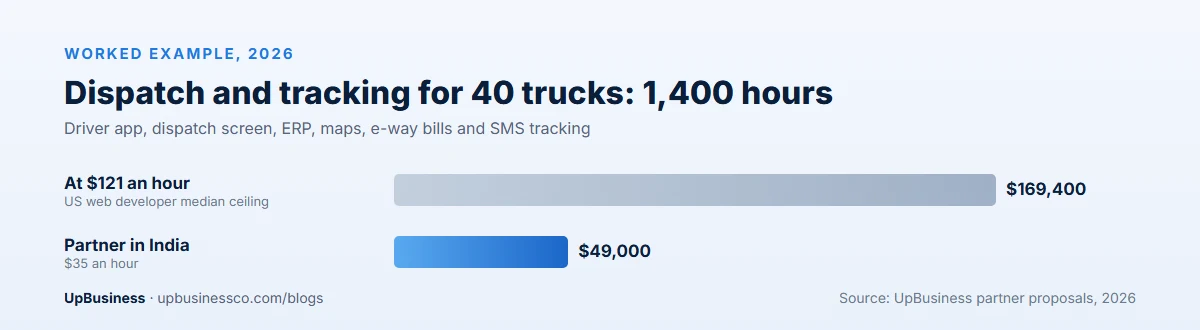
The same 1,400 hours at the $121 US median would cost about $169,400. Integrations are close to a fifth of the hours here, and in larger projects they often reach a quarter or more. If you want to test the idea first, a smaller first version with the driver app and dispatch screen only, about 600 hours, can go live in around three months. Our MVP development cost guide shows how to cut a first release.
Logistics Software for Small Businesses
A small business with five to 20 vehicles rarely needs a full TMS. It usually needs three things: a way to give drivers their jobs, a way to see where they are, and proof that each delivery happened. Many start with a packaged delivery app on a monthly plan, and that's often the right first step.
Custom software starts to pay off when the packaged app forces your team into workarounds, for example when you price by weight and distance in a way the tool can't handle, or when every order has to be copied from your accounting system by hand. A focused custom build of 400 to 700 hours, a driver app plus a simple dispatch screen linked to your accounting tool, costs about $14,000 to $24,500 at $35 an hour. Keep the first version small and add route planning or customer tracking once drivers use the app every day.
Logistics Software Examples
Here are common custom projects we see buyers ask for, with the main parts each one includes:
- Courier app for a city delivery business: customer booking, rider app with live location, cash and online payment, rider payouts.
- Distributor dispatch system: orders from the ERP, load planning by truck, driver app, e-way bills, delivery photos.
- Cold chain tracking: temperature sensors in trucks, alerts when a reading goes out of range, reports for customers and auditors.
- Freight booking portal for a 3PL: quotes, bookings, shipment status pages and invoices for business customers.
- Warehouse scanning app: barcode receiving, picking lists on handheld scanners, stock by bin, sync with the ERP.
- Trucking compliance dashboard: vehicle and driver documents, expiry alerts, maintenance schedules and fuel records.
Each of these is a good size for a first project with a new partner company, because the result is easy to test with real drivers and real orders.
Buy, Build or Combine?
| Option | Good when | Watch out for |
|---|---|---|
| Buy a packaged TMS, WMS or fleet product | Your process is standard and the product fits most of it | Per-vehicle or per-user fees that grow, limits on changes, data locked in |
| Build custom software | Your process is your edge, or you sell logistics as a service | Higher first cost, you own maintenance |
| Combine: buy the core, build the gaps | Packaged tools work but don't connect | Needs clear ownership of each system |
| Extend your ERP | You already run Odoo, Zoho or SAP well | ERP partners vary widely in logistics experience |
Most of the projects we see are the third kind: keep the ERP and maybe a packaged WMS, and build a driver app, dispatch screen, customer tracking and the links between them. If you run Odoo, our Odoo implementation cost guide shows what extending it costs. If you're building a two-sided freight platform, our marketplace development cost guide covers the marketplace parts.
Rules Your Logistics Software Must Handle
India. An e-way bill is generally required to move goods worth more than about $525 in one consignment, and businesses can generate them through the official system or its APIs[3]. Software that creates e-way bills from orders and updates vehicle numbers saves dispatch teams a lot of manual work. India's Unified Logistics Interface Platform (ULIP), launched under the National Logistics Policy in 2022, gives approved companies API access to government logistics data such as vehicle and driver records[4].
United States. Most interstate truck drivers who must keep records of duty status have to use an electronic logging device under FMCSA rules[5]. Your software usually reads data from a certified device provider rather than replacing it. Our guide for US companies hiring an Indian software partner covers contracts and data rules.
UAE and the Gulf. Many searches come from Dubai, where logistics firms work across free zones, ports and customs. Software there often needs Arabic and English, VAT invoices, customs document handling and links to port and free zone systems. Our guide for UAE and GCC companies hiring in India covers time zones, contracts and payments.
Ask any partner company which of these rules they have built for before, and ask to see it working.
AI in Logistics Software: What's Worth Paying For
Useful AI features in 2026 are practical ones: reading invoices, delivery notes and customs papers automatically, predicting arrival times from past trips, flagging unusual fuel use, and answering "where is my order" questions on WhatsApp or chat. Each one needs clean data first. A good partner company will tell you to fix data capture in the driver app before adding prediction. Our AI automation cost guide gives typical prices for document reading and chat automation.
How to Choose a Logistics Software Development Company
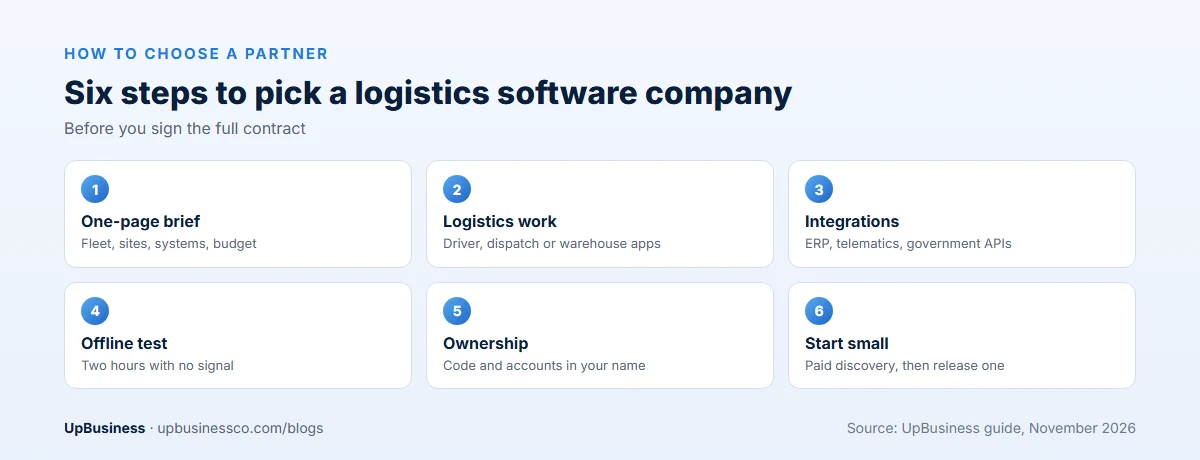
- Write a one-page brief. Fleet size, warehouses, order volume, current systems, the three biggest problems and the budget range.
- Ask for logistics or field-operations work. Driver apps, dispatch tools or warehouse scanning they have shipped, with a live demo.
- Check integration experience. Ask which ERPs, telematics providers and government APIs they have connected, and how they handle failures.
- Test offline mode. Ask how their driver apps behave with no signal for two hours.
- Agree ownership. Code in your repository, cloud and app store accounts in your name, and a clear handover. Our software development contract checklist covers IP and exit clauses.
- Start small. A paid discovery of two to four weeks, then the first release, before you commit the full budget.
Many logistics software projects in India, the US and the UAE are built by general custom software companies, not logistics-only firms. That works well if the team has shipped field apps and integrations before. Our guide to choosing a custom software development company in India lists what to check.
Finding Logistics Software Partners on UpBusiness
UpBusiness lists verified partner companies, mostly based in India. Every company has passed checks reviewed by our team: company details, registration and tax papers, the founder's identity, expertise and three client projects with evidence. Only companies with a TrustScore of 70 or more are listed.
Logistics projects usually sit under custom software and mobile app development. Our custom software development page and mobile app development page list companies that build business systems and field apps. Not every one has logistics clients, so ask each for driver, dispatch or warehouse work before you shortlist.
- Post your requirement with your fleet, warehouses, systems, budget and timeline.
- Get three partner companies matched to your budget, service and industry.
- Compare them side by side, run a paid discovery with your favourite and start with a first release. Buyers pay nothing, and there's no commission on the project.