


Browse our curated list of n8n Automation Companies
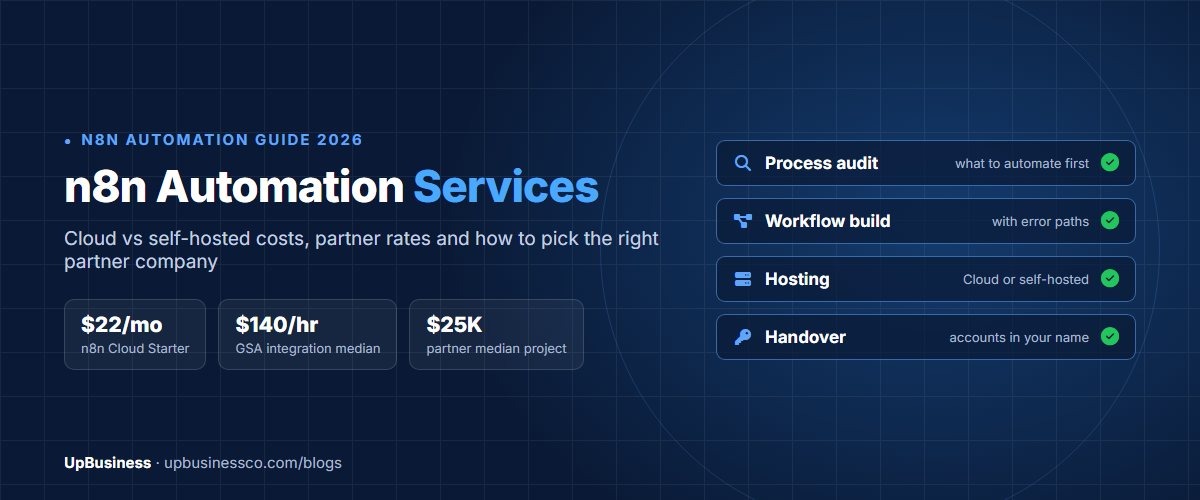
n8n automation services are paid help to design, build, host and look after workflows in n8n, the workflow automation tool that connects your apps, databases and AI models without a full software project. A partner company maps the process, builds the workflows, sets up n8n Cloud or a self-hosted server and fixes things when an API changes. The software itself can cost nothing: the self-hosted Community edition is free, and n8n Cloud starts at €20 a month (about $22) on annual billing[1]. This guide is for founders, operations heads and IT managers who want to know what an n8n partner builds, what it costs and how to choose one.
Key takeaways
- On n8n Cloud, Starter costs €20 a month (about $22) for 2,500 executions and Pro costs €50 (about $56) for 10,000. The self-hosted Community edition has no licence fee.
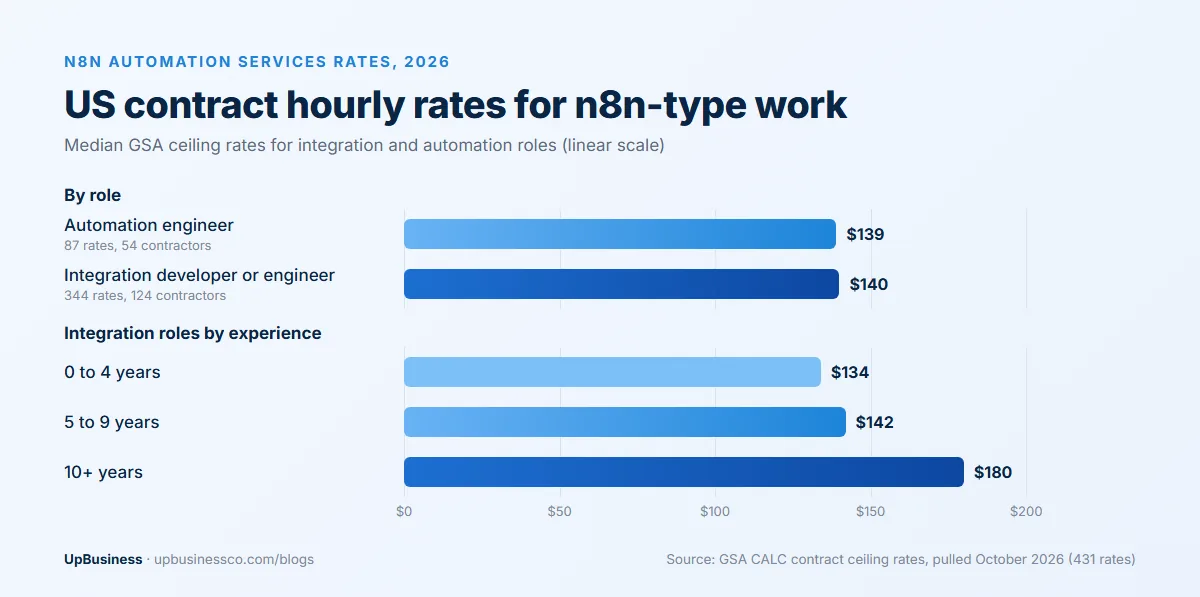
- US federal contract ceiling rates put integration developers at a median of $140 an hour and automation engineers at $139, based on 431 GSA rates pulled in October 2026.
- Our n8n automation listing shows 7 companies, but none names n8n automation as a service on its profile yet. Ask for live workflows before you hire.
- n8n bills one execution per full workflow run, while Zapier counts every successful action as a task, so step-heavy workflows usually cost less to run on n8n.
What Do n8n Automation Services Include?
n8n engagements usually cover some mix of the six pieces of work below. A small business might buy only the first two, while a company moving off Zapier at scale needs all of them.
| Service | What the partner does | What you get |
|---|---|---|
| Process audit | Maps the manual steps, systems and owners, then ranks processes by hours saved | A shortlist of workflows worth automating first, with rough effort |
| Workflow build | Builds triggers, branches, error paths and retries in n8n | Running workflows with test cases and a short runbook |
| Integrations | Connects CRMs, ERPs, accounting, email and internal APIs, writing custom nodes where none exist | Data moving between systems without copy and paste |
| AI steps and agents | Adds AI Agent nodes for classifying, drafting and routing, with human approval where needed | Workflows that read and decide, not just move data |
| Hosting and setup | Sets up n8n Cloud or a self-hosted server with SSL, backups, queue mode and monitoring | A stable instance in your company's name |
| Support and upkeep | Updates n8n, watches failed executions and fixes broken credentials or changed APIs | Workflows that keep running after the build team leaves |
n8n sits between no-code tools and custom code. Its integration library lists 2,412 integrations[2], and any workflow can drop into a JavaScript or Python code step when a ready-made node falls short. That flexibility is why companies hire help: the tool lets you build almost anything, including workflows that only one person understands. If your problem is broader than one tool, our AI automation services guide covers the wider market, and our AI integration services guide explains how AI models get wired into existing software.
When n8n Fits Better Than Zapier or Make
n8n suits technical teams with many steps per workflow, data that must stay on their own servers, or AI logic that needs code. Zapier suits non-technical teams that want the widest app catalogue with no hosting. The billing model often decides it.
Zapier counts each successful action in a Zap as a separate task[3]. n8n counts one execution per complete run of a workflow, however many steps it has[1]. Take a lead-routing workflow with 6 action steps that runs 3,000 times a month. That's 3,000 executions on n8n, which fits inside the 10,000 on Pro. On Zapier the same volume is 18,000 tasks. Make sits in between: most module actions use one credit each, so a run can use anywhere from two credits to thousands[4].
| Factor | n8n | Zapier | Make |
|---|---|---|---|
| Billing unit | One execution per full workflow run | One task per successful action | One credit per module action, for most actions |
| Self-hosting | Yes, free Community edition | No | No |
| Who builds it | Developers or technical ops staff | Business users | Business users and analysts |
| Best fit | High volume, many steps, data residency, AI agents | Quick wins across many SaaS apps | Visual multi-step scenarios on a budget |
Zapier's paid plans start at $19.99 a month for Professional and $69 for Team[3]. For a handful of two-step automations, that's often cheaper than paying anyone to set up n8n. The case for n8n gets stronger as volume, step count and privacy requirements grow.
How Much Does n8n Cost? Cloud Plans vs Self-Hosting
n8n costs nothing in licence fees if you self-host the Community edition, though you pay for a server and upkeep. n8n Cloud costs €20 a month (about $22) for Starter, €50 (about $56) for Pro and €667 (about $747) for the self-hosted Business plan, all billed annually, with Enterprise priced on request[1].
| Plan | Price a month (annual billing) | Executions a month | Where it runs | Notable limits |
|---|---|---|---|---|
| Community edition | €0, plus server | No plan limit | Your server | No SSO, environments, Git version control or shared projects |
| Starter | €20 (about $22) | 2,500 | n8n Cloud | 1 shared project, 5 concurrent executions |
| Pro | €50 (about $56) | 10,000 | n8n Cloud | 3 shared projects, up to 50 concurrent executions |
| Business | €667 (about $747) | 40,000 | Self-hosted only | SSO, Git version control, multiple environments |
| Enterprise | Custom | Custom | Cloud or self-hosted | Log streaming, external secrets, SLA support |
Dollar figures use the European Central Bank reference rate of $1.1193 to the euro on 23 October 2026[5]. Monthly billing costs more, since annual billing saves 17%. Companies under 20 employees can apply for n8n's Start-up Plan and get 50% off Business. The Business plan isn't yet offered on n8n Cloud[1].
Compared with the paid editions, the Community edition leaves out SSO, environments, external secrets and log streaming[6]. It also has no projects, no sharing of workflows or credentials between users and no Git version control. For one team with a few dozen workflows, that rarely matters. For several departments sharing credentials, it does.
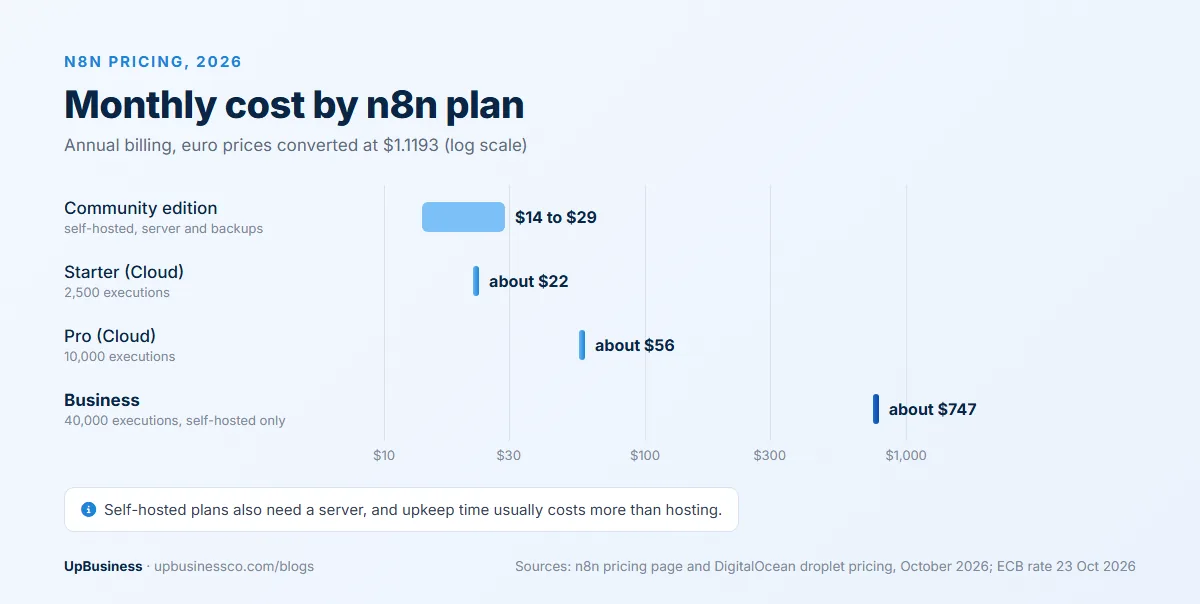
Self-hosting has its own bill. A DigitalOcean server with 2 GiB of memory costs $12 a month and one with 4 GiB costs $24, and weekly backups add 20% of the server price[7]. That puts a small production instance at roughly $14 to $29 a month before anyone's time. The time is the bigger number. Patching, checking failed runs and testing after major updates usually takes a few hours a month, and at contract rates that costs more than the server.
n8n Automation Services Pricing: What Partners Charge
There's no official rate card for n8n work, and the price pages that rank for it belong to agencies selling their own packages. A benchmark you can check yourself is the US government's GSA schedule, which publishes the maximum hourly rates that approved contractors can charge federal buyers.
| Role (GSA labour categories) | Rates | Middle half | Median |
|---|---|---|---|
| Integration developer or engineer | 344 rates, 124 contractors | $117 to $168 | $140 |
| Automation engineer (excluding test automation) | 87 rates, 54 contractors | $115 to $160 | $139 |
| Integration roles, 0 to 4 years | 118 rates | $134 | |
| Integration roles, 10+ years | 65 rates | $180 |
These are ceiling rates pulled from GSA CALC in October 2026[8], so they mark the top of what US government buyers pay. Commercial quotes in the US are often close to them. Partner companies in India and Eastern Europe usually quote well below.
Agency packages give a second view. One n8n agency publishes $400 to $1,200 for a single workflow and $1,500 to $4,500 for a multi-workflow system with an AI step, plus retainers of $1,200 to $8,000 a month[9]. Another sells a fixed $5,000 package and ongoing teams from $10,000 a month[10]. Treat both as marketing prices rather than market averages, since each agency chose what to publish.
The spread is wide because n8n projects range from one webhook into a spreadsheet to a set of AI agents reading documents across an ERP. Four things tend to move the quote:
- How many systems the workflows touch, and whether those systems have documented APIs or need custom nodes.
- Error handling. A workflow that retries, alerts someone and logs every failure can take twice the hours of one that simply stops.
- AI steps, because prompts, test cases and human approval paths add build and testing time.
- Hosting. A self-hosted setup with queue mode, backups and monitoring adds a day or more of setup before the first workflow runs.
Worked Example: Year-One Cost of a Three-Workflow Setup
Here's an illustrative example built from the numbers above. A 40-person company wants three workflows. One routes new leads from web forms to the CRM with an AI summary, another pushes invoices from email into accounting and the last sends a weekly operations report to Slack. Assume 80 hours of build and testing.
| Cost line | n8n Cloud Pro | Self-hosted Community edition |
|---|---|---|
| Build, 80 hours at the $140 GSA median | $11,200 | $11,200 |
| Extra server setup, 8 hours | None | $1,120 |
| Platform for 12 months | $672 (Pro at about $56 a month) | $346 (4 GiB server plus weekly backups) |
| Upkeep, 3 to 4 hours a month at $140 | $5,040 (3 hours) | $6,720 (4 hours) |
| Year-one total | About $16,900 | About $19,400 |
Two things stand out. Hosting fees are a small slice of the bill, so picking self-hosting only to save on the plan rarely pays off at this size. And upkeep runs at close to half the build cost every year, which is the line first-time buyers often leave out of the budget. Published 2026 rate cards put AI engineers in India at about $25 to $75 an hour, as our AI developer rates guide shows. At $25 to $50 an hour, an Indian partner company would deliver the same 80-hour build for roughly $2,000 to $4,000.
Cloud or Self-Hosted: Which Should Your Partner Set Up?
n8n's own documentation recommends Cloud for teams without technical staff or who don't want to manage infrastructure, and self-hosting for teams that need full control, custom setups or a free option[11]. Three questions usually settle it.
First, where must the data live? Health, finance and public-sector work often needs data kept in a named country or on your own cloud account, and self-hosting is the cleaner answer. Second, who'll keep it running? A self-hosted instance needs someone to apply updates and watch the server, either your IT team or the partner on a support contract. Third, how much volume do you expect? Pro covers 10,000 executions a month, and a workflow that runs every 5 minutes uses about 8,600 to 8,900 of those on its own[1].
Ask the partner to put the reasoning in writing. If they pick self-hosting, the proposal should name the server size, backup schedule, update process and who pays for each.
Licensing: What n8n's Sustainable Use License Allows
n8n isn't open source in the strict sense. It's released under the Sustainable Use License, which lets you use and modify the software for your own internal business purposes, or for non-commercial and personal use[12]. Distributing it to others is only allowed free of charge for non-commercial purposes.
For a typical buyer this is a non-issue. Running n8n to automate your own company's processes is internal use, and a partner company can build those workflows inside your instance. It matters if you plan to resell automations as a hosted product to your own customers, or to embed n8n in software you sell. In that case, ask n8n about an Enterprise or embed licence before the build starts, and have the partner confirm it in the proposal.
Security Checks for Self-Hosted n8n
Every n8n instance holds the keys to every system it touches, from CRM tokens to bank feeds. Before you sign off a self-hosted setup, ask the partner to show each of these working:
- HTTPS on the editor and webhook URLs, with the editor behind a login and multi-factor authentication.
- A backed-up encryption key for stored credentials, and a plan for rotating it[13].
- SSRF protection turned on, so workflows can't be tricked into calling internal addresses[14].
- A clean result from n8n's built-in security audit, which flags risky nodes, credentials and settings[15].
- Credentials created under service accounts your company owns, never under a developer's personal login.
- Daily backups of the database and a tested restore, since a lost database means lost workflows and history.
On Cloud, n8n handles the server side, but the last two points still apply.
n8n Automation Agency, Freelancer or In-House Consultant?
An n8n automation agency suits companies that want several workflows built, documented and supported under one contract. A freelance n8n consultant suits a single, well-defined workflow with a clear owner inside your team. Hiring in-house makes sense once automation work fills a full-time role.
| Option | Good for | Watch out for |
|---|---|---|
| Agency or partner company | Several workflows, AI steps, self-hosting and ongoing support | Junior staff doing the build under a senior name |
| Freelance n8n consultant | One workflow or a short fix with a clear brief | No cover when they're busy or move on |
| In-house automation engineer | A steady pipeline of automation work across teams | Full salary cost before the backlog proves itself |
Our agency vs freelancer vs in-house guide works through the full cost of each model. For n8n specifically, a common route is an agency build followed by a small monthly support block, with one person in-house trained to make simple edits.
UpBusiness Partner Data: n8n Automation Companies
Our UpBusiness n8n automation page lists 7 partner companies as of October 2026. None of them names n8n automation as a service on its profile yet, so we don't quote their project sizes here. One lists workflow automation among its top 3 services. The others lead with AI solutions, custom AI or app development. Ask each one to show you n8n workflows it runs for a client today.
So ask every shortlisted firm for live n8n examples rather than assuming the experience from the listing.
How to Choose an n8n Automation Partner
Start with a clear brief. Our software project brief template works for automation projects too. List the process and the systems involved, then add monthly volumes, who approves what and what should happen when a step fails. After that, check each partner on these points.
- Two or three running workflows they built, shown live with sensitive data hidden, including how errors are handled.
- A named lead who'll do the build, with their n8n and API experience, rather than a sales contact.
- A written recommendation on Cloud or self-hosting, with the server, backup and update plan if self-hosted.
- Workflow exports and credentials in your company's accounts, plus documentation for every trigger and error path.
- A test plan with real sample data for each workflow, and an acceptance step before final payment.
- Support terms after launch: monthly hours, response time for broken workflows and the cost of extra changes.
When proposals arrive, lay them side by side on hours, roles, deliverables and exclusions. Our guide to comparing software development proposals has a scoring sheet for that. Our software development contract checklist covers ownership, payment milestones and exit terms. If the work grows into agents that act on their own, read our AI agent development guide before you scope it.
Red Flags in n8n Proposals
- The partner hosts n8n on its own account and offers to "manage everything" with no export plan.
- A fixed price for "full automation" with no list of workflows, systems or volumes.
- No mention of error handling, retries or alerts.
- Claims of being an official n8n partner without a link you can check on n8n's own site.
- AI steps with no test cases and no human approval for actions that send money or messages.
- Self-hosting proposed with no backup, update or security plan.
If you'd like quotes from verified partner companies, post your project on UpBusiness with the processes you want automated, the systems involved, monthly volumes and your budget, and compare the proposals side by side.