

Browse our curated list of Custom Software Development Companies
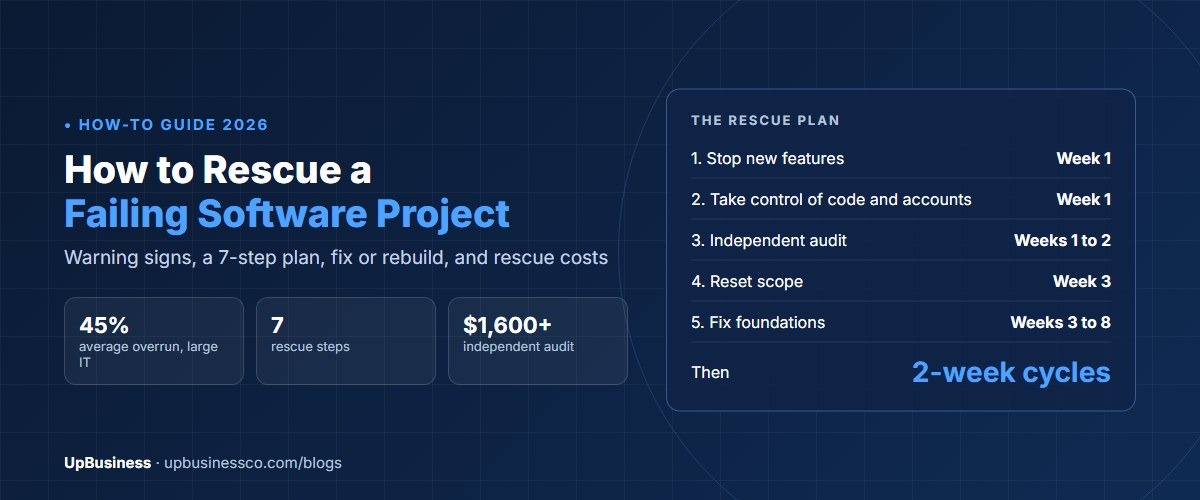
To rescue a failing software project, stop adding features, take control of your code and accounts, and get an independent audit within two weeks. The audit tells you whether to fix what you have, cut the scope, or rebuild. Many failing software projects can still be saved if you act before the budget is gone. An outside audit costs about $1,600 to $6,000. This guide shows the warning signs, a step-by-step rescue plan, costs and when to bring in a new partner.
It's written for founders, product owners and managers who paid for software that is late, over budget or full of bugs, whether the work was done in-house or by an outside company.
Key takeaways
- Large IT projects run 45% over budget and deliver 56% less value than planned on average, in a McKinsey and University of Oxford study of more than 5,400 projects.
- The first job in a rescue is control. Make sure you own the code repository, cloud accounts, domains and app store accounts.
- Adding more developers to a late project usually makes it later. Fix the plan and the process first.
- Rebuild only when the audit shows the core design can't carry your product. In many cases, fixing costs less than starting over.
Why Software Projects Fail
Software projects rarely fail because of one bad developer. They fail because of how the project was set up. McKinsey and the University of Oxford studied more than 5,400 IT projects and found large ones ran 45% over budget and 7% over time, while delivering 56% less value than predicted[1]. The study pointed to unclear goals, shifting requirements, weak teams and poor planning.
Here are the most common causes:
- Vague scope. "Build an app like Uber" means something different to every developer.
- No single decision maker. Three people give the team conflicting instructions.
- Price chosen over skill. The cheapest quote often missed hard parts of the work.
- No testing. Bugs pile up until every fix breaks something else.
- No working software to see. Months pass with status reports but nothing you can click.
- Key people leave. The one developer who understood the code moves on.
Our guide to the SDLC phases explains what should happen at each stage, so you can see which step was skipped.
Warning Signs of a Failing Software Project
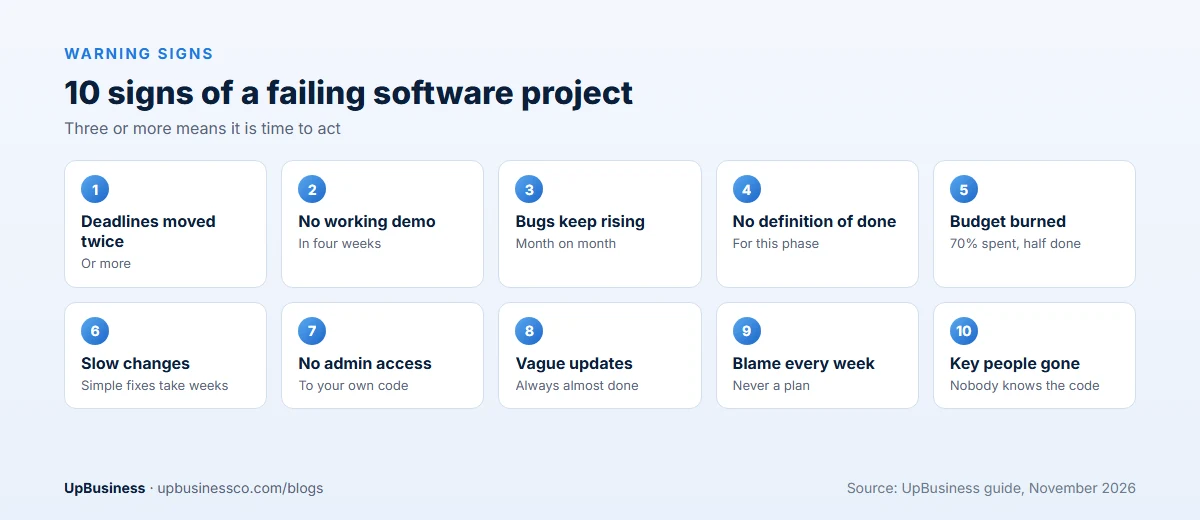
Check your project against these signs. Three or more means it's time to act.
- Deadlines have moved more than twice.
- You haven't seen working software in the last four weeks.
- Bug counts go up each month, not down.
- The team can't say what "done" means for the current phase.
- Over 70% of the budget is spent, and under 50% of the features work.
- Simple changes take weeks.
- You don't have admin access to the code, servers or accounts.
- Updates are vague: "almost done," "just a few fixes left."
- The team blames the requirements, the tools or you, every week.
- Key developers have left and nobody can explain parts of the code.
How to Rescue a Failing Software Project: 7 Steps
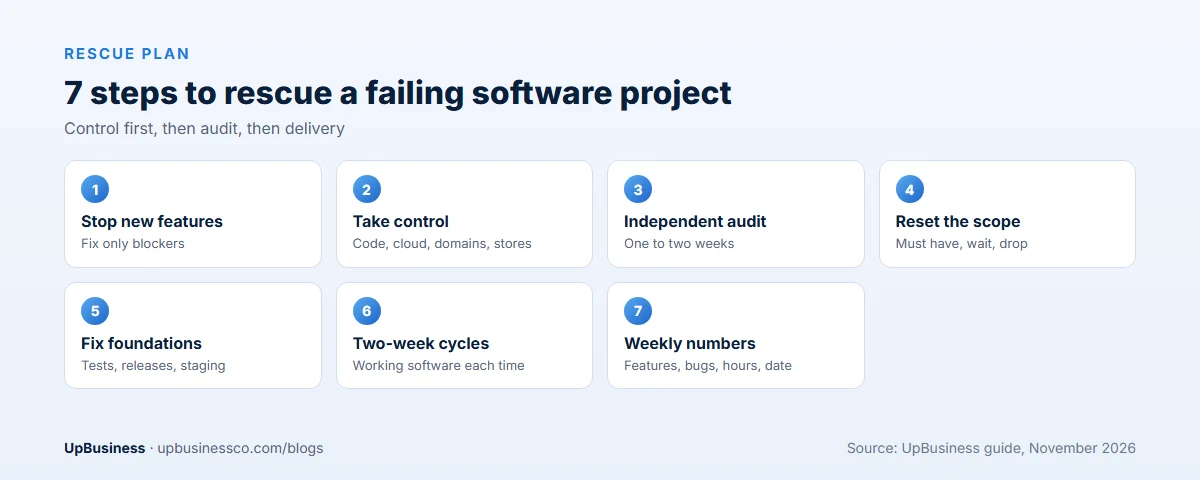
Step 1: Stop new feature work
Every new feature added to a broken system makes the rescue harder and more expensive. Freeze new work for two to four weeks. Only fix bugs that block users or stop the business.
Step 2: Take control of your assets
Before anything else, make sure you have owner or admin access to:
- The code repository, such as GitHub, GitLab or Bitbucket, with the full history.
- Cloud hosting accounts: AWS, Azure, Google Cloud or your web host.
- Domain names and DNS settings.
- Apple App Store and Google Play developer accounts.
- Databases, backups, email services, payment gateways and every third-party key.
- Design files, documents and the task tracker.
If a partner company holds these in its own name, ask for transfer in writing now. Your contract should already say you own the work. Our software development contract checklist shows the clauses to look for.
Step 3: Get an independent audit
Ask a second team, not the one that built it, to review the project. A good audit takes one to two weeks and covers the code, the design, the test setup, security and the plan. It should end with one clear recommendation. Fix it, cut the scope, or rebuild. The audit section below lists what to check.
Step 4: Reset the scope
List every feature and sort it into three groups: must have for launch, can wait, and drop. Expect the first launch to be smaller than the original plan. That's fine. A working smaller product beats a large broken one.
Step 5: Fix the foundations
Before new features, the team should fix what makes everything slow: missing tests, a broken release process, no staging server, or a database that needs changes. This often takes two to six weeks and feels like no progress. It's the most important part of the rescue.
Step 6: Deliver in short cycles
Work in two-week cycles. At the end of each, you see and test working software. If a cycle ends with nothing to show, you'll know within 14 days, not 6 months.
Step 7: Measure and report every week
Track four numbers each week. Count features done and open bugs by severity. Compare hours spent with the budget, and update the forecast launch date. Share them with everyone who funds the project.
What a Software Project Rescue Audit Covers
| Area | What the auditor checks | Warning sign |
|---|---|---|
| Code quality | Structure, duplication, naming, size of files | Same logic copied in many places |
| Architecture | How parts connect, database design, ability to grow | Everything in one huge file or table |
| Tests | Automated tests, how much code they cover | No tests, or tests that don't run |
| Release process | How code goes from developer to users | Manual copying of files to the server |
| Security | Logins, passwords, data access, known flaws in packages | Passwords or keys stored in the code |
| Third-party parts | Libraries, versions, licences | Old packages with known flaws |
| Documentation | Setup guide, API notes, decisions | Only one person knows how to run it |
| Plan and estimate | Remaining work, realistic dates and cost | No list of what's left |
Ask the auditor for a short report: the top 10 risks ranked by impact, the recommended path, and a cost and time estimate for each option. A 60-page report with no clear answer hasn't done its job.
Fix, Cut Scope or Rebuild?
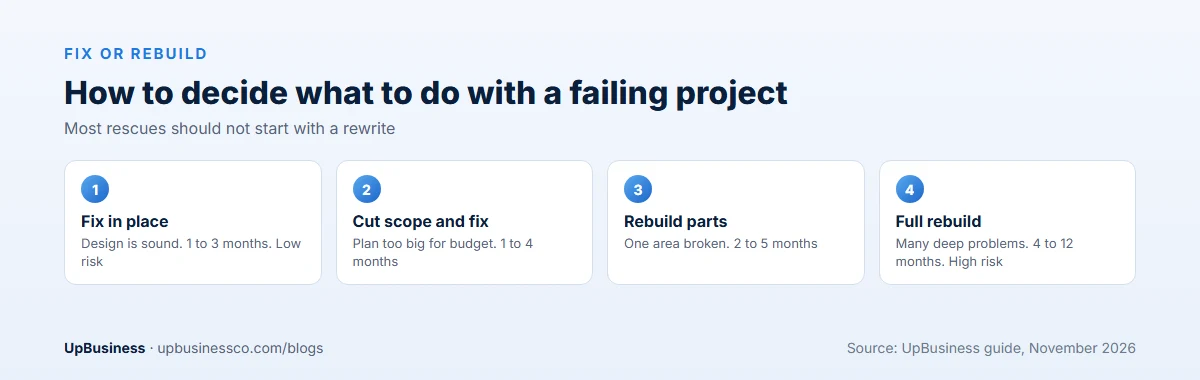
This is the biggest decision in any rescue. Developers often want to rebuild, because writing new code is more fun than fixing old code. Rebuilding is usually slower and more expensive than it looks.
| Option | Choose it when | Typical time | Risk |
|---|---|---|---|
| Fix in place | Core design is sound; problems are bugs, tests and process | 1 to 3 months | Low |
| Cut scope and fix | Design is fine but plan was too big for the budget | 1 to 4 months | Low to medium |
| Rebuild parts | One area is broken, such as payments or the database | 2 to 5 months | Medium |
| Full rebuild | Wrong technology, no tests, insecure, and nobody understands it | 4 to 12 months | High |
A full rebuild makes sense when the audit finds several deep problems at once: the wrong technology for the job, serious security holes, no tests, and code nobody can explain. Even then, keep the old system running until the new one is proven. Our guide to application modernization services covers rebuild options in more depth.
Talking to Your Current Team First
Before you replace anyone, have one honest meeting with the current team. Many projects fail because of the setup, not the people, and the team may already know what's wrong. Ask four questions:
- What exactly is left to build, as a list?
- What is slowing you down most right now?
- What would you need to finish the must-have features, and by when?
- What would you do differently if you started again?
Listen for specific, honest answers. "The payment code has no tests, so every change breaks checkout" is useful. "Just two more weeks" is not, if you've heard it before. If the team gives clear answers and agrees to an outside audit, you may be able to keep them under a new plan. If they refuse an audit or won't share access, that tells you what you need to know.
Contract and Payment Issues During a Rescue
Read your contract before you make any move. Check who owns the code, what notice you must give to end the deal, and which payments are still due. If the contract ties payments to milestones, you may not owe money for milestones that weren't delivered.
Keep the tone calm and put everything in writing. Ask for the handover items in an email with a clear date. Avoid threats; a team that feels attacked may delay the handover. If the other side won't hand over code you paid for, a lawyer's letter usually works faster than a court case. In future contracts, ask for code to be pushed to your own repository every day, so you're never stuck.
Software Project Rescue Services: What a Partner Does
A software project rescue service is a new team that takes over a troubled project. A good rescue partner works in stages: a fixed-price audit, a short stabilization phase, then delivery of the remaining features in short cycles. They should also document the system as they learn it. Then no single team can hold you hostage again. Expect a senior developer or architect to lead the audit, with a project manager who sends weekly reports.
Why Adding More Developers Rarely Helps
When a project is late, the first idea is often to add people. Fred Brooks described the problem in 1975 in The Mythical Man-Month: adding people to a late software project makes it later. New developers need weeks to learn the code, and existing developers spend time training them instead of building.
Add people only after the plan is reset, the foundations are fixed and the work can be split into clear, separate parts. Even then, add one or two at a time.
Real Examples of Failed Software Projects
Failure happens at every size, including at governments and banks.
- HealthCare.gov, 2013. The US health insurance website failed on launch day in October 2013. The US Government Accountability Office later found weak planning and oversight of contractors, including unclear requirements and missed warning signs[2]. A rescue team stabilized it in the following months by fixing monitoring, holding daily check-ins and fixing the worst problems first.
- TSB Bank, 2018. A UK bank moved customers to a new IT platform, and many lost access to their accounts for days or weeks. UK regulators later fined TSB £48.65 million for failing to manage the risks of the move[3].
Both cases share the same lessons. Nobody clearly owned the outcome, testing before launch was thin, and warning signs were seen but not acted on. Smaller projects fail the same way, just with less press.
How Much Does a Software Project Rescue Cost?
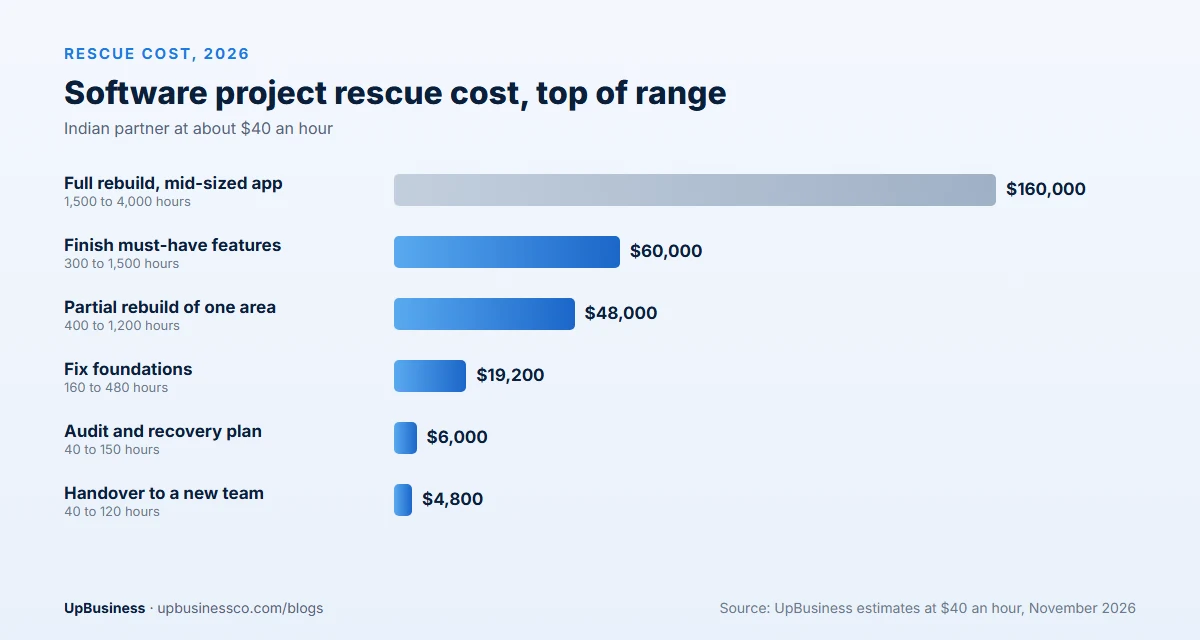
These are our estimates for a rescue by an Indian partner at about $40 an hour. US rates are much higher: the GSA CALC median ceiling rate is $167 an hour for a software architect and $107 for a project manager[4].
| Rescue work | Hours | Cost at $40/h |
|---|---|---|
| Independent audit and recovery plan | 40 to 150 | $1,600 to $6,000 |
| Handover and setup of a new team | 40 to 120 | $1,600 to $4,800 |
| Fixing foundations: tests, release process, staging | 160 to 480 | $6,400 to $19,200 |
| Finishing must-have features | 300 to 1,500 | $12,000 to $60,000 |
| Partial rebuild of one area | 400 to 1,200 | $16,000 to $48,000 |
| Full rebuild of a mid-sized app | 1,500 to 4,000 | $60,000 to $160,000 |
Worked Example: A Marketplace App, 8 Months Late
A startup paid $55,000 of a $70,000 budget for a service marketplace app: customer app, provider app, admin panel and payments. After 14 months, the planned 6-month build had no working payments, 180 open bugs and no tests. The original company stopped replying to emails.
Here's how a rescue would run:
| Step | Hours | Cost at $40/h |
|---|---|---|
| Recover code and accounts; audit | 80 | $3,200 |
| Set up tests, staging and release pipeline | 160 | $6,400 |
| Fix the 40 bugs that block users | 200 | $8,000 |
| Rebuild payments on a standard gateway | 180 | $7,200 |
| Finish must-have features, cut the rest | 240 | $9,600 |
| Total over about 4 months | 860 | $34,400 |
The final cost is about $89,400, or 28% over the original budget. A full rebuild would have cost more and taken longer. The startup launched with booking, payments and reviews, and moved loyalty points and in-app chat to a later phase.
Taking Over a Project From Another Developer
If you're replacing the team, plan the handover carefully. Ask the old team for:
- All source code, pushed to a repository you own.
- A list of every account, service and key the software uses.
- Database backups and the steps to restore them.
- Setup instructions to run the project on a new computer.
- Open bugs and known problems, in writing.
- A one to two hour call with the new team, if they'll agree.
Pay any final invoice only after these arrive, if your contract allows it. Then change every password and key, because the old team still knows them. Our app maintenance cost guide covers what ongoing support costs once the project is stable.
How to Avoid a Failing Software Project Next Time
- Write a clear brief. Goals, users, must-have features and budget. Our software project brief template helps.
- Compare proposals line by line. The cheapest quote often leaves out testing or admin work. See how to compare software development proposals.
- Check the company first. Our guide on how to verify a software development company and our due diligence checklist list what to check.
- Pay against working software. Tie payments to features you can test, not to dates.
- Own everything from day one. Code, accounts and designs in your name.
- Budget for testing. Plan 15% to 25% of build effort for testing. Our software testing cost guide gives ranges.
- Keep a 15% to 20% reserve. Every project finds surprises.
When to Bring In a Rescue Partner
Bring in an outside team when the current team can't explain the problem, when trust has broken down, or when the original company has stopped responding. An outside team brings fresh eyes and no reason to defend old decisions.
Ask any rescue partner these questions:
- Have you taken over a half-built project before? What did you find, and what did you do?
- How will you audit the code, and what will the report include?
- Will you give a fixed price for the audit before quoting the full rescue?
- Who will work on our project, and can we meet them?
- How will you report progress each week?
Our list of questions to ask a software development company has more.
Find a Rescue Partner on UpBusiness
UpBusiness lists verified partner companies, mostly based in India and serving buyers worldwide. Every company passes checks reviewed by our team: company details, registration and tax papers, the founder's identity, expertise and three client projects with evidence. Only companies with a TrustScore of 70 or more are listed.
Our custom software development companies page lists firms that build and maintain web apps, mobile apps and business systems. Ask each for a fixed-price audit first, so you can judge their work before you commit to the full rescue.
- Post your requirement with what was built, the stack, what's broken and your deadline.
- Get three partner companies matched to your budget, service and industry.
- Compare audit offers side by side. Buyers pay nothing, and there's no commission on the project.