

Browse our curated list of AI Development Companies
The best AI in healthcare use cases today are not robot doctors. They are tools that take paperwork off clinicians: writing visit notes, reading referral faxes, coding claims, booking patients and flagging who may miss an appointment. Those projects cost about $12,000 to $72,000 with an Indian partner and pay back within months. Diagnostic AI, such as reading scans, is a medical device in most countries and costs far more. Below are 12 use cases, what each costs, the rules that apply and how to start.
This guide is for clinic owners, hospital IT leads, health tech founders and operations heads who want to buy or build AI. It's written for buyers, not researchers, so every section ends with what you should do next.
Key takeaways
- Two in three US physicians used AI in 2024, up from 38% in 2023, and 57% said cutting paperwork was the biggest opportunity, according to the American Medical Association.
- The FDA's list of AI-enabled medical devices passed 1,400 by the end of 2025, and about three in four are for radiology.
- Admin and workflow AI costs $12,000 to $72,000 to build at about $40 an hour. Regulated diagnostic AI often costs $80,000 to $240,000 or more, before clinical studies.
- In the US, any partner that touches patient data must sign a business associate agreement. Healthcare had the highest average breach cost of any industry in IBM's 2025 report.
How Is AI Used in Healthcare Today?
Most AI in healthcare does one of three jobs. It reads and writes text, such as notes, letters and claims. It predicts something, such as a no-show, a readmission or a claim denial. Or it reads images and signals, such as X-rays, ECGs and skin photos.
The first two jobs are where most clinics start. They don't make medical decisions, so they're faster to approve and cheaper to build. The third job affects diagnosis. Regulators treat it as a medical device.
Doctors are already on board. The American Medical Association's 2024 survey of 1,183 physicians found 66% used some form of AI, up from 38% a year earlier[1]. Their top wish was less admin work. Our AI adoption statistics report covers adoption across other industries.
12 AI in Healthcare Use Cases, With Examples
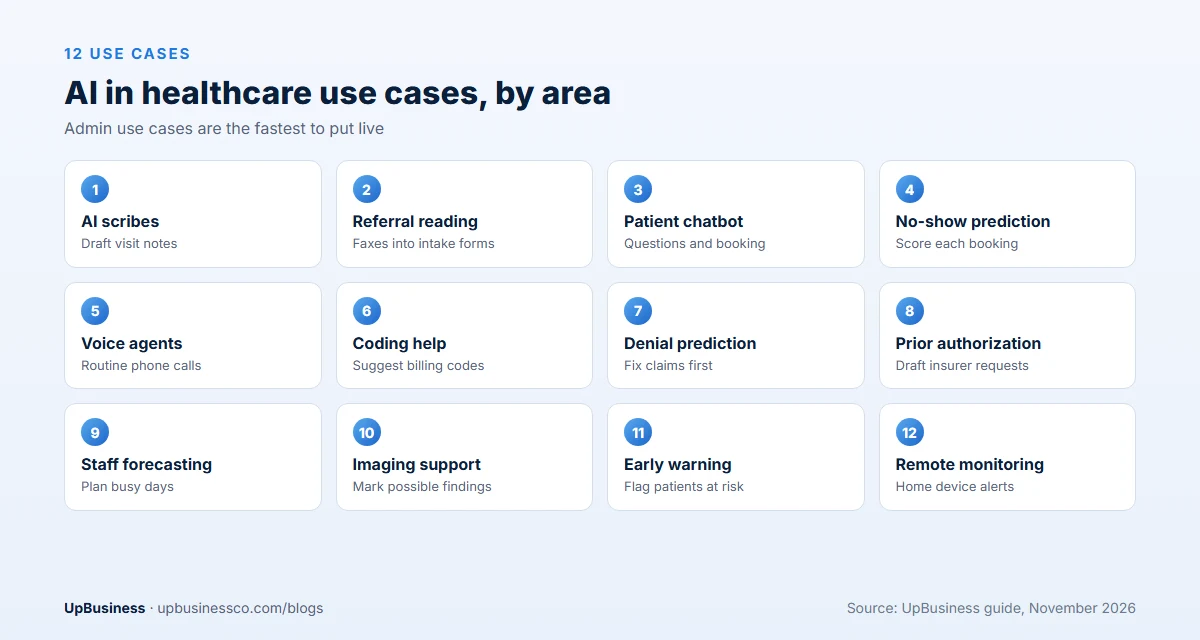
Here are the 12 use cases buyers ask about most, grouped by how hard they are to put live.
Admin and patient access
- Ambient clinical notes (AI scribes). The tool listens to the visit, with consent, and drafts the note for the doctor to check. In a 2025 study of 263 clinicians across six US health systems, burnout fell from 51.9% to 38.8% after 30 days of use[2].
- Referral and fax reading. AI pulls patient details, reason for referral and insurance from scanned documents and fills the intake form. Staff only check and approve. Our guide to intelligent document processing services explains how this works.
- Patient chatbot and booking. A website or WhatsApp assistant answers common questions, books and moves appointments, and sends reminders. It hands anything clinical to a person.
- No-show prediction. A model scores each booking for the chance the patient won't come. Staff call high-risk patients or double-book that slot.
- Voice agents for phone lines. An AI voice agent answers routine calls about hours, refills and appointment changes. Our AI voice agent cost guide has pricing.
Revenue and operations
- Medical coding help. AI suggests billing codes from the note. A certified coder accepts or changes them.
- Claim denial prediction. A model flags claims likely to be denied before they're sent, with the likely reason, so staff fix them first.
- Prior authorization drafts. AI gathers the clinical facts an insurer asks for and drafts the request.
- Staff and bed forecasting. Models predict busy days in the emergency room or wards so managers plan shifts.
Clinical support
- Imaging support. AI marks possible findings on X-rays, CT or mammograms for a radiologist to review. This is the biggest group on the FDA's AI device list[3].
- Early warning scores. Models watch heart rate, blood pressure, temperature and lab results to flag patients who may get worse, such as with sepsis.
- Remote patient monitoring. AI reviews readings from home devices, such as blood pressure cuffs or glucose monitors, and alerts nurses to the few that need action.
Generative AI, the kind that writes text, powers use cases 1, 2, 3, 6 and 8. Agentic AI, which can take steps on its own, is starting to appear in booking and prior authorization. In healthcare, keep a person approving every step that affects a patient.
Generative AI in Healthcare: Use Cases and Limits
Generative AI is the type behind tools like ChatGPT. In healthcare it's good at first drafts: visit notes, discharge letters in plain language, replies to patient messages, insurer letters and summaries of long records. It's poor at facts it can't check. It can make up a drug dose or a test result that sounds right.
So use it where a trained person reviews every output before it reaches a patient or a record. Give it your own approved documents to work from, rather than letting it answer from general knowledge. And log what it was asked and what it wrote, so you can trace any mistake. These three habits turn a risky tool into a useful one.
Which Use Cases Pay Back Fastest?
Start with work that is high volume, low risk and easy to measure. A clinic that handles 400 referral faxes a week, at 6 minutes each, spends 40 staff hours a week on typing. If AI cuts that to 2 minutes, you get back about 27 hours a week. That's a clear number you can check after one month.
| Use case | Risk to patients | Time to go live | Easy to measure? |
|---|---|---|---|
| Referral and fax reading | Low (staff approve) | 2 to 4 months | Yes: minutes per document |
| Patient chatbot and booking | Low (no clinical advice) | 1 to 3 months | Yes: calls and bookings handled |
| No-show prediction | Low | 2 to 4 months | Yes: no-show rate |
| AI scribe integration | Medium (doctor signs note) | 3 to 6 months | Yes: after-hours note time |
| Claim denial prediction | Low | 3 to 6 months | Yes: denial rate |
| Early warning scores | High | 6 to 12 months | Harder: needs clinical study |
| Imaging support | High (medical device) | 12 to 36 months | Needs regulatory approval |
High-risk tools can still be worth it. Just plan for longer testing, more paperwork and a bigger budget.
How Much Does AI in Healthcare Cost?
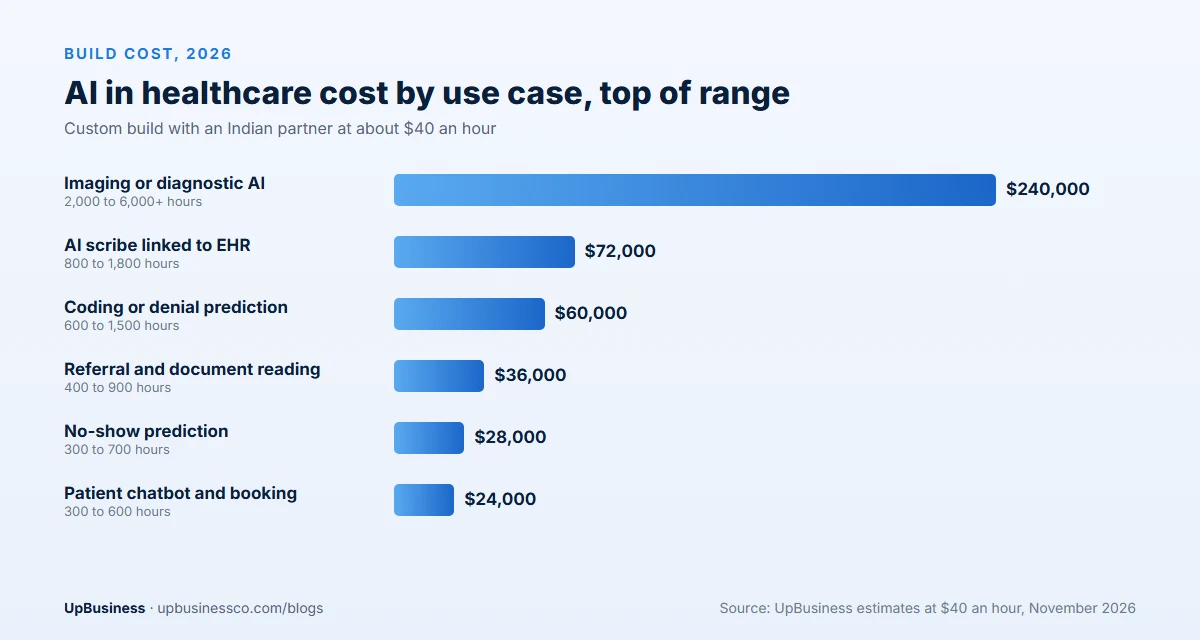
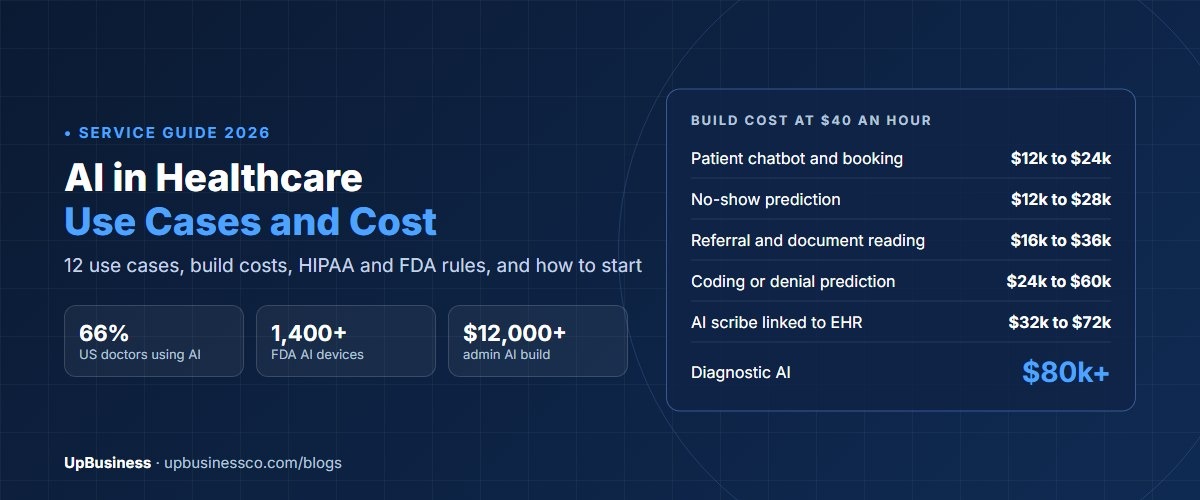
Cost depends on the use case, how clean your data is, which electronic health record (EHR) you use and the rules you must meet. These ranges are our estimates for a custom build with an Indian partner at about $40 an hour. They include design, build, testing and launch, but not software licences or cloud bills.
| Use case | Hours | Build cost at $40/h | Monthly running cost |
|---|---|---|---|
| Patient chatbot and booking | 300 to 600 | $12,000 to $24,000 | $200 to $1,000 |
| No-show prediction | 300 to 700 | $12,000 to $28,000 | $100 to $500 |
| Referral and document reading | 400 to 900 | $16,000 to $36,000 | $300 to $1,500 |
| Coding help or denial prediction | 600 to 1,500 | $24,000 to $60,000 | $500 to $2,000 |
| AI scribe connected to your EHR | 800 to 1,800 | $32,000 to $72,000 | $1,000 to $3,000 |
| Imaging or diagnostic AI (medical device) | 2,000 to 6,000+ | $80,000 to $240,000+ | Varies, plus regulatory costs |
Running costs cover cloud hosting, AI model usage, monitoring and support. They grow with volume. A chatbot that handles 5,000 chats a month costs much less to run than one that handles 100,000.
Three things push the price up. Linking to an EHR such as Epic, Oracle Health or athenahealth adds 100 to 400 hours, because each system has its own rules and test setups. Messy data, such as handwritten forms or years of free-text notes, adds cleaning work. And anything that counts as a medical device needs clinical testing, quality systems and regulatory filings, which can cost more than the software.
For chatbots alone, our AI chatbot development cost guide breaks prices down further.
Worked Example: AI Reads Referral Faxes for a Clinic Group
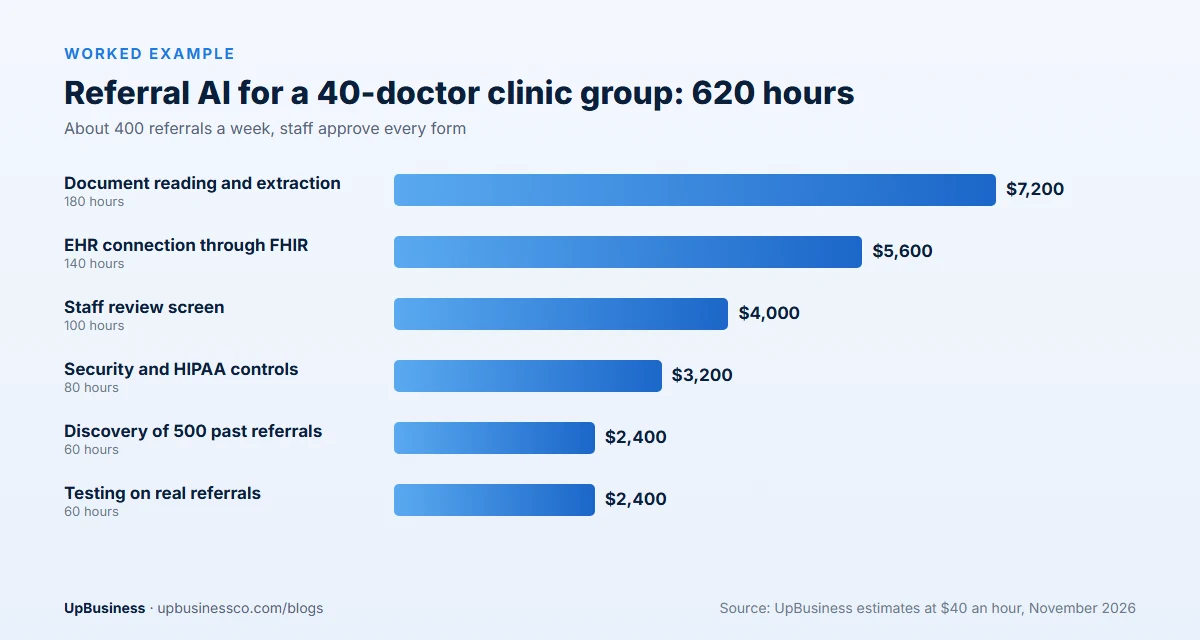
A clinic group with 40 doctors gets about 400 referrals a week by fax and email. Two staff members type each one into the EHR. The group wants AI to read each referral, fill the intake form and flag missing insurance details. Staff will review every form before it's saved.
| Work | Hours | Cost at $40/h |
|---|---|---|
| Discovery and review of 500 past referrals | 60 | $2,400 |
| Document reading and field extraction | 180 | $7,200 |
| EHR connection through FHIR (a health data standard) | 140 | $5,600 |
| Review screen for staff, with confidence scores | 100 | $4,000 |
| Security, audit logs and HIPAA controls | 80 | $3,200 |
| Testing against real past referrals | 60 | $2,400 |
| Total | 620 | $24,800 |
Running costs come to about $600 a month for cloud, document AI and support. If typing time drops from 6 minutes to 2 minutes per referral, the group saves about 27 staff hours a week. At $25 an hour for front-desk staff, that's about $2,700 a month. The build pays back in under a year, and staff can move to patient calls.
The same 620 hours from a US firm at $150 an hour would cost about $93,000. That gap is why many US clinics and health tech startups work with Indian partner companies, under a signed business associate agreement.
Rules You Must Follow
Health data is among the most protected data in the world. Before you share a single record with a partner, check which rules apply to you.
| Rule | Where | What it means for your AI project |
|---|---|---|
| HIPAA | United States | Any partner or cloud that stores or processes patient data must sign a business associate agreement (BAA) |
| FDA medical device rules | United States | AI that helps diagnose or treat may need FDA clearance before you sell or use it |
| GDPR | EU and UK | Health data is a special category; you need a legal basis, a data protection impact assessment and limits on transfers |
| EU AI Act | European Union | AI in medical devices counts as high-risk and needs risk controls, human oversight and records |
| Local health data laws | India, UAE, Australia and others | Check where data may be stored and whether patient consent is needed |
The US Department of Health and Human Services says a cloud provider that stores patient data is a business associate, even if the data is encrypted and the provider can't read it[4]. The same applies to an AI partner. In the EU, the AI Act puts AI used in medical devices in its high-risk group[5].
A simple test: if your AI only helps with admin, such as booking or reading forms, it's usually not a medical device. If it suggests a diagnosis or a treatment, talk to a regulatory expert before you build.
Security matters as much as law. Healthcare had the highest average breach cost of any industry in IBM's 2025 Cost of a Data Breach report[6]. If your tool uses a large language model, follow our LLM security checklist too.
What Can Go Wrong With Healthcare AI
AI can look accurate in a demo and fail with real patients. The best-known example is a sepsis warning model used in many US hospitals. When researchers at Michigan Medicine tested it on 27,697 patients, it missed about two in three sepsis cases and raised many false alarms[7].
The lessons for any buyer:
- Test on your own data. A model built on one hospital's patients may not work on yours.
- Check for bias. Ask how accuracy changes by age, sex, race and language. A model that works for most patients but fails for one group can cause harm.
- Watch it after launch. Accuracy can drop when your patients, staff habits or codes change. Plan a monthly check.
- Keep a person in charge. AI should suggest. A clinician or trained staff member should decide.
- Tell patients. Get consent for AI scribes and tell patients when they're talking to a chatbot.
Buy, Build or Customize?
You don't always need custom software. Many AI tools for healthcare are sold as ready products. Here's how to choose.
| Option | Best for | Cost | Watch out for |
|---|---|---|---|
| Buy a ready product | Common needs like AI scribes or coding help | Monthly fee per user or per visit | Fit with your EHR and workflow; data use terms |
| Customize a product | A ready tool that needs your forms, rules or language | Product fee plus 100 to 400 partner hours | Who owns the custom work |
| Build custom | Unusual workflows, your own product, or data you can't send out | $12,000 to $72,000 for most admin tools | Longer start; you own testing and upkeep |
Our guide to custom AI vs off-the-shelf AI goes deeper on this choice. Many clinics buy a scribe product and hire a partner to link it with their EHR and reports. Our AI integration services guide covers that kind of work.
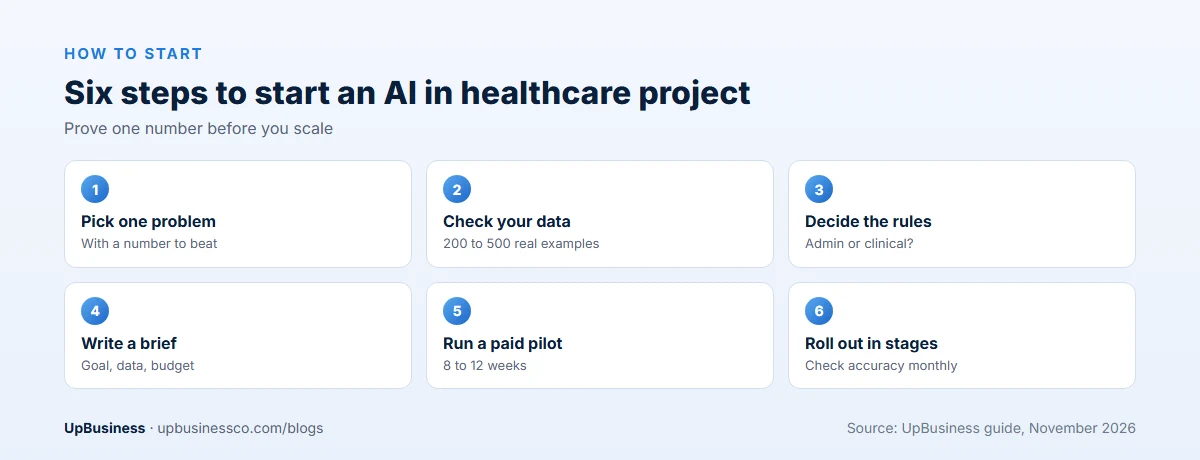
How to Start: A 6-Step Plan
- Pick one problem with a number. For example, "referral typing takes 40 staff hours a week." Avoid "use AI to improve care."
- Check your data. Collect 200 to 500 real examples, with patient details removed where possible. This shows the partner what they're dealing with.
- Decide the rules. Is it admin or clinical? Which laws apply? Who must approve it inside your organization?
- Write a short brief. Our AI RFP template lists what to include: goal, data, success measures, security and budget.
- Run a paid pilot. Build for one clinic or one department over 8 to 12 weeks. Measure the number from step 1.
- Roll out in stages. Add sites one by one, train staff and keep checking accuracy each month.
Questions to Ask a Healthcare AI Partner
Ask every partner these questions and get the answers in writing.
- Which healthcare projects have you built? Ask for two, with the EHR they connected to and what changed for the client.
- Will you sign a BAA or a data processing agreement? If the answer is no, stop there.
- Where will patient data be stored and processed? Get the country and cloud region in writing.
- Which AI models will you use, and does the model provider keep our data? Many providers offer settings that stop your data from being stored or used for training.
- How will you test accuracy and bias on our data? Ask for a sample test report.
- Who on your team will see patient data? Expect named people, two-step sign-in and access removed at the end.
- Who owns the code, the model settings and the training data? It should be you.
Our list of questions to ask an AI development company has more.
Red Flags in Healthcare AI Proposals
- "Our AI is 99% accurate." Accurate on what data, and for which patients? Ask for the test set.
- No mention of a BAA, consent or data location. The partner hasn't worked in healthcare before.
- Patient data sent to a public chatbot. Free consumer AI tools are not covered by a BAA.
- The AI makes clinical decisions alone. That creates legal and safety risk.
- No plan for after launch. Models need monitoring, updates and someone to call when they're wrong.
- A fixed price for a diagnostic tool with no regulatory plan. The software may be the cheap part.
Find a Healthcare AI Partner on UpBusiness
UpBusiness lists verified partner companies, mostly based in India and serving buyers worldwide. Every company passes checks reviewed by our team: company details, registration and tax papers, the founder's identity, expertise and three client projects with evidence. Only companies with a TrustScore of 70 or more are listed.
Our AI development companies page lists firms that build chatbots, document AI, AI agents and custom models. Few list healthcare as a main industry, so ask each one for past health projects and a signed BAA before you share any data.
- Post your requirement with the use case, your EHR, patient volume and where your patients are.
- Get three partner companies matched to your budget, service and industry.
- Send each the same questions from this guide and compare answers side by side. Buyers pay nothing, and there's no commission on the project.