

Browse our curated list of Disaster Recovery Companies
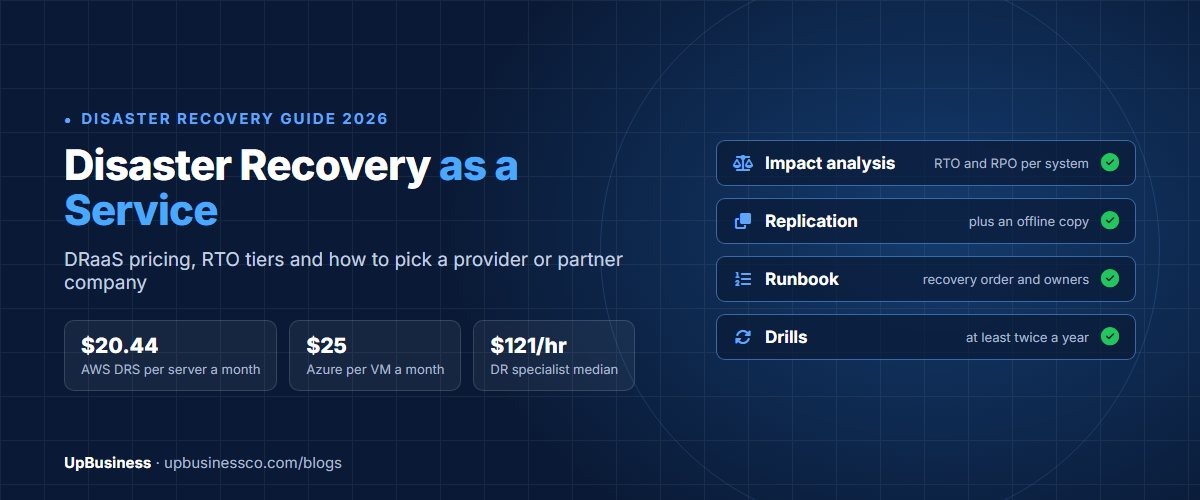
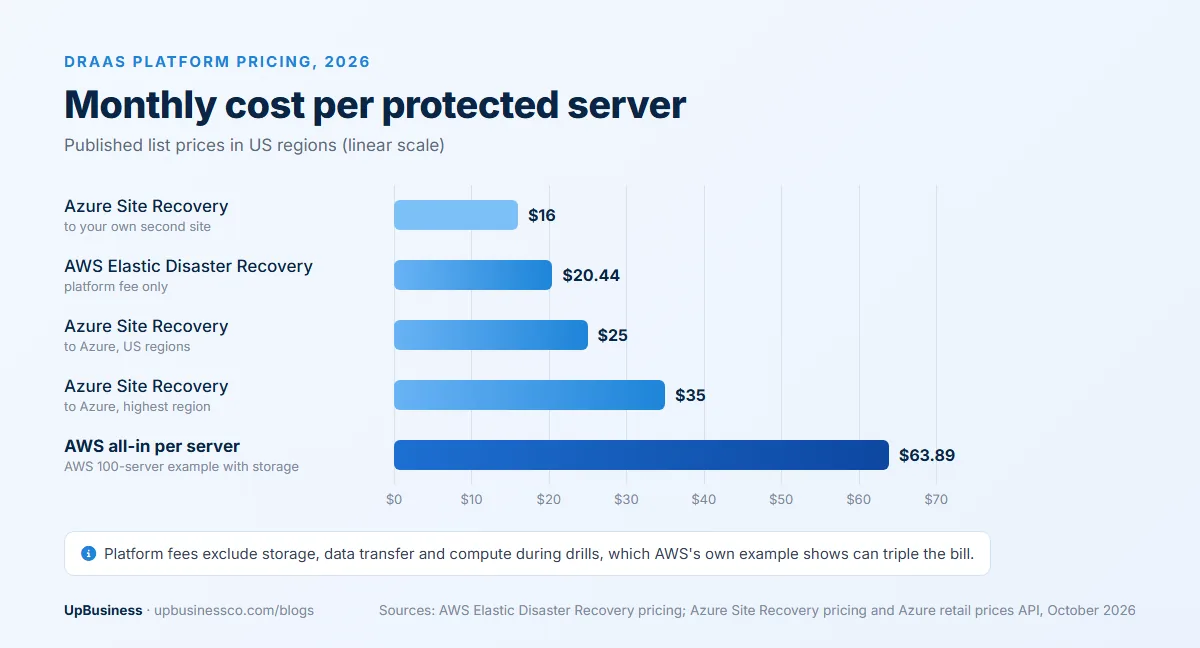
Disaster recovery as a service (DRaaS) is a paid arrangement where a cloud platform or a partner company keeps a copy of your servers and data ready in another location. When your main systems fail, you switch over and keep trading. The platform fee is the cheap part. AWS Elastic Disaster Recovery charges $0.028 per replicating server an hour, about $20.44 a month[1], and Azure Site Recovery charges $25 per protected instance a month for replication to Azure[2]. Storage, test runs and the people who build and rehearse the plan cost more. This guide is for founders, IT heads and operations managers who need to price disaster recovery as a service, compare it with plain backups and pick a provider or partner company to run it.
Key takeaways
- Platform fees start at about $16 to $25 a server a month, but AWS's own 100-server example totals $6,389.03 a month once storage and replication servers are added, roughly $64 a server.
- Your recovery time objective (RTO) and recovery point objective (RPO) set the price more than server count does. Minutes of downtime cost far more to buy than hours.
- US federal contract rates for disaster recovery specialists have a median ceiling of $121 an hour across 205 rates, so 40 to 120 hours of setup work costs roughly $5,000 to $15,000.
- In Sophos research on ransomware victims, median recovery costs were $3 million when backups were compromised against $375,000 when they weren't, which is why offline copies and tested recovery matter.
What Is Disaster Recovery as a Service (DRaaS)?
DRaaS copies your servers, applications and data to a second site, usually a public cloud region, and keeps that copy current. When the main site goes down through a hardware fault, a fire, a cloud outage or ransomware, you start the copies in the recovery site and point users at them. Moving back to the main site later is called failback.
People often use backup, disaster recovery and DRaaS as if they meant the same thing. They don't, and the difference decides how long your business is offline.
| Option | What it protects | How long recovery takes | Who runs the recovery |
|---|---|---|---|
| Backup | Copies of files, databases and system images | Hours to days, since servers must be rebuilt before data is restored | Your team |
| Disaster recovery (self-run) | Whole servers and applications, replicated to a second site you manage | Minutes to hours, depending on how much is kept running | Your team, with your own runbooks |
| Disaster recovery as a service | Whole servers and applications, replicated by a provider or partner company | Minutes to hours, set by the RTO you pay for | Shared or fully handled by the provider, as agreed in the contract |
You still need backups when you buy DRaaS. Replication copies mistakes too: if a file gets encrypted by ransomware or deleted by accident, the replica receives the same damage within seconds. Backups with older restore points, and at least one copy that attackers can't reach, cover that gap. CISA's ransomware guide asks organisations to keep offline, encrypted backups and to test that they can be restored[3].
Providers sell DRaaS in three operating models. In self-service DRaaS you get the replication tool and do everything else. In assisted DRaaS a partner company designs the setup and helps during tests and real events. In managed DRaaS the provider monitors replication, runs drills and carries out the failover for you. Expect that model to carry the highest monthly fee, since you're paying for the provider's people as well as the platform.
How Much Does Disaster Recovery as a Service Cost?
Disaster recovery as a service usually costs $16 to $35 per server a month in cloud platform fees, plus storage and replication resources that often double or triple that figure. A managed service or partner company adds setup fees, roughly $5,000 to $15,000 for 40 to 120 hours at US contract rates, and monthly support for monitoring and tests.
The big three clouds publish their prices, which gives you a checkable baseline before any partner company quotes.
| Platform | List price | What is billed on top |
|---|---|---|
| AWS Elastic Disaster Recovery[1] | $0.028 per replicating source server an hour, about $20.44 a month | EBS storage, snapshots and small EC2 replication servers; full EC2 compute only during drills and recovery |
| Azure Site Recovery to Azure[2] | $25 per protected instance a month in US regions, up to $35 in some others | Azure storage, storage transactions and data transfer; compute when recovered machines run. First 31 days free per instance |
| Azure Site Recovery to your own second site[2] | $16 per protected instance a month | Your own hardware, licences and data centre costs at the second site |
| Google Cloud Backup and DR[4] | Management fee per GiB of protected source capacity, plus storage per GiB | Compute and network charges when you restore or recover |
Why the platform fee is only part of the bill
AWS shows the gap in its own worked example. Replicating 100 on-premises servers with 30 TB of disks and a 3.3% daily change rate costs $2,044 a month in Elastic Disaster Recovery fees. EBS volumes add $1,425, snapshots kept for 7 days add $1,846.50 and the replication servers add $1,053.54, for a total of $6,389.03 a month[1]. That's about $63.89 a server, and the headline fee covers only a third of it.
Three things push the rest up. Data volume and change rate drive storage, since every changed block is copied and kept as a recovery point. Retention multiplies it: 30 days of recovery points cost more than 7. Test runs add compute for the hours the recovered servers run, which AWS puts at $122.94 for an 8-hour drill across the same 100 servers[1]. Licences matter too. Microsoft says recovered Windows Server and SQL Server machines must be properly licensed at the recovery site, though active Software Assurance includes a disaster recovery benefit for some cases[2].
What a partner company or managed provider charges
Fees for the people side are rarely published, so we pulled US federal contract rates from the GSA CALC database in October 2026[5]. Across 205 ceiling rates from 89 contractors for disaster recovery roles (specialists, analysts, administrators and managers), the median is $121 an hour and the middle half sits between $104 and $145. Business continuity planners, who lead the wider plan for people and processes, come in at a median of $130 across a smaller sample of 32 rates. These are maximum rates for US government buyers, so commercial quotes from the same firms are often similar or a little lower, while partner companies in India usually quote well below them.
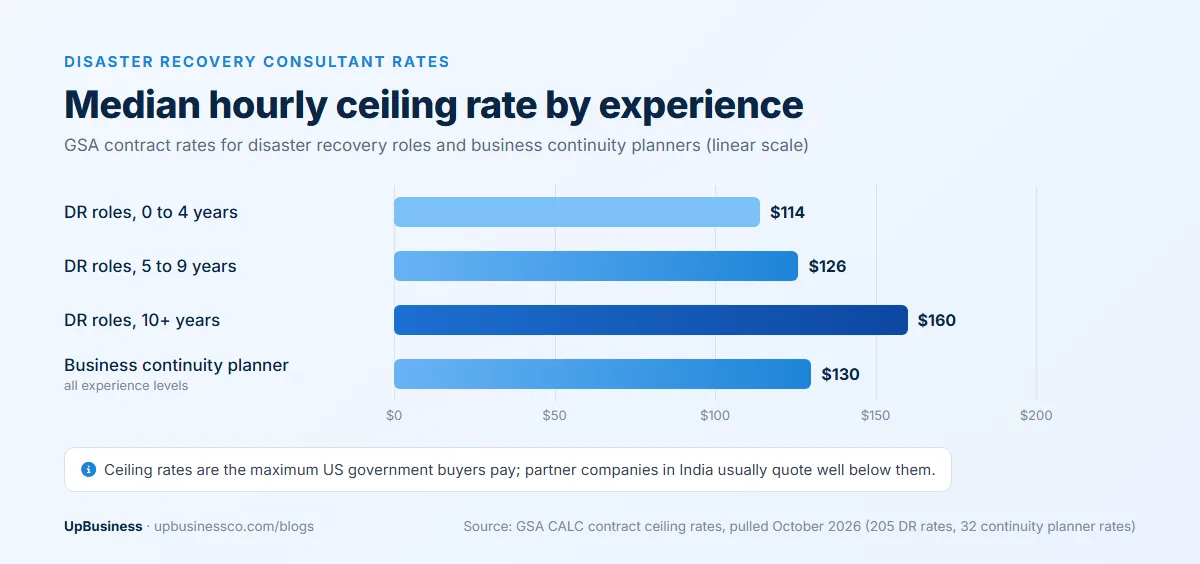
Seniority moves the rate more than job title. Ceiling rates for disaster recovery roles needing up to 4 years of experience have a median of $114 an hour, rising to $126 at 5 to 9 years and $160 at 10 years or more[5]. A good setup team mixes the two ends: a senior engineer to design the recovery order and run the first drill, and a mid-level engineer to build replication and write runbooks.
RTO and RPO: The Two Numbers That Set Your Price
Recovery time objective is how long a system can be down before the damage becomes unacceptable. Recovery point objective is how much recent data you can afford to lose, measured in time. NIST's contingency planning guide ties both to a business impact analysis, where you decide for each system how long the business can cope without it[6]. Ready.gov gives smaller firms the same advice in plainer terms: the recovery time for each IT system should match the needs of the business process that depends on it[7].
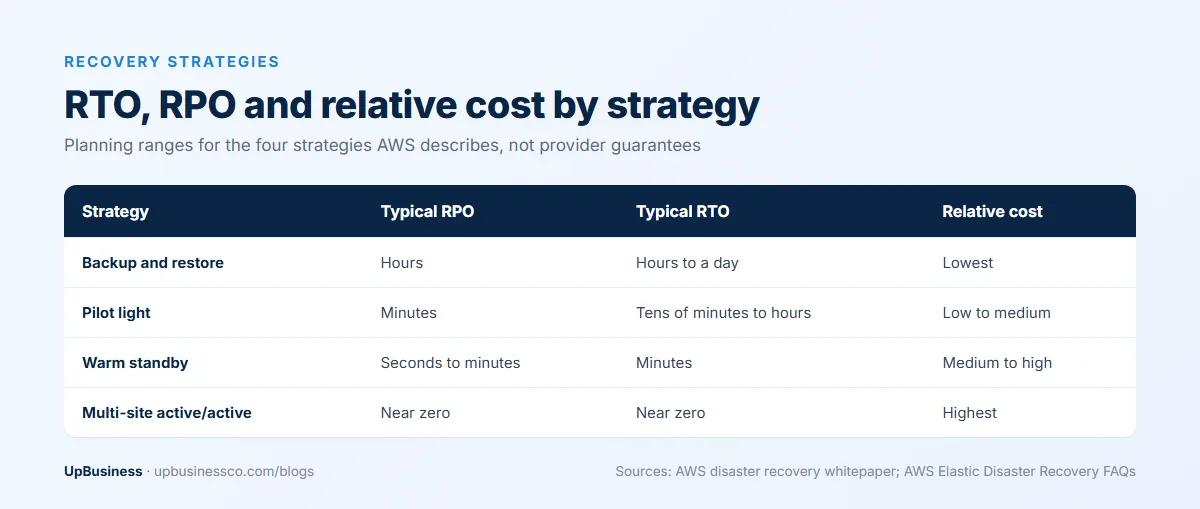
AWS describes four recovery strategies, from cheap backups to fully active copies in two regions[8]. The ranges below are planning figures for each strategy, not guarantees from any provider.
| Strategy | Typical RPO | Typical RTO | What runs all the time | Relative cost |
|---|---|---|---|---|
| Backup and restore | Hours (the last backup) | Hours to a day | Nothing; servers are rebuilt from backups | Lowest |
| Pilot light | Minutes | Tens of minutes to a few hours | Replicated data and core databases; app servers stay off | Low to medium |
| Warm standby | Seconds to minutes | Minutes | A scaled-down copy of the full system | Medium to high |
| Multi-site active/active | Near zero | Near zero | A full second copy serving live traffic | Highest, often close to double the infrastructure |
Replication-based DRaaS tools sit between pilot light and warm standby. AWS says Elastic Disaster Recovery supports RPOs of seconds and RTOs of minutes[9], because data is copied continuously while full servers are only started during a drill or a real event.
Not every system deserves the fastest tier. A typical small business might put its order system and customer database in a minutes-level tier, its accounting and email in an hours-level tier, and file archives in backup and restore. Splitting systems this way is the single biggest saving available, because paying minutes-level prices for an archive server buys nothing.
What Downtime Costs, and When DRaaS Pays for Itself
The case for spending on recovery rests on what an outage costs you. ITIC's 2024 hourly cost of downtime survey found that 97% of large enterprises with more than 1,000 employees put the cost of one hour of downtime above $100,000. Another 41% put it between $1 million and over $5 million[10]. In the same survey, nearly all firms reporting less than $100,000 an hour were micro businesses with fewer than 10 employees.
Smaller companies should run their own numbers rather than borrow these. Take revenue lost per hour, add staff who can't work, then add penalties, refunds and the cost of catching up. If that comes to $2,000 an hour and your order system goes down for two days, a $1,500 monthly DR bill pays for itself after one bad event every year or two.
Plenty of outages start with ordinary mistakes rather than disasters. Uptime Institute's 2025 outage analysis reports that nearly 40% of organisations had a major outage caused by human error in the past three years. In 85% of those cases, staff didn't follow procedures or the procedures themselves were flawed[11]. Written runbooks and rehearsed drills address exactly that.
Ransomware is the case that tests plans hardest. In a Sophos study of organisations hit by ransomware, 94% said attackers tried to compromise their backups and 57% of those attempts succeeded. Median recovery costs reached $3 million where backups were compromised, against $375,000 where they survived, and only 26% of the first group fully recovered within a week compared with 46% of the second[12]. A DR setup with isolated recovery points and separate credentials is what keeps you in the second group.
Worked Example: DRaaS for a 20-Server Business
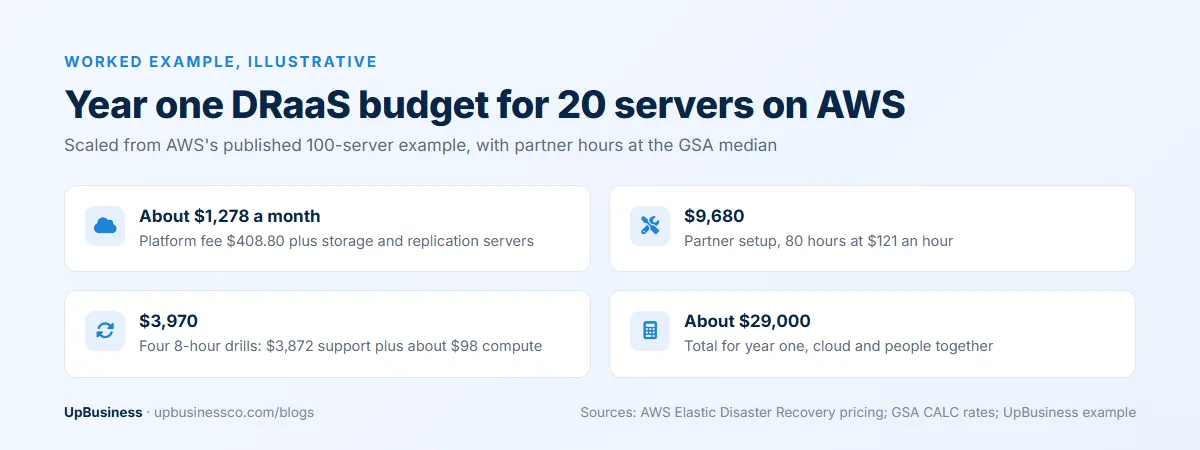
Here is an illustrative year-one budget for a business with 20 servers replicated to AWS, using AWS's published example as the per-server baseline. Treat it as a rough planning figure, not a quote.
| Cost line | How it's worked out | Year one |
|---|---|---|
| Elastic Disaster Recovery fee | 20 servers x $0.028 x 730 hours = $408.80 a month | $4,906 |
| Storage, snapshots and replication servers | AWS example of $4,345.03 for 100 servers, scaled to 20 = about $869 a month | $10,428 |
| Drill compute | 4 drills of 8 hours, about $24.59 each at one fifth of AWS's 100-server drill | $98 |
| Partner setup | 80 hours at the $121 GSA median for DR roles | $9,680 |
| Drill support | 4 drills x 8 hours x $121 | $3,872 |
| Total | About $29,000 |
The cloud bill comes to about $1,278 a month, or $15,334 a year, and the people side adds about $13,550. Each line moves with your choices. Servers with less data or a lower change rate shrink the storage line, and AWS's example assumes 300 GB per server, which is more than many small application servers hold. A partner company in India would usually quote the setup and the first year's drills for less than the US rate shown. On Azure, the platform fee for the same 20 servers is $500 a month after each instance's first 31 free days[2], before storage.
If a quote for this scope comes in far below $1,000 a month all in, ask which servers are excluded, how many recovery points are kept and whether any drill is included. A low quote usually means backup and restore sold under a DRaaS name.
Disaster Recovery Plan for a Small Business: 7 Steps
A small business doesn't need a 100-page plan. It needs a short document that the people on duty can follow at 2 a.m., built on these steps from Ready.gov's IT recovery guidance[7] and NIST SP 800-34[6].
- List every server, cloud service, laptop group and data store, with an owner for each.
- For each system, agree how long the business can run without it and how much data it can lose. Those answers become your RTO and RPO.
- Group systems into two or three tiers and pick a strategy for each tier from the table above.
- Set up backups with at least one offline or immutable copy, separate from the replication, and record where the credentials live.
- Write a runbook that sets the order in which systems come back and the DNS and network changes needed. It should also name who decides to fail over and how customers and staff hear about it.
- Keep contact details for staff, your partner company, your cloud provider and key suppliers in a printed copy as well as online.
- Test the plan, write down what broke, fix it and test again.
Order matters in step 5. Databases and identity services usually have to come back before the applications that depend on them. Start machines in the wrong order and the recovery can look like a failure, even when every server replicated correctly.
What a Disaster Recovery Partner Company Should Deliver
Whether you buy managed DRaaS or a one-off setup project, agree on deliverables you can check yourself before the final payment.
| Deliverable | How to accept it |
|---|---|
| Business impact analysis | Every system has an owner, an agreed RTO and RPO, and a tier |
| Replication and backup setup | Replication shows healthy for two weeks, and at least one backup copy sits in a separate account or offline |
| Recovery runbook | A staff member who didn't write it can follow it during a drill |
| First full drill | Systems come up in the right order within the agreed RTO, and a written report lists every issue found |
| Monitoring and alerts | Replication lag and failed backups send alerts to named people, and a test alert has been received |
| Access and ownership | Cloud accounts, recovery credentials and documentation are in your company's name |
For managed DRaaS, put the service terms in writing as well. That means the RTO and RPO the provider commits to per tier and the number of drills included each year. It also covers how fast they respond when you declare a disaster and what happens to your data if the contract ends. Our software development contract checklist covers exit, ownership and liability clauses that apply to DR contracts too.
How Often Should You Test Disaster Recovery?
Test at least twice a year, and after any big change such as a migration, a new core application or a change of provider. AWS notes that drills with its service don't stop replication or affect the source application[9], so the main costs are a few hours of compute and staff time.
Alternate between two kinds of test. A tabletop exercise walks the team through the runbook on paper and finds gaps in contacts and decisions. A technical drill starts the recovered servers in an isolated network and checks that users can log in and complete a real task, such as placing a test order. Keep each drill report as evidence for auditors, insurers and larger customers.
UpBusiness Partner Data: Disaster Recovery Services Companies
Our disaster recovery companies page lists 6 verified partner companies as of October 2026. They are full-service software firms, so we don't quote their project sizes here. Team sizes run from 1 to 10 employees up to 201 to 500, and four of the six are based in Noida, with one each in Ahmedabad and Mumbai.
None of the six lists disaster recovery among its top three specialisations. They're full-service software companies whose main work is app development, AI, digital transformation or ERP, with DR as one capability. That works well when the partner already builds or hosts the systems you need to protect. For a standalone DR project, ask each shortlisted partner for a recent drill report they ran (anonymised), the replication tool they used and the RTO they achieved against the target.
How to Choose a Disaster Recovery as a Service Provider
Start with your tiers and targets, not with a product. A request that says "order system back within 1 hour with no more than 5 minutes of data lost, accounting within 8 hours" gets comparable quotes, while "we need DRaaS" gets a price list. Then check each bidder on these points:
- Which platform the replication runs on, and whether you could keep running it with another partner company later.
- The RTO and RPO they will commit to in writing for each tier, and what happens if a drill misses them.
- How backups are protected from ransomware, including immutable or offline copies and separate admin credentials.
- Drills included per year, who runs them and what the report contains.
- Response time when you declare a disaster, with named contacts outside office hours.
- An itemised price that shows platform, storage, drill and support costs separately, plus the cost of failback.
- Where data is stored, which matters for privacy rules in the EU, UK, US states, India and the Gulf.
Put the answers side by side in one sheet; our notes on comparing software development proposals show a format that works for DR bids too. If your systems are moving to the cloud anyway, plan recovery as part of the cloud migration, since the same replication tools are often used for both. For day-to-day running of cloud servers, our managed cloud services guide covers what a provider handles outside a disaster, and the cybersecurity consulting guide covers the security controls that keep ransomware out of your backups. AWS-based estates can also use our AWS consulting partner guide, and the cloud cost optimization guide helps keep storage for recovery points from growing unchecked.
Red Flags in DRaaS Quotes
- One price for "DR" with no RTO or RPO written against each system.
- Backups stored in the same cloud account, with the same admin logins, as the live systems.
- No drill in the first 90 days, or drills charged at an open-ended hourly rate.
- Recovery accounts, keys or runbooks held only by the provider.
- Storage and data transfer left out of a monthly price that looks very low.
- A promise of "zero downtime" for a budget that only covers backup and restore.
If you'd like quotes from verified partner companies, post your project on UpBusiness with your list of systems and the RTO and RPO you need for each. Add your cloud platform and budget, then compare the proposals side by side.