

Browse our curated list of Backend Development Companies
Node.js vs Python comes down to what your backend does most. Pick Node.js for real-time features, many open connections and teams that already write JavaScript. Pick Python when AI, data processing or heavy calculations sit at the centre of the product. For a typical business app, such as logins, forms, dashboards and an API, both work well and cost about the same to build. Below we compare speed, hiring, cost, AI fit, security and support dates, with a simple way to decide.
This guide is for founders, product owners and managers choosing a backend before hiring a development company. It's written for the person paying, not for developers arguing about syntax. If you're also picking a frontend, see our React vs Angular comparison.
Key takeaways
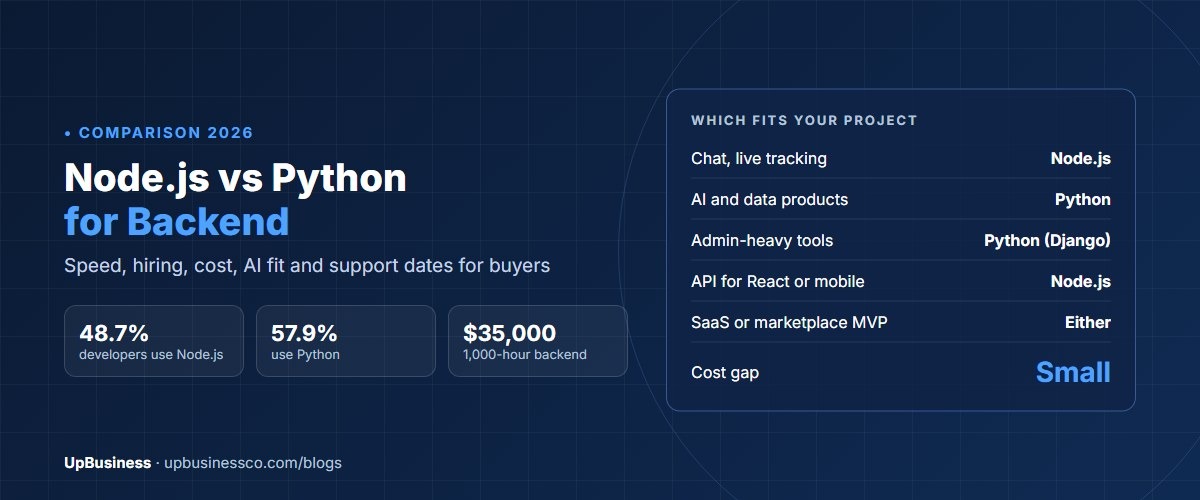
- Python is used by 57.9% of developers and Node.js by 48.7%, according to the Stack Overflow Developer Survey 2025. Both have large hiring pools.
- Node.js handles many connections at once very well, which suits chat, live tracking, notifications and API gateways.
- Python leads for AI, Machine Learning and data work. If those are core to your product, it's usually the right choice.
- Build cost is close: a 1,000-hour backend costs about $35,000 with an Indian partner in either language. The bigger cost driver is team skill, not the language.
Node.js vs Python at a Glance
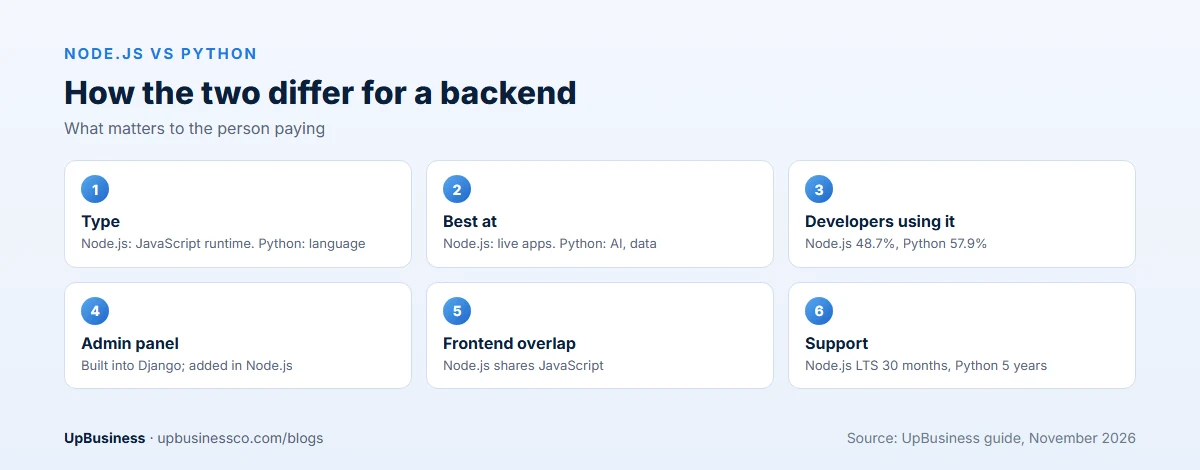
| Node.js | Python | |
|---|---|---|
| What it is | A runtime that runs JavaScript on the server | A general-purpose programming language |
| Main backend frameworks | Express, NestJS, Fastify | Django, FastAPI, Flask |
| Best at | Real-time apps, many connections, APIs | AI, data, automation, admin-heavy apps |
| Developers using it (2025) | 48.7% | 57.9% |
| Same language as the frontend | Yes, JavaScript or TypeScript | No |
| Built-in admin panel | No, added with libraries | Yes, with Django |
| Long-term support | Even-numbered LTS lines, about 30 months each | About 5 years per version |
| Typical Indian partner rate | $25 to $50 an hour | $25 to $50 an hour |
What Node.js and Python Are
Node.js lets developers run JavaScript, the language of web browsers, on the server. It was built around one idea: don't wait. When a request needs the database, Node.js moves on to the next request and comes back when the answer arrives. That makes it very good at handling thousands of connections that mostly wait on databases or other services.
Python is a general-purpose language known for being easy to read. On the backend, it runs web apps through frameworks such as Django and FastAPI. Outside the web, it's the main language for data analysis, scientific computing, automation scripts and AI. That second life is why many companies choose it.
Performance: Which Is Faster?
For most business apps, both are fast enough, and the database is the real bottleneck. Still, the two behave differently under load.
Node.js is strong with many short, waiting tasks. Chat apps, live dashboards, delivery tracking and API gateways fit its design. It's weaker at long calculations, which block other users unless developers move that work to separate worker threads.
Python was long limited by the GIL, a lock that let only one thread run Python code at a time. Modern frameworks like FastAPI work around that with async code, much like Node.js. Python 3.14, released in October 2025, made the free-threaded build, which removes the lock, an officially supported option[1]. For heavy maths, Python calls libraries written in C, such as NumPy, which are very fast.
The practical answer: if your app keeps tens of thousands of live connections open, lean toward Node.js. If it crunches data or runs models, lean toward Python. For everything in between, choose on team and ecosystem, not speed.
Hiring: Which Developers Are Easier to Find?
Both pools are large. In the Stack Overflow Developer Survey 2025, 57.9% of developers used Python and 48.7% used Node.js[2]. Among backend frameworks, Express was used by 19.9%, FastAPI by 14.8% and Django by 12.6%.
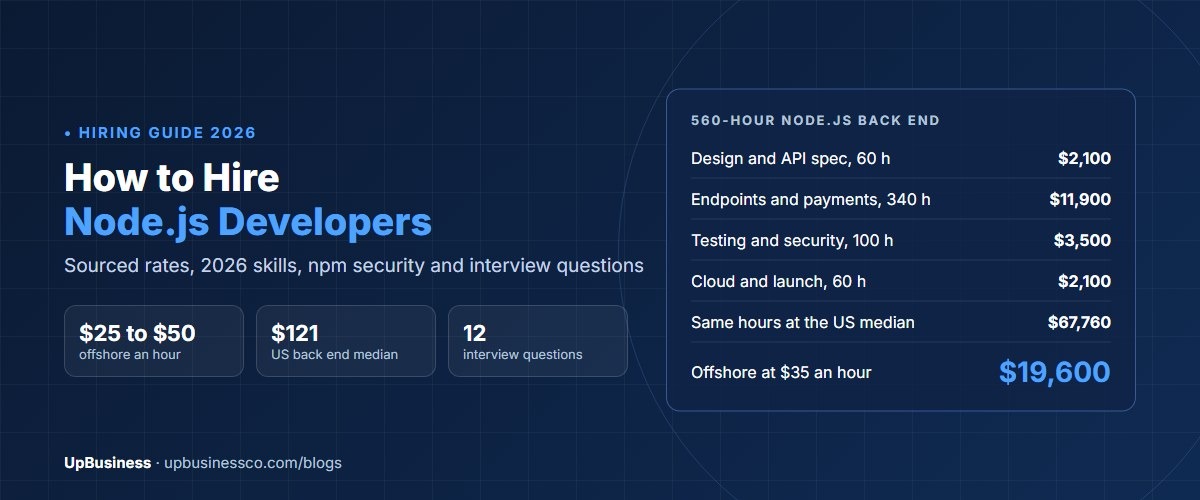
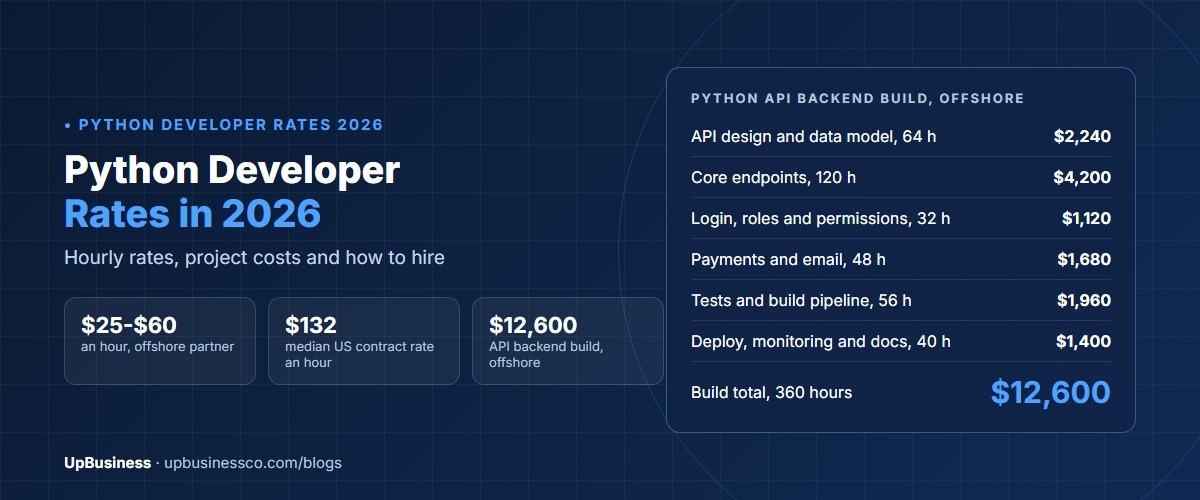
The bigger hiring difference is shape, not size. Node.js developers often work across frontend and backend, because both use JavaScript or TypeScript. One full-stack developer can cover more of a small product. Python backend developers more often come with data skills, which helps if reports, analytics or AI features are on the roadmap. Our guides to hiring Node.js developers and Python developer rates include interview questions and skill checks for each.
Whichever you choose, test real skills before you hire. For Node.js, ask how the candidate would keep a slow report from freezing the server for other users. For Python, ask how they'd structure a Django or FastAPI project so a new developer can find their way around in a day. Ask both how they write tests and how they'd upgrade to the next supported version. Good answers are specific and come with examples from past work. Vague answers about the language being "fast" or "easy" tell you little.
Cost: Node.js vs Python Development
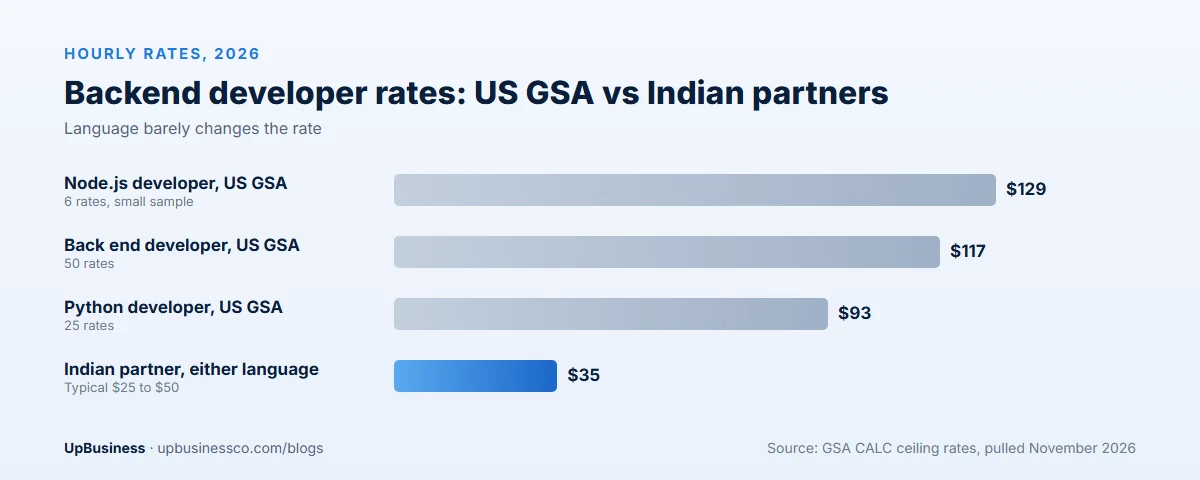
Language barely changes the hourly rate. Here's what US government contract data shows. These are GSA CALC ceiling rates, the most a contractor can charge US federal buyers, pulled in November 2026[3]:
| Role (GSA CALC, Nov 2026) | Rates found | Median per hour |
|---|---|---|
| Back end developer | 50 | $117 |
| Python developer | 25 | $93 |
| Node.js developer | 6 | $129 |
The Node.js sample is small, so treat it as a rough signal. Indian partner companies typically charge $25 to $50 an hour for either language, depending on seniority.
A worked example: a B2B SaaS backend with sign-in, roles, billing, an API for web and mobile, an admin panel and reports takes about 1,000 hours.
| Same 1,000-hour backend | Node.js (NestJS) | Python (Django) |
|---|---|---|
| Indian partner at $35 an hour | $35,000 | $35,000 |
| US back end median at $117 an hour | $117,000 | $117,000 |
| Admin panel effort | Built or added, about 120 hours | Django admin covers much of it, about 60 hours |
| Real-time features (chat, live status) | Simpler | Needs Django Channels or a separate service |
So the language can shift a few weeks of effort in one direction or another, depending on features. Django's built-in admin saves time on admin-heavy apps. Node.js saves time on real-time features and when one team writes both frontend and backend. Our software development cost benchmark covers wider cost drivers.
Node.js vs Python for AI Features
If AI is central to your product, Python is usually the better base. Most libraries for training models, processing data, building retrieval systems and testing AI output are Python-first. Data scientists also work in Python, so handing work between them and backend developers is easier.
If AI is one feature, such as a chatbot or document summary that calls a hosted model, Node.js is fine. Major AI providers ship official SDKs for both JavaScript and Python. Many teams use a split design: a Node.js API handles users, sign-in and live updates, and a small Python service handles the AI work. Our guide to AI integration services explains how that fits together.
Use Cases: Which Backend Fits Your Project
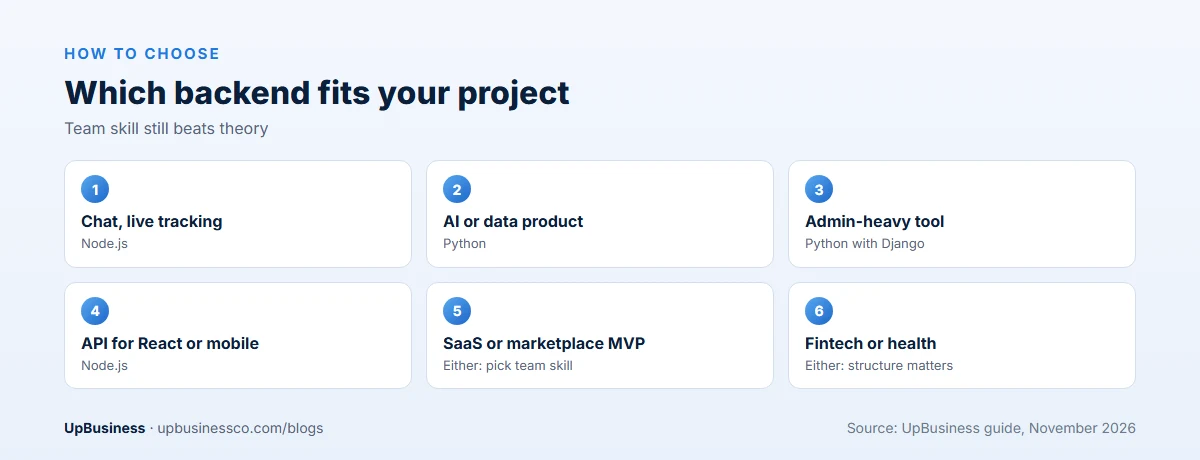
| Project | Better fit | Why |
|---|---|---|
| Chat, live tracking, multiplayer, live dashboards | Node.js | Handles many open connections well |
| AI product, recommendations, forecasting | Python | AI and data libraries are Python-first |
| Data pipelines, reports, automation | Python | Strong data tools and scripting |
| Admin-heavy internal tool or CMS | Python (Django) | Built-in admin, sign-in and forms |
| API for a React or React Native app | Node.js | Same language across the team |
| Marketplace or SaaS MVP | Either | Pick what your team knows best |
| Fintech or health with heavy rules | Either | Framework structure and testing matter more |
| Scraping and integrations with many systems | Either | Both have mature libraries |
If you're building a marketplace or SaaS product, our guide to SaaS application architecture shows how the backend choice fits with hosting, database and scaling decisions.
Node.js vs Python for Web Apps and APIs
Most buyers searching this question are building a web app or an API for a mobile app. Here, the two are closest.
For a REST or GraphQL API that serves a React, Angular or mobile frontend, Node.js with NestJS or Express is a natural fit. Your frontend and backend developers share one language, share data definitions written in TypeScript, and can cover for each other. That's a real saving for a small team.
For a web app with many staff screens, permissions and reports, Django often wins. It gives you sign-in, user roles, an admin panel and database migrations from day one. FastAPI is the pick when the API also serves AI or data features, because it sits in the same Python world as those libraries and creates API documentation automatically.
Node.js vs Python for an MVP vs a Large Product
For an MVP, speed to launch matters most. Choose whatever your partner has shipped most often. A team that has built ten Django products will beat a team trying Node.js for the first time, and the reverse is just as true.
For a large product with several teams, structure and hiring matter more. Ask for a structured framework, NestJS or Django, plus automated tests, typed code and a clear upgrade plan. At that size, the language you can keep hiring for over five years is worth more than any speed difference.
Frameworks Compared: Express and NestJS vs Django and FastAPI
You don't really choose a language. You choose a framework, and that shapes how fast your partner can build and how easy the code is to maintain.
| Framework | Language | Style | Good for |
|---|---|---|---|
| Express | Node.js | Minimal, you add what you need | Small APIs, quick prototypes |
| NestJS | Node.js (TypeScript) | Structured, with clear modules | Larger teams, enterprise APIs |
| Fastify | Node.js | Minimal and very fast | High-traffic APIs |
| Django | Python | Everything included: admin, sign-in, database tools | Admin-heavy apps, marketplaces, CMS |
| FastAPI | Python | Modern, async, automatic API docs | APIs, AI and data services |
| Flask | Python | Minimal | Small services and internal tools |
For buyers, the key question is structure. Minimal frameworks like Express and Flask leave each team to invent its own layout, which makes handing the code to a new partner harder. NestJS and Django give every project a familiar shape. If you expect to change partners or grow the team, ask for one of those, and for TypeScript if you choose Node.js. TypeScript adds type checks that catch many mistakes before release.
Scaling: What Happens When Users Grow
Both Node.js and Python power very large products. Scaling problems almost always come from design, not language: slow database queries, missing caches, or heavy work done inside a web request.
A Node.js server handles many users per process, so you often need fewer servers for chat-style or API-gateway traffic. A Python server usually runs several worker processes per machine, which uses more memory, but it's simple and predictable. Either way, ask your partner how they'd handle ten times your launch traffic. Good answers mention caching, background job queues, database indexes and running several copies of the app behind a load balancer.
Node.js vs Python for Serverless and Automation
If you plan to run code as serverless functions, such as AWS Lambda, both are fully supported runtimes[4] and both start quickly. Python is popular for scheduled jobs, data imports and scripts that connect systems. Node.js is popular for webhooks and small APIs next to a JavaScript frontend. For automation and scraping, both have mature tools, so pick the language your team already uses.
Security and Long-Term Support
Both languages are secure when used well. The bigger risk is the open-source packages every project pulls in. Node.js projects often use hundreds of small npm packages. In September 2025, the US cybersecurity agency CISA warned of a self-spreading attack that compromised more than 500 npm packages[5]. Python's package index has had similar attacks. Whichever you choose, ask your partner to lock package versions, scan dependencies on every build and limit who can publish releases.
Support dates matter for long-lived products:
| Node.js | Python | |
|---|---|---|
| Release pattern | New major version every 6 months; even numbers become LTS | One new version each October |
| Support length | About 30 months for each LTS line | About 5 years for each version |
| Example | Node.js 24 LTS is supported until April 2028 | Python 3.14 is supported until October 2030 |
| What to put in your contract | Use an active LTS line at launch | Use a version with 3+ years of support left |
Sources: the Node.js release schedule[6] and the Python developer guide[7]. Shorter Node.js support windows mean more frequent upgrades, so budget an upgrade every one to two years. Python upgrades come less often but can involve more code changes.
How to Decide: Six Questions
- What does your team or partner already know? Existing skill beats theoretical fit almost every time.
- Is AI or data analysis core to the product? If yes, choose Python.
- Do users need live updates? Chat, tracking or live dashboards point to Node.js.
- Will one team build web, mobile and backend? JavaScript everywhere points to Node.js.
- Is it admin-heavy, with lots of forms and staff screens? Django saves time.
- Who maintains it in three years? Choose the language you can hire for in your market.
If answers point both ways, don't force one language. A Node.js API with a Python service for AI or data is common and works well, though it adds a second codebase to maintain.
Common Mistakes When Choosing a Backend
- Choosing on benchmarks. Speed tests rarely match your app. Database design matters far more.
- Following one developer's preference. Ask what the language means for hiring and upkeep, not just for building.
- Using two languages too early. A split design helps at scale but doubles setup for an MVP. Our MVP development cost guide shows how to keep version 1 small.
- Ignoring support dates. Launching on a version near its end of life means an upgrade bill in year one.
- Skipping dependency checks. Unpinned packages are a real security risk in both ecosystems.
- Choosing a language your market can't hire for. Check job boards in your city or your partner's city before you decide. A product that only one or two people can maintain is a business risk, whatever the language.
- No tests from day one. Both languages let teams move fast without tests, and both punish it later when every change breaks something else.
Questions to Ask a Development Company
- Which would you choose for our project, and why? What would make you choose the other?
- Show us two live products you built on that backend, of similar size.
- Which framework and version will you use, and how long is it supported?
- How do you manage and scan open-source packages?
- How will the backend scale if users grow ten times?
- If we add AI or heavy data work later, how would that fit?
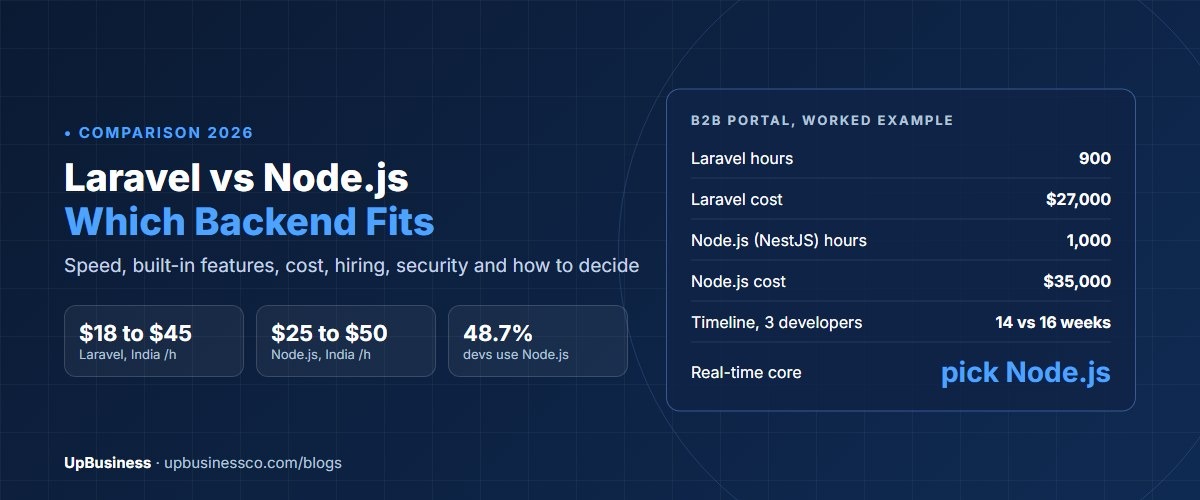
If you're also comparing PHP, our guide to hiring Laravel developers covers that option. For data-heavy products, see our data engineering services cost guide.
Find a Backend Development Company on UpBusiness
UpBusiness lists verified partner companies, mostly based in India and serving buyers worldwide. Every company has passed checks reviewed by our team: company details, registration and tax papers, the founder's identity, expertise and three client projects with evidence. Only companies with a TrustScore of 70 or more are listed.
- Post your requirement and describe what your backend must do.
- Get three partner companies matched to your budget, service and industry.
- Compare them on our backend development page or custom software page, and ask each for two past projects in the language they recommend. Buyers pay nothing, and there's no commission on the project.