

Browse our curated list of Frontend Development Companies
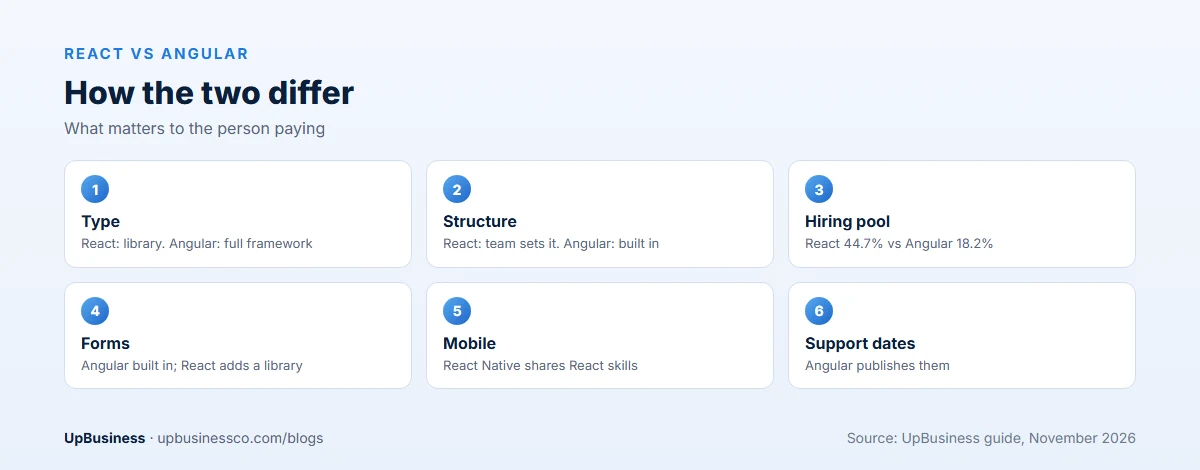
React vs Angular comes down to how much structure you want built in. React is a library for building screens. Your team picks the other tools, such as routing, forms and state management. Angular is a full framework with those tools included and one standard way to use them. For a business app, pick React for flexibility, a bigger hiring pool and fast-moving products. Pick Angular for large, form-heavy internal systems built by big or changing teams. Both are fast enough, and build costs are close.
This guide is for founders, product owners and IT managers choosing a frontend for a new web app, or deciding whether to move an old one. It compares the two on what matters to the person paying. We look at hiring, cost, speed and learning curve. We also cover long-term support and fit for enterprise apps, using current versions and sourced data.
Key takeaways
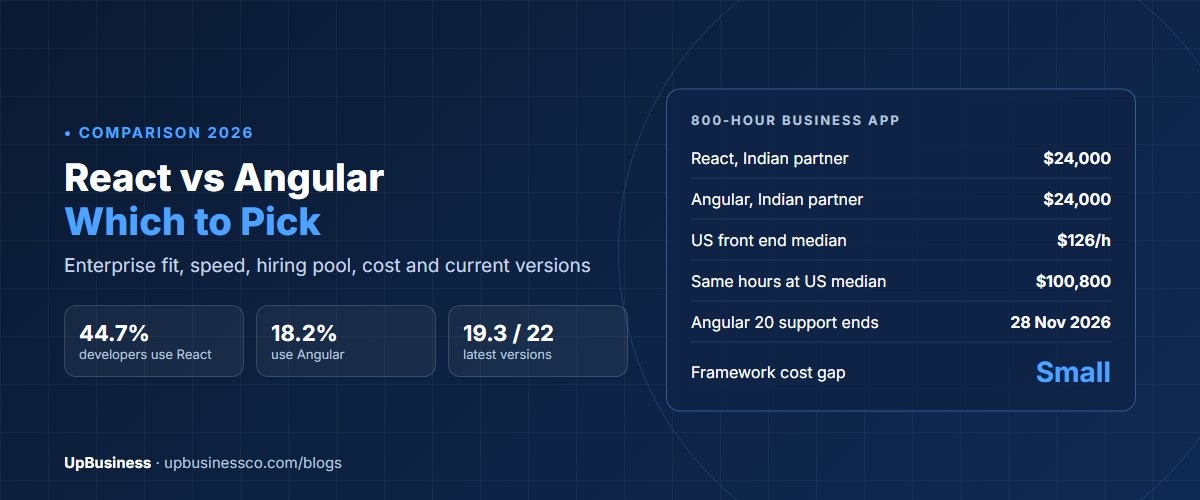
- React was used by 44.7% of developers in the 2025 Stack Overflow survey, against 18.2% for Angular. React's hiring pool is more than twice as large.
- Current versions: React 19.3, released on 9 September 2026, and Angular 22, released on 3 June 2026.
- Angular publishes support dates for each version. Angular 20 loses long-term support on 28 November 2026.
- For the same scope, build cost depends far more on your team's rate and the app's complexity than on the framework.
React vs Angular: The Short Answer
| React | Angular | |
|---|---|---|
| What it is | A library for building user interfaces | A complete framework for web apps |
| Made by | Meta and the open-source community | |
| Language | JavaScript or TypeScript | TypeScript |
| Built-in tools | Few; you choose the rest | Routing, forms, HTTP, testing and more |
| Structure | Flexible, set by your team | One standard structure |
| Developer use (2025) | 44.7% | 18.2% |
| Current version | 19.3 (September 2026) | 22 (June 2026) |
| Best for | Startups, products, public sites, shared web and mobile skills | Large internal systems, form-heavy apps, big teams |
What Is React?
React is a JavaScript library for building user interfaces, made by Meta. You build screens from small reusable parts called components. React handles how those parts update when data changes. For everything else, such as moving between pages, handling forms or talking to a server, teams add other libraries or use a framework built on React, such as Next.js.
The latest version is React 19.3[1], released on 9 September 2026 with features such as View Transitions and Fragment Refs. The React Compiler reached its first stable release, 1.0, in October 2025[2]. It speeds up apps automatically, so developers write less tuning code by hand.
What Is Angular?
Angular is a complete framework for web apps, made by Google and written in TypeScript. It includes routing, forms, a way to call servers, testing tools and a command-line tool that creates new projects in a standard structure. Every Angular app looks broadly the same inside. So developers can move between projects with little ramp-up.
Angular 22, released on 3 June 2026, is the current version[3]. From v22, Angular ships one major version a year, and each is normally supported for about 24 months. Angular 20's long-term support ends on 28 November 2026[4]. Angular 22 also made Signal Forms stable, a simpler way to build and validate forms.
Which Is Better for Enterprise Applications?
Both run large enterprise apps. The question is which fits your organisation.
Angular suits enterprise apps when you have many developers, many teams, or frequent staff changes. Its fixed structure means a new developer can find their way around any Angular app quickly. Built-in forms, validation and testing suit the form-heavy screens common in banking, insurance, healthcare and government systems.
React suits enterprise apps when you want to share skills across web and mobile, move fast, or pick best-in-class tools for each job. Large companies run big React apps successfully, but they set their own rules for structure and libraries. Without those rules, React codebases can drift as teams change.
A simple test: if your company already has strong frontend leads who will set and enforce standards, React works well at scale. If you'd rather the framework enforce the standards, Angular is the safer choice.
React vs Angular Performance: Which Is Faster?
For most business apps, neither is noticeably faster to users. Both are fast enough when built well, and both are slow when built badly. Speed depends far more on how much code you send to the browser, how many images and scripts the page loads, and how often screens update.
Both frameworks have improved here. React's compiler now handles much of the tuning work automatically. Angular's signals update only the parts of a screen that change, and newer Angular apps can run without the older change-detection library. If speed is critical, ask each candidate company how they measure it and which targets they hit on similar apps.
React vs Angular: Which Is Easier to Learn?
React is usually quicker to start with. A developer who knows JavaScript can build a simple screen in a day. The harder part comes later: choosing and combining the other libraries a real app needs.
Angular takes longer to learn at first. Developers need TypeScript and Angular's own ideas, such as services, dependency injection and RxJS. But once learned, the same patterns apply to every Angular app. For a buyer, this means React developers ramp up faster on small projects, and Angular developers ramp up faster when joining an existing large app.
Which Has More Jobs and Developers?
| Web framework | All respondents using it, 2025 |
|---|---|
| React | 44.7% |
| Angular | 18.2% |
| Vue.js | 17.6% |
Source: Stack Overflow Developer Survey 2025[5]. React's pool is more than twice as large, and it's the more common choice for new startups. Angular remains second and is especially strong in banking, insurance, healthcare and government. In India, both pools are large, because many service companies run big teams in each. For hiring guides with skills and interview questions, see how to hire React developers and how to hire Angular developers.
React vs Angular Cost
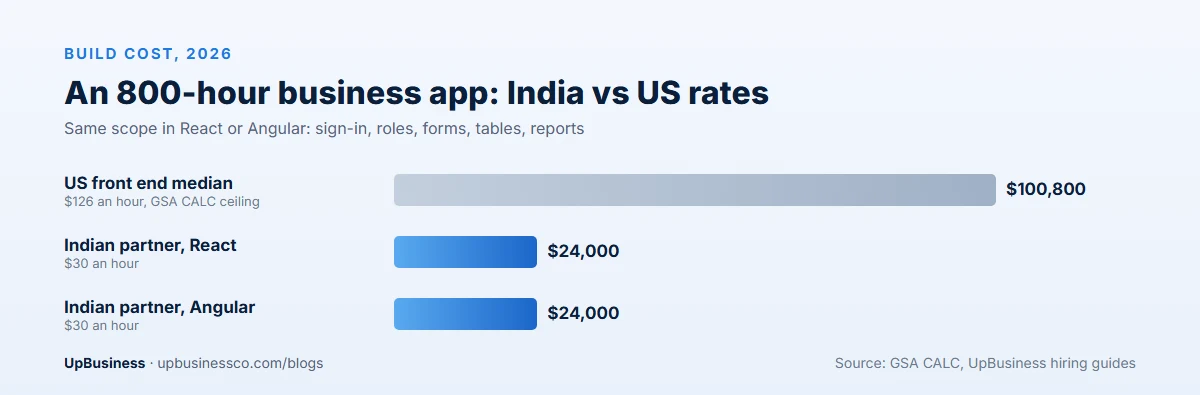
For the same scope, the framework changes cost less than most buyers expect. The team's rate and the app's complexity matter far more.
| Rate source | React | Angular |
|---|---|---|
| GSA CALC US federal ceiling, front end developers (92 rates) | $126 median | $126 median |
| GSA CALC titles naming the framework | $92 median (26 rates) | $86 median (9 rates) |
| Typical Indian partner company | $20 to $45 an hour | $20 to $45 an hour |
The US figures are ceiling rates from the government's CALC tool[6], pulled in November 2026; private projects often pay less. Indian ranges come from partner rates in our earlier hiring guides.
Worked example. An internal dashboard for 300 staff with sign-in, roles, forms, tables, charts and reports takes about 800 hours in either framework, including design, testing and project management. At $30 an hour with an Indian partner company, that's about $24,000. At the $126 US front end median, about $100,800. Angular can save time on form-heavy screens because forms come built in. React can save time on public-facing sites with Next.js. The difference is rarely more than 10% either way. Our software development cost benchmark shows typical hours by app size.
React vs Angular for Mobile Apps
If you also want mobile apps, React has an advantage. React Native lets a React team build iOS and Android apps with much of the same knowledge. Angular has no direct equivalent from Google, though tools such as Ionic can wrap Angular apps for mobile. If one team will build web and mobile, React is usually the more practical choice. Our comparison of Flutter vs React Native covers the mobile side.
React vs Angular With .NET, Java or Node.js
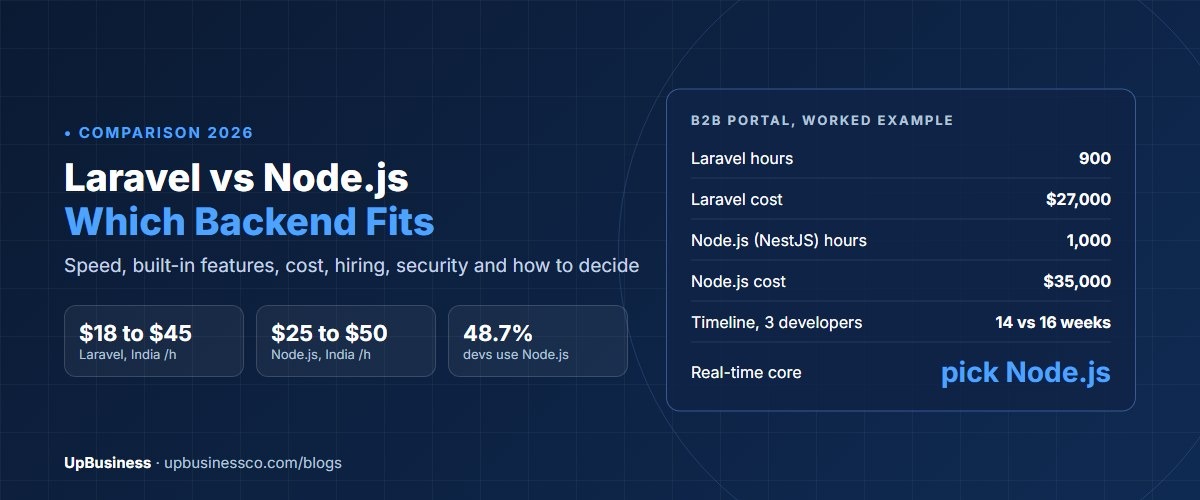
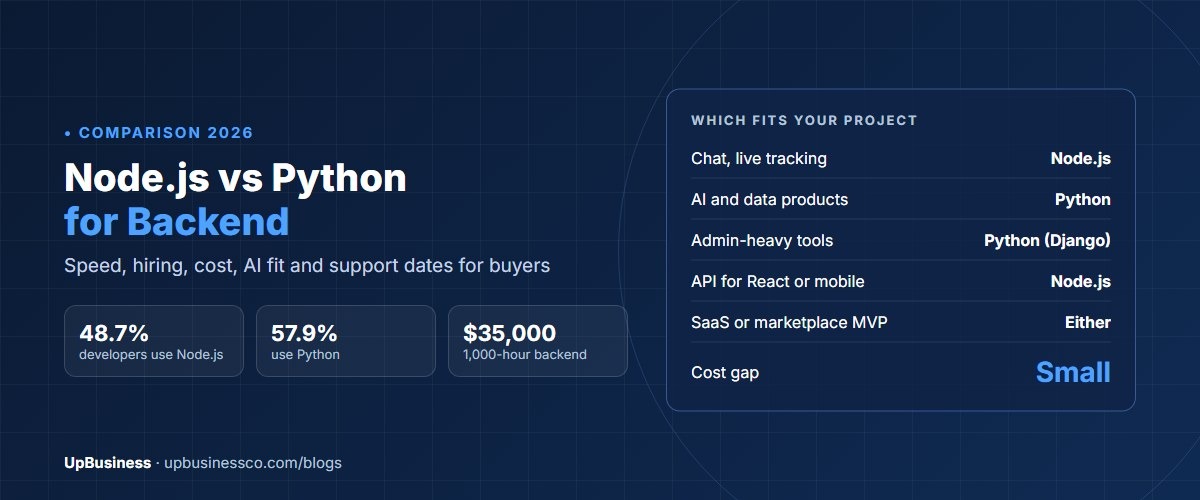
Both work with any back end that offers an API, whether it's .NET, Java Spring Boot, Node.js or Python. Angular has long been popular with .NET and Java teams, because its structure and TypeScript feel familiar to them. React pairs naturally with Node.js teams who already use JavaScript everywhere. Neither choice locks you in on the server side. See our guides to hiring .NET developers and hiring Node.js developers for the back end.
Pros and Cons of React and Angular
| Pros | Cons | |
|---|---|---|
| React | Largest hiring pool; flexible; huge library choice; shares skills with React Native; strong for public sites with Next.js | You pick and maintain many libraries; structure varies between teams; more decisions up front |
| Angular | Everything built in; one standard structure; strong forms and testing; clear support dates | Steeper start; smaller hiring pool; heavier for small projects; fewer mobile options |
React vs Angular: Feature by Feature
| Feature | React | Angular |
|---|---|---|
| Routing between pages | Added library, or built into Next.js | Built in |
| Forms and validation | Added library | Built in, with Signal Forms stable in v22 |
| Calling the server | Fetch or an added library | Built-in HTTP client |
| State management | Many options; team chooses | Services and signals built in |
| Testing | Added tools | Testing setup included |
| Rendering on the server for SEO | Next.js and other frameworks | Built-in server rendering |
| Project setup | Several starter tools | One official command-line tool |
The pattern is clear. Angular gives you one answer for each need. React gives you a choice for each need. One saves decisions. The other gives freedom. Neither is wrong.
When to Choose React
- You are building a new product and expect to change it often.
- You want to hire quickly from the largest pool of developers.
- You plan iOS and Android apps too, and want to share skills with React Native.
- Your site must rank well on Google, and you plan to use Next.js.
- Your team has strong leads who will set clear rules for the code.
When to Choose Angular
- You are building a large internal system with many screens and forms.
- Many developers, or several teams, will work on it over many years.
- Your developers often change, and new ones must find their way fast.
- Your back end team works in .NET or Java and likes a fixed structure.
- You want published support dates for each version, to plan upgrades.
React vs Angular for Startups
Most startups pick React. It's quick to start, easy to hire for and flexible when the product changes every few weeks. If the startup will also need mobile apps, React Native lets the same people help. Angular can still be the right call for a startup selling complex software to banks or insurers, where the product is full of forms and rules from day one.
For an early product, the bigger risk isn't the framework. It's building too much before you know what users want. Pick the framework your first developers know best, and spend the effort on a small first release.
Long-Term Support and Upgrades
Angular publishes a support window for every major version. From v22, each one gets about 24 months: 12 of active support and 12 of long-term support for security and critical fixes. That makes upgrade planning easy. You know when a version will stop getting fixes.
React doesn't publish fixed end dates in the same way. Major versions are rarer, and updates are usually gradual. The catch is the other libraries a React app depends on. Each has its own release pace, and they can fall out of date at different times.
Either way, plan a small upgrade budget every year. Skipping upgrades for three or four years turns a few days of work into a project of its own.
What About Vue?
Vue.js is the third big option. In 2025, 17.6% of developers used it, close behind Angular at 18.2%. Vue sits between the two: lighter than Angular, with more built in than React. It is popular for small and mid-sized apps and with some teams in Asia and Europe. If a partner company recommends Vue, ask why, and check that you can hire for it where you are.
What About Next.js?
You don't have to decide on Next.js at the start, but it's easier if you do. Moving a large React app onto it later takes real work, so ask your partner about it in the first week.
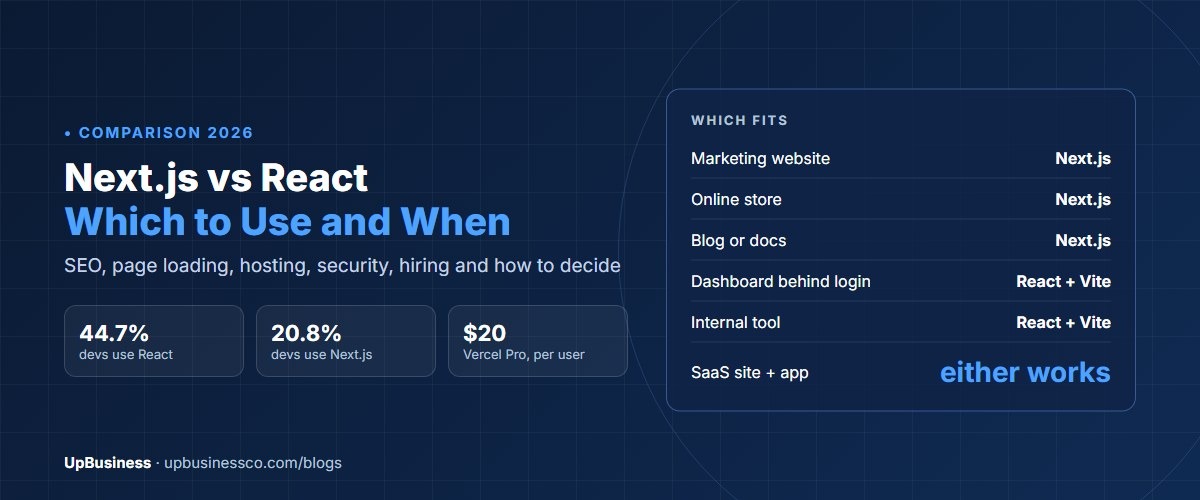
Next.js is a framework built on top of React. It adds routing, server rendering and other tools that React leaves out. Many teams now start React projects with Next.js. That makes the React vs Angular choice closer than it looks: React with Next.js gives you many of the built-in tools that Angular has, while keeping the React hiring pool. Public websites and online stores often use this setup, because pages rendered on the server are easy for Google to read.
How to Choose: Six Questions
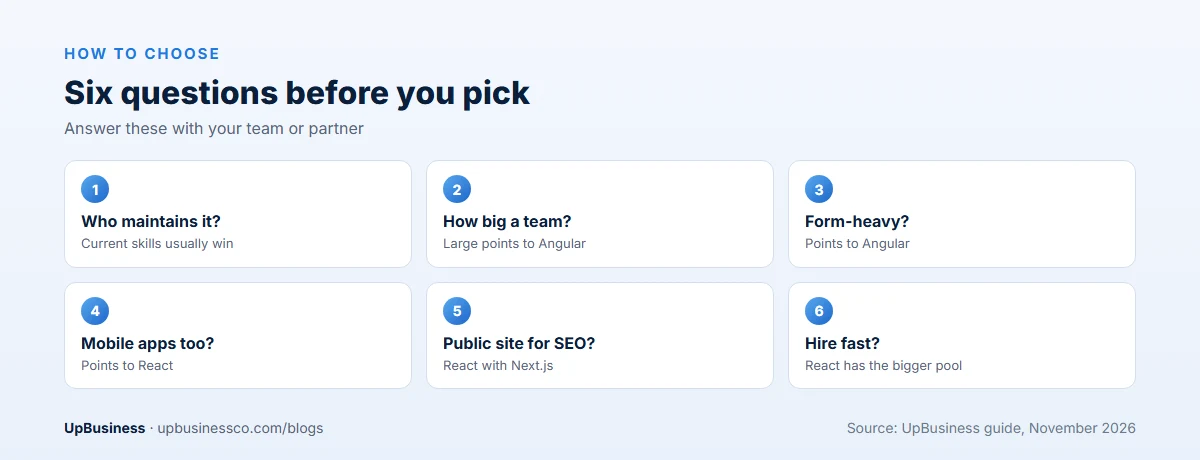
- Who will maintain it? If your current team knows one framework well, that usually wins.
- How big will the team get? Many developers or frequent changes point to Angular's fixed structure.
- Is it form-heavy? Lots of data-entry screens point to Angular.
- Do you need mobile apps too? Shared web and mobile skills point to React.
- Is it a public site that must rank on Google? React with Next.js is a common, proven setup.
- How fast must you hire? React's larger pool makes hiring quicker in most markets.
Should You Move From Angular to React, or the Other Way?
Usually not, unless there's a strong reason. Rewriting a working app costs almost as much as building it the first time, and adds risk. Good reasons include being stuck on an unsupported version, being unable to hire for your framework, or needing to share code with a mobile app.
A special case is AngularJS, the old 1.x framework. Its official support ended in January 2022. Moving from AngularJS is close to a rewrite whichever framework you pick, so choose based on the questions above. Our guide to application modernisation explains how to plan a move in stages.
Our Verdict
If you're unsure, start with two questions: who will maintain the app, and how big will the team get? A small or changing product with a fast hiring need points to React. A large, form-heavy internal system with many developers points to Angular.
Then ask two or three partner companies to recommend a framework for your app and explain why. If they all say the same thing for the same reasons, you have your answer. If one pushes hard for a framework without asking about your team, your users or your plans, treat that as a warning sign. The right framework is the one your team can build well and keep running for years.
Find React and Angular Developers on UpBusiness
UpBusiness lists verified partner companies, mostly based in India and serving buyers worldwide. Every company has passed checks reviewed by our team: company details, registration and tax papers, the founder's identity, expertise and three client projects with evidence. Only companies with a TrustScore of 70 or more are listed.
Our frontend development page lists companies that build web apps. Not every one names React or Angular as a core service, so ask each for two apps they built in your chosen framework. Our questions to ask a software development company help you check their answers, and our SaaS application architecture guide covers the bigger technical choices.
- Post your requirement with your app, preferred framework, budget and timeline.
- Get three partner companies matched to your budget, service and industry.
- Compare them side by side and ask each which framework they'd pick for your app, and why. Buyers pay nothing, and there's no commission on the project.