

Browse our curated list of Flutter App Development Companies
Flutter vs React Native comes down to your team and your app, not to speed. Both build one app for iOS and Android from one codebase, and both are fast enough for nearly every business app in 2026. Pick React Native if your team already writes React or TypeScript, or if you want to share code with a website. Pick Flutter if you want the same custom look on every device, or plan to reach desktop and embedded screens too. For the same scope, build costs are close.
This guide is for the person paying for the app: a founder, product owner or IT manager who has to approve a framework without writing the code. It covers what changed in both frameworks in 2025 and 2026, performance, learning curve, popularity and hiring, cost with sourced rates, which app types suit which framework, and the questions to ask a partner company before you sign.
Key takeaways
- React Native turned on its New Architecture by default in version 0.76 (October 2024) and removed the old one in version 0.84 (February 2026). Most old performance complaints about the "JavaScript bridge" no longer apply.
- Flutter uses its own drawing engine, Impeller, by default on iOS and on Android 10 and newer since version 3.27. Screens look the same on every device.
- In the 2024 Stack Overflow survey, 9.4% of developers used Flutter and 8.4% used React Native. Neither is a niche choice.
- React Native uses JavaScript or TypeScript, which 66% and 43.6% of developers use. Flutter uses Dart, used by 5.9%. That gap shapes your hiring pool more than any benchmark.
- For the same app, build hours and costs are usually close. The hourly rate of the team you hire changes the budget far more than the framework does.
Flutter or React Native: Which Is Better in 2026?
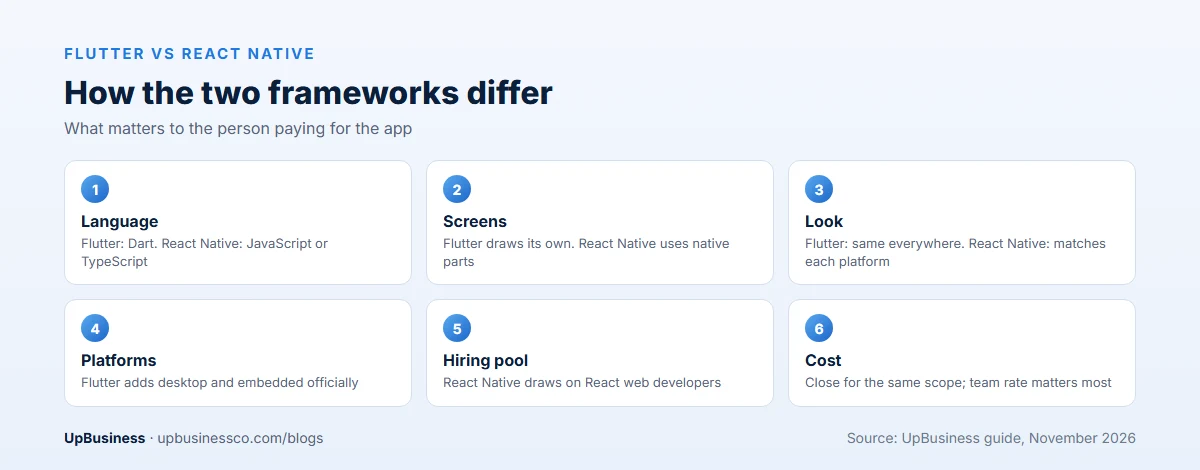
Neither is better in general. React Native is the better choice when your people know React, when the app should feel exactly like a native iOS or Android app, or when you want to share logic with a React website. Flutter is the better choice when brand design matters more than native look, when you want pixel-identical screens everywhere, or when you also need desktop, kiosk or embedded apps.
Most searches ask "which is better", "which is faster" and "which is easier to learn". The honest answer to all three is that the gap has narrowed. Both frameworks rebuilt their foundations in the last two years, so many comparison posts written before 2025 describe problems that are gone.
Flutter vs React Native at a Glance
| Flutter | React Native | |
|---|---|---|
| Backed by | Meta, with Microsoft, Expo and others | |
| Language | Dart | JavaScript or TypeScript |
| How screens are drawn | Its own engine (Impeller) draws every pixel | Uses the real iOS and Android components |
| Look and feel | Same design on every device | Matches each platform by default |
| Latest stable (Nov 2026) | 3.47 | 0.88, released 19 October 2026 |
| Web and desktop | Official support for web, Windows, macOS, Linux | Web through React Native Web; desktop through community and Microsoft projects |
| Build and release service | Your own pipeline, or a CI service | Expo services, free tier to $199 a month plus usage |
| Hiring pool | Smaller, Dart specialists | Larger, drawn from React web developers |
| Best fit | Brand-heavy apps, many platforms, custom UI | Teams that know React, native feel, shared web code |
What Changed in 2025 and 2026
Old comparisons still say React Native is slow because JavaScript talks to native code through a "bridge". That stopped being true. React Native 0.76 made the New Architecture the default in October 2024[1]. Version 0.80 froze the old architecture in June 2025, version 0.82 in October 2025 was the first to run entirely on the new one, and version 0.84 in February 2026 removed the old components and made Hermes V1 the default JavaScript engine[2]. The latest release is 0.88, from 19 October 2026.
The React Native website keeps documentation for versions 0.77 to 0.88 and marks 0.76 and older as unmaintained[3]. If a partner company proposes to build on an old version, ask why.
Flutter changed its engine too. Since version 3.27, Impeller is the default renderer on iOS and on Android API 29 (Android 10) and newer, with a fallback to the older OpenGL path on older phones[4]. Impeller was built to remove the stutter some Flutter apps showed the first time an animation ran. The current stable line is 3.47[5].
What this means for you: if a partner company's main argument is "React Native is slow" or "Flutter apps stutter", their information is a few years old.
Flutter vs React Native Performance
For most business apps, users can't tell the difference. Lists, forms, maps, payments and chat run smoothly in both when the code is written well. Performance problems in real projects nearly always come from the app's own code: too many network calls, large images, or heavy work on the main thread.
Where differences still show:
- Heavy animation and custom graphics. Flutter draws everything itself, so complex custom animations and charts are often easier to make smooth.
- Native look and platform updates. React Native uses the real platform components, so when Apple or Google change their design, a React Native app picks up much of it. A Flutter app has to be updated to match.
- App size. A Flutter app carries its engine, so a basic Flutter app is usually a few megabytes larger. For most apps this doesn't matter. In markets where people use low-storage phones, it can.
- Startup time. Both now start quickly. React Native's Hermes engine compiles JavaScript ahead of time, which shortened startup.
Many benchmark posts compare a demo app, not a real product. If speed matters a lot, ask the partner company to build the single hardest screen of your app as a paid two-week test in the framework they suggest.
Which Is Easier to Learn?
For a developer who already knows JavaScript, React Native is easier. For a developer who knows Java, Kotlin, C# or Swift, Dart often feels familiar within a few weeks, and many say Flutter's single toolkit is simpler than React Native's mix of libraries.
The bigger question for a buyer is who will maintain the app in three years. The 2025 Stack Overflow survey found 66% of developers use JavaScript and 43.6% use TypeScript, against 5.9% for Dart[6]. React was the most used web framework at 44.7%. Every React web developer is a possible React Native hire after a short ramp-up. Dart developers are fewer, though the ones you find usually work on Flutter full time.
Popularity, Market Share and Jobs
Both frameworks are widely used. In the 2024 Stack Overflow survey, 9.4% of all respondents used Flutter and 8.4% used React Native. Among professional developers the numbers were 9.4% and 9.0%[7]. Claims you'll see online that one framework holds "46% of the market" usually come without a source, so treat them with care.
For jobs and salaries, the pattern follows the language. There are more React and React Native roles because many companies hire JavaScript developers for web and mobile together. Flutter roles are fewer but steady, and Flutter specialists are common in India, where many agencies standardised on it for client apps.
For you as a buyer, popularity matters for two reasons: how easily you can replace a developer, and whether the packages your app needs are maintained. Both frameworks pass on both counts for normal business apps.
Flutter vs React Native Cost
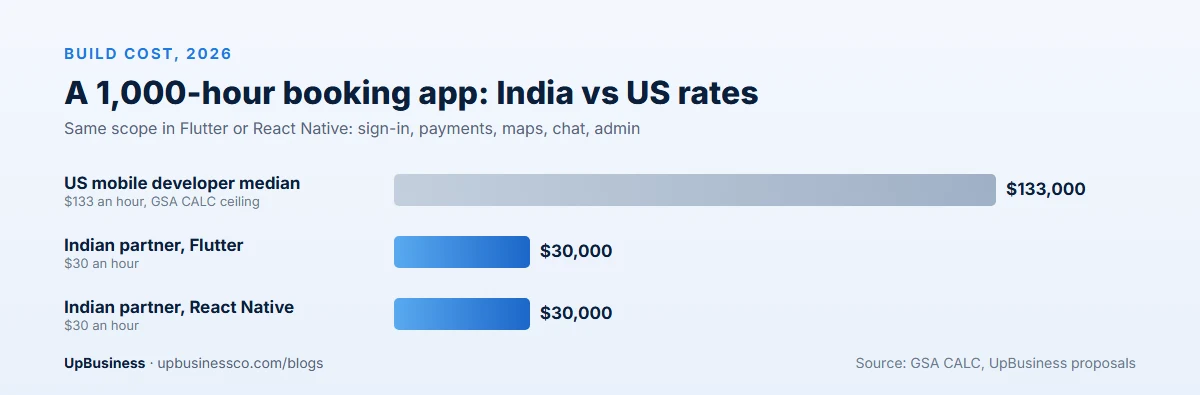
For the same scope, the framework changes the cost much less than the team's hourly rate does. Both save money over building two separate native apps, because most screens and logic are written once. Neither removes backend work, design, testing on two platforms or the native code some features still need.
Our two cost guides price apps in detail. The Flutter app development cost guide puts a standard business app built by an Indian team at $19,000 to $58,000. The React Native app development cost guide uses blended global team rates and puts a mid-complexity app at $40,000 to $90,000. The gap between the two comes from the rate basis, not the framework.
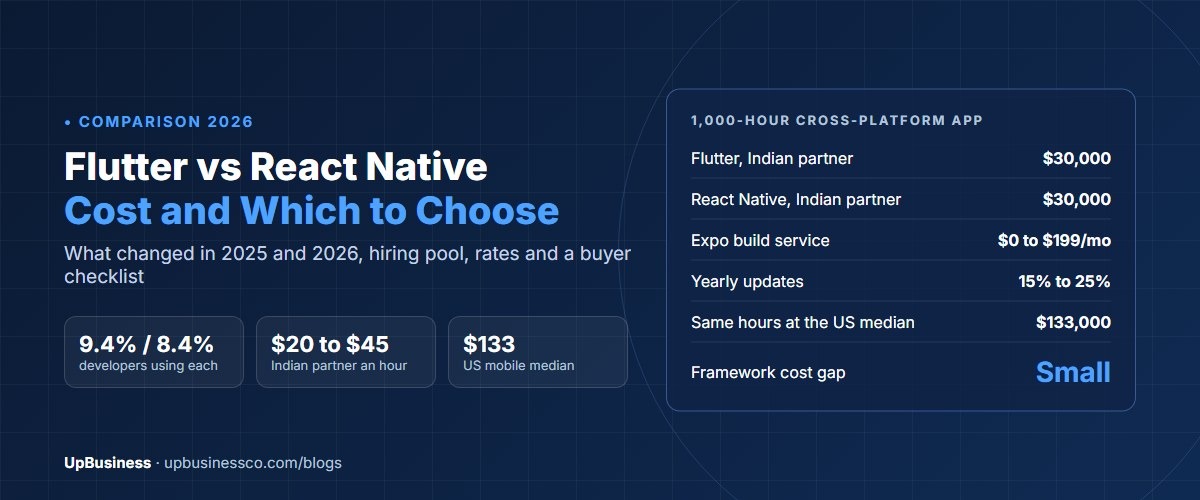
On rates, US federal GSA contract ceiling rates for mobile application developers have a median of $133 an hour across 34 rates from 14 contractors, pulled on 7 November 2026. The median is $131 for 0 to 4 years of experience and $150 for 5 to 9 years[8]. These are maximum rates for US government buyers, so private US work often costs less. Indian partner companies commonly bill $20 to $45 an hour for Flutter or React Native developers, with project management and testing often included.
| Cost item | Flutter | React Native |
|---|---|---|
| Build hours for the same app | About the same | About the same |
| Typical Indian partner rate | $20 to $45 an hour | $20 to $45 an hour |
| US government ceiling median | $133 an hour (mobile developer) | $133 an hour (mobile developer) |
| Build and release service | CI service of your choice, often free tiers | Expo: free, $19 or $199 a month plus usage |
| Reuse with a website | Flutter web, less common for public sites | Logic and some UI shared with a React site |
| Native modules for special hardware | Platform channels in Kotlin and Swift | Native modules in Kotlin and Swift |
Expo, the most common toolkit for React Native, offers its cloud build and update service free with 15 Android and 15 iOS builds a month. Paid plans are $19 a month with $45 of build credit, and $199 a month with $225 of build credit, plus usage[9]. Flutter teams usually use a general build service instead, and many stay inside free tiers.
Worked example. A booking app with sign-in, payments, maps, chat, push notifications and an admin panel takes about 1,000 hours in either framework. At $30 an hour with an Indian partner company, that's about $30,000. At the $133 US median it would be about $133,000. Plan 15% to 25% of the build cost each year for updates, as our app maintenance cost guide explains.
Flutter vs React Native for Different Kinds of Apps
| App type | Usually better fit | Why |
|---|---|---|
| Ecommerce or D2C app | Either | Both handle catalogues, carts and payments well |
| App with a React website | React Native | Share logic, types and some UI with the site |
| Brand-heavy or highly animated app | Flutter | Same custom design on every device |
| Fintech or banking app | Either | Security depends on the backend and code reviews, not the framework |
| Field service or logistics app | Either; Flutter if it runs on rugged or kiosk devices | Flutter also targets embedded and desktop screens |
| Simple 2D game | Flutter | Its own engine suits custom drawing; real games need a game engine |
| App that must look exactly like iOS | React Native | Uses real iOS components |
| Mobile plus desktop app | Flutter | Official Windows, macOS and Linux support |
For serious 3D or action games, neither framework is the right tool. Use a game engine. If you're still deciding between iPhone and Android first, our iOS vs Android cost guide covers that choice.
Flutter vs React Native vs Kotlin Multiplatform and Native Apps
Many searches now add Kotlin Multiplatform to the comparison. Kotlin Multiplatform shares business logic between Android and iOS, while each app can keep its own native screens, or share screens with Compose Multiplatform. It suits teams with strong Android developers who want native screens on both platforms. It's a good choice, but the hiring pool is smaller than for React Native.
Fully native apps, Swift for iOS and Kotlin for Android, still make sense for apps that depend on the newest platform features on day one, heavy camera or sensor work, or very tight battery use. They cost more, because you build and test two apps. For most business apps, a cross-platform framework is the practical choice.
Flutter, React Native and AI Coding Tools
Searches like "flutter or react native for vibe coding" show that many founders now build first versions with AI coding assistants. Both frameworks work with these tools. Because far more public code exists in JavaScript and TypeScript, assistants tend to give more examples for React Native, though they handle Dart well too.
AI-written code still needs a senior developer's review before real users and payments touch it. An AI-built prototype is a good way to test an idea. When you hand it to a partner company, expect them to rewrite parts of it, and ask for that in the quote. Our MVP development cost guide shows how to budget a first version.
How to Choose: A Checklist for Buyers
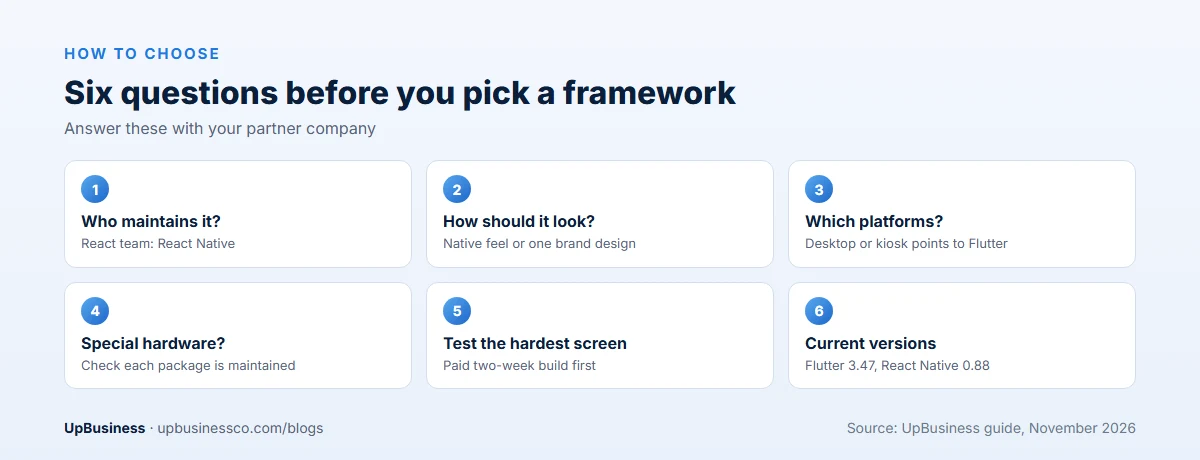
- Who will maintain it? If your in-house people write React, lean to React Native. If you'll rely on a partner company long term, ask which framework their senior people use daily.
- How should it look? Native iOS and Android feel points to React Native. One strong brand design everywhere points to Flutter.
- Which platforms? Phones only: either. Phones plus desktop or kiosk: Flutter. Phones plus a React website: React Native.
- Special hardware or SDKs? List every device feature and third-party SDK, such as Bluetooth, payments or KYC, and check each has a maintained package in the framework.
- Test the hardest screen. Pay for a two-week build of the most complex screen before you commit the full budget.
- Agree on versions. New work should start on a current release: Flutter 3.47 or React Native 0.88 as of November 2026.
Questions to Ask a Partner Company Before You Pick
- Which framework do you recommend for this app, and what would make you choose the other one?
- Show us two live apps you built in this framework. Who on that team would work on ours?
- Which packages will the app depend on, and who maintains them?
- How do you handle native code when a package doesn't exist?
- How will you release updates, and what will the build service cost us each month?
- Will the code, the app store accounts and the build service be in our name from day one?
Our list of questions to ask a software development company and our contract checklist cover the commercial side.
Finding Flutter and React Native Partners on UpBusiness
UpBusiness lists verified partner companies, mostly based in India. Every company has passed checks reviewed by our team: company details, registration and tax papers, the founder's identity, expertise and three client projects with evidence. Only companies with a TrustScore of 70 or more are listed.
Our Flutter app development page, React Native app development page and mobile app development page list companies that build cross-platform apps. Many of them build apps in general rather than in one framework only, so ask each for two apps in the framework you choose. Our guide to choosing a mobile app development company in India explains how to compare them, and if you pick React Native, our guide on hiring React developers covers the skills to check.
- Post your requirement with the app idea, platforms, budget and timeline.
- Get three partner companies matched to your budget, service and industry.
- Compare them side by side, ask each to recommend a framework and say why, then start with a paid test screen. Buyers pay nothing, and there's no commission on the project.