

Browse our curated list of AI Development Companies
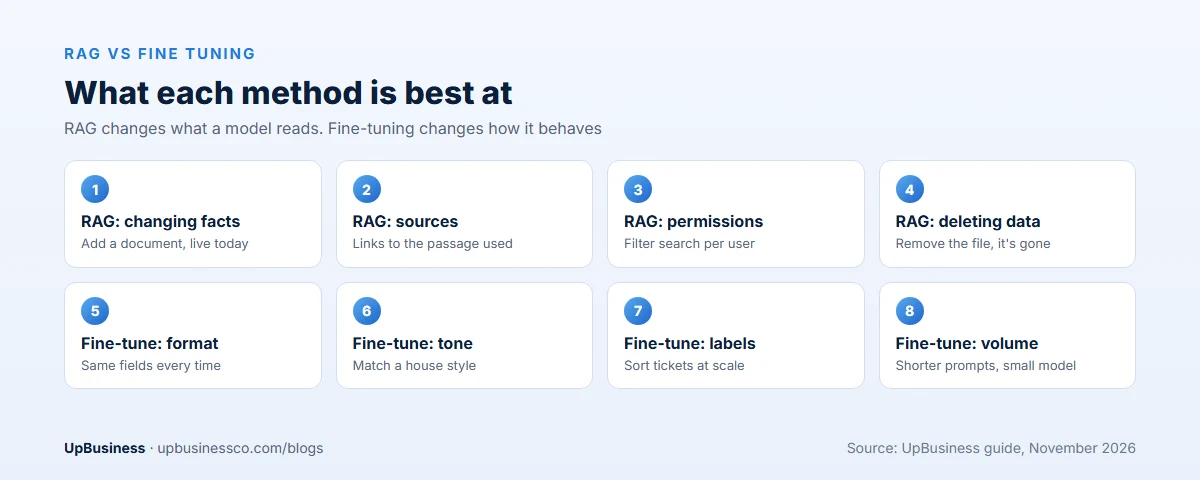
RAG vs fine tuning comes down to one question: does your AI need to know new facts, or behave in a new way? RAG (retrieval-augmented generation) looks up your documents at the moment a question is asked, so answers stay current and can cite a source. Fine-tuning retrains a model on examples, so it learns a fixed format, tone or task. For most business assistants built on company knowledge, start with RAG. Fine-tune when you need consistent output at high volume. Many mature products use both.
This guide is for founders, product owners and managers who are paying for an AI build. It compares cost, accuracy, upkeep and risk, and ends with a simple way to decide.
Key takeaways
- RAG is the better way to give a model facts. A Microsoft study found RAG beat fine-tuning at adding knowledge, both for facts the model had seen and for new ones.
- Fine-tuning is the better way to change behaviour: output format, tone, labels and shorter prompts.
- A first RAG assistant costs about $10,000 to $36,000 to build with an Indian partner. A fine-tuning project costs about $10,000 to $50,000, mostly for data work.
- The two can stack. In a Microsoft agriculture study, fine-tuning added over 6 points of accuracy and RAG added about 5 more.
RAG vs Fine Tuning at a Glance
| RAG | Fine-tuning | |
|---|---|---|
| What it changes | What the model can look up | How the model behaves |
| Best for | Answers from documents that change | Fixed format, tone, labels, short prompts |
| New information | Add a document, live in minutes | Retrain, often days of work |
| Shows its sources | Yes, it can link to the passage used | No |
| Per-user permissions | Yes, filter what each user can search | No, everything is inside the model |
| Data you need | Your documents, cleaned and split up | Hundreds to thousands of labelled examples |
| Typical build cost | $10,000 to $36,000 | $10,000 to $50,000 |
| Main running cost | Search and longer prompts per question | Hosting the tuned model, retraining |
| Main risk | Bad search returns the wrong passage | Model learns errors in the training data |
What Is RAG?
RAG stands for retrieval-augmented generation. The idea was set out in a 2020 paper by researchers at Facebook AI[1]. Instead of hoping the model remembers a fact, the system finds it first.
It works in three steps. First, your documents are split into short passages and stored in a search index. Second, when a user asks a question, the system finds the passages that match best. Third, those passages go into the prompt, and the model writes an answer based on them.
The model itself never changes. You change what it reads. That is why RAG suits help centres, policy manuals, product catalogues, contracts and any knowledge that is updated often. Add a new policy today and the assistant can quote it today.
Our RAG chatbot cost guide breaks down the build and running costs in detail.
What Is Fine-Tuning?
Fine-tuning takes a model that already exists and trains it a little further on your own examples. Each example is a pair: an input and the exact output you want. After training, the model produces that kind of output without long instructions.
Think of RAG as giving a new employee a reference binder. Fine-tuning is more like training them until a task becomes habit. The binder is better for facts. Training is better for how the work is done.
OpenAI's own guide sets a minimum of 10 examples and says gains usually show from 50 to 100[2]. Google suggests starting with 100 examples for Gemini tuning and adding more if needed[3]. Real business projects often use 500 to 10,000 examples, and most of the budget goes into collecting and checking them. Our LLM fine-tuning cost guide has platform prices and a full budget.
What the Research Says About Accuracy
Two studies are worth knowing before you pay for either approach.
In 2023, Microsoft researchers compared the two methods for adding knowledge to a model. RAG did better on facts the model had seen during training and on brand new facts. The team also found that models struggle to learn new facts through plain fine-tuning[4]. In short, if the goal is "know our product catalogue", fine-tuning is the weaker tool.
A 2024 Microsoft study on farming questions tested both on GPT-4, GPT-3.5 and Llama 2. Fine-tuning raised accuracy by over 6 percentage points, and adding RAG on top raised it by about 5 more. The gains stacked. For one question type, fine-tuning also lifted answer similarity from 47% to 72%[5].
The lesson for buyers: these are not rival products. RAG supplies facts. Fine-tuning shapes behaviour. A project can need one, the other or both.
When to Use RAG
Choose RAG when most of these are true:
- Your content changes. Prices, stock, policies, help articles or case files are updated weekly or daily.
- Users need sources. Staff or customers must see which document an answer came from, so they can check it.
- Access differs by user. A sales rep should not see HR files. RAG can filter the search by user. A tuned model can't forget what it learned for one user.
- You have documents, not labelled examples. Most companies have manuals and wikis. Few have thousands of perfect question and answer pairs.
- You need to delete data. Remove a file from the index and it's gone from answers. Removing a fact from a tuned model means retraining.
Typical RAG projects: internal knowledge assistants, customer support bots, contract and policy search, sales enablement tools and document question answering.
When to Use Fine-Tuning
Choose fine-tuning when the problem is behaviour, not knowledge:
- Strict output format. The model must return the same JSON fields, codes or layout every time, and prompting still slips.
- Classification at scale. Sorting tickets, tagging documents or routing emails into fixed labels.
- A house style. Product descriptions or replies that must match your brand voice closely.
- High volume. You send millions of requests a month, and a tuned small model can replace a large model with a long prompt.
- Specialist language. Medical, legal or industry terms the base model handles badly, after prompting has been tried.
Test prompting first. Newer base models follow instructions well. When OpenAI began closing its self-serve fine-tuning platform, it said prompt-based methods now beat fine-tuning on cost and speed for many past use cases. Its deprecations page says remaining customers can't create new fine-tuning jobs after 6 January 2027[6]. Fine-tuning is still widely available on other platforms, but that move tells you where the default should be.
RAG vs Fine Tuning Cost
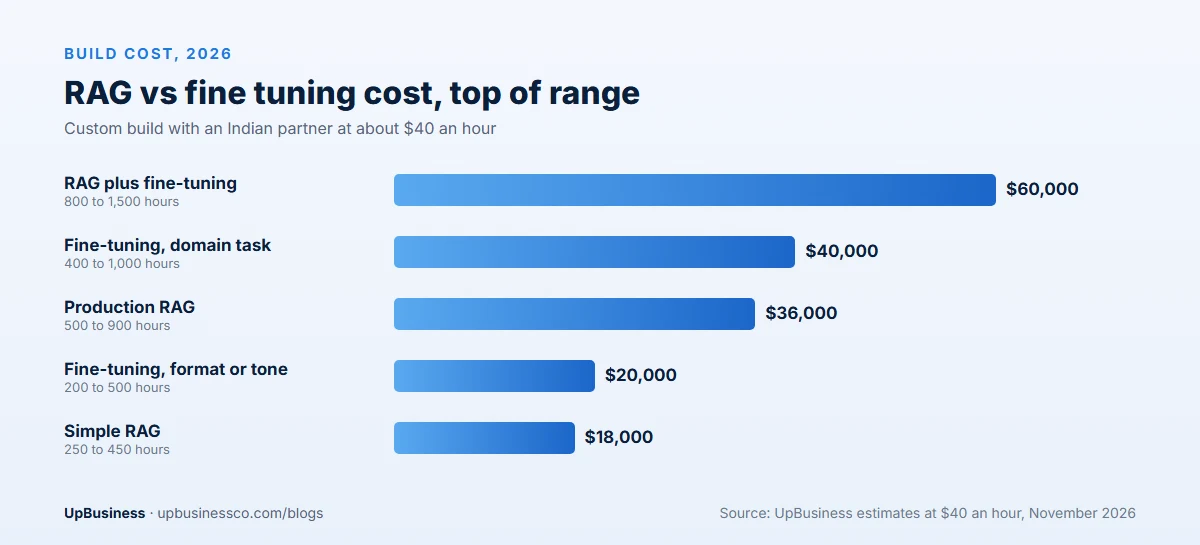
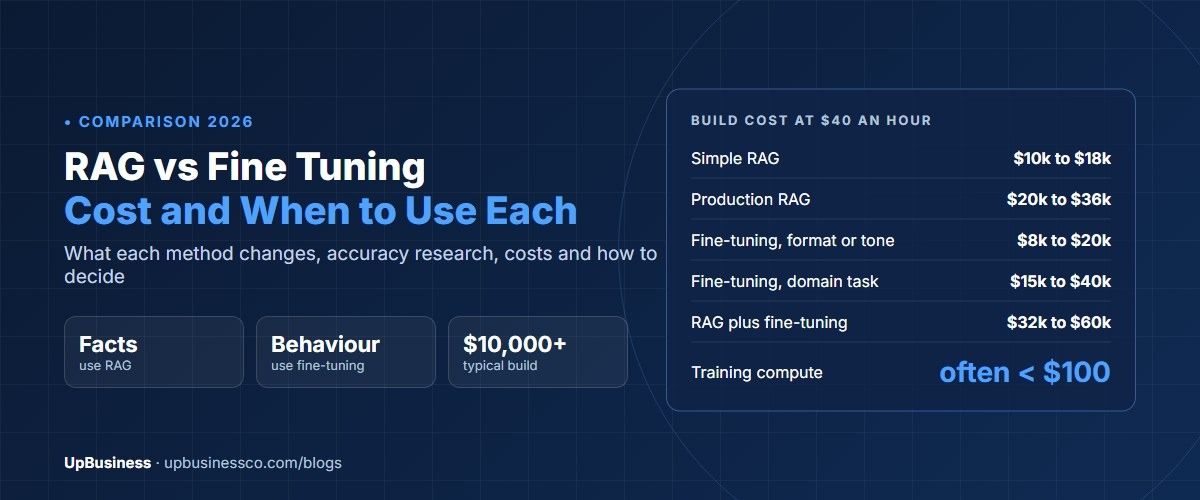
The build cost of both is mostly people, not computing. These ranges are our estimates for work done by an Indian AI partner at about $40 an hour. US rates are often three to four times higher. See our guide to AI developer rates in India for rate bands by role.
| Project | Typical hours | Build cost at $40/h |
|---|---|---|
| Simple RAG: one document source, one user group | 250 to 450 | $10,000 to $18,000 |
| Production RAG: several sources, permissions, citations | 500 to 900 | $20,000 to $36,000 |
| Fine-tuning for format or tone | 200 to 500 | $8,000 to $20,000 |
| Fine-tuning for a domain task, 2,000+ examples | 400 to 1,000 | $15,000 to $40,000 |
| RAG plus a fine-tuned model | 800 to 1,500 | $32,000 to $60,000 |
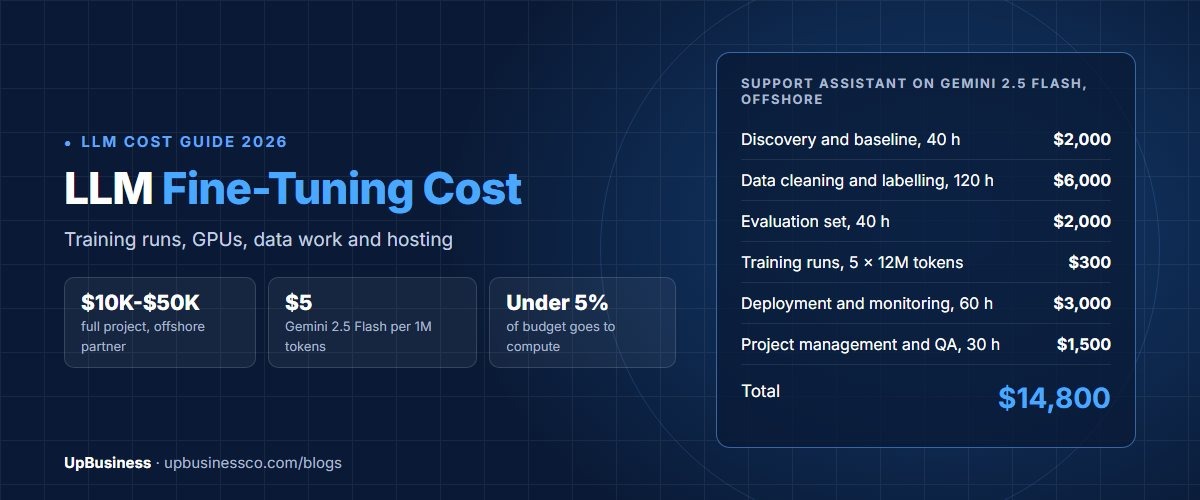
The computing for fine-tuning itself is small. Published prices show training at $0.34 per million tokens for small open models on Together AI[7], $0.50 on Fireworks AI for models up to 16 billion parameters[8] and $5 for Gemini 2.5 Flash on Google Vertex AI[9]. A run on 12 million tokens costs between about $4 and $60. The labour around it is what you pay for.
RAG has a cheap setup too. Turning text into search vectors costs $0.02 per million tokens with OpenAI's small embedding model[10]. A library of 10,000 pages at about 500 tokens each is 5 million tokens, so indexing it costs about 10 cents. Again, the cost is in cleaning documents, testing search quality and building the app around it.
Running Costs After Launch
This is where the two approaches differ most, and where quotes often stay silent.
RAG running costs come from every question. Each one runs a search, then sends the found passages to the model. That makes prompts longer, often 2,000 to 6,000 tokens per question. At low volume this is cheap. At hundreds of thousands of questions a month, it becomes the largest line in the bill. You also pay for the search database, though many teams use the PostgreSQL database they already run.
Fine-tuning running costs come from hosting. On serverless platforms such as Fireworks AI or Gemini, a tuned model is billed per token at the base price. If you host an open model on your own GPU, one H100 on RunPod at $2.89 an hour costs about $2,110 a month if it runs all the time[11]. Then there's retraining. When products or rules change, the training data goes stale, and most teams retrain every three to six months.
A simple rule: RAG costs more per question, fine-tuning costs more per change. If your content changes often, RAG is cheaper over a year. If your task is stable and volume is huge, a small tuned model can win.
Ask every partner for a monthly running cost at three traffic levels before you sign. Also budget for upkeep. A RAG system needs someone to fix broken document imports and review failed answers. A tuned model needs someone to gather new examples. Either way, plan for 10 to 20 hours of work a month after launch.
Accuracy, Errors and Hallucinations
Neither method stops a model from making things up. They fail in different ways.
RAG fails when search fails. If the system pulls the wrong passage, the model writes a confident answer from the wrong source. Most RAG problems are search problems: poor splitting of documents, old versions left in the index, or tables and scans that were never converted to text. The fix is testing search quality on real questions before launch.
Fine-tuning fails when the examples are wrong. The model learns your mistakes as well as your good answers. It also can't tell users where an answer came from, which makes errors harder to spot.
For both, ask your partner for a test set of at least 100 real questions with agreed correct answers. Score the system on it before launch and after every change. A partner who can't explain how they will measure accuracy is not ready to build either. Our LLM security checklist covers the related risks, such as prompt injection through documents.
Can You Use RAG and Fine-Tuning Together?
Yes, and many production systems do. The common pattern is to fine-tune a model for behaviour, then give it RAG for facts.
A support assistant is a good example. RAG pulls the right help articles. A small tuned model writes replies in the company's tone and always ends with the correct next step. Another pattern uses a tuned model only for one step, such as sorting incoming tickets, while RAG answers the questions.
Don't start with both. Build RAG first, measure where it falls short, and fine-tune only to fix a gap you can see in the scores. Doing both on day one doubles the work before you know what users need.
What About Prompting and Long Context?
Two cheaper options sit before both methods.
Prompt engineering means writing clear instructions and a few good examples into the prompt. It costs days, not weeks. For many format and tone problems, it's enough.
Long context means pasting whole documents into the prompt. Some models now read hundreds of thousands of tokens at once. If your knowledge base is small, say a 40-page manual, this can replace RAG for a pilot. It gets slow and expensive as content grows, and it can't filter by user.
A sensible order is prompt first, RAG second, fine-tuning third. Move to the next step only when the last one fails your test set. Our guide to custom AI vs off-the-shelf AI covers when a ready-made tool beats any custom build.
Worked Example: A Support Assistant for a SaaS Company
A SaaS company has 1,200 help articles, release notes that change every two weeks and about 40,000 support tickets a month. It wants an assistant that answers customers and drafts replies for agents.
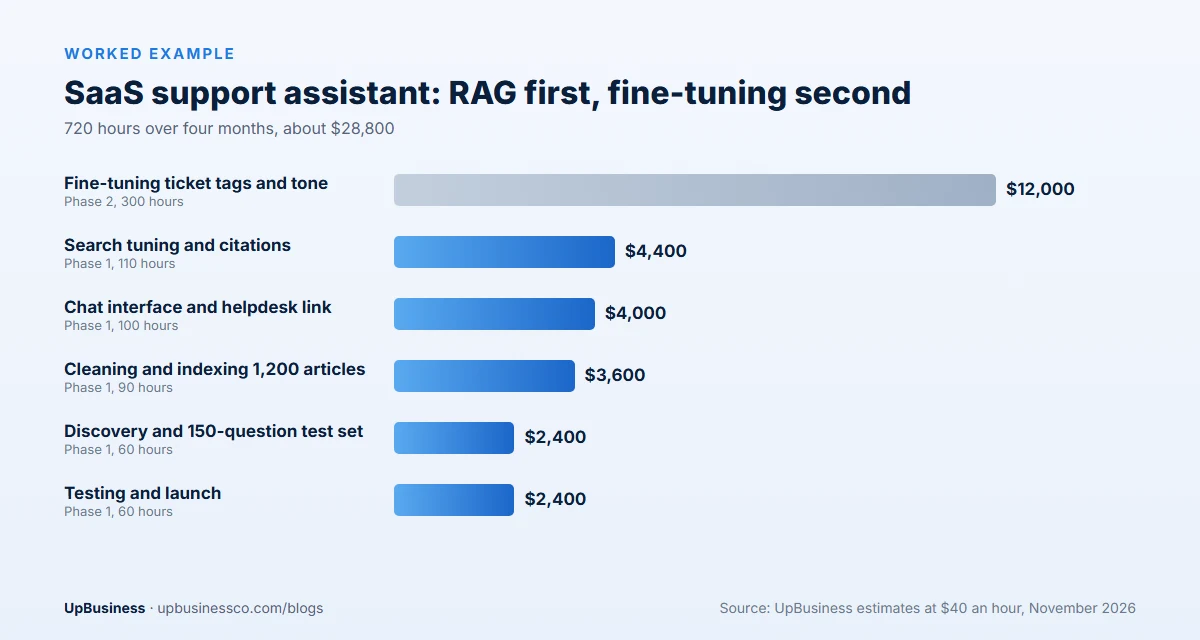
Phase 1, RAG (about 420 hours, $16,800). Discovery and a 150-question test set took 60 hours. Cleaning and indexing the help centre took 90. Search tuning and citations took 110. The chat interface and helpdesk link took 100. Testing and launch took 60. The assistant answered 78% of the test set correctly at launch, with a link to the source article each time.
Phase 2, fine-tuning (about 300 hours, $12,000, plus under $200 of training). Three months later, the team saw two gaps: reply tone was uneven, and ticket tags were wrong 1 time in 5. It fine-tuned a small open model on 3,000 past tickets that agents had already tagged and answered well. The tuned model now tags tickets and drafts the reply. RAG still supplies the facts.
Total: about $28,800 over four months. Starting with fine-tuning would have taught the model the help centre as it was on one day, and every release would have needed new training. Note that 78% is this example's figure, not a benchmark. Your number depends on your content and questions.
How to Decide: RAG or Fine-Tuning
Answer these five questions in order:
- Is the problem facts or behaviour? Facts point to RAG. Format, tone or labels point to fine-tuning.
- How often does the information change? Monthly or faster points strongly to RAG.
- Do users need to see sources, or see different data? If yes, use RAG.
- Do you have 500+ good labelled examples? If not, fine-tuning will start with a data project.
- Will volume pass a million requests a month? If yes, a tuned small model may lower running costs. Ask for a cost model at your real volume.
Still unsure? Ask for a two-week pilot that tests prompting and RAG on your own 100-question set. The scores will tell you whether fine-tuning is needed.
Questions to Ask an AI Development Partner
- Which approach do you recommend for our case, and what would make you change your mind?
- How will you measure accuracy, and can we see the test set?
- For RAG: how do you split documents, handle tables and scans, and keep the index current?
- For fine-tuning: where will the training examples come from, and who checks them?
- What will this cost to run per month at 1,000, 10,000 and 100,000 users?
- Who owns the index, the training data and any tuned model weights?
- How do you stop one user from seeing another user's data?
Our list of questions to ask an AI development company goes further, and the AI RFP template turns these into a request you can send to several companies.
Find an AI Development Partner on UpBusiness
UpBusiness lists AI development companies with verified profiles, TrustScores, team sizes and average project sizes. Post your requirement and we match you with three companies that fit your budget. Ask each one which method they would use and why. A partner who recommends the cheapest approach that passes your test set is the one to trust. See also our overview of types of AI development services and AI chatbot development cost.