

Browse our curated list of Backend Development Companies
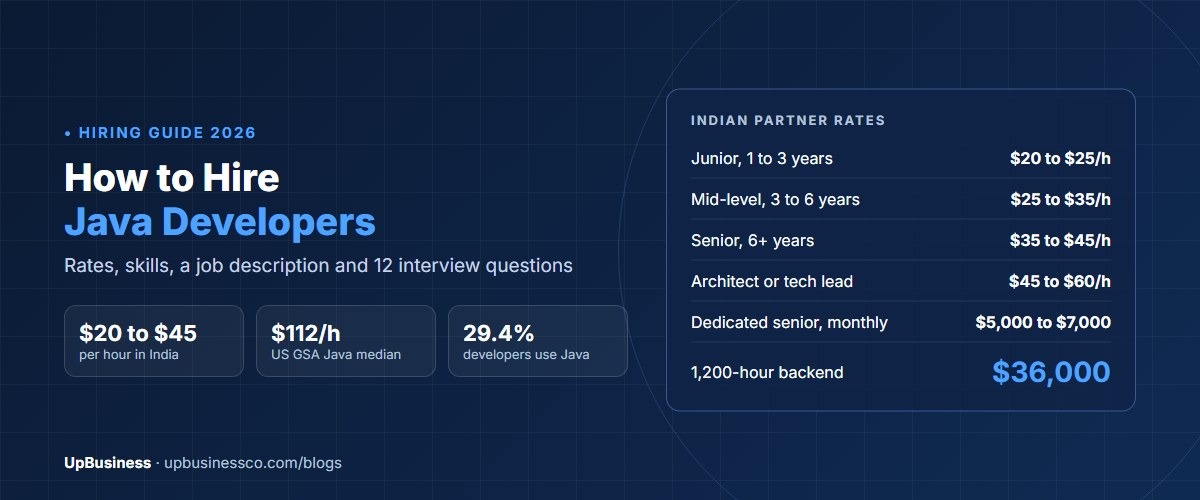
To hire Java developers, decide first whether you need one person in your team or a partner company to build a whole system. Then test for the skills your project actually uses, usually Spring Boot, SQL and cloud deployment, with a short paid task. Java developers in India usually charge $20 to $45 an hour. US government contract data puts the median Java developer ceiling rate at $112 an hour. This guide covers rates, skills, a job description, 12 interview questions and red flags.
It's for CTOs, founders and IT heads who need Java work done. That might be a new backend, an upgrade of an old system, or extra hands for a team.
Key takeaways
- Java is used by 29.4% of developers, and Spring Boot by 14.7%, in Stack Overflow's 2025 survey. Banks, insurers and big retailers still run on it.
- US GSA ceiling rates for Java developers have a median of $112 an hour across 109 rates. Indian partner companies usually charge $20 to $45 an hour.
- Java 25 is the newest long-term support release. Oracle gives it premier support until September 2030, so new projects should start on Java 21 or 25.
- A paid two to four hour task tells you more than a quiz. Check how they write tests, deal with errors and use a database.
How to Hire Java Developers: The Short Version
- Write down the work. Is it a new system, an upgrade of an old one, or support for a live product? Each needs a different kind of person.
- Choose a hiring model. Freelancer, dedicated developer from a partner company, or a full project team.
- Set a budget from real rates. Use the rate tables below.
- Screen for the stack you use. Spring Boot, Hibernate, your database, your cloud.
- Give a paid task. Two to four hours on a small piece of real work.
- Start with a 30-day trial. Agree what "good" looks like before day one.
Is Java Still in Demand in 2026?
Yes. Java isn't new, but it runs a large share of the world's business software. In Stack Overflow's 2025 Developer Survey, 29.4% of all developers said they used Java, and 14.7% used Spring Boot, its most popular framework[1]. Banks, payment firms, insurers, phone companies and airlines lean on it. It's stable, fast and well supported.
Java also keeps moving. Oracle released Java 25 in September 2025 as a long-term support (LTS) version, with premier support until September 2030[2]. Java 21, the previous LTS, has premier support until September 2028. The next LTS is planned for September 2027.
For buyers, this means two kinds of demand. New projects want Spring Boot developers who build cloud services. Older companies want developers who can upgrade systems still on Java 8 or 11. These are different skills. Be clear about which one you need.
What Does a Java Developer Do?
Most Java developers build the server side of software: the part users don't see. They write the APIs that web and mobile apps call. They link to databases and handle payments and logins. They also run jobs in the background, such as sending emails or making reports.
| Type of Java work | Typical stack | Common in |
|---|---|---|
| REST APIs and microservices | Spring Boot, Spring Security, PostgreSQL or MySQL | SaaS, fintech, marketplaces |
| Enterprise systems | Spring, Jakarta EE, Oracle Database, message queues | Banks, insurers, telecom |
| Legacy upgrades | Java 8 or 11 to Java 21 or 25, Spring Boot 2 to 3 or 4 | Any company with older systems |
| Data and streaming | Kafka, Spark, Flink | Analytics, logistics, ad tech |
| Android backends | Spring Boot or Ktor, with Kotlin on the app side | Consumer apps |
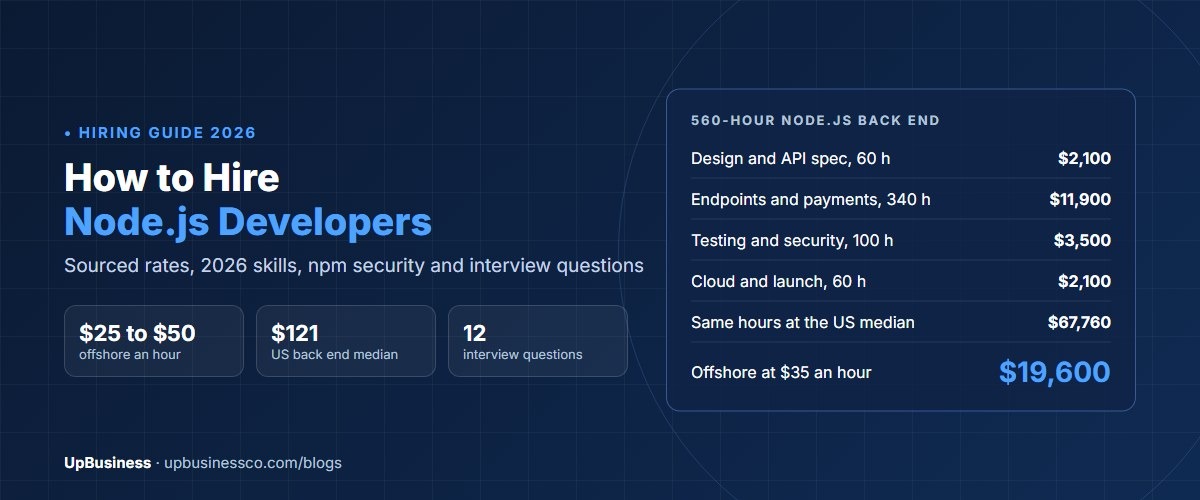
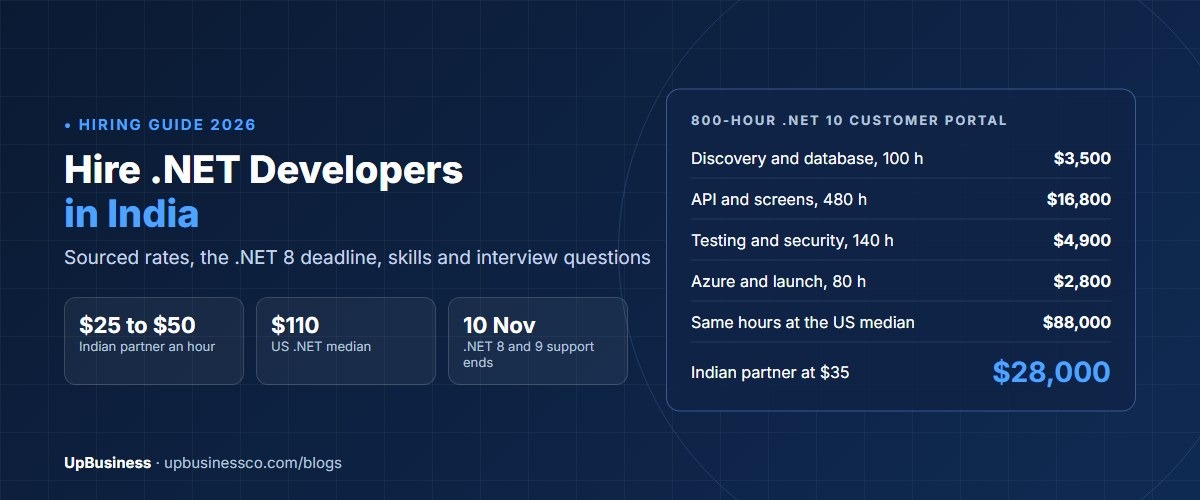
If your app is mostly real-time chat or a simple API, other stacks may be quicker to build with. Our Node.js vs Python comparison covers those options. For Microsoft-based companies, see our guide to hiring .NET developers.
Java Developer Rates and Salaries in 2026
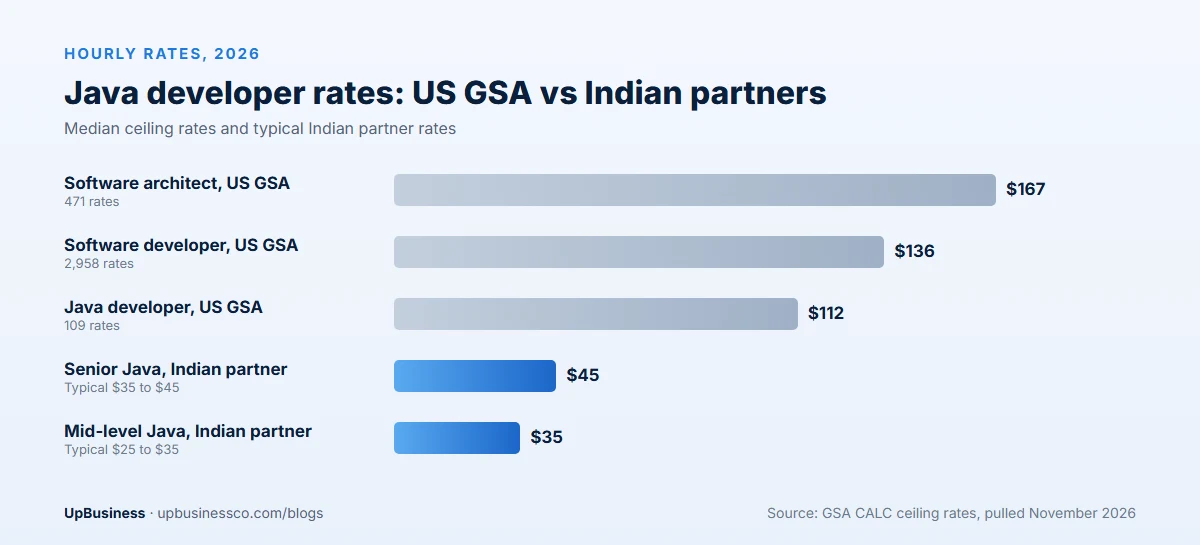
We pulled US government contract rates from the GSA CALC database in November 2026[3]. These are ceiling rates, the most a contractor may charge US federal buyers. They're a public, checkable benchmark, though many US private-sector agencies charge more.
| Role (GSA CALC, Nov 2026) | Rates | Median per hour | 0 to 4 years | 5 to 9 years | 10+ years |
|---|---|---|---|---|---|
| Java developer | 109 | $112 | $98 | $115 | $126 (5 rates) |
| Software developer (all languages) | 2,958 | $136 | $117 | $147 | $173 |
| Software architect | 471 | $167 | $148 | $161 | $193 |
For salaried staff, the US Bureau of Labor Statistics puts the median pay for software developers at $133,080 a year in May 2024[4]. Add benefits, payroll taxes, equipment and hiring time, and a US employee costs well above that.
Indian partner companies usually charge these rates for Java work:
| Experience | Typical hourly rate in India | Monthly dedicated developer | What they can own |
|---|---|---|---|
| Junior, 1 to 3 years | $20 to $25 | $2,800 to $3,500 | Features under review |
| Mid-level, 3 to 6 years | $25 to $35 | $3,500 to $5,000 | Modules and APIs on their own |
| Senior, 6+ years | $35 to $45 | $5,000 to $7,000 | Design, upgrades, performance work |
| Architect or tech lead | $45 to $60 | $7,000 to $9,000 | System design and team lead |
Monthly prices assume about 160 hours. Rates rise for banking or payments experience, cloud certifications and overlap with US working hours.
Freelancer, Dedicated Developer or Project Team?
| Model | Best for | Cost | Main risk |
|---|---|---|---|
| Freelancer | Small fixes, short tasks, a second opinion | $15 to $50 an hour | Availability and handover if they leave |
| Dedicated developer from a partner | Ongoing work in your team, under your lead | $2,800 to $7,000 a month | You manage the work day to day |
| Project team from a partner | A whole new system or a large upgrade | Fixed price or monthly team fee | Scope changes need clear rules |
| In-house hire | Core systems you'll run for years | US median pay $133,080 plus benefits | 2 to 4 months to hire |
A dedicated developer works only on your project. The partner company handles pay, laptops and cover if they leave. Our guide to dedicated developers vs project-based teams compares them in detail. For the wider choice, see agency vs freelancer vs in-house.
Java Developer Skills That Matter in 2026
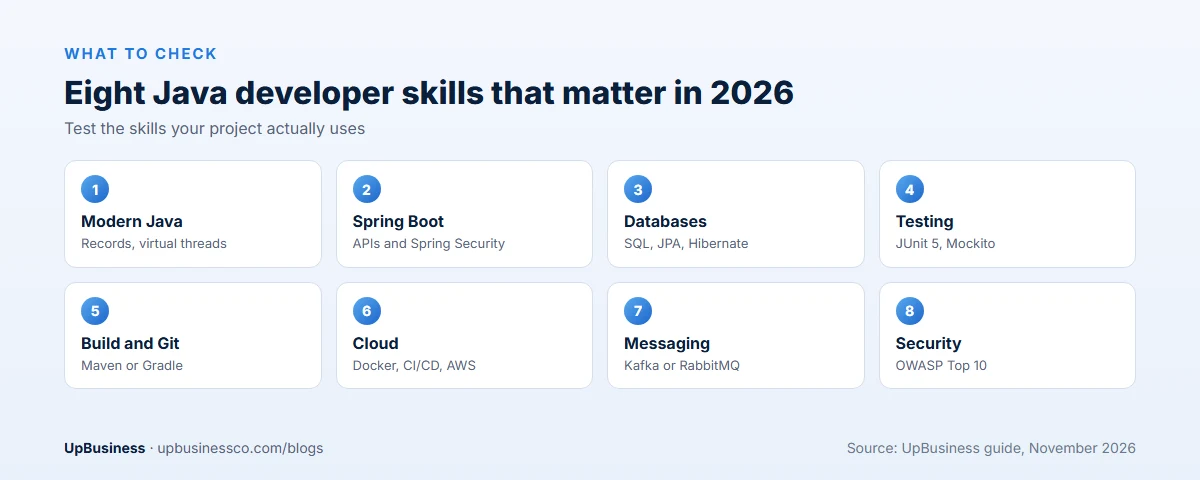
Don't hire on "Java" alone. Check for the skills your project uses.
- Modern Java. Records, streams, the newer switch syntax and virtual threads from Java 21. A developer stuck on Java 8 habits will write longer, slower code.
- Spring Boot. Building REST APIs, app settings, and Spring Security for logins and roles. Spring Boot 4 was released in November 2025[5].
- Databases. SQL, indexes and transactions, plus JPA or Hibernate. Ask how they'd find a slow query.
- Testing. JUnit 5, Mockito and integration tests. No tests means bugs reach your users.
- Build tools and Git. Maven or Gradle, branches, pull requests and code review.
- Cloud and containers. Docker, a CI/CD pipeline and at least one of AWS, Azure or Google Cloud.
- Messaging. Kafka or RabbitMQ for systems that pass events between services.
- Security basics. Input checks, safe password storage, and the OWASP Top 10 web risks.
Soft skills matter as much. A good hire explains trade-offs in plain words. They ask when something is unclear, and they write short notes on what they changed.
Java Developer Job Description You Can Copy
Role: Java Backend Developer (Spring Boot), remote, full time.
What you'll do:
- Build and maintain REST APIs in Java 21 and Spring Boot for our web and mobile apps.
- Design database tables and write fast SQL for PostgreSQL.
- Write unit and integration tests for all new code.
- Deploy with Docker and our CI/CD pipeline on AWS.
- Review teammates' code and join a daily 15-minute call with at least 3 hours of overlap with our time zone.
You have: 4+ years of Java, 2+ years of Spring Boot, strong SQL, JUnit testing, Git and Docker. Experience with Kafka, Kubernetes or payments is a plus.
How we hire: a 30-minute call, a paid 3-hour task, then a 45-minute review of your task with our tech lead.
A Screening Process That Works
- Read the profile for proof. Look for projects with numbers, such as users or data size. Skip profiles that only list buzzwords.
- Hold a 30-minute call. Ask them to explain a past system. What did it do, what was their part, and what would they change?
- Give a paid task. For example: build an API that creates and lists orders, with validation, a database and tests. Pay for 2 to 4 hours.
- Review the task together. Ask why they made each choice. This shows if they wrote it themselves.
- Check references. Ask a past client about deadlines, communication and code quality.
When you hire through a partner company, ask to interview the actual developer, not a sales lead. Get the developer's name in the contract.
12 Java Developer Interview Questions
- What's the difference between an interface and an abstract class, and when would you use each?
- How does a HashMap work, and what happens when two keys have the same hash?
- What are virtual threads in Java 21, and when would they help our API?
- How does Spring decide which object to inject, and what is a bean scope?
- How would you secure a REST API so users only see their own data?
- What is the N+1 query problem in Hibernate, and how do you fix it?
- How do you handle database transactions when one step of a payment fails?
- How would you find the cause of a memory leak in a running service?
- What would you test with unit tests, and what with integration tests?
- How would you upgrade a service from Java 11 to Java 21 without downtime?
- When would you split a system into microservices, and when would you keep one app?
- Tell me about a production bug you fixed. How did you find it?
Good answers use examples from real work. Watch for a developer who can say "I don't know, but here's how I'd find out."
Hiring Java Full Stack Developers
A Java full stack developer builds both the backend in Java and the screens users see, usually in React or Angular. This suits small teams and early products, where one person can ship a whole feature from database to button.
Test both halves. Many "full stack" profiles are strong in Java and weak on the front end, or the other way round. Give a paid task that touches both: an API plus a simple page that lists and edits records. Full stack developers in India usually cost $25 to $45 an hour, close to backend rates. For larger products, a backend specialist plus a front-end specialist usually works faster than two generalists.
Java or Another Language?
Sometimes the right hire isn't a Java developer at all. Here's a quick guide:
| If your project is... | Good fit | Why |
|---|---|---|
| A bank, insurer or large enterprise system | Java | Mature tools, strong typing, long support |
| An Android app backend | Java or Kotlin | Kotlin runs on the same platform and mixes with Java code |
| Real-time chat or a small API | Node.js | Same language as the front end, quick to build |
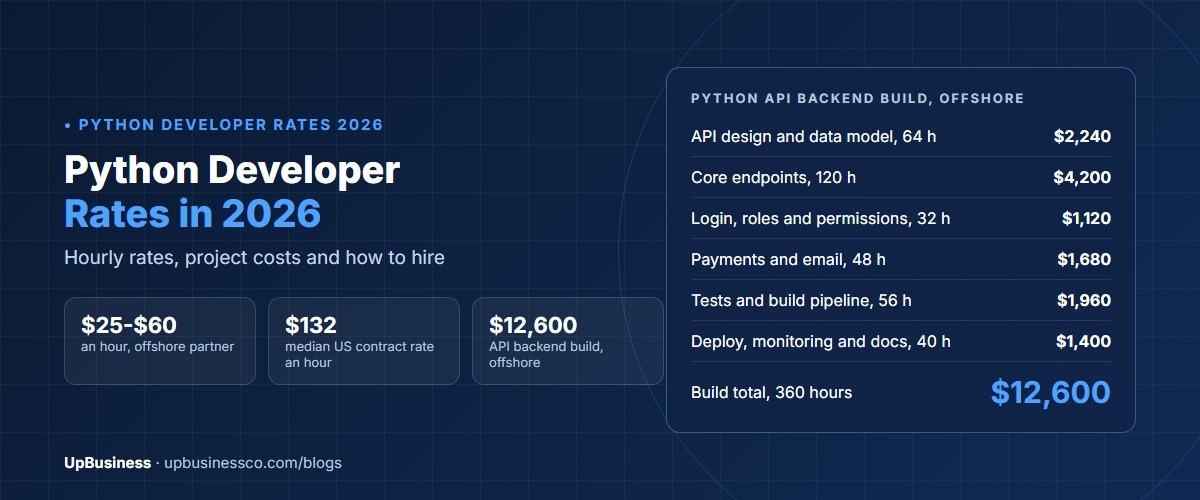
| AI or data-heavy product | Python | Best libraries for AI and data work |
| A Microsoft-based company | .NET | Fits Azure and existing Microsoft tools |
Team skill matters more than the language. A strong team in one language beats a weak team in the "perfect" one.
Hiring Java Developers for Legacy Upgrades
Lots of firms still run Java 8 systems built 10 or more years ago. Upgrading them needs a different profile than building new APIs. Look for people who have moved real systems to Java 17, 21 or 25. They should have swapped out old libraries and added tests to code that had none.
Ask for a plan before any code changes. It should say what gets upgraded first and how it will be tested. It should also say how you'll roll back if something breaks. A careful upgrade of a mid-sized system often takes 400 to 1,200 hours. For the choice between an upgrade and a rebuild, see our guide to application modernization services.
Hiring Java Developers in India From the US, UK, Europe or the Gulf
India has one of the world's largest pools of Java talent. Much of it was built on decades of bank and big company work. Buyers abroad hire there for cost and depth of experience. To make it work:
- Agree overlap hours. Three to four hours of shared time is enough for most teams. India is 9.5 to 10.5 hours ahead of the US East Coast and 4.5 to 5.5 hours ahead of the UK.
- Put IP and data rules in the contract. All code and documents should belong to you. Our software development contract checklist lists the clauses.
- Pay through the partner company. It handles local tax, payroll and replacements if someone leaves.
US buyers can read our full guide to hiring a software development company in India from the US.
Red Flags When Hiring Java Developers
- No tests in the sample task. They'll skip them on your project too.
- Only Java 8 experience for a new build. Fine for upgrades, slow for modern work.
- A different person shows up after the interview. Name the developer in the contract.
- Very low rates for a "senior." Under $15 an hour for a senior is a warning sign.
- Vague answers about past systems. Real experience comes with real numbers and problems.
- No access to your code repository. All work should be pushed to your Git account, daily.
What It Costs to Hire Java Developers: Two Examples
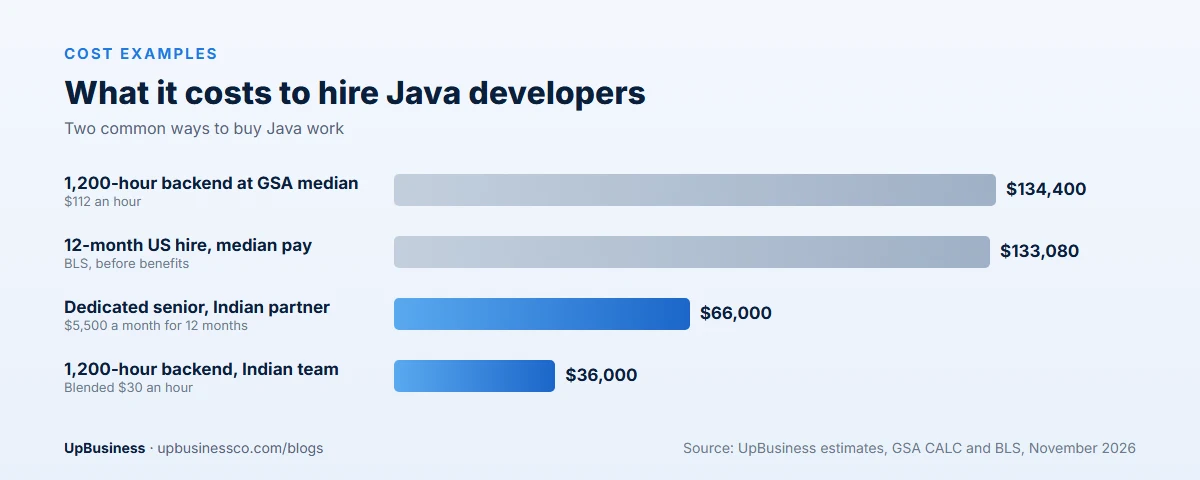
Example 1: a new backend for a B2B ordering app. A wholesale firm needs APIs for its web and mobile apps: customer accounts, product catalog, orders, invoices and payments, with an admin panel. A partner team of one senior and two mid-level Java developers, plus a part-time tester, delivers it in about 1,200 hours. At a blended $30 an hour, that's about $36,000. At the GSA Java median of $112 an hour, the same hours would cost about $134,000.
Example 2: one dedicated senior Java developer. A US SaaS company adds a senior Spring Boot developer to its team for 12 months at $5,500 a month, or $66,000 a year. A US hire at the BLS median of $133,080 costs about twice that before benefits.
Either way, budget 10% to 15% extra for project management, code review and changes you'll think of once work starts.
Your First 30 Days With a New Java Developer
- Week 1: access to code, tickets and a test environment. A small bug fix to learn the codebase.
- Week 2: a small feature with tests, reviewed by your lead.
- Week 3: a larger feature and a short written note on any risks they see in the code.
- Week 4: a review call. Check speed, code quality, communication and test coverage against what you agreed.
If the first month goes well, agree a three-month plan. If it doesn't, tell the partner company early and ask for a replacement.
Find Java Developers on UpBusiness
UpBusiness lists verified partner companies, mostly based in India and serving buyers worldwide. Every company passes checks reviewed by our team: company details, registration and tax papers, the founder's identity, expertise and three client projects with evidence. Only companies with a TrustScore of 70 or more are listed.
Our backend development companies page and custom software development page list firms that build server-side systems. Few name Java as a main skill on their profile yet, so ask each for two past Java or Spring Boot projects before you compare prices. Our list of questions to ask a software development company helps with the first call.
- Post your requirement with your stack, the work, team size and budget.
- Get three partner companies matched to your budget, service and industry.
- Interview the developers they put forward and compare side by side. Buyers pay nothing, and there's no commission on the project.
Hiring for other stacks too? See our guides to hiring Node.js developers and Python developer rates.