

Browse our curated list of Mobile App Development Companies
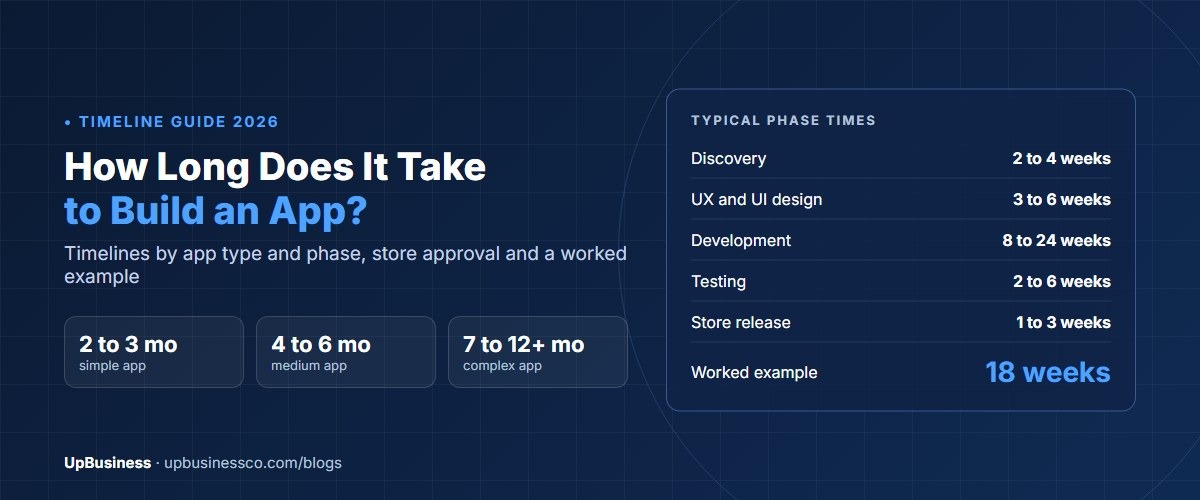
How long does it take to build an app? A simple app takes about 2 to 3 months, a medium app 4 to 6 months, and a complex app 7 to 12 months or more, from first workshop to store launch. A clickable prototype can be ready in 2 to 4 weeks. These figures assume a small professional team and quick decisions from you. This guide shows timelines by app type, how long each phase takes, what slows projects down and how to plan a realistic launch date.
It's written for founders, product owners and managers planning a mobile app with an outside development company.
Key takeaways
- Most first apps take 3 to 6 months. Development is only about half of that. Discovery, design, testing and store release take the rest.
- New personal Google Play accounts must run a closed test with at least 12 testers for 14 days before launch. Plan for it.
- Apple says 90% of App Store submissions are reviewed within 24 hours, but a rejection can add days.
- The biggest delays come from scope changes and slow decisions, not slow coding.
App Development Timeline by App Type
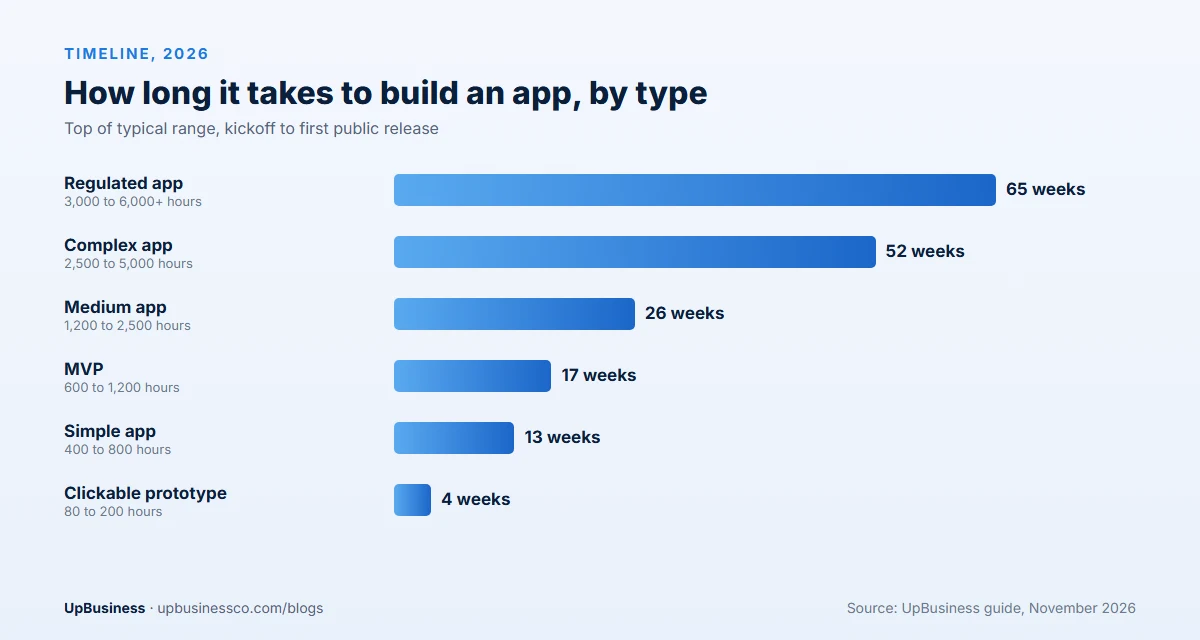
These are our estimates for a team of two to four developers with design and testing support, working with an Indian partner company. Time runs from kickoff to the first public release.
| App type | Examples | Typical hours | Timeline |
|---|---|---|---|
| Clickable prototype | Screens to test with users, no real code | 80 to 200 | 2 to 4 weeks |
| Simple app | Calculator, content app, single form, basic login | 400 to 800 | 2 to 3 months |
| MVP | Core feature only, one user type, payments if needed | 600 to 1,200 | 3 to 4 months |
| Medium app | Booking, ecommerce, two user types, admin panel | 1,200 to 2,500 | 4 to 6 months |
| Complex app | Marketplace, live tracking, chat, many integrations | 2,500 to 5,000 | 7 to 12 months |
| Regulated app | Health, finance or insurance with audits | 3,000 to 6,000+ | 9 to 15 months |
Hours and calendar time don't map exactly. A 1,200-hour app with three developers can't simply be finished in a third of the time, because design, review and testing happen in sequence. Adding people also adds coordination. For costs at each size, see our MVP development cost guide.
How Long Each Phase Takes
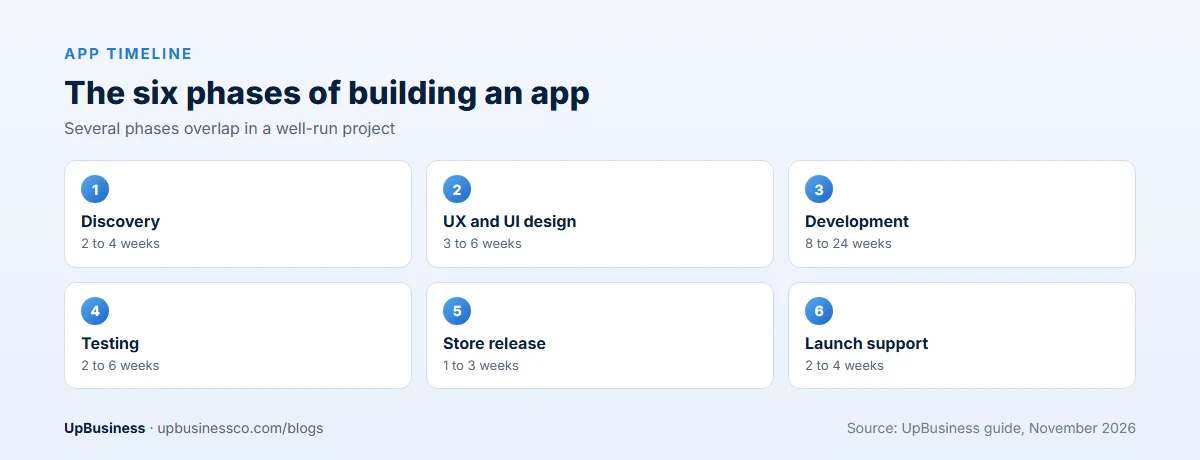
Every professional app project goes through the same phases. Some overlap, but none can be skipped without risk.
| Phase | What happens | Typical time |
|---|---|---|
| Discovery | Goals, users, features, technical plan, estimate | 2 to 4 weeks |
| UX and UI design | User flows, wireframes, final screens, prototype | 3 to 6 weeks |
| Development | Backend, app screens, integrations, admin panel | 8 to 24 weeks |
| Testing | Functional, device, speed and security tests | 2 to 6 weeks, partly during development |
| Store release | Store listings, reviews, closed testing on Android | 1 to 3 weeks |
| Launch support | Fixing issues from real users | 2 to 4 weeks after launch |
Discovery turns an idea into a plan. Your partner should end it with a feature list, screen list, technical design and a fixed estimate. Our app requirements document template can cut this phase by a week or more, because the answers are ready. Don't skip discovery to save time. Projects that start coding without it usually lose more weeks later, when missing details surface during the build.
Design starts with rough wireframes and ends with final screens. A clickable prototype at this stage is worth the time. Showing it to five real users often finds problems that would cost weeks to fix in code.
Development is usually run in two-week cycles called sprints. Ask to see working software at the end of each one. If four weeks pass with nothing to tap on, treat it as a warning sign.
Testing should run alongside development, not only at the end. A team that leaves all testing to the last month almost always slips.
Our guide to the SDLC phases explains each stage and its outputs in more detail.
App Store and Google Play Approval Times
Many first-time founders plan the launch for the day coding ends. The stores need time too.
Apple App Store. Apple says that on average 90% of submissions are reviewed in less than 24 hours[1]. That is fast, but rejections are common for first apps, often for missing privacy details, broken login for reviewers or features that look unfinished. Each fix and resubmission adds a day or more. You also need an Apple Developer Program membership, which costs $99 a year[2]. Organizations need a D-U-N-S number to enroll, which can take time to get, so start early.
Google Play. Google charges a one-time $25 registration fee[3]. The bigger issue is testing. Personal developer accounts created after 13 November 2023 must run a closed test with at least 12 testers who stay opted in for 14 days in a row before they can apply for production access[4]. That's at least two weeks you can't compress. Organization accounts don't face this rule, which is one reason to publish under a company account.
Plan two to three weeks between "code complete" and "live in both stores".
Timeline by Platform: iOS, Android or Both
Building one platform first is faster. Building both with one shared codebase is usually the best balance.
| Approach | Effect on timeline |
|---|---|
| iOS only or Android only, native | Fastest for one platform |
| Both platforms, Flutter or React Native | About 10% to 30% longer than one native app |
| Both platforms, two native apps | Often 60% to 90% longer than one native app |
| Web app first, mobile later | Fastest way to test demand if users are on desktop |
Cross-platform tools let one team ship iOS and Android from mostly shared code. Our Flutter vs React Native comparison covers which to choose, and our iOS vs Android cost guide explains when one platform first makes sense.
How Much Time Each Feature Adds
A quick way to sense-check a timeline is to look at features one by one. These are our estimates for one experienced developer working with a ready backend. Design and testing add to each one.
| Feature | Typical extra time |
|---|---|
| Email or phone login, password reset | 1 to 2 weeks |
| Social login (Google, Apple) | 3 to 5 days |
| Online payments with a payment gateway | 2 to 3 weeks |
| Push notifications | 1 week |
| In-app chat | 3 to 5 weeks |
| Maps and live location tracking | 3 to 6 weeks |
| Video calls | 3 to 5 weeks with a ready service |
| Offline mode with sync | 3 to 6 weeks |
| Admin panel for staff | 3 to 5 weeks |
| Reports and dashboards | 2 to 4 weeks |
| Two or more languages | 1 to 2 weeks, plus translation |
Add up the features you want and compare the total with the quote. If a partner promises chat, tracking, payments and an admin panel in eight weeks, ask how. Features that look small, such as offline mode, often take the longest because every screen has to handle a missing connection.
Fixed Deadline or Fixed Scope?
You can fix the launch date or the feature list, but rarely both. Projects that try to lock both usually give way on quality, and testing is the first thing cut.
If the date matters most, for example a trade show or a season, keep the date and agree a ranked feature list. The team builds from the top. Whatever isn't ready by the date moves to the next release. This keeps launch dates real.
If the features matter most, for example a regulated product that must meet every rule, fix the scope and accept a date range instead of one date. Ask for the range to narrow as the work moves on. A good partner gives a range after discovery and a firm date once design is approved.
Either way, write the rule into the contract. It saves arguments in month three.
Web App vs Mobile App: Which Is Faster to Build?
A web app is usually 20% to 40% faster to build than a mobile app with the same features. There's one codebase, no app store review and no device testing across dozens of phones. Updates go live the moment you release them.
Mobile apps earn their extra time when users need the phone's features, such as the camera, location, push notifications or offline use, or when they'll open the app many times a day. Many startups launch a web app first to prove demand, then build mobile apps once they know which features people use.
How Long Does It Take to Build an App Like Uber or Instagram?
People often ask about famous apps. The honest answer: the versions you use today took years and large teams. What you can build is a first version with the core loop.
| App like | Core first version | Timeline for first version |
|---|---|---|
| Uber | Rider app, driver app, live map, matching, payments, admin | 6 to 9 months |
| Profiles, photo posts, feed, likes, comments, follows | 4 to 6 months | |
| Sign-in by phone, one-to-one chat, groups, media, push | 5 to 8 months | |
| Food delivery | Customer, restaurant and rider apps, tracking, payments | 6 to 9 months |
Multi-sided apps take longest because each side is almost a separate app. A ride or delivery app needs three: customer, driver and an operations panel. Cut the first version to one city, one payment method and manual operations where you can.
How Long Does It Take to Build an App by Yourself or With AI?
A non-technical founder using no-code or AI app builders can have a working prototype in days or weeks. That's a real change, and it's a cheap way to test an idea.
Turning that prototype into an app that handles payments, real user data and app store review is different. Login security, data rules, testing on many devices and store requirements still take weeks of skilled work. Many teams use AI builders to prove demand, then rebuild properly with developers.
AI coding tools help professional developers too, but the gain is not automatic. In a 2025 study, METR found experienced open-source developers took 19% longer to finish tasks when using early-2025 AI tools, even though they believed they were faster[5]. Treat any quote that promises AI will halve your timeline with care, and ask for evidence from past projects.
A solo developer with good skills can usually build a simple app in 3 to 6 months part-time. A medium app alone often takes a year or more.
What Slows App Projects Down
Coding speed is rarely the problem. These are the usual causes of delay:
- Scope changes during the build. Each new feature added mid-project pushes everything behind it.
- Slow decisions. A founder who answers questions within a day keeps a 4-month project on track. One who takes a week per decision can turn it into 8 months.
- Late content. Text, images, prices and legal pages that arrive in the last week.
- Third-party integrations. Payment gateways, maps, ERPs or old company systems with poor documentation.
- Design rework. Changing screens after development has started costs far more than changing them in design.
- Store rejections. Missing privacy information, account deletion or reviewer login details.
- Testing left to the end. Bugs found late take longer to fix, because more code depends on them.
If your project is already badly late, our guide on how to rescue a failing software project explains what to do next.
How to Build an App Faster Without Cutting Quality
- Write requirements before you ask for quotes. Clear requirements shorten discovery and reduce surprises.
- Cut the first version hard. Launch with the one feature users can't live without. Add the rest after real feedback.
- Use a cross-platform framework if you need iOS and Android.
- Use ready services for login, payments, maps and push notifications instead of building them.
- Name one decision maker who can answer questions the same day.
- Start store accounts in week one, including the D-U-N-S number and Android closed testing.
- Review working software every two weeks and change course early, when it's cheap.
Worked Example: A Home Cleaning Booking App
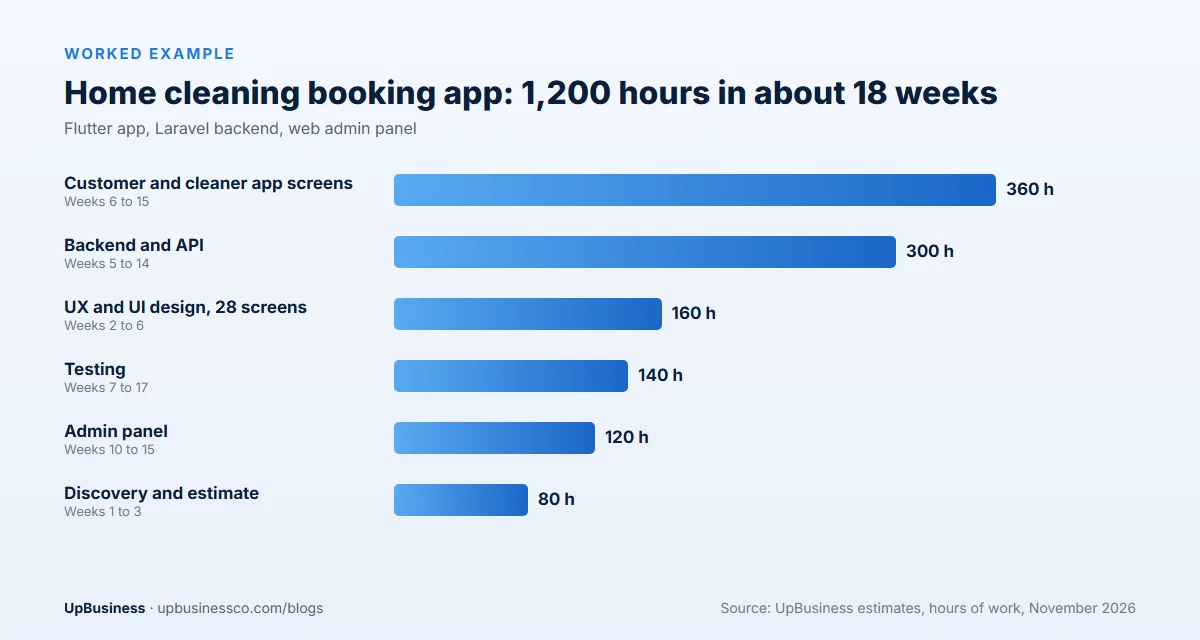
A startup wants an app where customers book home cleaning, pay online and rate the cleaner. Cleaners see their jobs in the same app. The team uses Flutter for iOS and Android, a Laravel backend and a simple web admin panel.
| Work | Hours | Weeks (calendar) |
|---|---|---|
| Discovery and estimate | 80 | Weeks 1 to 3 |
| UX and UI design, 28 screens | 160 | Weeks 2 to 6 |
| Backend and API | 300 | Weeks 5 to 14 |
| Customer and cleaner app screens | 360 | Weeks 6 to 15 |
| Admin panel | 120 | Weeks 10 to 15 |
| Testing | 140 | Weeks 7 to 17 |
| Store release and launch fixes | 40 | Weeks 16 to 18 |
| Total | 1,200 | About 18 weeks |
At $40 an hour, the build costs about $48,000. The team is two developers, a part-time designer, a part-time tester and a project manager. Nine of the 18 weeks run phases side by side, which is how a 1,200-hour app fits into just over four months. Running it strictly one phase after another would take about seven months.
The plan also leaves two weeks of buffer for store review and Android closed testing. Without that buffer, the launch date would slip on the first rejection. For running costs after launch, see our app maintenance cost guide.
What Happens After Launch
Launch is not the finish line. Plan for three stages after the first release.
Weeks 1 to 4: stabilise. Real users find bugs that testers missed, on phones no one tested. Keep the team in place to fix them fast. Crash rates and store ratings in the first month shape how stores rank your app.
Months 2 to 3: learn. Watch which features people use, where they drop off and what they ask for. This is where version 2 should come from, not from the wish list written before launch.
Ongoing: update. Apple and Google release new operating system versions every year, and stores set rules your app must meet to stay listed. Budget time each year for these updates, even if you add no features.
Most teams ship a version 2 within three to six months of launch.
How to Check a Timeline in a Proposal
When development companies send proposals, compare the timelines as carefully as the prices.
- Is the timeline broken into phases with dates, or is it one number?
- Does it include discovery, design, testing and store release, or only coding?
- Does it show what you'll see at the end of each two-week sprint?
- Does it list what the company needs from you, and by when?
- Is there buffer for store review and Android closed testing?
- How many people will work on the app, and are they named?
- What happens to the date and price if you add features?
A very short timeline from one company, when three others quote longer, usually means something was left out. Ask what.
Find a Mobile App Development Company on UpBusiness
UpBusiness lists mobile app development companies with verified profiles, TrustScores, team sizes and average project sizes. Post your requirement and we match you with three companies that fit your budget and launch date. Ask each one for the phase plan of a past app similar to yours. For costs by framework, see our guides to React Native app development cost and Flutter app development cost, or read how to hire Flutter developers if you plan to build a team.