

Browse our curated list of Website Development Companies
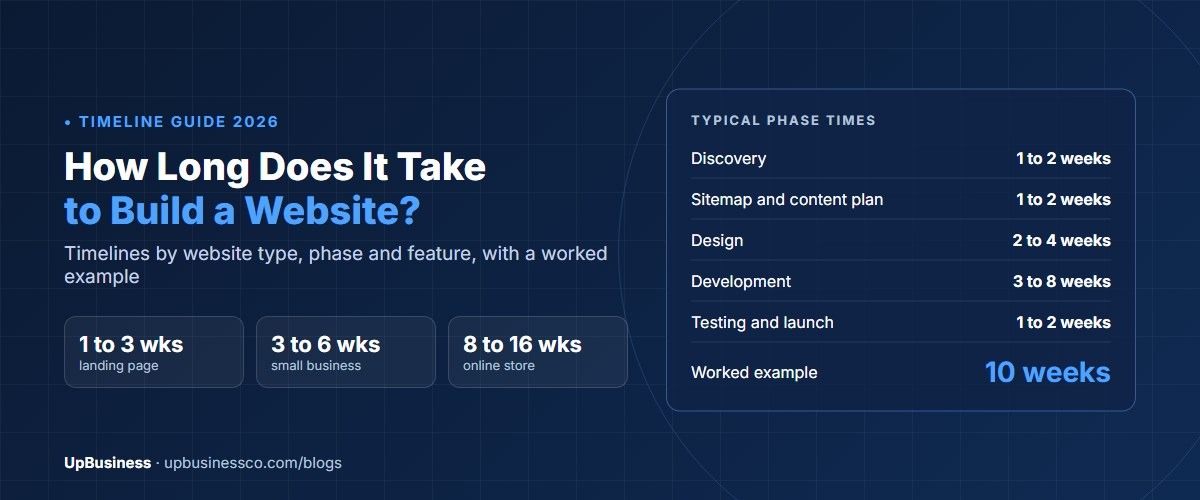
How long does it take to build a website? A landing page takes 1 to 3 weeks, a small business website 3 to 6 weeks, a custom WordPress or Webflow site 6 to 10 weeks, an ecommerce store 8 to 16 weeks, and a custom web portal 3 to 6 months. These figures run from the first meeting to launch, with a professional team and content that arrives on time. Late content is the most common reason websites miss their date. This guide shows timelines by website type, phase and feature, what slows projects down and how to plan a realistic launch.
It's written for business owners, marketing leads and managers planning a website with an outside web development company.
Key takeaways
- Most business websites take 4 to 10 weeks. Coding is often less than half of that. Planning, design, content and testing take the rest.
- Content is the biggest risk to your date. Text, photos and product data should be ready before design is finished.
- After launch, Google says crawling a new or changed page can take from a few days to a few weeks. Plan marketing around that.
- Ecommerce stores and portals take longer because of products, payments, user accounts and integrations.
How Long Does It Take to Build a Website by Type?
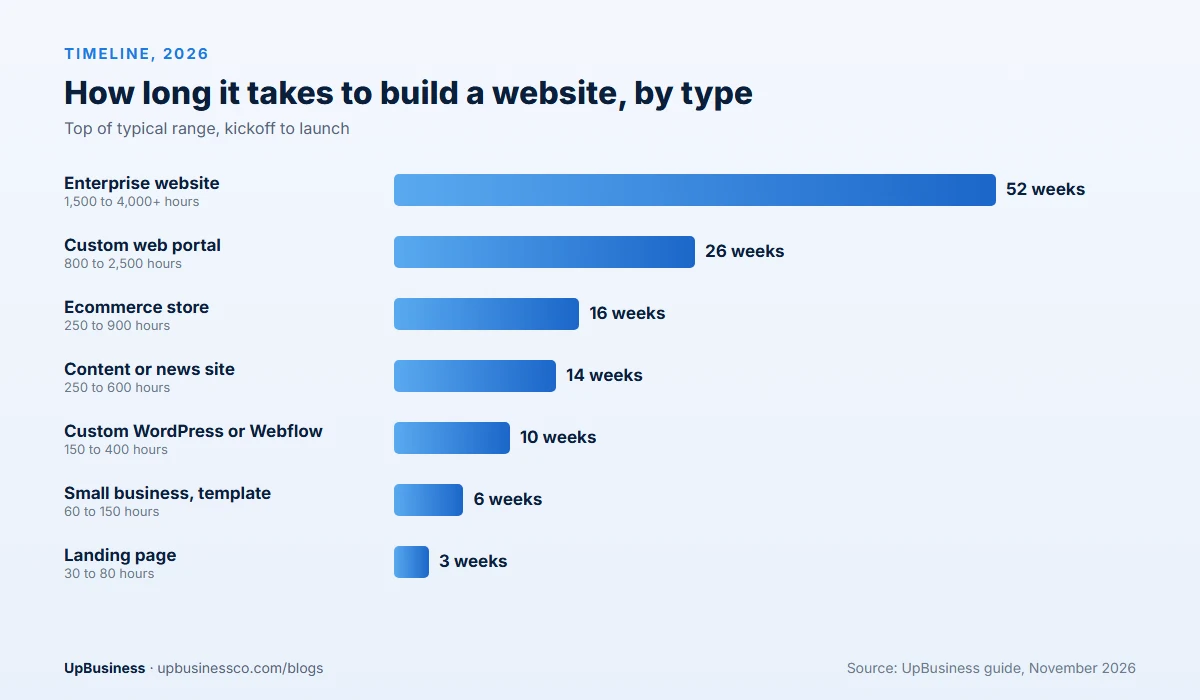
These are our estimates for a small professional team: a designer, one or two developers and a project manager. Time runs from kickoff to launch.
| Website type | Typical size | Typical hours | Timeline |
|---|---|---|---|
| Landing page | 1 page, a form, analytics | 30 to 80 | 1 to 3 weeks |
| Small business website, template based | 5 to 10 pages | 60 to 150 | 3 to 6 weeks |
| Custom WordPress or Webflow site | 10 to 30 pages, custom design | 150 to 400 | 6 to 10 weeks |
| Content or news site | Many templates, categories, search | 250 to 600 | 8 to 14 weeks |
| Ecommerce store | 50 to 2,000 products, payments | 250 to 900 | 8 to 16 weeks |
| Custom web portal or web app | Logins, dashboards, integrations | 800 to 2,500 | 3 to 6 months |
| Enterprise website | Many teams, languages, approvals | 1,500 to 4,000+ | 6 to 12 months |
The bigger the site, the more time goes into decisions, reviews and content rather than code. A 10-page site with one decision maker can launch in a month. A 30-page site that needs sign-off from four departments can take a quarter. For prices at each size, see our website development cost guide.
Website Development Timeline by Phase
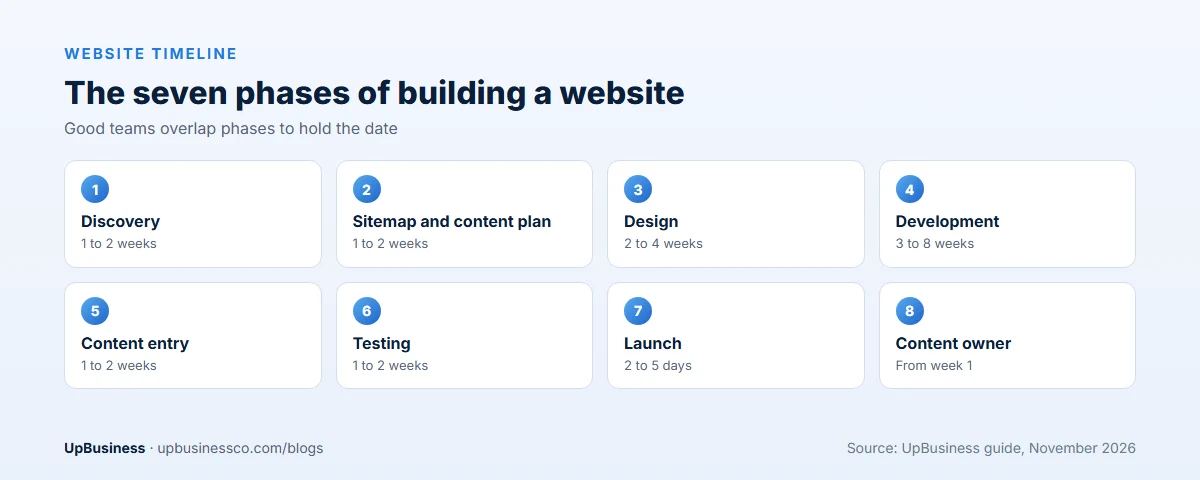
Every professional website goes through the same phases. Good teams overlap some of them, but none should be skipped.
| Phase | What happens | Typical time |
|---|---|---|
| Discovery | Goals, audience, pages, features, competitors, estimate | 1 to 2 weeks |
| Sitemap and content plan | Page list, what each page says, who writes it | 1 to 2 weeks |
| Design | Wireframes, home page design, inner page templates | 2 to 4 weeks |
| Development | Building templates, features, forms, integrations | 3 to 8 weeks |
| Content entry | Adding text, images, products and SEO details | 1 to 2 weeks |
| Testing | Browsers, phones, forms, speed, accessibility | 1 to 2 weeks |
| Launch | Domain, hosting, redirects, analytics, go-live checks | 2 to 5 days |
Discovery ends with a written scope: the page list, features, integrations and a fixed estimate. Our website requirements document template gives you the answers a partner needs before it can quote, which shortens this phase.
Design usually starts with the home page. Once you approve it, inner page templates go faster because the look is set. Each extra round of design changes adds about a week. Our UI and UX design cost guide explains what good design work includes.
Development turns designs into working pages. Ask to see a staging site, a private copy of the website, within the first two weeks of development. You should be able to click through real pages, not just look at pictures.
Testing checks every form, link and page on phones and desktops. It should also check speed and basic accessibility. Teams that skip it fix the same bugs after launch, when real visitors see them.
Timeline by Platform
The platform you choose changes how long the build takes. It also changes who can update the site later.
| Platform | Typical build time | Good fit |
|---|---|---|
| Website builders (Wix, Squarespace) | Days to 2 weeks | Very small sites you'll manage yourself |
| WordPress with a ready theme | 2 to 5 weeks | Small business sites on a tight budget |
| WordPress with a custom theme | 6 to 10 weeks | Business sites with their own design and SEO needs |
| Webflow | 4 to 10 weeks | Design-led marketing sites edited by marketers |
| Shopify | 4 to 12 weeks | Online stores that want hosted checkout |
| Custom code (React, Next.js, Laravel) | 8 weeks to 6 months | Portals, web apps, unusual features |
WordPress runs about 4 in 10 of all websites, according to W3Techs[1], so finding developers and plugins is easy. That is one reason it is often the fastest route for a custom business site. Our guides to WordPress website development cost and Webflow development cost compare the two in detail, and our custom vs template website comparison explains when a ready theme is enough.
Content: The Most Common Cause of Delay
Ask any web agency what delays projects and most will say the same thing: content. Developers can finish templates on time, then wait weeks for text, photos, team bios, case studies or product data.
Plan content as its own workstream, with an owner and dates:
- Decide who writes. Your team, the agency or a copywriter. If the agency writes, it needs interviews and approvals, which take time.
- Start in week one. Write the main pages while design is under way, not after development ends.
- Collect assets early. Logos, brand colours, photos, videos and legal pages such as privacy and terms.
- Prepare product data. For stores, a clean spreadsheet with names, prices, sizes, stock and images saves days of entry.
- Limit approvers. Each extra person who must approve a page adds days to the schedule.
A useful rule: if content for a page isn't ready two weeks before launch, launch without that page and add it later.
How Much Time Each Feature Adds
A quick way to check a timeline is to add up the features. These are our estimates for a developer working on an existing site build. Design and testing add a little to each one.
| Feature | Typical extra time |
|---|---|
| Contact or quote form with email alerts | 1 to 2 days |
| Blog with categories and search | 3 to 5 days |
| Booking or appointment system | 1 to 2 weeks |
| Member login and account pages | 1 to 2 weeks |
| Online payments | 1 to 2 weeks |
| Store with up to 100 products | 2 to 4 weeks |
| CRM or ERP connection | 1 to 4 weeks |
| Second language | 1 to 2 weeks, plus translation |
| Custom calculator or quote tool | 1 to 3 weeks |
| Moving content from an old site | 1 to 3 weeks |
Integrations are the hardest to predict. A connection to a modern CRM with good documentation can take two days. A link to an old in-house system can take a month. Ask the partner which integrations they have built before, and test access early.
Agency, Freelancer or In-House: Effect on Timeline
Who builds the site changes the timeline as much as what you build.
A web agency or development company can run design, development, content and testing side by side, because it has several people. That is usually the fastest route for sites over 10 pages. The trade-off is cost and a fixed process.
A freelancer can be quick on small sites and very good value. On bigger builds, one person has to do each phase in turn, and holidays or other clients can pause the work. Ask what happens if they fall ill for two weeks.
An in-house team knows the business well but often has other priorities. Website work tends to slip behind daily tasks unless someone owns the launch date.
For a 20-page custom site, a typical agency plan is 8 to 10 weeks. The same site with one freelancer often takes 12 to 16 weeks.
A Sample Six-Week Plan for a Small Business Site
Here is how a 10-page WordPress site with a ready theme can launch in six weeks:
- Week 1: kickoff, page list, content owners, logins shared.
- Week 2: home page design and theme setup; client writes main page text.
- Week 3: design approved; inner pages built; photos chosen.
- Week 4: all pages built on staging; forms and analytics added.
- Week 5: content entered; one combined round of feedback; fixes.
- Week 6: testing on phones and browsers, redirects, launch and sitemap submission.
Ecommerce Website Timelines
Online stores take longer than brochure sites for three reasons: product data, payments and testing. Every product page, filter, cart rule, discount, tax rule and shipping option must work, on every device.
A Shopify store with a ready theme and 50 products can launch in 4 to 6 weeks. A custom-designed store with 1,000 products, an ERP link and several payment methods usually takes 3 to 4 months. Payment gateway approval and test orders alone can take a week. See our ecommerce website development cost guide and Shopify development cost guide for the full breakdown.
Launch, Speed and Getting Found on Google
Launch day is not when your site appears on Google. Google says crawling can take anywhere from a few days to a few weeks after you ask it to recrawl a page[2]. Submit a sitemap in Search Console on launch day and plan ads or email for the first month.
Speed should be tested before launch, not after. Google's Core Web Vitals set good targets: the main content should load within 2.5 seconds, the page should respond to taps within 200 milliseconds and the layout shouldn't jump around[3]. Basic accessibility checks against WCAG 2.2[4] take a day or two and avoid costly fixes later.
If you're replacing an old site, set up redirects from every old address to its new one. Missing redirects are the main reason traffic drops after a relaunch. If the new site doesn't appear in search after a few weeks, our guide to why a website is not showing on Google lists the usual causes.
Website Redesign Timeline
A redesign of an existing site often takes about as long as a new build, sometimes longer. The extra work is reviewing old content, mapping old addresses to new ones, keeping search rankings and moving data.
A 20-page business site redesign usually takes 6 to 10 weeks. A large site with hundreds of pages can take 3 to 6 months, mostly in content review and redirects. Our website redesign SEO guide covers how to relaunch without losing traffic.
Can You Build a Website in a Week?
Yes, if it's small. A one-page site or a 3 to 5 page site on a website builder or ready WordPress theme can be live in a week, when the content is ready on day one. AI website builders can produce a first draft in minutes, which is useful for testing an idea.
A custom design, a store or anything with logins and integrations can't be done properly in a week. Design approval, content, testing and launch checks each need days. A partner who promises a custom 20-page site in a week is usually reusing a template or skipping testing. For a single campaign page, our landing page cost guide shows what a fast, focused build looks like.
What Slows Website Projects Down
- Late or unapproved content. The top cause, by a wide margin.
- Too many decision makers. Feedback from five people that disagrees means extra design rounds.
- Scope added mid-build. A new section or feature pushes everything behind it.
- Design changes after development starts. Changing a layout in code costs several times more than changing it in design.
- Waiting for access. Domain logins, hosting, analytics and third-party accounts that nobody can find.
- Integration surprises. Old systems without documentation or test accounts.
- Testing squeezed at the end. Bugs found on launch week delay the launch.
How to Build a Website Faster
- Write your requirements first. Clear pages, features and examples cut discovery and quotes.
- Start content on day one, with one owner and a deadline for each page.
- Name one decision maker who collects feedback and answers within a day.
- Use a proven platform and theme unless you need something unusual.
- Launch with must-have pages and add the rest in the first month.
- Share all logins in week one: domain, hosting, analytics, Search Console and tools.
- Review the staging site weekly and give feedback in one list, not many messages.
Worked Example: A 25-Page B2B Services Website
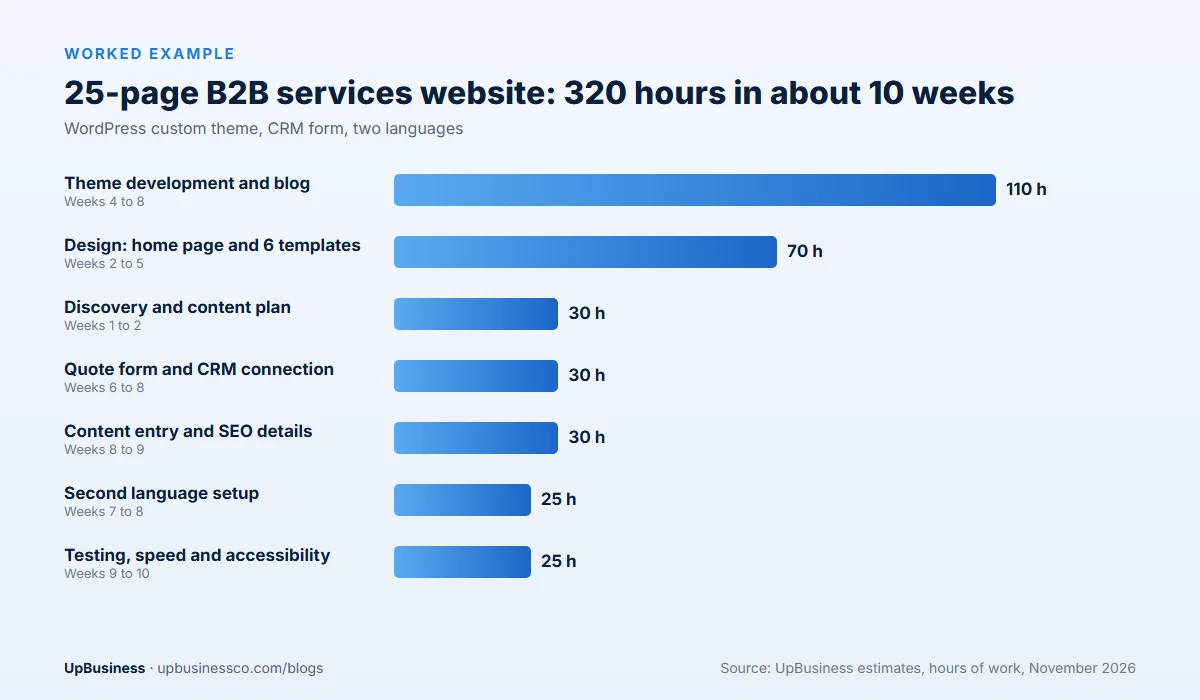
A B2B consulting firm needs a new 25-page website with a custom design, service pages, case studies, a blog, a quote form linked to its CRM and two languages. The team uses WordPress with a custom theme.
| Work | Hours | Weeks (calendar) |
|---|---|---|
| Discovery, sitemap and content plan | 30 | Weeks 1 to 2 |
| Design: home page and 6 templates | 70 | Weeks 2 to 5 |
| Theme development and blog | 110 | Weeks 4 to 8 |
| Quote form and CRM connection | 30 | Weeks 6 to 8 |
| Second language setup | 25 | Weeks 7 to 8 |
| Content entry and SEO details | 30 | Weeks 8 to 9 |
| Testing, speed and accessibility | 25 | Weeks 9 to 10 |
| Total | 320 | About 10 weeks |
At $40 an hour, the build costs about $12,800. Content is written by the client's team from week 1 to week 7, with the agency editing. The plan works only because one partner at the firm approves every page within two days. With a review committee, the same project would likely take 14 to 16 weeks.
After launch, budget for updates, backups and security. Our website maintenance cost guide explains typical monthly plans. If you also need a mobile app, see our guide on how long it takes to build an app.
Who Does What: Your Tasks vs the Agency's
Many delays come from unclear roles. Agree these in writing before work starts.
| Task | Usually owned by |
|---|---|
| Business goals, audience and priorities | You |
| Sitemap, wireframes and design | Agency, approved by you |
| Page text and photos | You, or a copywriter you hire |
| Product data and prices | You |
| Building, testing and launch | Agency |
| Domain, hosting and account access | You provide, agency sets up |
| Final sign-off before launch | You |
How to Check a Timeline in a Website Proposal
- Is the timeline broken into phases with dates, or is it one number?
- Does it include content entry, testing and launch, or only design and coding?
- Does it say what the company needs from you, and by when?
- How many design revision rounds are included?
- When will you see a working staging site?
- What happens to the date if content is late, or if you add pages?
- Who on their team will do the work, and are they named?
If one company quotes far shorter than three others, ask what it left out. Our guide on how to choose a web development company lists more questions to ask.
Find a Website Development Company on UpBusiness
UpBusiness lists website development companies with verified profiles, TrustScores, team sizes and average project sizes. Post your requirement and we match you with three companies that fit your budget and launch date. Ask each one for the phase plan of a past site similar to yours, and compare who owns content in each plan.